Correo Electrónico
 DNINFOA - SIA
 Bibliotecas
 Convocatorias
 Identidad U.N.


Published
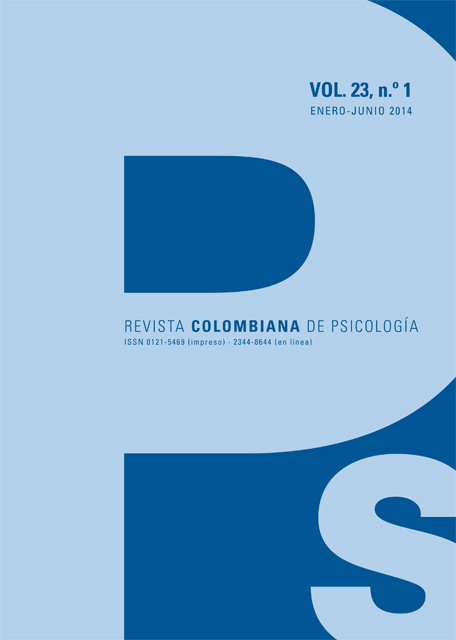
Metas de Bienestar y Valores en una Comunidad Rural Andina de Puno-Perú
Wellbeing Goals and Values in a Rural Andean Community of Puno‒Peru
Metas de Bem-Estar e Valores em uma Comunidade Rural Andina de Puno‒Peru
Keywords:
colectivismo, concepciones de desarrollo, materialismo, metas de bienestar, valores, collectivism, materialism, wellbeing goals, values, coletivismo, metas de bem-estar (es)collectivism, materialism, wellbeing goals, values, Peru (en)
coletivismo, materialismo, metas de bem-estar, valores, Peru (pt)
Se realizó un estudio cualitativo con el objetivo de identificar, describir y analizar la relación entre las metas de bienestar y los valores que poseen los pobladores de una comunidad andina en Puno, Perú. Los resultados sugieren que las principales metas de bienestar para los participantes son: tener buen ganado, tener dinero y brindarle mejor educación a sus hijos. Los valores considerados positivos son: el trabajar y el compañerismo; en contraposición, los valores negativos son: la ociosidad y la envidia-egoísmo. De lo anterior se infiere que los valores identificados corresponden a culturas colectivistas y materialistas, y que estos influyen en la configuración y consolidación de las metas de bienestar de los miembros de la comunidad.
Downloads
References
Abela, J. A. (2008). Las técnicas de análisis de contenido: una revisión actualizada. Granada: Universidad de Granada.
Andréu, J. (2003). Las técnicas de análisis de contenido: una revisión actualizada. Recuperado de http://public.centrodeestudiosandaluces.es/pdfs/S200103.pdf
Austin, J. & Vancouver, J. (1996). Goals constructs in psychology: Structure process and content. Psychological Bulletin, 120(3), 338-375.
Basabe, N. & Ros, M. (2005). Cultural dimensions and social behavior correlates: Individualism-collectivism and power distance. Revue Internationale de Psychologie Sociale, 18(1), 189-225.
Bilbao, M. A., Techio, E. M., & Páez, D. (2007). Felicidad, cultura y valores personales: estado de la cuestión y síntesis meta-analítica. Revista de Psicología, 25(2), 233-276.
Castro Solano, A. & Díaz Morales, J. F. (2002). Objetivos de vida y satisfacción vital en adolescentes españoles y argentinos. Psicothema, 14(1), 112-117.
Catanneo, M. E. (2008). Metas de adolescentes argentinos: un estudio exploratorio. Orientación y Sociedad, 8, 1-10.
Elliot, A. J. & Fryer, J. W. (2008). The goal construct. En J. Shah & W. Gardner (Eds.), Handbook of motivation science (pp. 235-250). New York: The Guilford Press.
Estermann, J. (2006). Filosofía andina: sabiduría indígena para un mundo nuevo. La Paz: ISEAT.
Gissi, J., Zubieta, E., & Páez, D. (2002). La identidad social y cultural de América Latina. En J. F. Morales, D. Páez, A. L. Kornblit, & D. Asún (Coords.), Psicología social (pp. 57-94). Buenos Aires: Prentice-Hall.
Gouveia, V. & Clemente, M. (1998). La medida del individualismo y del colectivismo. La investigación en el campo de la psicología cultural. La Coruña: Universidad de La Coruña.
Hofstede, G. (1991). Cultures and organizations: Software of the mind. London: McGraw-Hill.
Hugo, D. (2006). Metas y emociones cuando se aprende a enseñar ciencias por autorregulación. Revista Electrónica de Motivación y Emoción, 9(22). Recuperado de http://reme.uji.es/articulos/numero22/article3/nemero%2022%20article%203%20METAS.pdf
Inglehart, R. (1998). Modernización y posmodernización. El cambio cultural, económico y político en 43 sociedades. Madrid: CIS/Siglo XXI.
Inglehart, R., Basáñez, M., Diez-Medrano, J., Halman, L., & Luijkx, R. (2003). Human beliefs and values. México D. F.: Siglo XXI.
Kasser, T., & Ryan, R. M. (1996). Further examining the American dream: Differential correlates of intrinsic and extrinsic goals. Personality and Social Psychology Bulletin, 22(3), 280-287.
Kimble, C., Hirt, E., Díaz-Loving, R., Hosch, H., Lucker, G. W. & Zárate, M. (2002). Psicología Social de las Américas. México: Prentice-Hall.
Lehman, D. R., Chiu, Ch., & Schaller, M. (2004). Psychology and culture. Annual Review of Psychology, 55, 689-714.
Ortiz, A. (2001). La pareja y el mito: estudios sobre las concepciones de la persona y de la pareja en los Andes. Lima: Fondo Editorial de la Pontificia Universidad Católica del Perú.
Ortiz, A. & Yamamoto, J. (1999). Mixturas. Anthropologica, 17(17), 225-244.
Páez, D. & Zubieta. E. (2004). Dimensiones culturales. Individualismo-colectivismo, creencias y conducta social. En D. Páez, I. Fernández, S. Ubillos, & E. Zubieta (Coords.), Psicología social, cultura y educación (pp. 90-101). Madrid: Pearson Prentice Hall.
Porta, L. & Silva, M. (2003). La investigación cualitativa: el análisis de contenido en la investigación educativa. Recuperado de http://www.uccor.edu.ar/paginas/REDUC/porta.pdf
Ruíz-Bravo, P. (2003). Identidades femeninas, cultura y desarrollo: un estudio comparativo en el medio rural peruano. Louvain: Presses Universitaires de Louvain.
Salmela-Aro, K. (2010). Personal goals and well-being: How do young people navigate their lives? New Directions for Child and Adolescent Development, 130, 13-26.
Sánchez-Burks, J., Nisbett, R. E., & Ybarra, O. (2000). Cultural styles, relational schemas and prejudice against out-groups. Journal of Personality and Social Psychology, 79(2), 174-189.
Schwartz, S. (1992). Universals in the content and structure of values: Theory and empirical tests in 20 countries. Advances in Experimental Social Psychology 25, 1-65.
Schwartz, S. & Bilsky, W. (1990). Toward a theory of the universal content and structure of values: Extensions and cross-cultural replications. Journal of Personality and Social Psychology, 58(5), 878-891.
Smith, P. B. & Schwartz, S. H. (1997). Values. En J. W. Berry, M. H. Segal, & C. Kagitçibasi (Eds.), Handbook of cross-cultural psychology (Vol. 3, pp. 77-118.). Needham Heights: Allyn & Bacon.
Suh, E., Diener, E., Oishi, S., & Triandis, H. (1998). The shifting basis of life satisfaction judgments across cultures: Emotions versus norms. Journal of Personality and Social Psychology, 74(2), 482-493.
Suh, E. & Koo, J. (2008). Comparing subjective well-being across cultures and nations: the "what" and "why" questions. En M. Eid & R. Larsen (Eds), The science of subjective well-being (pp. 414-427). New York: Guilford Press.
Triandis, H. C. (1995). Individualism and collectivism. Boulder: Westview Press.
Triandis, H. (1996). The psychological measurement of cultural syndromes. American Psychologist, 51(4), 407-415.
Twenge, J., Campbell, W. K., & Freeman, E. (2012). Generational differences in young adults' life goals, concern for others, and civic orientation, 1966-2009. Journal of Personality and Social Psychology, 102(5), 1045-1062.
Veenhoven, R. (2008). Sociological theories of subjective well-being. En M. Eid & R. Larsen (Eds), The science of subjective well-being (pp. 44-61). New York: Guilford Press.
Vieytes, R. (2004). Metodología de la investigación en organizaciones, mercado y sociedad: epistemología y técnicas. Buenos Aires: De las Ciencias.
Yamamoto, J. (2004). El protocolo de entrevista a profundidad de componentes de bienestar. Manuscrito no publicado.
Yamamoto, J. & Feijoo, A. (2007). Componentes émicos del bienestar. Hacia un modelo alternativo de desarrollo. Revista de Psicología, 25(2), 197-231.
Zlobina, A. (2004). La teoría de valores de S. Schwartz. En D. Páez, I. Fernández, S. Ubillos, & E. Zubieta (Coords.), Psicología social, cultura y educación (pp. 73-88). Madrid: Prentice Hall.
License
Copyright (c) 2014 Revista Colombiana de PsicologíaThe RCP is published under the Creative Commons license and can be copied and reproduced according to the conditions of this license (http://creativecommons.org/licenses/by-nc-nd/2.5). RCP articles are available online at https://revistas.unal.edu.co/index.php/psicologia/issue/archive. If you would like to subscribe to the RCP as reader, please go to https://revistas.unal.edu.co/index.php/psicologia/information/readers and follow the instructions mentioned in the webpage. Additionally, a limited number of print journals are available upon request. To request print copies, please email revpsico_fchbog@unal.edu.co.