
Published
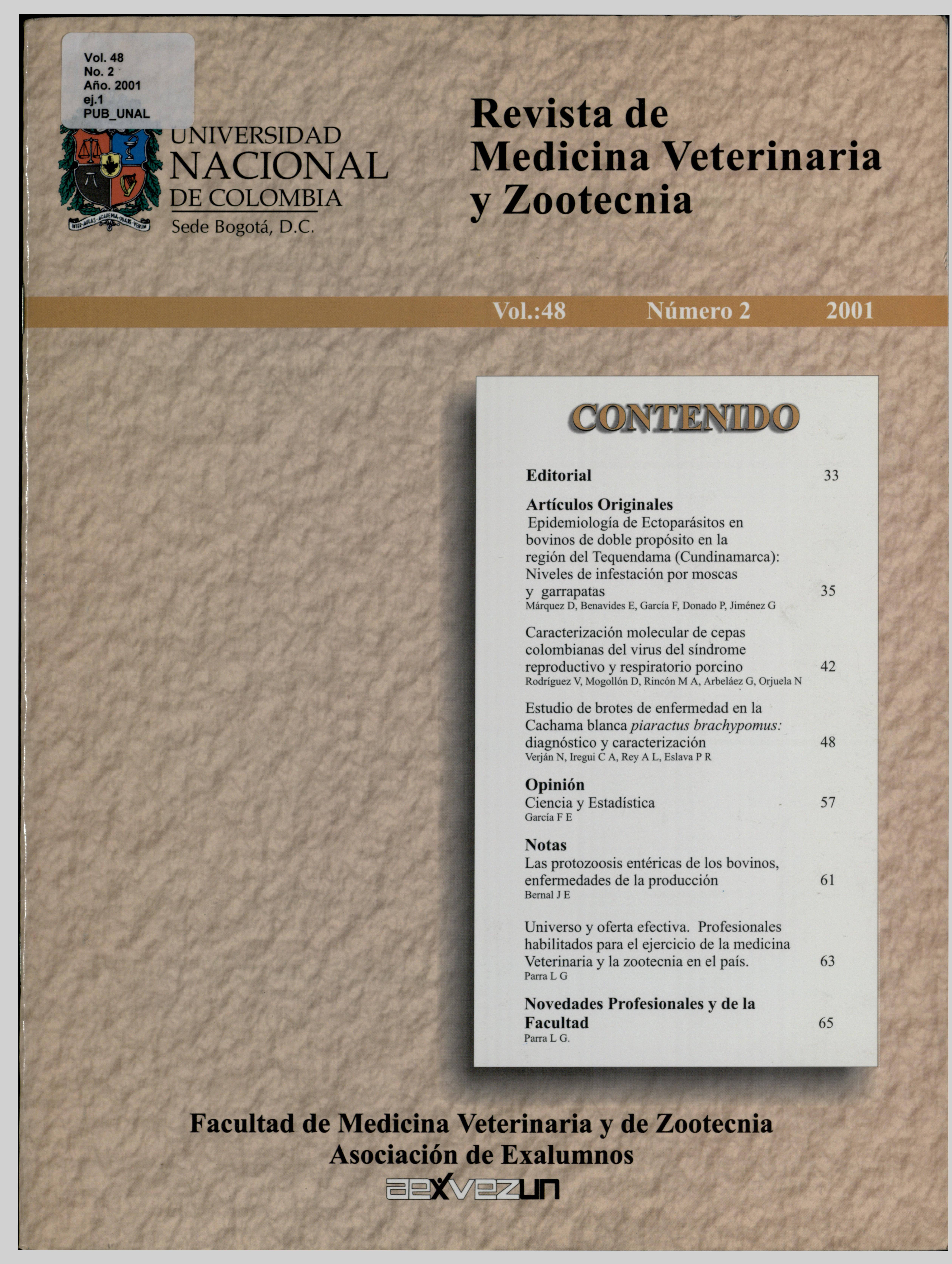
Caracterización molecular de cepas colombianas del virus del síndrome reproductivo y respiratorio porcino
Keywords:
Síndrome reproductivo y respiratorio porcino, transcripción reversa, reacción en cadena de la polimerasa anidada, polimorfismo en la longitud de los fragmentos de restricción, secuenciación (es)Downloads
Por primera vez en Colombia se caracterizaron cuarenta cepas del virus del Síndrome Reproductivo y Respiratorio Porcino aisladas de campo, utilizando Polimorfismo en la Longitud de los Fragmentos de Restricción (RFLP). De estas cepas fueron secuenciadas cinco para establecer sus relaciones genéticas. Se encontraron tres patrones de RFLP circulando en el país: 172, 262 y 252. Se presentó circulación simultánea en dos granjas de cepas virales con patrones de restricción 252 y 262, a la vez que se dio el caso de animales que presentaban infecciones mixtas y se detecto el virus en muestras de fetos. Las cepas colombianas secuenciadas pertenecen al genotipo americano del VSRRP. Se discutió la importancia de estos hallazgos con relación a la epidemiología de la enfermedad en Colombia.
References
BomerAand Strabyaard B. Appearance of acute PRRS like symptoms in sows after vaccination with a modified live PRRS vaccine. Vet Res, 1997.
Faaberg K, Yuan S, Schmidt B and Murtaugh M. Porcine reproductive and respiratory syndrome virus: Detection of viral recombination. American Association of Swine Practitioners. 403-408, 1999.
Meng XJ. Heterogeneity of Porcine reproductive and respiratory syndrome virus: implications for current vaccine efficacy and future vaccine development. Vet Microbiol. 7:310-329,2000
Mengeling W, Lager K and Vorwald A. Safety and efficacy of vaccination of pregnant gilts against porcine reproductive and respiratory syndrome. Am J Vet Res. 60:796-801, 1999.
Mengeling W, Vordwald A, Lager K, Clouser B and Wesley R. Identification and clinical assessment ofsuspected vaccinerelated field strains of porcine reproductive and respiratory syndrome virus. Am J Vet Res. 60:334-340, 1999.
Mogollón D, Rincón M, Arbeláez G, Orjuela N, Ruiz S and Corredor J. Isolation of Porcine Reproductive and respiratory syndrome (PRRS) virus in Colombia. The 16th International Pig Veterinary Society Congress, Melboume, Australia. 642, 2000.
Snijder E, Meulenberg J. The Molecular biology of arteriviruses. J Gen Vir. 79:961-979, 1998.
Umthun A and Mengeling W. Restriction fragment length polymorphism analysis ofstrains of porcine reproductive and respiratory syndrome virus by use of a nested-set reverse transcriptase-polymerase chain reaction. Am J Vet Res. 60:802-806,1999
Wesley R, Mengeling W, Lager K, Clouser D, Landgraf J, Frey M. Evidence for divergence ofrestriction fragment length polymorphism following in vivo replication of porcine reproductive and respiratory syndrome virus. Am J Vet Res. 60: 463-767, 1999.
Wesley R. Differentiation of a porcine reproductive and respiratory syndrome virus vaccine strain from North American field strains by restriction fragment length polymorphism analysis ofORF 5. J Vet Diag Invest. 10: 140-144, 1998.
Zimmerman J. PRRS Compendium. National Pork Producers Council, 1998.
Article abstract page views
Downloads
How to Cite
License
Copyright (c) 2001 V. Rodríguez, D. Mogollón, M. A. Rincón, G. Arbeláez, N. Orjuela

This work is licensed under a Creative Commons Attribution-NonCommercial-NoDerivatives 4.0 International License.
This article is published under the terms of the Creative Commons Attribution-NonCommercial-NoDerivatives 4.0 International License (CC BY-NC-ND 4.0).
The authors retain copyright of their work and grant the journal the right of first publication.
Readers are free to copy and redistribute the material in any medium or format under the license terms, provided proper attribution is given, the work is not used for commercial purposes, and no modifications or derivatives are made.



