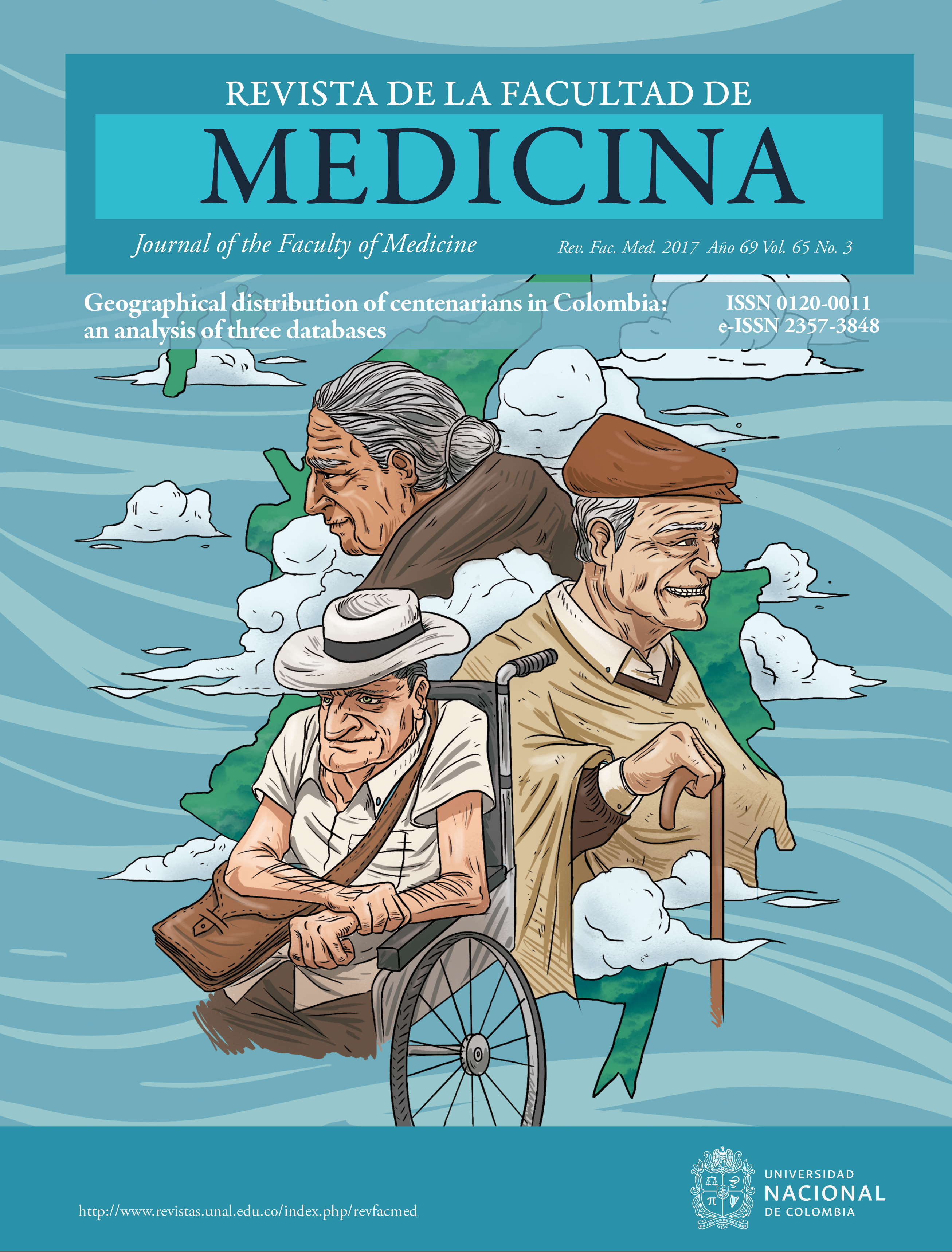
Publicado
Effects of yoga (pranayama) on lung function and lactate kinetics in sedentary adults at intermediate altitude
Efectos de la práctica de yoga (pranayamas) sobre la función pulmonar y cinética del lactato en adultos sedentarios de altitud intermedia
DOI:
https://doi.org/10.15446/revfacmed.v65n3.56310Palabras clave:
Yoga, Lactic Acid, Spirometry, Altitude, Sedentary Lifestyle (en)Yoga, Ácido láctico, Espirometría, Altitud, Estilo de vida sedentario (es)
Descargas
Introduction: Clinical evidence-based medicine has found increasing benefits of yoga.
Objective: To describe the effects on lung function assessed by rest spirometry —vital forced capacity (VFC), forced expiratory volume in one second (FEV1), and FEV1/VFC ratio— in a group of apparently healthy adults, as well as to explore the effects of pranayama techniques in lactate kinetics.
Materials and methods: Quasi-experimental study performed in sedentary adults with no prior experience in yoga practice, who received a stimulus during 12 weeks with a minimum frequency of two sessions per week. They were divided into a yoga group (YG) and a control group (CG). Body composition, blood pressure, heart rate, double product (DP), peripheral oxygen saturation (SpO2), blood lactate (Lacts), hematocrit (Htc) by micromethod, and spirometry were determined before and after a training plan with Pranayama. The variables analyzed were forced vital capacity (FVC), forced expiratory volume in one second (FEV1) and FEV1/FVC ratio.
Results: Significant differences were found in FVC, FEV1 and lactate among YG and CG (p<0.05), and before and after the stimulus in the YG (p<0.05). The double product improved in both groups.
Conclusions: Targeted practice of pranayama for 12 weeks improved FVC, FEV1, double product (p <0.05) and lactate production capacity (anaerobic capacity).
Introducción. La medicina basada en evidencia clínica encuentra cada vez más beneficios del yoga en sus practicantes.
Objetivo. Describir los efectos en la función pulmonar y la cinética del lactato ocasionados por la práctica de pranayamas en adultos con apariencia saludable.
Materiales y métodos. Se realizó un estudio cuasiexperimental en adultos sedentarios sin experiencia en la práctica de yoga, quienes realizaron un estímulo durante 12 semanas con un frecuencia mínima de dos sesiones por semana. Se dividieron en un grupo de yoga (GY) y un grupo de control (GC). Se determinó composición corporal, presión arterial, frecuencia cardíaca, doble producto (DP), saturación periférica de oxígeno (SpO2), lactato en sangre (Lacts), hematocrito (Htc) por micrométodo, y espirometría previa y posterior a un plan de entrenamiento con pranayamas. Las variables analizadas fueron: capacidad vital forzada (CVF), volumen espiratorio forzado del primer segundo (VEF1) y relación VEF1/CVF.
Resultados. Los resultados de la CVF, VEF1 y lactato presentaron diferencias significativas entre el GY y el GC (p<0.05), antes y después del estímulo en el GY (p<0.05). El doble producto mejoró en ambos grupos.
Conclusiones. La práctica dirigida de pranayamas durante 12 semanas mejoró la CVF, el VEF1, el doble producto (p<0.05) y la capacidad de producción de lactato (capacidad anaeróbica).
Referencias
Sengupta P. Health impacts of yoga and pranayama: a state-of-the-art review. Int J Prev Med. 2012;3(7):444-58.
Rivas D, González M. Yoga Inbound: un encuentro con la luz del ser. Bogotá D.C.: Editorial SEVA; 2014.
Rajak Ch, Rampalliwar S, Mahour J. A study of combined effect of yoga (yogic exercises, pranayama & meditation) on hyper-reactivity to cold pressor test in healthy individuals. Natl J Physiol Pharm Pharmacol. 2012;2(2):140-5.
Goyal R, Lata H, Walia L, Narula M. Effect of pranayama on rate pressure product in mild hypertensives. Int J Appl Basic Med Res. 2014;4(2):67-71. http://doi.org/b584.
Singh S, Soni R, Singh K, Tandon O. Effect of yoga practices on pulmonary function tests including transfer factor of lung for carbon monoxide (TLCO) in asthma patients. Indian J Physiol Pharmacol. 2012;56(1):63-8.
Kinser PA, Elswick RK, Kornstein S. Potential long-term effects of a mind-body intervention for women with major depressive disorder: sustained mental health improvements with a pilot yoga intervention. Arch Psychiatr Nurs. 2014;28(6):377-83. http://doi.org/f6qwtk.
Patil SG, Dhanakshirur G, Aithala MR, Naregal G, Das K. Effect of yoga on oxidative stress in elderly with grade-I hypertension: a randomized controlled study. J Clin Diagn Res . 2014;8(7):BC04–7. http://doi.org/b585.
Bali HK. Yoga - an ancient solution to a modern epidemic. Ready for prime time? Indian Heart J. 2013;65(2):132-6. http://doi.org/b586.
Mondal S. Science of exercise: ancient Indian origin. J Assoc Physicians India. 2013;61(8):560-2.
Danucalov M, Simões R, Kozala E, Leite J. Cardiorespiratory and metabolic changes during yoga sessions: the effects of respiratory exercises and meditation practices. Appl Psychophysiol Biofeedback. 2008;33(2):77-81. http://doi.org/fh55mc.
Van Lunteren E, Haxhiu MA, Cherniack NS. Effects of tracheal airway occlusion on hyoid muscle length and upper airway volume. J Appl Physiol. 1989;67(6):2296-302.
Sieck G, Ferreira L, Reid M, Mantilla C. Mechanical properties of respiratory muscles. Compr Physiol. 2013;3(4):1553-67. http://doi.org/b587.
Tenório LH, Santos AC, Câmara Neto JB, Amaral FJ, Passos VM, Lima AM, et al. The influence of inspiratory muscle training on diaphragmatic mobility, pulmonary function and maximum respiratory pressures in morbidly obese individuals: a pilot study. Disabil Rehabil. 2013;35(22):1915-20. http://doi.org/b588.
Hlastala M, Berger A. Physiology of respiration. 2nd ed. New York: Oxford University Press; 2001.
Macklem P. The act of breathing. In: Roussos C, Macklem P, editors. The thorax, Part A: Physiology. New York: Marcel Dekker Inc; 1995. p. 445-56.
Osmond D. Functional anatomy of the chest wall. In: Roussos C, Macklem P, editors. The thorax, Part A: Physiology. New York: Marcel Dekker Inc; 1995. p. 413-44.
Van Lunteren E, Spiegler S, Moyer M. Differential expression of lipid and carbohydrate metabolism genes in upper airway versus diaphragm muscle. Sleep. 2010; 33(3):363-70.
Bracher A, Coleman R, Schnall R, Oliven A. Histochemical properties of upper airway muscles: comparison of dilator and nondilator muscles. Eur Respir J. 1977;10(5):990-3.
Lloyd J, Brozanski B, Daood M, Watchko J. Developmental transitions in the myosin heavy chain phenotype of human respiratory muscle. Biol Neonate. 1996;69(2):67-75.
Hisa Y, Malmgren LT, Lyon MJ. Quantitative histochemical studies on the cat infrahyoid muscles. Otolaryngol Head Neck Surg. 1990;103(5):723-32.
Babb TG. Exercise ventilatory limitation: the role of expiratory flow limitation. Exerc Sport Scie Rev. 2013;41(1):11-8. http://doi.org/b589.
Oliven A, Carmi N, Coleman R, Odeh M, Silbermann M. Age-related changes in upper airway muscles morphological and oxidative properties. Exp Gerontol. 2001;36(10):1673-86. http://doi.org/d38k98.
Poon CS, Song G. Bidirectional plasticity of pontine pneumotaxic postinspiratory drive: implication for a pontomedullary respiratory central pattern generator. Prog Brain Res. 2014;209:235-54. http://doi.org/b59b.
Souza H, Rocha T, Pessoa M, Rattes C, Brandão D, Fregonezi G, et al. Effects of inspiratory muscles training in elderly women on respiratory muscle strength, diaphragm thickness and mobility. J Gerontol A Biol Sci Med Sci. 2014;69(12):1545-53. http://doi.org/f8mc6p.
Ray US, Pathak A, Tomer OS. Hatha yoga practices: expenditure, respiratory changes and intensity of exercise. Evid Based Complement Alternat Med. 2011;2011:241294. http://doi.org/cxz26n.
Sinha B, Ray US, Pathak A, Selvamurthy W. Energy cost and cardiorespiratory changes during the practice of Surya Namaskar. Indian J Physiol Pharmacol. 2004;48(2):184-90.
Vogiatzis I, Athanasopoulos D, Habazettl H, Kuebler W, Wagner H, Roussos C, et al. Intercostal muscle blood flow limitation in athletes during maximal exercise. J Physiology. 2009;587(14):3665-77. http://doi.org/cqgr2k.
Sinha B, Sinha TD. Effect of 11 months of yoga training on cardiorespiratory responses during the actual practice of Surya Namaskar. Int J Yoga. 2014;7(1):72-5. http://doi.org/b59c.
Raju P, Kumar KA, Reddy SS, Madhavi S, Gnanakumari K, Bhaskaracharyulu C, et al. Effect of yoga on exercise tolerance in normal healthy volunteers. Indian J Physiol Pharmacol. 1986;30(2):121-32. http://doi.org/dxpv5t.
Raju PS, Madhavi S, Prasad KV, Reddy MV, Reddy ME, Sahay BK, et al. Comparison of effect of yoga & physical exercise in athletes. Indian J Med Res. 1994;100(8):81-7.
Kiecolt-Glaser JK, Christian LM, Andridge R, Hwang BS, Malarkey WB, Belury MA, et al. Adiponectin, leptin, and yoga practice. Physiol Behav. 2012;107(5):809-13. http://doi.org/fx5drt.
Sarvottam K, Magan D, Yadav RK, Mehta N, Mahapatra SC. Adiponectin, interleukin-6 and cardiovascular disease risk factors are modified by a short-term yoga-based lifestyle intervention in overweight and obese men. J Altern Complement Med. 2013;19(5):397-42. http://doi.org/b59d.
Asociación Médica Mundial. Declaración de Helsinki de la Asociación Médica Mundial. Principios éticos para las investigaciones médicas en seres humanos. Fortaleza: 64.a Asamblea General de la AMM; 2013 [cited 2016 Mar 20]. Available from: https://goo.gl/hvf7l1.
Colombia. Ministerio de Salud. Resolución 8430 de 1993 (octubre 4): Por la cual se establecen las normas científicas, técnicas y administrativas para la investigación en salud. Bogotá D.C.; octubre 4 de 1993 [cited 2016 Mar 20]. Available from: https://goo.gl/F5m6cP.
Prakash S, Meshram S, Ramtekkar U. Athletes, yogis and individuals with sedentary lifestyle; do their lung functions differ? Indian J Physiol Pharmacol. 2007;51(1):76-80.
Birkel D, Edgren L. Hatha yoga: improved vital capacity of college students. Altern Ther Health Med. 2000;6(6):55-63.
Manaspure S, Fadia A, Gowda D. Effect of specific pranayama techniques on ventilator functions of lung. Res J Pharm Bio Cheml Sci. 2011;2(4):351-7.
Chakraborty T, Das K, Smajdar K. Effect of yogic exercise on selected pulmonary function tests in apparently healthy elderly subjects. J Dental Med Sci. 2013;9(1):1-5. http://doi.org/b59f.
Mooventhan A, Khode V. Effect of Bhramari pranayama and OM chanting on pulmonary function in healthy individuals: a prospective randomized control trial. Int J Yoga. 2014;7(2):104-10. http://doi.org/b59g.
Mason H, Vandoni M, Debarbieri G, Codrons E, Ugargol V, Bernardi L. Cardiovascular and respiratory effect of yogic slow breathing in the yoga beginner: what is the best approach? Evid Based Complement Alternat Med. 2013;2013:743504. http://doi.org/b59h.
Fagevik Olsén M, Lannefors L, Westerdahl E. Positive expiratory pressure - Common clinical applications and physiological effects. Respir Med. 2015;109(3):297-307. http://doi.org/f26bdm.
Bernardi L, Passino C, Sapadacini G, Bonfichi M, Arcaini L, Malcovati L, et al. Reduced hypoxic ventilatory response with preserved blood oxygenation in yoga trainees and Himalayan Buddhist monks at altitude: evidence of a different adaptive strategy? Eur J Appl Physiol. 2007;99(5):511-8.
Abel AN, Lloyd LK, Williams JS. The effects of regular yoga practice on pulmonary function in healthy individuals: a literature review. J Altern Complement Med. 2013;19(3):185-90. http://doi.org/f4r5r5.
Himashree G, Mohan L, Singh Y. Yoga practice improves physiological and biochemical status at high altitudes: a prospective case-control study. Altern Ther Health Med. 2016;22(5):53-9.
Roh H, Lee D. Respiratory function of university students living at high altitude. J Phys Ther Sci. 2014;26(9):1489-92. http://doi.org/b59j.
Dimensions
PlumX
Visitas a la página del resumen del artículo
Descargas
Cómo citar
Licencia
Derechos de autor 2017 Revista de la Facultad de Medicina

Esta obra está bajo una licencia Creative Commons Reconocimiento 3.0 Unported.
-