Correo Electrónico
 DNINFOA - SIA
 Bibliotecas
 Convocatorias
 Identidad U.N.


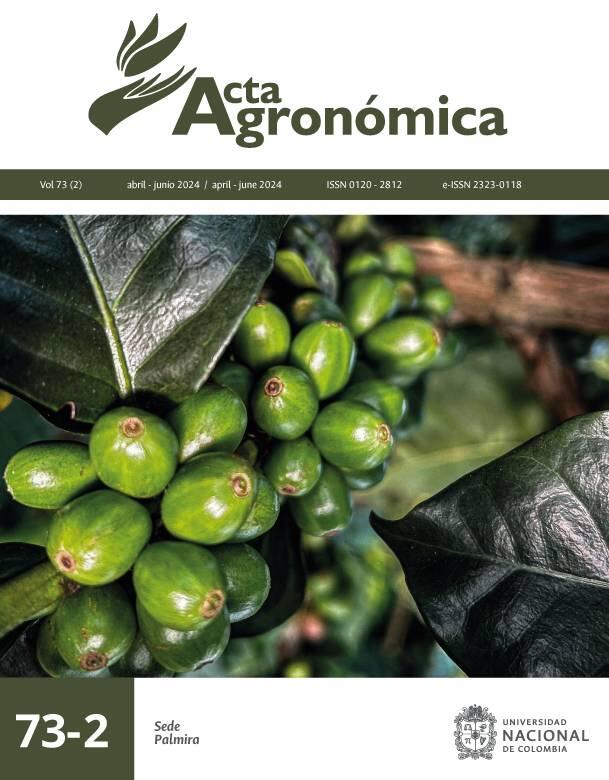
Publicado
Effect of citric acid and calcium on quality and shelf-life of fresh-cut banana (Musa paradisiaca L.)
Efecto del ácido cítrico y calcio en la calidad y vida útil del banano (Musa paradisiaca L.) mínimamente procesado
DOI:
https://doi.org/10.15446/acag.v73n2.115097Palabras clave:
Antioxidant, banana, cold storage, post-harvest, respiration rate (en)antioxidante, almacenamiento refrigerado, banano, intensidad respiratoria, poscosecha (es)
Descargas
The objective of this study was to evaluate the quality attributes and respiratory activity of banana slices during storage at 13 ± 2 °C and 92 ± 2 % relative humidity (RH), simulating marketing conditions. The bananas were selected, washed, sanitized, and cut into slices. Then, they were divided into four groups to which different treatments were applied: 1 % (w/v) calcium chloride (CaCl2) + 0.92 % citric acid (abbreviated as CaAc); 1 % (w/v) CaCl2 (abbreviated as Ca) alone; 0.92 % (w/v) citric acid (abbreviated as Ac) alone; and fruit without application of calcium chloride and citric acid as control (C). Physicochemical analyses were performed using standard methodologies, such as ICONTEC norms. pH values, titratable acidity, color, total soluble solids, weight loss, firmness, and respiration rate were evaluated every 2 days until Day 17. The combined treatment of 1 % (w/v) CaCl2 + 0.92 % citric acid (w/v) significantly decreased respiration rate, weight loss, and browning, and preserved quality attributes during storage. The combination of refrigeration and the application of 1 % (w/v) CaCl2 + 0.92 % (w/v) Ac can extend the shelf life of banana slices up to 9 days.
El objetivo de este trabajo fue evaluar el comportamiento de los atributos de calidad y la actividad respiratoria de rodajas de banano almacenadas a 13 ± 2 °C y 92 ± 2 % de humedad relativa (HR), simulando las condiciones de comercialización. Los bananos fueron seleccionados, lavados, higienizados y cortados en rodajas, después se dividieron en cuatro grupos a los que se les aplicaron diferentes tratamientos: 1 % (p/v) cloruro de calcio (CaCl2) + 0.92 % (p/v) ácido cítrico; 1 % (p/v) CaCl2 solo; 0.92 % (p/v) ácido cítrico solo; y fruta sin ácido cítrico ni CaCl2 denominada control. Se utilizaron métodos de análisis fisicoquímicos bajo metodologías consagradas como las normas ICONTEC. Se evaluaron valores de pH, acidez titulable, color, sólidos solubles totales, pérdida de peso, firmeza e intensidad respiratoria, cada dos días y hasta el día 17. Se encontró que el tratamiento combinado de 1 % (p/v) CaCl2 + 0.92 % (p/v) ácido cítrico disminuyó considerablemente la intensidad respiratoria, la pérdida de peso y el pardeamiento, y permitió conservar los atributos de calidad durante el almacenamiento. La combinación de refrigeración y la aplicación de 1 % (p/v) CaCl2 + 0.92 % (p/v) ácido cítrico puede alargar hasta 9 días la vida útil de las rodajas de banano.
Referencias
Aimi Azira, S.; Wan Zunairah, W. I.; Nor Afizah, M.; Nor-Khaizura, M. A. R.; Radhiah, S.; Ismail Fitry M. R. and Nur Hanani, Z. A. (2021). Prevention of browning reaction in banana jam during storage by physical and chemical treatments. Food Research, 5(5), 55-62. https://doi.org/10.26656/fr.2017.5(5).046
Arora, S.; Goraya, R. K.; Siddiqui, S. and Gehlot, R. (2021). Influence of anti‐browning treatments on enzymatic browning, distinctive properties, and microbiological characteristics of banana pulp during short‐term frozen storage, Journal of Food Processing and Preservation, 45(3), e15259. https://doi.org/10.1111/jfpp.15259
Chang, L.; Yang, M.; Zhao, N.; Xie, F.; Zheng, P.; Simbo, J.; Yu, X. and Du, S. (2022). Structural, physicochemical, antioxidant and in vitro digestibility properties of banana flours from different banana varieties (Musa spp.). Food Bioscience, 47, 101624. https://doi.org/10.1016/j.fbio.2022.101624
Deori, G. D.; Langthasa, S.; Hazarika, D. N.; Goswami, R. K. and Kalita, M. K. (2020). Effect of pre-treatment on quality of minimally processed culinary banana cv. Kachkal (ABB group). Journal of Pharmacognosy and Phytochemistry, 9(1), 2256-2262. https://doi.org/10.22271/phyto.2020.v9.i1al.10807
Elbagoury, M. M.; Turoop, L.; Runo, S. and Sila, D. N. (2021). Regulatory influences of methyl jasmonate and calcium chloride on chilling injury of banana fruit during cold storage and ripening. Food Science & Nutrition, 9(2), 929-942. https://doi.org/10.1002/fsn3.2058
FAO. (2023). Datos sobre alimentación y agricultura. Food and Agriculture Organization of the United Nations (FAO). https://www.fao.org/faostat/es/#data/QCL
Guzmán Bortolini, N. (2021). Aplicación post-cosecha del ácido giberélico como agente retardante de la maduración de banano proveniente del Trópico de Cochabamba. Journal Boliviano de Ciencias, 17(Sp. Num.), 75-85. https://doi.org/10.52428/20758944.v17iEspecial.8
Huang, W.; Shi, Y.; Yan, H.; Wang, H.; Wu, D.; Grierson, D. and Chen, K. (2023). The calcium-mediated homogalacturonan pectin complexation in cell walls contributes the firmness increase in loquat fruit during postharvest storage. Journal of Advanced Research, 49, 47-62. https://doi.org/10.1016/j.jare.2022.09.009
ICONTEC. (1999). Fruit and vegetable products. Colombian Institute of Technical Standards and Certification (ICONTEC). https://www.icontec.org/
Jaime-Guerrero, M.; Álvarez-Herrera, J. G. and Fischer, G. (2024). Effect of calcium on fruit quality: A review. Agronomía Colombiana, 42(1), e112026. https://doi.org/10.15446/agron.colomb.v42n1.112026
Mirshekari, A.; Madani, B. and Golding, J. B. (2017). Suitability of combination of calcium propionate and chitosan for preserving minimally processed banana quality. Journal of the Science of Food and Agriculture, 97(11), 3706-3711. https://doi.org/10.1002/jsfa.8231
Moreno, J. L.; Tran, T.; Cantero-Tubilla, B.; López-López, K.; Becerra López, L. A. L. and Dufour, D. (2021). Physicochemical and physiological changes during the ripening of banana (Musaceae) fruit grown in Colombia. International Journal of Food Sciencie + Technology, 56(3), 1171-1183. https://doi.org/10.1111/ijfs.14851
Pathare, P. B.; Opara, U. L. and Al-Said, F. A. J. (2013). Colour measurement and analysis in fresh and processed foods: a review. Food and Bioprocess Technology, 6, 36-60. https://doi.org/10.1007/s11947-012-0867-9
Pleșoianu, A. M. and Nour, V. (2022). Pectin-based edible coating combined with chemical dips containing antimicrobials and antibrowning agents to maintain quality of fresh-cut pears. Horticulturae, 8(5), 449. https:// doi.org/10.3390/horticulturae8050449
Sarifudin, A.; Afifah, N.; Indrianti, N.; Desnilasari, D.; Kristanti, D.; Ratnawati, L. and Ekafitri, R. (2021). Optimization of banana bar formulation to provide a nourishing snack for toddlers using response surface methodology. Food Science and Technology, 41(suppl. 1), 21-28. https://doi.org/10.1590/fst.07620
Shehata, S. A.; Abdeldaym, E. A.; Ali, M. R.; Mohamed, R. M.; Bob, R. I. and Abdelgawad, K. F. (2020). Effect of some citrus essential oils on post-harvest shelf life and physicochemical quality of strawberries during cold storage. Agronomy, 10(10), 1466. https://doi.org/10.3390/agronomy10101466
Siqueira, M.; Barbosa, N.; Cordenunsi, B.; Hassimotto, N. and Resende, E. (2018). Chemical changes in Prata-Anã banana stored under reduced O2 and increased CO2 Levels. Acta Scientiarum, 40, e39788. https://doi.org/10.4025/actascitechnol.v40i1.39788
Yam, K. L. and Papadakis S. E. (2004). A simple digital imaging method for measuring and analyzing color of food surfaces. Journal of Food Engineering, 61(1), 137–142. https://doi.org/10.1016/S0260-8774(03)00195-X
Yildiz, G. (2018). The effect of different chemical agents on the prevention of enzymatic browning in banana. Journal of Food Science and Engineering, 7, 91-96. https://doi.org/10.17265/2159-5828/2018.02.005
Zahra, F.; Khalid, S.; Aslam, M. and Sharmeen, Z. (2021). Health benefits of banana (Musa): A review study. International Journal of Biosciences, 18(4), 189-199. https://doi.org/10.12692/ijb/18.4.189-199
Cómo citar
APA
ACM
ACS
ABNT
Chicago
Harvard
IEEE
MLA
Turabian
Vancouver
Descargar cita
CrossRef Cited-by
Dimensions
PlumX
Visitas a la página del resumen del artículo
Descargas
Licencia

Esta obra está bajo una licencia internacional Creative Commons Atribución-NoComercial-SinDerivadas 4.0.
Política sobre Derechos de autor:Los autores que publican en la revista se acogen al código de licencia creative commons 4.0 de atribución, no comercial, sin derivados.

Es decir, que aún siendo la Revista Acta Agronómica de acceso libre, los usuarios pueden descargar la información contenida en ella, pero deben darle atribución o reconocimiento de propiedad intelectual, deben usarlo tal como está, sin derivación alguna y no debe ser usado con fines comerciales.