Correo Electrónico
 DNINFOA - SIA
 Bibliotecas
 Convocatorias
 Identidad U.N.


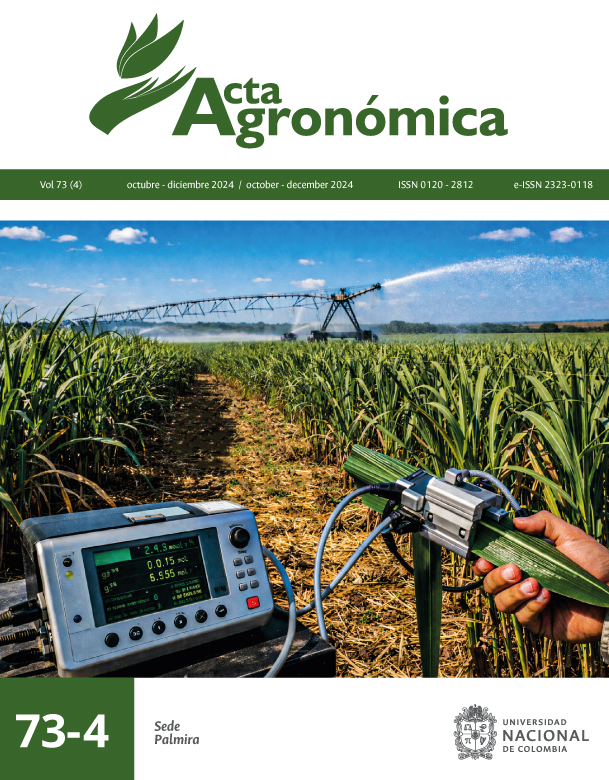
Publicado
Physiological performance of sugarcane genotypes under different irrigation levels
Comportamiento fisiológico de genotipos de caña de azúcar bajo diferentes niveles de riego
DOI:
https://doi.org/10.15446/acag.v73n4.120465Palabras clave:
evapotranspiration, infrared gas analyzer, photosynthesis, Saccharum spp., water deficit (en)análisis de gases infrarrojos, déficit hídrico, evapotranspiración, fotosíntesis, Saccharum spp. (es)
Descargas
Developing and selecting genotypes that are responsive or tolerant to variations in water availability is essential for sugarcane production. The aim of this study was to evaluate the performance of 32 sugarcane genotypes under different water conditions. The responses of physiological variables as a function of different irrigation levels were evaluated. The experiment used a Randomized Complete Block Design (RCBD) in a split-plot arrangement. Four irrigation levels (20 %, 40 %, 60 %, and 100 % of crop evapotranspiration) were allocated to main plots, and the subplots were represented by 32 genotypes belonging to different genera and species. The evaluated physiological variables of the plants were photosynthesis rate (A), stomatal conductance (gs), quantum yield of CO2 assimilation (PhiCO2), and transpiration rate (E). Leaf vapor pressure deficit (VpdL) was estimated based on leaf temperature. The results revealed that genotypes 10, 26, and 29 consistently maintained high physiological performance across all irrigation levels, whereas genotype 7 showed notable resilience under water deficit. These genotypes are identified as promising candidates for cultivation under water‑limited conditions and may support the selection of efficient, drought‑tolerant material for semi‑arid regions.
El desarrollo y la selección de genotipos sensibles o tolerantes a variaciones en la disponibilidad hídrica son esenciales para la producción de caña de azúcar. El objetivo de este estudio fue evaluar el rendimiento de 32 genotipos de caña de azúcar bajo distintas condiciones hídricas, buscando analizar el comportamiento de las variables fisiológicas en distintos niveles de riego. El diseño experimental fue de Bloques Completos al Azar, donde los tratamientos fueron distribuidos en parcelas subdivididas. Se asignaron cuatro niveles de riego (20 %, 40 %, 60 % y 100 % de la evapotranspiración del cultivo) a las parcelas principales, y las subparcelas estuvieron representadas por 32 genotipos pertenecientes a diferentes géneros y especies. Las variables fisiológicas de las plantas analizadas fueron tasa de fotosíntesis (A), conductancia estomática (gs), rendimiento cuántico calculado a partir de la asimilación de CO2 (PhiCO2) y tasa de transpiración (E). El déficit de presión de vapor (VpdL) se estimó con base en la temperatura foliar. Los resultados revelaron que los genotipos 10, 26 y 29 mantuvieron un alto rendimiento fisiológico de forma consistente en todos los niveles de riego, mientras que el genotipo 7 mostró una resiliencia notable ante el déficit hídrico. Estos genotipos fueron identificados como candidatos prometedores para el cultivo en condiciones de escasez de agua, lo que respalda la selección de material más eficiente y tolerante a la sequía para regiones semiáridas.
Referencias
Allen, R. G.; Pereira, L. S.; Raes, D. and Smith, M. (1998). FAO Irrigation and Drainage Paper 56. Crop Evapotranspiration: Guidelines for computing crop water requirements. Food and Health Organization (FAO). http://www.climasouth.eu/sites/default/files/FAO%2056.pdf
Bhering, L. L. (2017). Rbio: A tool for biometric and statistical analysis using the R platform. Crop Breeding and Applied Biotechnology, 17(2), 187-190. http://doi.org/10.1590/1984-70332017v17n2s29
Chandiposha, M.; Zharare, G. E. and Nzima, M. D. S. (2023). Screening of sugarcane varieties for tolerance to water deficiency using containers. International Journal of Agronomy, 2023, 5705785. https://doi.org/10.1155/2023/5705785
Conab. (2024). Acompanhamento da safra brasileira, cana-de-açúcar, safra 24/25, 3º levantamento, v. 12, n. 3. Companhia Nacional de Abastecimento (Conab). https://www.novacana.com/pdf/28112024091104_boletim-safras-cana-281124_NC.pdf
Dinh, T. H.; Takaragawa, H.; Watanabe, K.; Nakabaru, M. and Kawamitsu, Y. (2019). Leaf photosynthesis response to change of soil moisture content in sugarcane. Sugar Tech, 21, 949-958. https://doi.org/10.1007/s12355-019-00735-8
Garcia, F. H. S.; Das Chagas Mendonça, A. M.; Rodrigues, M.; Matias, F. I.; Da Silva Filho, M. P.; Santos, H. R. B.; Taffner, J. and Barbosa, J. P. R. A. D. (2020). Water deficit tolerance in sugarcane is dependent on the accumulation of sugar in the leaf. Annals of Applied Biology, 176(1), 65-74. https://doi.org/10.1111/aab.12559
Gomathi, R.; Krishnapriya, V.; Arunkumar, R.; Govindaraj, P. and Ram, B. (2020). Physiological traits imparting drought stress tolerance to promising sugarcane (Saccharum spp.) clones. Plant Physiology Reports, 25, 509-515. https://doi.org/10.1007/s40502-020-00536-2
Khalili, M.; Naghavi, M. R.; Aboughadareh, A. P. and Talebzadeh, S. J. (2012). Evaluating of drought stress tolerance based on selection indices in spring canola cultivars (Brassica napus L.). Journal of Agricultural Science, 4(11), 78-85. https://doi.org/10.5539/jas.v4n11p78
Kumar, D.; Malik, N. and Sengar, R. S. (2021). Physio-biochemical insights into sugarcane genotypes under water stress. Biological Rhythm Research, 52(1), 92-115. https://doi.org/10.1080/09291016.2019.1587838
Leanasawat, N.; Kosittrakun, M.; Lontom, W. and Songsri, P. (2021). Physiological and agronomic traits of certain sugarcane genotypes grown under field conditions as influenced by early drought stress. Agronomy, 11(11), 2319. https://doi.org/10.3390/agronomy11112319
Li, C.; Nong, Q.; Solanki, M. K.; Liang, Q.; Xie, J.; Liu, X.; Li, Y.; Wang, W.; Yang, L. and Li, Y. (2016). Differential expression profiles and pathways of genes in sugarcane leaf at elongation stage in response to drought stress. Scientific Reports, 6, 25698. https://doi.org/10.1038/srep25698
Li, C.; Wang, Z.; Nong, Q.; Lin, L.; Xie, J.; Mo, Z.; Huang, X.; Song, X.; Malviya, M. K.; Solanki, M. K. and Li, Y. (2021). Physiological changes and transcriptome profiling in Saccharum spontaneum L. leaf under water stress and re-watering conditions. Scientific Reports, 11, 5525. https://doi.org/10.1038/s41598-021-85072-1
Marcos, F. C. C.; Silveira, N. M.; Marchiori, P. E. R.; Machado, E. C.; Souza, G. M.; Landell, M. G. A. and Ribeiro, R. V. (2018). Drought tolerance of sugarcane propagules is improved when origin material faces water deficit. PLoS One, 13(12), e0206716. https://doi.org/10.1371/journal.pone.0206716
Oliveira, J. T.; Da Cunha, F. F.; De Oliveira, R. A.; Da Silva Júnior, A. G. and Bufon, V. B. (2020). Economic analysis of two sprinkler irrigation systems for sugarcane and soybean crops in Brazil. International Sugar Journal, 122(1464), 772-779. https://www.researchgate.net/publication/346773401_Economic_analysis_of_two_sprinkler_irrigation_systems_for_sugarcane_and_soybean_crops_in_Brazil
Reyes, J. A. O.; Carpentero, A. S.; Santos, P. J. A. and Delfin, E. F. (2020). Effects of water regime, genotype, and formative stages on the agro-physiological response of sugarcane (Saccharum officinarum L.) to drought. Plants, 9(5), 661. https://doi.org/10.3390/plants9050661
Sajid, M.; Amjid, M.; Munir, H.; Ahmad, M.; Zulfiqar, U.; Ali, M. F.; Abul Farah, M.; Ahmed, M. A. A. and Artyszak, A. (2023). Comparative analysis of growth and physiological responses of sugarcane elite genotypes to water stress and sandy loam soils. Plants, 12(15), 2759. https://doi.org/10.3390/plants12152759
Scott, A. J. and Knott, M. (1974). A cluster analysis method for grouping means in the analysis of variance. Biometrics, 30(3), 507-512. https://doi.org/10.2307/2529204
Shrivastava, A. K.; Srivastava, T. K.; Srivastava, A. K.; Misra, V.; Srivastava, S.; Singh, V. K. and Shukla, S. P. (2016). Climate change induced abiotic stresses affecting sugarcane and their mitigation. Indian Institute of Sugarcane Research (IISR), Lucknow. https://www.researchgate.net/profile/Varucha-Misra/publication/304701706_Climate_change_induced_abiotic_stresses_affecting_sugarcane_and_their_mitigation/links/58144b7f08aeffbed6bc3d79/Climate-change-induced-abiotic-stresses-affecting-sugarcane-and-their-mitigation.pdf
Silva, M. de A.; Jifon, J. L.; Da Silva, J. A. G. and Sharma, V. (2007). Use of physiological parameters as fast tools to screen for drought tolerance in sugarcane. Brazilian Journal of Plant Physiology, 19(3), 193-201. https://doi.org/10.1590/S1677-04202007000300003
Zhang, X.; Mei, X.; Wang, Y.; Huang, G.; Feng, F.; Liu, X.; Guo, R.; Gu, F.; Hu, X.; Yang, Z.; Zhong, X. and Li, Y. (2020). Stomatal conductance bears no correlation with transpiration rate in wheat during their diurnal variation under high air humidity. PeerJ, 8, e8927. https://peerj.com/articles/8927/ DOI: https://doi.org/10.7717/peerj.8927
Cómo citar
APA
ACM
ACS
ABNT
Chicago
Harvard
IEEE
MLA
Turabian
Vancouver
Descargar cita
CrossRef Cited-by
Dimensions
PlumX
Visitas a la página del resumen del artículo
Descargas
Licencia

Esta obra está bajo una licencia internacional Creative Commons Atribución-NoComercial-SinDerivadas 4.0.
Política sobre Derechos de autor:Los autores que publican en la revista se acogen al código de licencia creative commons 4.0 de atribución, no comercial, sin derivados.

Es decir, que aún siendo la Revista Acta Agronómica de acceso libre, los usuarios pueden descargar la información contenida en ella, pero deben darle atribución o reconocimiento de propiedad intelectual, deben usarlo tal como está, sin derivación alguna y no debe ser usado con fines comerciales.