
Publicado
Avifauna: monitoreo como indicador de restauración con núcleo de estacas y plántulas en Zapatoca (Santander, Colombia).
Birdlife: monitoring as an indicator of restoration with core cuttings and seedlings in Zapatoca (Santander, Colombia)
DOI:
https://doi.org/10.15446/abc.v30n1.112755Palabras clave:
Diversidad de aves, Indicadores ecológicos, Núcleos de regeneración vegetal, Reservas naturales privadas, Restauración ecológica basada en vegetación nativa (es)Bird diversity, Ecological indicators, Ecological restoration with native vegetation, Private nature reserves, Vegetation regeneration nuclei (en)
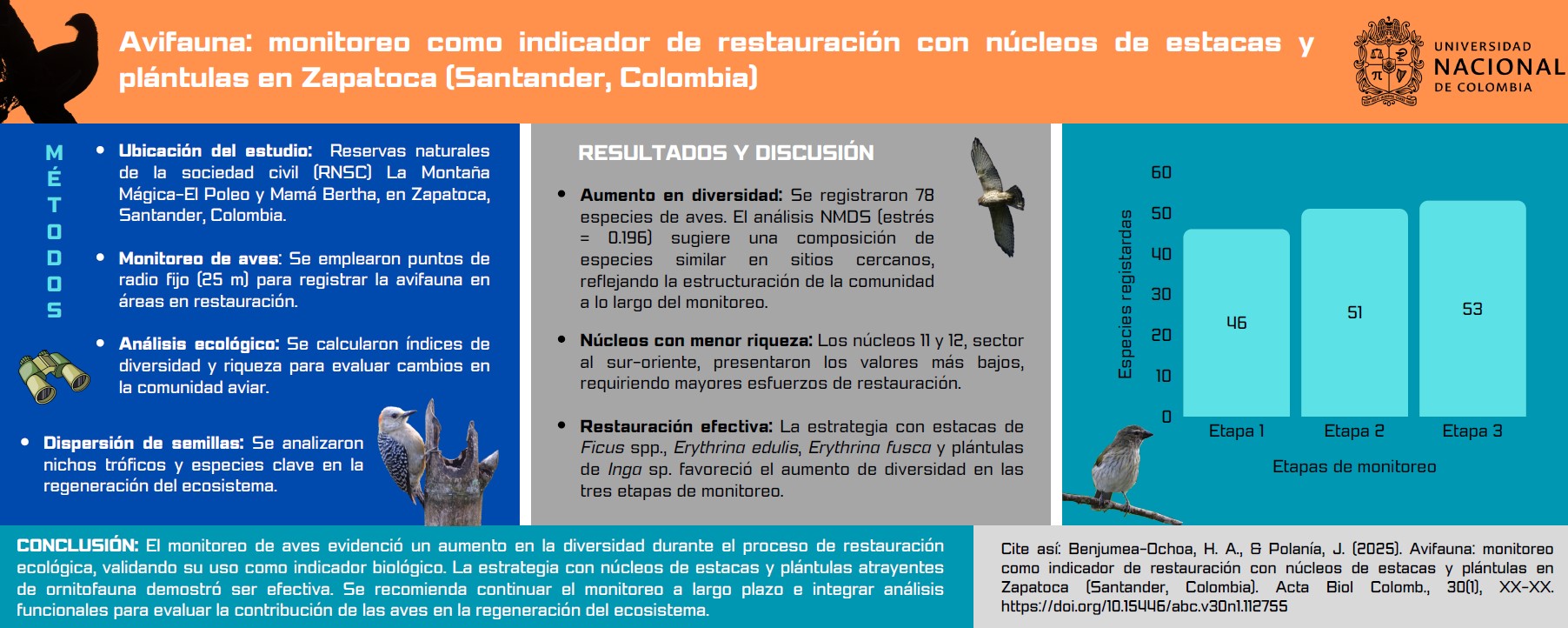
El proyecto Reforestation in the Serranía de Los Yariguies of the Colombian Andes estableció 244 núcleos de vegetación a mediados del 2017 en dos reservas naturales de la sociedad civil (RNSC) ubicadas en la cresta norte de la Serranía Yariguíes (Zapatoca, Santander), donde predominan bosques húmedo montano bajo y premontano (sensu Holdridge bh-MB y bh-PM, respectivamente). El monitoreo de aves como indicador de la restauración se inició en enero del 2018 en 26 núcleos, separados 200 m, como primera etapa. Se replicó en noviembre del 2018 y en julio del 2019, para una segunda y tercera etapa. En 15 minutos/núcleo durante 5 horas/día (06:00 a 11:00) se registraron riqueza y abundancia mediante el método de radio fijo (25m) y se calcularon, además, índices que evalúan la comunidad desde su composición (Abundancia, Diversidad/Equidad, Nichos tróficos, Shannon, Simpson) y procesos ecológicos (dispersión de semillas), así como similitud (Sorensen y Jaccard). Además de evaluar la estructura (diversidad) y funcionalidad (tamaño) para la dispersión de semillas. La referencia de bosques conservados de las RNSC fueron avistamientos del 2015. Aquí se logró un listado de 74 especies, con valores ascendentes de Shannon, Margalef, Simpson y Pielou al avanzar las etapas. En adición, los de Sorensen y Jaccard descendieron. Además, se encontró en la comunidad siete nichos tróficos. En la dispersión de semillas hubo dominancia de aves grandes. Estos valores permiten hallar qué zonas requieren manejo adaptativo (núcleos 11 y 12) para su evolución en la trayectoria de restauración deseada.
The Reforestation in the Serranía de Los Yariguies of the Colombian Andes project established 244 vegetation nuclei in mid-2017 in two natural reserves of civil society (RNSC) located on the northern crest of the Yariguíes mountain range (Zapatoca, Santander), where low and premontane montane humid forests (sensu Holdridge bh-MB and bh-PM, respectively) predominate. Bird monitoring as an indicator of restoration began in January 2018 in 26 nuclei, separated by 200 m, as the first stage. It was replicated in November 2018 and July 2019, for a second and third stage. In 15 minutes/nucleus during five hours/day (06:00 to 11:00) richness and abundance were recorded using the fixed radio method (25m) and indices that evaluate the community from its composition (Abundance, Diversity/Equity, Trophic Niches, Shannon, Simpson) and ecological processes (seed dispersal), as well as similarity (Sorensen and Jaccard) were calculated. In addition to evaluating the structure (diversity) and functionality (size) for seed dispersal. The reference of conserved forests of the RNSC were sightings from 2015. Here, a list of 74 species was obtained, with ascending values of Shannon, Margalef, Simpson, and Pielou as the stages progressed. However, those of Sorensen and Jaccard decreased. In addition, seven trophic niches were found in the community. Large birds dominated seed dispersal. These values allow us to find which areas require adaptive management (nuclei 11 and 12) for their evolution in the desired restoration trajectory.
Referencias
Aguilar-Garavito, M. y Ramírez, W. (2015). Monitoreo a procesos de restauración ecológica aplicado a ecosistemas terrestres. Instituto de investigación de Recursos Biológicos Alexander von Humboldt (IAvH).
Alexandrino, E. R., Buechley, E. R., Karr, J. R., de Barros, Ferraz, K. M. P. M., de Barros Ferraz, S. F., do Couto, H. T. Z. and Şekercioğlu, Ç. H. (2017). Bird based Index of Biotic Integrity: Assessing the ecological condition of Atlantic Forest patches in human-modified landscape. Ecological indicators, 73, 662-675. https://doi.org/10.1016/j.ecolind.2016.10.023
Álvarez, M., Córdoba, S., Escobar, F., Fagua, G., Gast, F., Mendoza, H., Ospina, M., Umaña, A. M. y Villarreal, H. (2006). Manual de métodos para el desarrollo de inventarios de biodiversidad. Programa de inventarios de Biodiversidad Grupo de Exploración y Monitoreo Ambiental (GEMA). Instituto de Investigación de Recursos Biológicos Alexander von Humboldt.
Avenza Systems Inc. (03 de agosto de 2024). Avenza Maps. https://www.avenza.com/avenza-maps/
Ayerbe-Quiñones, F. (2018). Guía ilustrada de la avifauna colombiana. Wildlife Conservation Society.
Carlo, T. A. and Morales, J. M. (2016). Generalist birds promote tropical forest regeneration and increase plant diversity via rare-biased seed dispersal. Ecology, 97(7), 1819–1831. https://doi.org/10.1890/15-2147.1
Chao, A. (1987). Estimating the population size for capturerecapture data with unequal catchability. Biometrics, 43(4), 783-791. https://doi.org/10.2307/2531532
Chazdon, R. L. (2014). Second growth: The promise of tropical forest regeneration in an age of deforestation. University of Chicago Press https://doi.org/10.7208/chicago/9780226118109.001.0001
Chiu, C. H., Wang, Y. T., Walther, B. A. and Chao, A. (2014). An improved nonparametric lower bound of species richness via a modified Good–Turing frequency formula. Biometrics, 70(3), 671-682. https://doi.org/10.1111/biom.12200
Colorado-Zuluaga, G. J. (2004). Relación de la morfometría de aves con gremios alimenticios. Boletín SAO, 14(27), 25-32.
Contreras-Vásquez, M. A. (en prensa). Caracterización de los recursos florales utilizados por los colibríes en la RNSC “La Montaña Mágica–El Poleo”, Zapatoca, Santander [Tesis de grado]. Universidad Nacional de Colombia – Sede Bogotá.
Díaz-Páez, M., Werden, L. K., Zahawi, R. A., Usuga, J. and Polanía, J. (2022). Vegetative propagation of native tree species: an alternative restoration strategy for the tropical Andes. Restoration Ecology, 30(7), e13611. https://doi.org/10.1111/rec.13611
Díaz-Valencia, S. A. y J. Polanía. (2015). Aproximación a la comunidad de aves en la Reserva Natural de la Sociedad Civil “La Montaña Mágica-El Poleo”, Colombia. Cartel presentado en el XIV Congreso Forestal Mundial. (Durban, Suráfrica).
Ellison, A. M., Bank, M. S., Clinton, B. D., Colburn, E. A., Elliott, K., Ford, C. R., Foster, D. R., Kloeppel, B. D., Knoepp, J. D., Lovett, G. M., Mohan, J., Orwig, D. A., Rodenhouse, N. L., Sobczak, W. V., Stinson, K. A., Stone, J. K., Swan, C. M., Thompson, J., Von Holle, B. and Webster, J. R. (2005). Loss of foundation species: consequences for the structure and dynamics of forested ecosystems. Frontiers in Ecology and the Environ, 3(9), 479-486. https://doi.org/10.1890/15409295(2005)003[0479:LOFSCF]2.0.CO;2
ESRI. Environmental Systems Research Institute. (2018). ArcGIS 10.4.1. ESRI, Redlands Eusse-González, D. y Cano – Palacios, T. (2018). Sembrando plantas para cosechar aves. Asociación para el estudio y conservación de las aves en Colombia–Calidris.
Gray, M. A., Baldauf, S. L., Mayhew, P. J. and Hill, J. K. (2007). The response of avian feeding guilds to tropical forest disturbance. Conservation Biology, 21(1), 133-141. https://doi.org/10.1111/j.1523-1739.2006.00557.x
Hammer, Ø., Harper, D. A. and Ryan, P. D. (2001). PAST: Paleontological statistics software package for education and data analysis. Palaeontologia electronica, 4(1), 9.
Hill, M. O. (1973). Diversity and evenness: a unifying notation and its consequences. Ecology, 54(2), 427-432. https://doi.org/10.2307/1934352
Holdridge, L. R. (1967). Life zone ecology. (rev. ed.). IDEAM. Instituto de Hidrología, Meteorología y Estudios Ambientales. (2018). Ministerio de Ambiente y Desarrollo Sostenible de Colombia.
IGAC. Instituto Geográfico Agustín Codazzi. (2015). Mapa digital de suelos de Colombia, escala 1:100.000. formato shapefile, versión en proceso de revisión. (Colombia).
Jaccard, P. (1901). Étude comparative de la distribution florale dans une portion des Alpes et des Jura. Bull Soc Vaudoise Sci Nat, 37, 547-579.
Jaramillo, A. (2019). Wedge-tailed Grass-finch (Emberizoides herbicola). In: del Hoyo, J., Elliott, A., Sargatal, J., Christie, D. A. and de Juana, E. (eds.). Handbook of the Birds of the World Alive. Lynx Edicions. https://www.hbw.com/node/62088
Jordano, P. and Schupp, E. W. (2000). Seed disperser effectiveness: The quantity component and patterns of seed rain for Prunus mahaleb. Ecological Monographs, 70(4), 591-615. https://doi.org/10.1890/0012-9615(2000)070[0591:SDETQC]2.0.CO;2
Kahmen, S. (2004). Plant trait responses to grassland management and succession. Dissertationes Botanicae, 382, 1-122.
Latja, P., Valtonen, A., Malinga, G. M. and Roininen, H. (2016). Active restoration facilitates bird community recovery in an Afrotropical rainforest. Biological Conservation, 200, 70-79. https://doi.org/10.1016/j.biocon.2016.05.035
Leishman, M. R., Wright, I. J., Moles, A. T. and Westoby, M. (2000). The evolutionary ecology of seed size. Seeds: the ecology of regeneration in plant communities, 2, 31-57. https://doi.org/10.1079/9780851994321.00
MacGregor-Fors, I., Blanco-García, A. and Lindig-Cisneros, R. (2010). Bird community shifts related to different forest restoration efforts: a case study from a managed hábitat matrix in Mexico. Ecological Engineering, 36(10), 1492-1496. https://doi.org/10.1016/j.ecoleng.2010.06.001
Margalef, R. (1958). Information theory in ecology. Gen. Systems, 3, 36-71.
McMullan, M., Donegan, T. M. and Quevedo, A. (2010). Field guide to the birds of Colombia. Fundación ProAves.
Moreno, C. E., Barragán, F., Pineda, E. y Pavón, N. P. (2011). Reanálisis de la diversidad alfa: alternativas para interpretar y comparar información sobre comunidades ecológicas. Revista mexicana de biodiversidad, 82(4), 1249-1261. https://doi.org/10.22201/ib.20078706e.2011.4.745
Oksanen, J. (2010). Vegan: community ecology package. Recuperado el 21 de Agosto de 2021, de https://vegan.rforge.r-project.org/
Oreja, J. G., de la Fuente-Díaz-Ordaz, A. A., Hernández-Santín, L., Buzo-Franco, D. y Bonache-Regidor, C. (2010). Evaluación de estimadores no paramétricos de la riqueza de especies. Un ejemplo con aves en áreas verdes de la ciudad de Puebla, México. Animal biodiversity and conservation, 33(1), 31-45. https://doi.org/10.32800/abc.2010.33.0031
Ortega-Álvarez, R. and Lindig-Cisneros, R. (2012). Feathering the scene: The effects of ecological restoration on birds and the role birds play in evaluating restoration outcomes. Ecological Restoration, 30(2), 116-127. https://doi.org/10.3368/er.30.2.116
Ortega-Álvarez R., Lindig-Cisneros, R. MacGregor-Fors, I. Renton, K. and Schondube. J. E. (2013). Avian community responses to restoration efforts in a complex volcanic landscape. Ecological Engineering, 53, 275-283. https://doi.org/10.1016/j.ecoleng.2012.12.058
Pielou, E. C. (1966). The measurement of diversity in different types of biological collections. Journal of theoretical biology, 13, 131-144. https://doi.org/10.1016/0022-5193(66)90013-0
Pigot, A. L., Sheard, C., Miller, E. T., Bregman, T. P., Freeman, B. G., Roll, U., Seddon, N., Trisos, C. H., Weeks, B. C. and Tobias, J. A. (2020). Macroevolutionary convergence connects morphological form to ecological function in birds. Nature Ecology & Evolution, 4, 1-10. https://doi.org/10.1038/s41559-019-1070-4
Ralph, C. J., Droege, S. and Sauer, J. R. (1995). Managing and monitoring birds using point counts: standards and applications. US Department of Agriculture, Forest Service, Pacific Southwest Research Station: p. 161-168, 149.
Ralph, C. J., Geupel, G. R., Pyle, P., Martin, T. E., DeSante, D. F. y Milá, B. (1996). Manual de métodos de campo para el monitoreo de aves terrestres. https://doi.org/10.2737/PSW-GTR-159
R Development Core Team, R. C. (2020). RA language and environment for statistical computing, R Foundation for Statistical. Computing. https://www.r-project.org/
Remsen, J. V. Jr., Areta, J. I., Bonaccorso, E., Claramunt, S., Del-Rio, G., Jaramillo, A., Lane, D. F., Robbins, M. B., Stiles, F. G., and Zimmer, K. J. (11 de febrero de 2020). A classification of the bird species of South America. Museum of Natural Science, Louisiana State University. http://www.museum.lsu.edu/~Remsen/SACCBaseline.htm
Rurangwa, M. L., Matthews, T. J., Niyigaba, P., Tobias, J. A. and Whittaker, R. J. (2021). Assessing tropical forest restoration after fire using birds as indicators: An afrotropical case study. Forest Ecology and Management, 483, 118765. https://doi.org/10.1016/j.foreco.2020.118765
S. F. Applicality Ltd. (3 de Agosto de 2024). Mobile Topographer. Athens, Greece. https://www.applicality.com/mobile-topographer/
SAS. Planet. (03 de agosto de 2024). SAS Planet 160707. Russia. https://sasgis.org/
Schmidt, V. y Schaefer, H. M. (2004). Unlearned preference for red may facilitate recognition of palatable food in young omnivorous birds. Evolutionary Ecology Research, 6(6), 919-925.
Simpson, E. H. (1949). Measurement of diversity.Nature, 163(4148), 688.
Smith E. P. and van Belle G. (1984). “Nonparametric estimation of species richness” Biometrics, 40(1), 119-129. https://doi.org/10.2307/2530750
Sorensen, T. (1948). A method of establishing groups of equal amplitude in plant sociology based on similarity of species and its application to analyses of the vegetation on Danish commons. Biol. Skr, 5, 1-34.
Spotswood, E. N., Goodman, K. R., Carlisle, J., Cormier, R. L., Humple, D. L., Rousseau, J., Guers, S. L. and Barton, G. G. (2012). How safe is mist netting? Evaluating the risk of injury and mortality to birds. Methods in Ecology and Evolution, 3(1), 29-38. https://doi.org/10.1111/j.2041210X.2011.00123.x
Sylvester, J., Valencia, J., Verchot, L. V., Chirinda, N., Sanchez, M. A. R., Quintero, M. and Castro-Nunez, A. (2020). A rapid approach for informing the prioritization of degraded agricultural lands for ecological recovery: A case study for Colombia. Journal for Nature Conservation, 58, 125921. https://doi.org/10.1016/j.jnc.2020.125921
Vargas, C. E. C., Callejas, S. D. S. y Pisco, A. F. M. (2019). Plantas amenazadas de la colección viva del Jardín Botánico de Bogotá. Revista Facultad de Ciencias Básicas, 15(2), 45-56. https://doi.org/10.18359/rfcb.4382
Walker, B. H. (1992). Biodiversity and ecological redundancy. Conservation biology, 6(1), 18-23. https://doi.org/10.1046/j.1523-1739.1992.610018.x
Wenny, D. G., De Vaut, T. L., Johnson, M. D., Kelly, D., Sekercioglu, C. H., Tomback, D. F. y Whelan, C. J. (2011). The need to quality ecosystem services provided by birds. Journal of Ornithology, 128(1), 1-14. https://doi.org/10.1525/auk.2011.10248
Whelan, C. J., Wenny, D. G. and Marquis, R. J. (2008). Ecosystem services provided by birds. Annals of the New York Academy of Sciences, 1134(1), 25-60. https://doi.org/10.1196/annals.1439.003
Wilman, H., Belmaker, J., Simpson, J., de la Rosa, C., Rivadeneira, M. M. and Jetz, W. (2014). EltonTraits 1.0: Species-level foraging attributes of the world’s birds and mammals: Ecological Archives E095-178. Ecology, 95(7), 2027-2027. https://doi.org/10.1890/13-1917.1
Zanini, L. and Ganade, G. (2005). Restoration of Araucaria forest: the role of perches, pioneer vegetation, and soil fertility. Restoration Ecol., 13(3),507– 514. https://doi.org/10.1111/j.1526-100X.2005.00063.x
Dimensions
PlumX
Visitas a la página del resumen del artículo
Descargas
Cómo citar
Licencia

Esta obra está bajo una licencia internacional Creative Commons Atribución-NoComercial-CompartirIgual 4.0.
1. La aceptación de manuscritos por parte de la revista implicará, además de su edición electrónica de acceso abierto bajo licencia Attribution-NonCommercial-ShareAlike 4.0 (CC BY NC SA), la inclusión y difusión del texto completo a través del repositorio institucional de la Universidad Nacional de Colombia y en todas aquellas bases de datos especializadas que el editor considere adecuadas para su indización con miras a incrementar la visibilidad de la revista.
2. Acta Biológica Colombiana permite a los autores archivar, descargar y compartir, la versión final publicada, así como las versiones pre-print y post-print incluyendo un encabezado con la referencia bibliográfica del articulo publicado.
3. Los autores/as podrán adoptar otros acuerdos de licencia no exclusiva de distribución de la versión de la obra publicada (p. ej.: depositarla en un archivo telemático institucional o publicarla en un volumen monográfico) siempre que se indique la publicación inicial en esta revista.
4. Se permite y recomienda a los autores/as difundir su obra a través de Internet (p. ej.: en archivos institucionales, en su página web o en redes sociales cientificas como Academia, Researchgate; Mendelay) lo cual puede producir intercambios interesantes y aumentar las citas de la obra publicada. (Véase El efecto del acceso abierto).




