Published
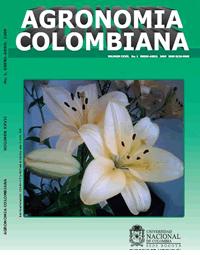
Efecto de la vernalización de bulbos reutilizados sobre la calidad de la flor de lirio (Lilium sp.) en la Sabana de Bogotá
Effect of reused bulb vernalization on lily flower quality (Lilium sp.) in the Bogota Plateau
Keywords:
vida en florero, precocidad, temperatura, almacenamiento, floración (es)vase life, precocity, temperature, storage, flowering (en)
Downloads
En Colombia el cultivo de lirio ha adquirido gran importancia, pero su expansión está condicionada al costo elevado de los bulbos. El bulbo para producción de flor es importado; este produce flor de calidad solamente en la primera cosecha, por lo que el productor debe comprar nuevamente material para poder mantener sus programas de siembra. Sin embargo, con la vernalización del bulbo que queda después del corte de la flor se pueden obtener más flores de buena calidad. Por tanto, el objetivo del trabajo fue evaluar el efecto de la vernalización sobre la calidad de flor de lirio. Se utilizó un diseño completamente al azar. Se sometieron bulbos del híbrido asiático Castello a 10 tratamientos compuestos por la interacción de tres tiempos (4, 6 y 8 semanas) y tres temperaturas de vernalización (-2, 3 y 14°C) más un testigo comercial (bulbos importados). Este último fue el mejor tratamiento, seguido de la vernalización de bulbos a 3°C durante 8 semanas, con el que se obtuvieron plantas más precoces, menos flores sin abrir, mayor porcentaje de flores calidad Extra, Súper *3 botones y mayor vida en florero, lo que puso de manifiesto la importancia de la vernalización en la producción de lirio.
References
Azcón-Bieto, J. y M. Talón. 2000. Fisiología y bioquímica vegetal. McGraw-Hill/Interamericana, Barcelona, España.
Bernier, G., A. Havelange, C. Houssa, A. Petitjean y P. Lejeune. 1993. Physiological signals thatinduce flowering. Plant Cell 5, 1147-1155.
Bernier, G., J. Kinet y R. Sachs.1981. The physiology of flowering. Vol I. The initiation of flowers. CRC Press, Boca Ratón, FL.
Clement, C., M. Burrus y J.C. Audran. 1996. Floral organ growth and carbohydrate content during pollen development in Lilium. Amer. J. Bot. 83, 459-469.
Chouard, P. 1960. Vernalization and its relations to dormancy. Annu. Rev. Plant Physiol. 11, 191-238.
Cocozza, M. 1974. Research concerning the effects of bulb vernalization and plastic film covers on tulip flowering. Acta Hort. 43, 53-70.
Collins, W. y D. Smith. 1975. Vernalization as a factor influencing the rate of development in subterranean clove (Trifolium subterraneum L.). Aust. J. Agric. Res. 26, 959-966.
Costa, C. y M. Días. 1967. Comparação do método de frigorificação vs. florescimento em condições naturais e suas consequências para o melhoramento da cebola nas condições de estado de São Paulo. Relatório de Ciências do Instituto de Genética, ESALQ, USP 1, 94-97.
De Hertogh, A. 1996. Marketing and research requirements for Lilium in North America. Acta Hort. 414, 17-24.
Dennis, E., C. Helliwell y W. Peacock. 2006. Vernalization: spring into flowering. Dev. Cell 11, 1-7.
Erwin, J. y G. Eigles. 1998. Influence of simulated shipping and rooting temperature and production year on easter lily (Lilium longiflorum Thunb.). development. J. Amer. Soc. Hort. Sci. 123(29), 230-233.
Fisher, P. y J. Lieth. 2000. Variability in flower development of Easter lily (Lilium longiflorum Thunb.): model and decision-support system. Comput. Electron. Agric. 26, 53-64.
Funnell, K. y R. Heins. 1998. Plant growth regulators reduce postproduction leaf chlorosis of potted asiflorum lilies. HortScience 33, 1036-1037.
García, F., J. Caselles y M. Santamarina. 2006. Introducción al funcionamiento de las plantas. Editorial UPV, Valencia, España.
Ho, L. 1988. Metabolism and compartmentation of imported sugars in sink organs in relation to sink strength. Annu. Rev. Plant Physiol. Plant Mol. Biol. 39, 355-378.
Inamoto, K., T. Hase, M. Doi y H. Imanishi. 2000. Effects of duration of bulb chilling on dry matter distribution in hydroponically forced tulips. Scientia Hort. 85, 295-306.
Jackson, S., P.E. James, E. Carrera, E. Prat y S.B. Thomas. 2000. Regulation of transcript levels of a potato gibberellin 20-oxidase gene by light and phytochrome B. Plant Physiol. 124, 423-430.
Kimani, P.M., J.L. Karinki, R. Peters y H.D. Rabinowitch. 1994. Potential of onion seed production in a tropical environment. Acta Hort. 358, 341-349.
Lee, S.J., Y.A. Kim y H.J. Wang. 1996. Effect of bulb vernalization on the growth and flowering of asiatic hybrid lily. Acta Hort. 414, 229-234.
Metzger, J.D. 1990. Comparison of biological activities of gibberellins and gibberellin-precursors native to Thalaspi arvense L. Plant Physiol. 94, 151-156.
Michaels, S.D. y R.M. Amasino. 2000. Memories of winter: vernalization and the competence to flower. Plant Cell Environ. 23, 1145-1153.
Moe, R. 1979. Effect of precoolong at 5 or -1°C on shoot growth, flowering, and carbohydrate metabolism in tulip bulbs. Scientia Hort. 10, 187-201.
Nakayama, M., H. Yamane, H. Nojiri, T. Yokota, I. Yamaguchi, N. Murofushi, N. Takahasi, T. Nishijima, M. Koshioka, N. Katsura y M. Nonaka. 1995. Qualitative and quantitative analysis of endogenous gibberellins in Raphanus sativus L. during cold treatment and the subsequent growth. Biosci. Biotech. Biochem. 59, 1121-1125.
Nardi, C., G.A. Buriol, R.A. Bellé, N.A. Streck y M. Schuh. 2004. Vernalização afeta a mobilização de reservas de açúcares e nitrogênio e a emergência de plantas de lírio (Lilium longiflorum thunb.) 'Snow Queen' Cienc. Rural 34, 1027-1033.
Oka, M., Y. Tasaka, M. Iwabuchi y M. Mino. 2001. Elevated sensitivity to gibberellin by vernalization in the vegetative rosette plants of Eustoma grandiflorum and Arabidopsis thaliana. Plant Sci. 160, 1237-1245.
Ramin, A.A. y J.G. Atherton. 1991. Manipulation of bolting and flowering in celery (Apiurn graeeolens L. var. dulce). II. Juvenility. J. Hort. Sci. 66(6), 709-717.
Reghin, M.Y., R.F. Otto, J.R. Olinik, C.F.S. Jacoby y R.P. Oliveira. 2005. Vernalização em bulbos e efeito no rendimento e potencial fisiológico de sementes de cebola. Hort. Brasil. 23(2), 294-298.
Salisbury, F.B. y C.W. Ross. 1994. Fisiología vegetal. Grupo Editorial Iberoamérica S.A., México D.F.
Schiappacasse C.F., S.G. Carrasco y C.F. Carrasco. 2006. Efecto de cuatro niveles de sombreamiento sobre la calidad de vara y bulbo de dos cultivares de Lilium (Lilium spp.). Agric. Téc. (Chile) 66(4), 352-359.
Spikman, G. 1989. Development and ethylene production of buds and florets of cut freesia inflorescences as influenced by silver thiosulphate, aminoethoxyvinylglucine and sucrose. Scientia Hort. 39, 73-81.
Streck, N.A. y M. Schuh. 2005. Simulating the vernalization response of the 'Snow Queen' lily (Lilium longiflorum Thunb.). Sci. Agric. 62(2), 58-64.
Stuart, N.W. 1954. Moisture content of packing medium, temperature and duration of storage as factors in forcing lily bulbs. Proc. Amer. Soc. Hort. Sci. 95(5), 554-558.
Sung, S. y R.M. Amasino. 2004. Vernalization and epigenetics: how plants remember winter. Curr. Opin. Plant Biol. 7, 4-10.
Taiz, L. y E. Zeiger. 2002. Plant physiology. 3rd ed. Sinauer Associates Inc. Publishers, Sunderland, MA.
Thomashow, M.F. 1999. Plant cold acclimation: freezing tolerance genes and regulatory mechanisms. Annu. Rev. Plant. Physiol. Plant. Mol. Biol. 50, 571-599.
Van Der Meulen-Muisers, J.M., J.C. Van Oeveren, H. Linus, W. Van Der Plas y J.M. Van Tuyl. 2001. Postharvest flower development in Asiatic hybrid lilies as related to tepal carbohydrate status. Postharvest Biol. Technol. 21, 201-211.
Wang, S.Y. y A.N. Roberts. 1970. Physiology of dormancy en Lilium longiflorum Thunb. 'Ace'. J. Amer. Soc. Hort. Sci. 95(5), 554-58.
Wilkins, H.F. 1980. Easter Lilies. pp. 327-352. En: Larson, R.A. (ed.). Introduction to floriculture. Academic Press, San Diego, CA.
Woltering, E.J. y W.G. Van Doorn. 1988. Role of ethylene in senescence of petals morphological and taxonomical relationships. J. Exp. Bot. 39, 1605-1616.
Article abstract page views
Downloads
How to Cite
License
Copyright (c) 2009 Agronomía Colombiana

This work is licensed under a Creative Commons Attribution-NonCommercial-ShareAlike 4.0 International License.
© Centro Editorial de la Facultad de Ciencias Agrarias, Universidad Nacional de Colombia
Reproduction and quotation of material appearing in the journal is authorized provided the following are explicitly indicated: journal name, author(s) name, year, volume, issue and pages of the source. The ideas and observations recorded by the authors are their own and do not necessarily represent the views and policies of the Universidad Nacional de Colombia. Mention of products or commercial firms in the journal does not constitute a recommendation or endorsement on the part of the Universidad Nacional de Colombia; furthermore, the use of such products should comply with the product label recommendations.
The Creative Commons license used by Agronomia Colombiana journal is: Attribution - NonCommercial - ShareAlike (by-nc-sa)

Agronomia Colombiana by Centro Editorial of Facultad de Ciencias Agrarias, Universidad Nacional de Colombia is licensed under a Creative Commons Reconocimiento-NoComercial-CompartirIgual 4.0 Internacional License.
Creado a partir de la obra en http://revistas.unal.edu.co/index.php/agrocol/.