
Publicado
De la guerra a la redistribución: realineamiento político en Colombia
FROM WAR TO REDISTRIBUTION: POLITICAL REALIGNMENT IN COLOMBIA
DOI:
https://doi.org/10.15446/anpol.v38n111.125126Palabras clave:
Colombia, Realineamiento, Elecciones, Redistribución (es)Colombia, Realignment, Elections, Redistribution (en)
Descargas
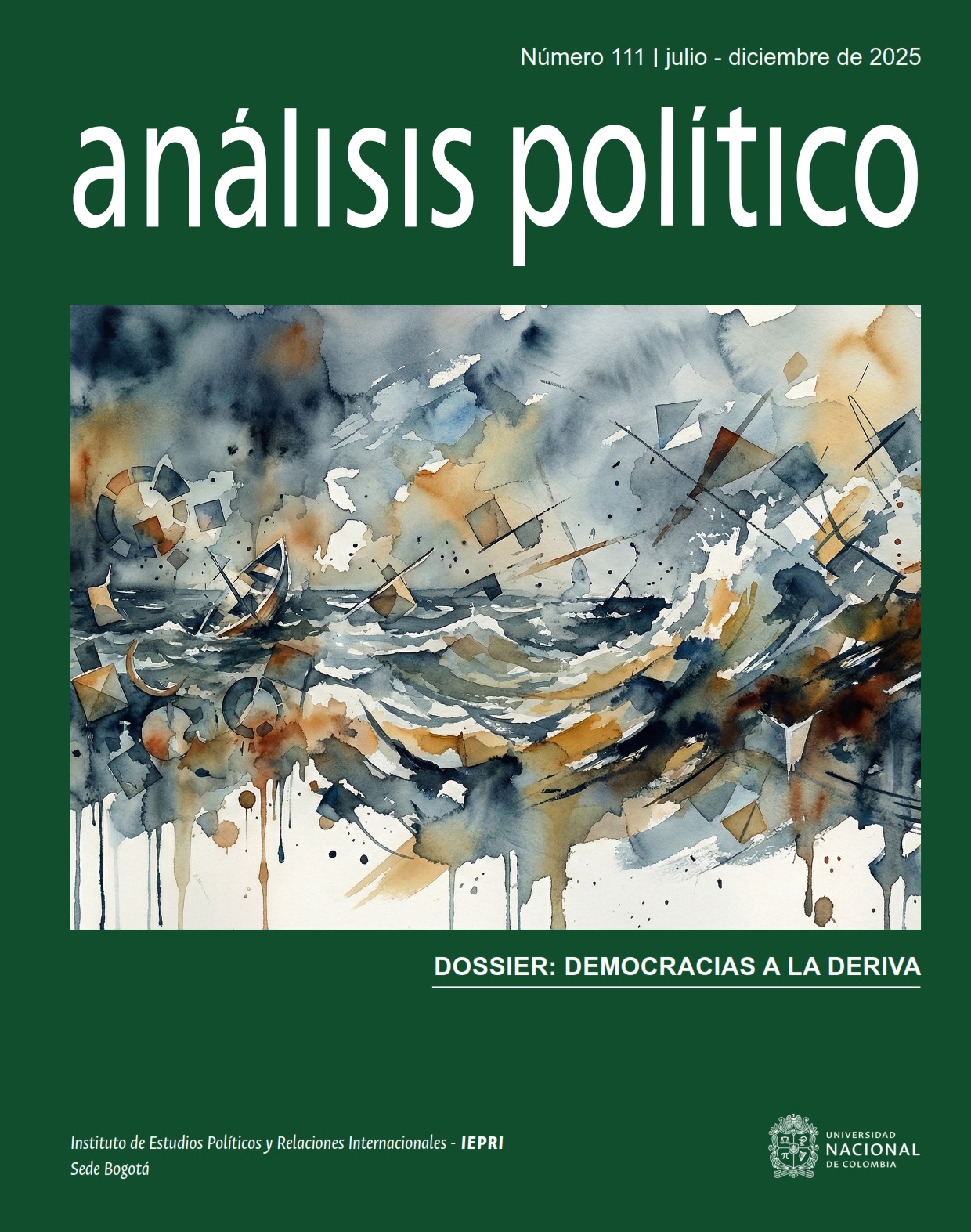
En menos de una década, Colombia ha experimentado un proceso de desalineamiento y posterior realineamiento político. Durante años, las identidades políticas se estructuraron en torno al conflicto armado: la izquierda asociada a la negociación y la derecha a la mano dura. La paz de 2016 desactivó de forma abrupta este eje, y los votantes reorientaron sus prioridades hacia la economía y la redistribución, mientras los partidos permanecieron anclados al clivaje del conflicto. El vacío de representación resultante abrió espacio en 2022 para un candidato anti-establishment que introdujo la redistribución como eje central. Tres años después, se observa un realineamiento asimétrico: la izquierda se ha organizado programáticamente en torno a la redistribución, mientras la derecha carece de definición en este eje y se cohesiona en torno al rechazo a Gustavo Petro.
In less than a decade, Colombia has undergone a process of dealignment and subsequent political realignment. For years, political identities were structured around the armed conflict: the left associated with negotiation and the right with a hardline approach. The 2016 peace accord abruptly deactivated this axis, and voters reoriented their priorities toward the economy and redistribution, while the parties remained anchored to the conflict cleavage. The resulting representation gap opened space in 2022 for an anti-establishment candidate who placed redistribution at the center. Three years later, an asymmetric realignment is evident: the left has organized programmatically around redistribution, while the right lacks definition on this axis and coheres around opposition to Gustavo Petro.
Referencias
Albarracín, J., Gamboa, L., & Mainwaring, S. (2018). Deinstitutionalization without collapse: Colombia’s party system. In S. Mainwaring (Ed.), Party Systems in Latin America: Institutionalization, Decay, and Collapse (pp. 227–254). Cambridge University Press.
Barr, R. R. (2009). Populists, outsiders and anti-establishment politics. Party Politics, 15 (1), 29–48. https://doi.org/10.1177/1354068808097890
Barrenechea, R., & Otero-Bahamón, S. (2025). When voters leave: Demand-driven dealignment and populism in Colombia. Taiwan Journal of Democracy, 21(1), 97–122. https://www.tfd.org.tw/backend/upload/publish/quarterly/527734e644db99fad532277a5d297664.pdf
Barrenechea, R., Otero-Bahamón, S., Basset, Y., Zanotti, L., Botero, S., Camargo, G., Londoño, S., Sampayo, A. M., Franco-Cuervo, A. B., Cante Maldonado, F., Cárdenas, U. A., Fonseca, S.,
Bitar, S., Tolosa Bello, S. C., & Tolosa Bello, Y. J. (2023). Gustavo Petro y el triunfo de la izquierda en Colombia: análisis de las preferencias de voto en la primera vuelta presidencial de 2022. Colombia Internacional, 116, 103–132
Botero, F., Losada, R., & Wills-Otero, L. (2016). Sistema de partidos en Colombia (1974–2014): ¿La evolución hacia el multipartidismo? In F. Freidenberg (Ed.), Los sistemas de partidos de América Latina (1978–2015). Tomo 2: Cono Sur y Países Andinos (pp. 339–400). Instituto Nacional Electoral & Instituto de Investigaciones Jurídicas-UNAM.
Botero, S., & Otero-Bahamón, S. (2019, December 5). Colombia is having its largest wave of protests in recent decades. Why? The Washington Post. https://wapo.st/2s4uQ9C
Botero, S., Otero-Bahamón, S., & Londoño-Méndez, S. (2023). Colombia 2022: Del fin de la guerra al gobierno del cambio. Revista de Ciencia Política (Santiago), 43(2), 223–254. https://doi.org/10.4067/S0718-090X2023005000114
Carreras, M., Morgenstern, S., & Su, Y.-P. (2015). Refining the theory of partisan alignments: Evidence from Latin America. Party Politics, 21 (5), 671–685. https://doi.org/10.1177/1354068813491538
Castillo, M., & Jaramillo Jassir, M. (2023). Gustavo Petro vs. Rodolfo Hernández. ¿Dos populismos encontrados? Editorial Universidad del Rosario. https://doi.org/10.12804/urosario9789585001428
Dalton, R. J., Flanagan, S. C., & Beck, P. A. (Eds.). (1984). Electoral change in advanced industrial democracies: Realignment or dealignment? Princeton University Press.
Gamboa Gutiérrez, L. (2019). El reajuste de la derecha colombiana: El éxito electoral del uribismo. Colombia Internacional, 99, 187–214.
Grossmann, M., & Hopkins, D. A. (2016). Asymmetric politics: Ideological Republicans and group interest Democrats. Oxford University Press.
Iyengar, S., & Wagner, M. (2025). Conceptualizing affective polarization. In M. Torcal & E. Harteveld (Eds.), Handbook of Affective Polarization (pp. 21–33). Edward Elgar Publishing. https://doi.org/10.4337/9781035310609
Kessler, G., Vommaro, G., Rodríguez-Raga, J. C., & Calderón Herrera, J. A. (2024). La sociedad contra las élites: aproximación a las bases sociales del apoyo electoral a Petro en Colombia. Colombia Internacional, 117. https://doi.org/10.7440/colombiaint117.2024.01
Key, V. O., Jr. (1955). A theory of critical elections. The Journal of Politics, 17 (1), 3–18.
Lelkes, Y., & Sniderman, P. M. (2016). The ideological asymmetry of the American party system. British Journal of Political Science, 46 (4), 825–844.
Lupu, N. (2016). Party brands in crisis: Partisanship, brand dilution, and the breakdown of political parties in Latin America. Cambridge University Press.
Mudde, C. (2004). The populist zeitgeist. Government and Opposition, 39 (4), 541–563. https://doi.org/10.1111/j.1477-7053.2004.00135.x
Plata Caviedes, J. C., Ávila García, C. A., & García Sánchez, M. (2020). Colombia, un país en medio de la pandemia 2020: Democracia e instituciones. Observatorio de la Democracia, Universidad de los Andes. https://obsdemocracia.org/wp-content/uploads/2021/06/02_USAID_Democracia_2020.pdf
Roberts, K. M. (2015). Populism, political mobilizations, and crises of political representation. In C. de la Torre (Ed.), The Promise and Perils of Populism: Global Perspectives (pp. 140–158). University Press of Kentucky.
Roberts, K. M. (2021). Populism and polarization in comparative perspective: Constitutive, spatial, and institutional dimensions. Government and Opposition, 57(4), 680–702. https://doi.org/10.1017/gov.2021.14
Saffón Sanín, M. P., & Güiza Gómez, D. I. (2019). Colombia en 2018: entre el fracaso de la paz y el inicio de la política programática. Revista de Ciencia Política (Santiago), 39(2), 217–237. https://doi.org/10.4067/S0718-090X2019000200217
Slater, D., & Simmons, E. (2013). Coping by colluding: Political uncertainty and promiscuous powersharing in Indonesia and Bolivia. Comparative Political Studies, 46 (11), 1366–1393. https://doi.org/10.1177/0010414012453447
Wills-Otero, L. (2014). Colombia: Analyzing the strategies for political action of Álvaro Uribe’s government, 2002–10. In J. P. Luna & C. Rovira Kaltwasser (Eds.), The Resilience of the Latin American Right (pp. 194–215). Johns Hopkins University Press.
Weyland, K. (2001). Clarifying a contested concept: Populism in the study of Latin American politics. Comparative Politics, 34 (1), 1–22.
Dimensions
PlumX
Visitas a la página del resumen del artículo
Descargas
Cómo citar
Licencia
Derechos de autor 2026 Análisis Político

Esta obra está bajo una licencia internacional Creative Commons Reconocimiento-NoComercial-SinObraDerivada 3.0.
Todo el contenido de esta revista, excepto dónde está identificado, está bajo una Creative Commons license. Atribution-NonComercial-NonDerivs 3.0 Unported.
