Correo Electrónico
 DNINFOA - SIA
 Bibliotecas
 Convocatorias
 Identidad U.N.


Publicado
Análisis prospectivo de los bioinsumos agrícolas en Colombia: una consulta a expertos
Prospective analysis of agricultural bioinoculants in Colombia: an expert consultation
DOI:
https://doi.org/10.15446/rev.colomb.biote.v17n2.48472Palabras clave:
Método Delphi, bacterias promotoras de crecimiento vegetal (PGPR), agricultura ecológica, desarrollo sostenible, Delphi method, plant, growth, promoting bacteria (PGPB), organic farming, sustainable development (es)Título en ingles: Prospective analysis of agricultural bioinoculants in Colombia: an expert consultation
La productividad y sostenibilidad de la agricultura en Colombia pueden ser influidas positivamente a través del aprovechamiento de la biodiversidad para la producción de bioinsumos. Fueron analizados a mediano y largo plazo, los posibles escenarios futuros generados por las regulaciones que intervienen en el avance tecnológico de los bioinsumos, a través de la aplicación de una encuesta Delphi, con la participación de 23 expertos, teniendo en cuenta las tres dimensiones del desarrollo sostenible. Sobre la base de este estudio, se encontró que el 65% de los expertos consideran que el impacto de la innovación o el desarrollo tecnológico del uso de bioinsumos en la producción agrícola, tiene un alto impacto económico con un nivel de concordancia significativo (≥0.05). Adicionalmente, el 65% seleccionó como el mejor escenario, en el cual se den condiciones que promuevan mayor desarrollo, acceso y aplicación de los bioinsumos, de tal forma que se incremente el ritmo de incorporación de la tecnología por parte de los productores. En conclusión, más allá del nivel de desarrollo tecnológico, es necesario revisar los procesos legislativos para la comercialización de los bioinsumos, fue evidente que el éxito futuro de la industria de la producción de productos biológicos dependerá de la gestión de empresas innovadoras, la eficiente comercialización de los mismos, la educación y transferencia a los productores y el progreso de la investigación.
Productivity and sustainability of agriculture in Colombia can be influenced positively through the use of biodiversity for the production of bioinoculants. They were analyzed in the medium and long term, the future scenarios generated by the regulations involved in the technological advancement of bio-products through the application of a Delphi survey, with the participation of 23 experts in bio-products, taking into account the three dimensions sustainable development. Based on this study, it was found that 65% of the experts believe that the impact of innovation and technological development of the use of bio- products in agricultural production, has a high economic impact with a significant level of agreement (≥0.05). Additionally, 65% selected as the best scenario, in which conditions that promote greater development, access and application of bio-products, so that the rate of adoption of technology is increased by the producers to make. In conclusion, beyond the level of technological development is necessary to revise the legislative process for the marketing of bio-products, it was clear that the future success of the industry in the production of biological products depend on the management of innovative enterprises, efficient marketing thereof, education and transfer to producers and the progress of the investigation.
Key words: Delphi method, plant growth promoting bacteria (PGPB), organic farming, sustainable development.
DOI: https://doi.org/10.15446/rev.colomb.biote.v17n2.48472
ARTÍCULO DE REVISIÓN
Análisis prospectivo de los bioinsumos agrícolas en Colombia: una consulta a expertos
Prospective analysis of agricultural bioinoculants in Colombia: an expert consultation
Diana Corina Zambrano*, Ruth Rebeca Bonilla**, Laura Avellaneda***, Gregorio Zambrano****
* Microbióloga Industrial, M.Sc., cPh.D., Doctorado en Ciencias Naturales para el Desarrollo -Instituto Tecnológico de Costa Rica. Cartago, Costa Rica. corina_zambrano@yahoo.es.
** Licenciada en Biología y Química, M.Sc., Ph.D., Directora Laboratorio de Suelos, Corporación Colombiana de Investigación Agropecuaria - CORPOICA. Mosquera, Cundinamarca, Colombia. rbonilla@corpoica.org.co.
*** M.Sc en Ciencias Biológicas - Área Microbiología, Investigadora Master, Corporación Colombiana de Investigación Agropecuaria - CORPOICA. Mosquera, Cundinamarca, Colombia. lavellaneda@corpoica.org.co.
**** Economista, estudiante Maestría en Economía. Profesional de Apoyo Planeación estratégica, Corporación Colombiana de Investigación Agropecuaria - CORPOICA. Mosquera, Cundinamarca, Colombia. gzambrano@corpoica.org.co
Recibido: febrero 26 de 2015 Aprobado: septiembre 28 de 2015
Resumen
La productividad y sostenibilidad de la agricultura en Colombia pueden ser influidas positivamente a través del aprovechamiento de la biodiversidad para la producción de bioinsumos. Fueron analizados a mediano y largo plazo, los posibles escenarios futuros generados por las regulaciones que intervienen en el avance tecnológico de los bioinsumos, a través de la aplicación de una encuesta Delphi, con la participación de 23 expertos, teniendo en cuenta las tres dimensiones del desarrollo sostenible. Sobre la base de este estudio, se encontró que el 65% de los expertos consideran que el impacto de la innovación o el desarrollo tecnológico del uso de bioinsumos en la producción agrícola, tiene un alto impacto económico con un nivel de concordancia significativo (≥0.05). Adicionalmente, el 65% seleccionó como el mejor escenario, en el cual se den condiciones que promuevan mayor desarrollo, acceso y aplicación de los bioinsumos, de tal forma que se incremente el ritmo de incorporación de la tecnología por parte de los productores. En conclusión, más allá del nivel de desarrollo tecnológico, es necesario revisar los procesos legislativos para la comercialización de los bioinsumos, fue evidente que el éxito futuro de la industria de la producción de productos biológicos dependerá de la gestión de empresas innovadoras, la eficiente comercialización de los mismos, la educación y transferencia a los productores y el progreso de la investigación.
Palabras clave: método Delphi, bacterias promotoras de crecimiento vegetal (PGPR), agricultura ecológica, desarrollo sostenible.
Abstract
Productivity and sustainability of agriculture in Colombia can be influenced positively through the use of biodiversity for the production of bioinoculants. They were analyzed in the medium and long term, the future scenarios generated by the regulations involved in the technological advancement of bio-products through the application of a Delphi survey, with the participation of 23 experts in bio-products, taking into account the three dimensions sustainable development. Based on this study, it was found that 65% of the experts believe that the impact of innovation and technological development of the use of bio- products in agricultural production, has a high economic impact with a significant level of agreement (≥0.05). Additionally, 65% selected as the best scenario, in which conditions that promote greater development, access and application of bio-products, so that the rate of adoption of technology is increased by the producers to make. In conclusion, beyond the level of technological development is necessary to revise the legislative process for the marketing of bio-products, it was clear that the future success of the industry in the production of biological products depend on the management of innovative enterprises, efficient marketing thereof, education and transfer to producers and the progress of the investigation.
Key words: Delphi method, plant growth promoting bacteria (PGPB), organic farming, sustainable development.
Introducción
La biodiversidad se refiere a la variedad de formas vivas: animales, plantas y microorganismos diferentes; los genes que contienen y los ecosistemas de los cuales hacen parte. (Department of the Environment, Sport and Territories, 1999). Según Rangel (2005) Colombia, es uno de los dos países con mayor expresión de la diversidad biológica en todos los niveles en que esta condición se expresa alfa (especies), beta (comunidades vegetales o tipos de vegetación) y gama (ecosistemas). La biodiversidad de Colombia es más grande que otros países tropicales como Brasil y Costa Rica (Bueno et al., 2011).
La agrobiodiversidad es un sub-conjunto vital de la biodiversidad (FAO, 2004a) que comprende la variedad y variabilidad de animales, plantas y microorganismos que son importantes para la alimentación y la agricultura; derivada de la interacción entre el ambiente, los recursos genéticos y los sistemas de manejo, incluyendo las prácticas utilizadas por los productores (Ocampo, 2012). Se ha señalado que la gran diversidad de cultivos, sistemas de producción, microorganismos, especies de animales y razas es una medida de la importancia de la biodiversidad para la agricultura (Kumar et al., 2013), por lo tanto, Lobo (2008) menciona que la agrobiodiversidad es un bien estratégico de gran importancia para el desarrollo de los países megadiversos.
La diversidad de microorganismos es menos conocida que la de los recursos fito y zoo genéticos, sin embargo, representa un recurso genético de alta importancia en la agricultura (Lobo, 2008). La productividad agrícola y la sostenibilidad se benefician de los microorganismos en diversas formas. Por ejemplo, los biofertilizantes son inoculantes microbianos que pueden promover crecimiento de las plantas e incrementar su productividad, estos beneficios han sido reportados ampliamente con actividades como la fijación del nitrógeno atmosférico en gramíneas y cereales (Collino et al., 2015), así como, la mejora en la absorción de nutrientes (Bashan et al., 2014). Existen respuestas positivas a la inoculación de bacterias promotoras de crecimiento vegetal (PGPR) en diferentes cultivos, tales como palma aceitera (Adiprasetyo et al., 2014), coco y plátano (Mia et al., 2007; Mía et al., 2010). Recientemente, Fahad et al., (2015a) mencionan que las PGPR son capaces de sintetizar fitohormonas que estimulan el crecimiento y la división celular, ayudando a que las plantas toleren las condiciones de estrés ambiental, este efecto ha sido reportado en girasol (Wagas et al., 2015), plantas ornamentales (Stetsenko et al., 2015) y maíz (Fahad et al., 2015b), entre otros.
También se han reportado una amplia gama de microorganismos que realizan el control biológico de insectos, plagas y malezas y de otros microorganismos asociados a los vegetales que contribuyen con factores de crecimiento o a los mecanismos de defensa de éstos contra los ataques de insectos y enfermedades (Tilman et al., 2002), con amplia difusión y empleo de Bacillus thuringiensis, el cual ha sido aplicado durante más de 50 años para el control de plagas causadas por lepidópteros (Ruan et al., 2015). Según Lobo (2008) se sabe que más del 25% de las pérdidas agrícolas son causadas por plagas y que más del 90% son controlados por enemigos naturales que viven en áreas adyacentes a los cultivos; en este contexto, se estima que la sustitución de pesticidas por controladores naturales representa $54 billones de dólares por año en Estados Unidos.
Otro de los usos de los bioinsumos se fundamenta en la interacción de las plantas con los hongos micorrízicos arbusculares (HMA) los cuales representan un grupo de microorganismos edáficos que establecen simbiosis con las plantas influyendo positivamente en su crecimiento y desarrollo (Mujica et al., 2014), estos microorganismos forman un micelio extrarradical que permite una transferencia recíproca de carbono a partir del hospedante y nutrientes tomados del suelo (Leake et al., 2004) y entre las plantas unidas por la red micelial (Camargo-Ricalde et al., 2012). Según Mujica et al., (2014) la utilización de estos microorganismos resulta factible para cualquier sistema de producción agrícola debido a las funciones que realizan una vez que se asocian con las plantas, tales como, el incremento en la absorción de nutrientes y agua por medio del aumento en el volumen de suelo explorado, mayor resistencia a las toxinas, incremento de la traslocación y solubilización de elementos esenciales, protección contra patógenos radicales, el aumento de la tolerancia ante condiciones abióticas adversas (Smith y Read, 2008) y la estabilización de agregados en el suelo producto de la secreción de una glicoproteína recalcitrante, conocida como glomalina (Helgason et al., 2010).
En Colombia, la participación en los costos de producción asociados a fertilización y a control de plagas, enfermedades y malezas, difiere dependiendo de factores como: producto, zona geográfica y tamaño de la explotación (Perfetti et al., 2012). De esta manera, la participación de costos de producción asociados a fertilización representó en 2011 el 4,5% para los claveles y el 42% para cultivos de palma en el Meta. El control de malezas ascendió al 2.9% de los costos de un cultivo de café en la zona sur y un máximo de 12,4% para cultivos de palma en el Meta. El control de plagas correspondió al 0,9% de los costos de la producción de arroz en el Tolima y el 14.7% para el cultivo de palma en el Magdalena. El control de enfermedades ascendió a 1.6% de los costos de un cultivo de papa en Nariño y al 22.8% de un cultivo de palma en Santander (Sánchez et al., 2013).
Así mismo, el manejo inadecuado del suelo por el uso de insumos de síntesis química ha generado un problema global, causando agotamiento de la nutrición en el suelo y acidificación del suelo. Estos efectos adversos han conllevado a reducciones en la productividad de los cultivos (Hungría y Vargas, 2000), complementario a que la eficiencia en el uso de productos químicos es muy baja y la mayor parte del insumo aplicado es desperdiciado, debido a que no es absorbido por las plantas (Robertson y Vitousek, 2009). Por lo tanto, existe una necesidad inmediata de reducir el uso de productos de síntesis química al complementar y optimizar la fertilización con productos biológicos. La gran diversidad de microorganismos benéficos ofrece numerosas oportunidades, según recomiendan Marimuthu et al. (2013) el uso de bacterias es conveniente y puede ser directamente aplicado a las semillas o al suelo.
Según Lobo (2008) el empleo sostenible de la diversidad debe vincularse a procesos biotecnológicos para hacerlo más eficiente. Una de las posibilidades es explorar las reservas microbiológicas nativas, debido a que ofrecen un potencial para desarrollar tecnologías alternativas para los pequeños agricultores, quienes demandan tecnologías accesibles que no representen un riesgo para el ecosistema y/o la salud. La producción de bioinsumos y extractos vegetales en Colombia ha desarrollado en los últimos años un nicho de mercado dentro del sector agropecuario nacional. En el 2008, se encontraban 71 empresas registradas y avaladas por el Instituto Colombiano Agropecuario –ICA (Zambrano y Riaño, 2008), según estos mismos autores el mercado de los bioinsumos en Colombia es nuevo y poco a poco ha venido ganando una mayor receptividad tanto por agentes interesados en su producción, como por aquellos que los requieren como insumo para sus cultivos.
En el 2010 Chaparro et al., analizaron el panorama actual sobre el acceso a recursos genéticos y biológicos en los proyectos desarrollados por los grupos registrados ante Colciencias, encontrando que casi en su totalidad desarrollan productos que en su mayoría constituyen investigación básica (99%) y que difícilmente pueden tener una utilidad comercial (1%). Tal como fue señalado por Cabrera y López (2008), la falta de indicadores para separar la investigación básica de la investigación con posibilidades de uso comercial es un problema persistente y frecuente en los diversos regímenes de acceso a recurso genético. Las dificultades para la operación del sistema de acceso han tenido como consecuencia que parte sustancial de la investigación sobre la diversidad biológica y genética del país se desarrolle por fuera del marco jurídico (Nemogá, 2010).
Según Duarte y Velho (2008) es importante tener en cuenta que Colombia posee uno de los marcos jurídicos y legales más complejos a nivel mundial, que ha dificultado la posibilidad de avanzar en trabajos científicos tanto en alianza entre universidades o centros de investigación, así como, en alianzas entre lo científico y lo empresarial. Además, mencionan Duarte y Velho (2009) que como país biodiverso ha venido incrementando las capacidades endógenas de sus grupos de investigación científica y tecnológica para adelantar procesos de bioprospección, pero estos esfuerzos no se han podido expresar de una forma plena ya que el marco legal que regula la exploración y explotación de la biodiversidad colombiana está limitando de una manera muy restrictiva el avance de alianzas y articulaciones.
El uso de escenarios para estudiar el futuro, permite hacer un acercamiento a situaciones que pueden dar lugar a cambios importantes y la creación de relaciones explícitas entre los eventos que no se pueden relacionar fácilmente (Bañuls y Turoff, 2011), es así, como el impacto a largo o mediano plazo de las regulaciones o políticas nuevas o cambiantes, utilizando acontecimientos de naturaleza binaria, pueden analizarse de manera prospectiva. Por lo tanto, el objetivo central de este trabajo fue desarrollar un análisis prospectivo de los bioinsumos de uso agrícola en Colombia a través de la metodología de consulta con expertos, teniendo en cuenta las tres dimensiones del desarrollo sostenible para la construcción del instrumento de captura de la información.
Materiales y métodos
El estudio prospectivo se realizó utilizando el método Delphi (Listone y Turoff, 2002), con el fin de elaborar pronósticos a mediano y largo plazo, a través del uso sistemático del juicio intuitivo de un grupo de expertos para obtener un consenso de opiniones informadas.
Elección de expertos
Para identificar a los expertos se desarrolló una búsqueda en la base de datos Plataforma ScienTI de Colciencias, esta base de datos tenía un total de 4189 personas reconocidas por Colciencias como pares. Se realizó un primer filtro por área del conocimiento "Ciencias Agrarias", área "Agronomía", encontrando un total de 180 personas registradas; seguidamentese realizó un segundo filtro por área del conocimiento "Ciencias Biológicas", área "Microbiología", encontrando un total de 310 personas. Sus curriculum vitae fueron revisados confirmando que tuvieran trabajos desarrollados en el tema de bioinsumos, obteniendo una base de 90 expertos potenciales.
Al grupo de 90 expertos fue enviada la autoevaluación de sus competencias utilizando el Software SurveyMonkey® (http://www.surveymonkey.com). La competencia de los potenciales expertos se determinó a través del coeficiente de competencia, el cual debía ser superior a 0.80 para ser tenido en cuenta como experto. La competencia se determina por un coeficiente K = ½ (Kc + Ka), donde Kc representa una medida del nivel de conocimientos sobre el tema investigado y Ka una medida de las fuentes de argumentación (Cruz y Martínez, 2012). Así, si 0.8 < K < 1.0 el coeficiente de competencia es alto y si 0.7 < K < 0.8 el coeficiente de competencia es medio.
El cálculo de Kc se realizó a partir de la autoevaluación del candidato a experto determinando el nivel de conocimientos que consideraba poseer en una escala del 0 al 10, el valor seleccionado por el candidato se dividió por 10 para normalizar los datos. El promedio de las respuestas se multiplicó por 0.1; de esta forma, la evaluación "0" indica que el experto no tiene ningún conocimiento, mientras que la evaluación 10 significa que el experto tiene pleno conocimiento de la problemática tratada.
La autoevaluación de los conocimientos de los expertos de la variable Kc se realizó calificando los siguientes criterios: a) Mejora de la producción, control de calidad y procesos agroindustriales, nuevos bioinsumos y biotecnologías para el medio ambiente. b) Percepción pública de la biotecnología, bioseguridad, aspectos legales, sociales y económicos de la biotecnología. c) Innovación y desarrollo biotecnológico y d) Políticas públicas en bioinsumos.
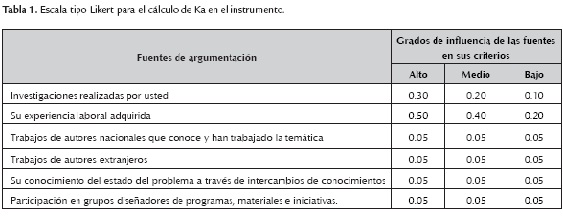
El cálculo de la variable Ka se realizó a partir de la autoevaluación de los posibles expertos, de acuerdo a seis posibles fuentes de argumentación en una escala tipo Likert expuestos en la tabla 1 (Cruz y Martínez, 2012). Cada uno tuvo que seleccionar según su criterio si era alto, medio o bajo y a cada criterio se le asignó un valor. En el instrumento de captura de la información en el momento de la respuesta. no fueron visibles los valores.
Elaboración y lanzamiento de los cuestionarios
El cuestionario de consulta a los expertos se compuso por 30 preguntas agrupadas en 3 módulos. Luego de diseñadas las preguntas por los autores el formulario fue validado con 3 especialistas externos antes de ser enviados a los expertos. Fue desarrollado teniendo en cuenta las tres dimensiones del desarrollo sostenible involucrando consideraciones ambientales, económicas y sociales (Hodson y Díaz, 2013). En la tabla 2 se resumen estos criterios.
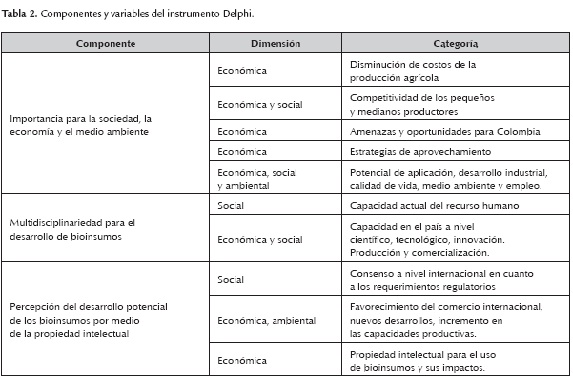
Sobre la base de las dimensiones anteriores se diseñó un instrumento en el cual se desglosaron en un total de 26 preguntas, para que fueran valorados en bajo, alto y medio.
En la construcción de escenarios en la escala se les planteó la opción de elección de alguno de los dos escenarios: 1) La tendencia y el ritmo actual de incorporación de bioinsumos en la producción agrícola se mantiene como hasta el momento; y 2) Se dan condiciones que habilitan a un mayor desarrollo, acceso y aplicación de los bioinsumos, de forma tal que se incrementa el ritmo de incorporación a los sistemas de producción agrícola. 1= Muy improbable, 2= Improbable, 3= Existe duda, 4= Probable y 5= Muy probable, de acuerdo a la experiencia y conocimiento de los expertos.
Los expertos fueron encuestados de manera aislada y sus opiniones fueron recogidas por vía electrónica y de forma anónima utilizando el Software SurveyMonkey®, con esto se trató de eliminar el efecto de los líderes.
Desarrollo práctico y análisis de resultados
El análisis de la información se realizó utilizando el software SPSS 21,0, para el cálculo del Coeficiente de concordancia de Kendall (W de Kendall) que representa el nivel de consenso entre los participantes (Schmidt, 1997; Schmidt et al., 2001). Este coeficiente varía entre 0 y 1, indicando el grado de consenso alcanzado por el panel (fuerte consenso para W> 0,7, consenso moderado para W = 0,5 y débil consenso para W <0,3) (Schmidt et al., 2001).
Schmidt (1997) propuso dos criterios estadísticos para tomar decisiones sobre cómo suspender o continuar las rondas Delphi. El primer criterio es un fuerte consenso entre los miembros del panel que se determina con base en el coeficiente de concordancia de Kendall. Si hay un acuerdo tal, el proceso de la encuesta debe ser detenido (Habibi et al., 2014); por lo tanto, solo se realizó una sola ronda en este estudio.
Resultados y discusión
Elección de expertos
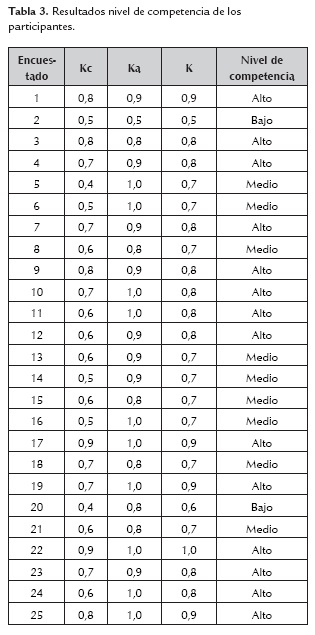
La autoevaluación de expertos fue enviada a 90 personas y respondida por 25 personas, de los cuales 23 fueron clasificados como expertos de acuerdo a los coeficientes K superiores a 0.7. En la tabla 3 se presenta el cálculo de la competencia de cada participante, donde se pudo identificar que el 56% de los expertos tenían competencia alta, el 36% de los expertos poseían competencia media y el 8% poseía competencia baja. Las respuestas de los expertos con nivel de competencia bajo no fueron tenidas en cuenta en el análisis.
Elaboración y lanzamiento de los cuestionarios
La encuesta fue respondida en su totalidad por los 23 expertos que se encontraban en rango medio y alto en el valor de K. El cálculo del coeficiente de Kendall reveló una consenso moderado W = 0,45, lo cual es comprensible al observar que el número de expertos es casi la mitad del número de ítems. No obstante, el resultado fue significativo (X² = 65,22; p ≥ 0,05).
Importancia para la sociedad, la economía y el medio ambiente
Los expertos consideraron que los bioinsumos son importantes para disminuir los costos de la producción agrícola, tal como fue mencionado por Herridge et al. (2008) quienes estimaron en Vietnam que el costo anual de la fertilización nitrogenada se reduciría de USD $30 a USD $1 millón por año si los fertilizantes químicos fueran reemplazados por inoculantes.
Según Shankar et al. (2011) la baja eficiencia de la producción agrícola está estrechamente relacionado con la pobre conversión energética que, a su vez, está influida por los factores fisiológicos del cultivo, el medio ambiente y otros factores biológicos, incluyendo los microorganismos del suelo. El suelo y la microflora rizosférica pueden acelerar el crecimiento de las plantas y mejorar su resistencia a patógenos e insectos mediante la producción de metabolitos bioactivos. Los expertos consideran altamente probable que los bioinsumos mejoren la competitividad de los pequeños y medianos productores agrícolas.
La opinión de los expertos con un nivel de concordancia significativa (≥0,05) en los criterios calificados sobre el impacto de la innovación o el desarrollo tecnológico del uso de bioinsumos en la producción agrícola, muestra que el 65% considera que tiene un potencial alto, el 31% medio y un 4% bajo en el impacto económico. El potencial alto de impactar la producción agrícola ha sido mencionado por Herrmann y Lesueur (2013), quienes resaltan que especialmente los biofertilizantes pueden tener importancia económica debido a que reemplazan parcialmente a los fertilizantes de síntesis química, los cuales son cada vez más costosos. Además, otros autores como Shankar et al. (2011) mencionaron que existe un creciente consenso a nivel mundial, acerca de la factibilidad de obtener el máximo rendimiento agronómico con utilidades netas más altas sin el uso de fertilizantes artificiales, herbicidas, insecticidas y pesticidas.
Montoya (2010) mencionó que la biotecnología y las ciencias de la vida son las más prometedoras para abordar problemas complejos, por su capacidad de desarrollar productos para varios sectores de la economía de manera sostenible y eco-innovadora. El 52% de los expertos consideran que el potencial de desarrollo de bioinsumos a nivel industrial es alto, el 39% medio y el 9% bajo; la percepción podría explicarse por las dificultades que deben superar las pequeñas y medianas empresas de biotecnología, por tener un alto coeficiente de capital y largos tiempos para la rentabilidad; basados en lo reportado por Montoya (2010).
Los expertos consideran que los insumos podrían convertirse en una herramienta útil para incrementar la competitividad de la agroindustria, el 78% considera que es alto, el 18% medio y 4% bajo, esto ha sido ampliamente soportado por autores que mencionan que las PGPRs en cultivos de leguminosas que fijan el nitrógeno tales como maní, frijol y soja pueden generar el ahorro entre 20 – 40% de nitrógeno químico, logrando la fijación de 50-300 kg de nitrógeno al suelo y disminuyendo aproximadamente entre 55 a 220 kg de urea por hectárea (Gomare et al., 2013). Sin embargo, pese a los beneficios reportados, estudios recientes muestran que hay una actividad inventiva muy baja y escaso impacto industrial en los desarrollos relacionados con cultivos relevantes para el Colombia, tales como la caña de azúcar y el café (Silva et al., 2014).
El 70% de los expertos considera que el impacto en la calidad de vida de los productores es alto, el 22% medio y el 8% bajo. Se observó que este mejoramiento posiblemente pudo ser visto como la disminución de los costos de producción, que generan, al mismo tiempo el incremento en los ingresos percibidos por el productor, esto es coincidente con lo reportado por Khalid (2012) quien menciona que el uso de bioinsumos es más económico que el de insumos de síntesis química, por lo tanto, mejoran los ingresos de los agricultores y su uso es más seguro para la salud de ellos y de los consumidores (Khalid 2004).
El uso de fertilizantes inorgánicos, en particular nitrógeno y fósforo, ha sido relacionado con la eutrofización de los cuerpos de agua, además, la evidencia es fuerte con respecto a la disminución de la biodiversidad en los sistemas agrícolas y sistemas semi-naturales y naturales por el uso de abonos inorgánicos, herbicidas y pesticidas en la agricultura . Existen varios reportes sobre la resistencia adquirida a productos químicos, utilizados para control de malezas y plagas (Andrews et al., 2010). Este contexto está de acuerdo con la opinión de los expertos quienes manifestaron que la incorporación de bioinsumos tiene sobre el medio ambiente un impacto alto el 79%, medio el 17% y bajo el 4%, debido a la amplia contribución de los microorganismos del suelo a la sostenibilidad de los ecosistemas, actuando como los agentes principales de conducción del ciclado de nutrientes, la regulación y dinámica de la materia orgánica del suelo, la inmovilización de carbono en el suelo y la emisión de gases efecto invernadero. Debido a los efectos de los microrganismos en el suelo se logra modificar su estructura física y regímenes de agua, la mejora de la eficiencia de la absorción de nutrientes y la salud de las plantas (Shankar et al., 2011).
Los expertos consideran que en el empleo el uso de bioinsumos tiene un impacto del 48% alto, 43% medio y 8% bajo. Estos resultados son consistentes con lo reportado por Montoya (2010) en la empresa Biocultivos S.A, empresa de base tecnológica integrada por la Universidad Nacional de Colombia y el gremio de cultivadores de arroz, se crearon 24 puestos de trabajo altamente calificados y 15 técnicos.
Multidisciplinariedad para el desarrollo de bioinsumos
A los expertos se les solicitó la valoración de si la capacidad actual de los profesionales colombianos es suficiente para el desarrollo de bioinsumos a nivel comercial, frente a esta pregunta respondieron el 35% que existe duda, 30% es probable y 35% muy probable; aunque no hubo un consenso entre los participantes, si se observó una tendencia a considerar que es apropiada la capacidad de los profesionales debido a que ninguno marcó las opciones de muy improbable e improbable que eran las calificaciones más bajas. Esto coincide con los resultados presentados por Duarte y Velho (2009), quienes mencionaron que los grupos dedicados a realizar bioprospección poseen recursos humanos capacitados para realizar investigación en áreas de conocimiento que son básicas para llevar a cabo dicho proceso, y que este proceso de formación académica refleja el producto de una política colombiana para capacitar recursos humanos a nivel de doctorado, tanto en universidades extranjeras como a través de los programas nacionales.
Las experiencias demuestran que a medida que el país proveedor de los recursos naturales posea más capacidad científica y tecnológica instalada, aprovechará de una mejor forma las potencialidades del desarrollo de los bioinsumos, a través de la bioprospección (Laird y Wynberg, 2002; Quezada, 2004). Por lo tanto, fue consultada la opinión de los expertos sobre la posición de Colombia con respecto a otros países quienes respondieron con un nivel débil de acuerdo a W=0,119 (no significativo ≤ 0,05), el primer criterio fue la capacidad científica y tecnológica calificada por los experos como alta en un 35%, media 52% y baja 13%; el segundo criterio fue la capacidad de innovación valorada como alta en un 22%, media en el 56% y baja en el 22%; el tercer criterio fue la capacidad de producción, que fue evaluada como alta por el 13%, media el 79% y baja el 17%; y por último, la capacidad de comercialización considerada en un 9% como alta, media en el 61% y baja por el 30%.
En términos generales los expertos consideraron que la capacidad científica y tecnológica se encuentra en un nivel medio; sin embargo, debe resaltarse la opinión de una baja capacidad de comercialización. Este mismo criterio fue mencionado en el 2001 por Castellanos et al., quienes plantearon la necesidad del surgimiento de un nuevo tipo de expertos, quienes además de ser especializados en ciencia y tecnología, deben lograr un entendimiento mayor del mundo de los negocios, de manera que los científicos puedan convertirse no sólo en generadores de conocimiento, sino también en interlocutores con capacidad de llegar a la industria para apoyar los procesos de selección, negociación, implantación o transferencia de tecnologías.
Percepción del desarrollo potencial de los bioinsumos por medio de la propiedad intelectual
La propiedad intelectual sobre los microorganismos, especialmente la patentabilidad, ha despertado el interés no sólo de los juristas, sino también de los científicos, debido a que las invenciones microbiológicas pueden ser de procedimiento o de producto, referidas a aquellos productos obtenidos con la intervención de microorganismos, los cuales pueden incluir materia inanimada (metabolitos) o animada (microorganismo) (Martínez, 2014). Los expertos fueron consultados sobre la probabilidad de alcanzar el consenso en los países sobre los requerimientos regulatorios, para la utilización de los bioinsumos en la producción agrícola, el 48% de los expertos estimaron que este consenso podrá ocurrir en el periodo 2020-2024.
La protección a través de mecanismos de propiedad intelectual de los bioinsumos permitirá que la producción y desarrollo, según el concepto de los expertos, aumentará mucho 52%, aumentara poco 26% y se mantendrá estable 22%. Según Gonzales et al. (2010), los derechos de propiedad intelectual tienen una gran importancia porque otorgan, además del reconocimiento a los creadores, la retribución económica que les corresponde por el desarrollo de los productos o los procesos.
El aumento de la protección de la propiedad intelectual de bioinsumos, podrá darse en Colombia según el 43% de los expertos si se revisa el sistema de propiedad intelectual, si se aumenta la capacidad de seguimiento y negociación de acuerdos comerciales según el 33% de los expertos, el 14% no sabe/no responde, por último, el 10% considera que Colombia deberá concientizar a los generadores de nuevas tecnologías de la necesidad de patentar sus innovaciones. Según Solleiro y Briceño (2003) la protección de la propiedad intelectual debe funcionar como motor de la innovación y no como obstáculo para el desarrollo nacional; sin embargo, la percepción de los expertos es que ha limitado el desarrollo de productos.
Tomando como horizonte el 2020, fue consultado a los expertos si la propiedad intelectual tendrá alguna clase de impacto en la capacidad de innovación biotecnológica en Colombia, y que impacto considera más factible. Los expertos manifestaron que tendrá un aumento importante de la capacidad de innovación en bioinsumos 43%, no tendrá impacto significativo en la capacidad de innovación en bioinsumos 26%, impactará en términos de una disminución de la capacidad de innovación en bioinsumos 13%, no sabe/no responde 4% y otro 13%. El aumento percibido en la opinión de los expertos puede ser atribuido a que una protección de la propiedad intelectual bien concebida alienta la actividad creativa, el desarrollo industrial, la inversión y el comercio honesto; sin embargo algunos autores como Granados et al. (2009) señalan que los regímenes de propiedad intelectual más enérgicos, puedan disminuir el ritmo general de la innovación e incrementar la diferencia de conocimientos entre países industrializados y países en vías de desarrollo.
Construcción de escenarios
El 35% (8/23) de los expertos seleccionó el escenario número 1, la tendencia y el ritmo actual de incorporación de bioinsumos en la producción agrícola se mantiene como hasta el momento; y el 65% (15/23) seleccionó el escenario número 2, se dan condiciones que habilitan a un mayor desarrollo, acceso y aplicación de los bioinsumos, de forma tal que se incrementa el ritmo de incorporación a los sistemas de producción agrícola.
Bajo el escenario 1 los expertos consideraron que en el 2020 será posible lograr 39 bioinsumos nuevos registrados ante el Instituto Colombiano Agropecuario (ICA) durante el año, a esto respondieron que existe duda en un 38%, y en el escenario 2 que existe duda con el 39%. En ambos escenarios se presenta un resultado similar, los expertos mencionaron que si se implementan políticas adecuadas de generación de empresas de base biotecnológica e investigación, 39 bioinsumos registrados/año es un número sensato si se considera la dinámica del sector agrícola y los grupos de investigación en Colombia.
Fue propuesta la proyección al 2029, plateando la posibilidad que se lograrán 87 bioinsumos nuevos registrados ante el ICA durante el año, el 50% de los expertos seleccionaron en el escenario 1 que existe duda y en el escenario 2 el 35% como probable. Estos resultados muestran que para alcanzar a mediano plazo un alto número de registros de nuevos bioinsumos se deben hacer cambios; es decir, así Colombia cuente con una alta biodiversidad que ha permitido aislar muchos organismos con potencial, la legislación colombiana tiende a afectar las iniciativas nacionales y por ende a incentivar actividades ilegales, el subregistro o incluso favorecer a empresas extranjeras. Según Nemogá (2010) básicamente ese potencial industrial que tiene la biodiversidad, no se puede aprovechar si no se cumplen requerimientos del marco jurídico institucional, incluso se pueden presentar problemas para publicar resultados de investigación o cuando se pretenden derechos de propiedad intelectual sobre tales resultados o innovaciones.
Frente a la pregunta si el sector productivo agrícola colombiano estará preparado para acompañar, absorber y aprovechar los avances científicos y tecnológicos nacionales e internacionales en bioinsumos, los expertos que seleccionaron el escenario 1 respondieron que es probable en un 50%, y en el escenario 2 respondieron que existe duda 52%. Estos resultados indican que es más fácil que el sector productivo incorpore estas tecnologías como parte de sus insumos manteniendo las condiciones actuales, posiblemente porque en el escenario 2 tendría que buscarse nuevos mercados debido al número mayor de productos. En cualquiera de los dos casos, es posible que los agricultores que adopten esta biotecnología, especialmente quienes lo hagan cuanto antes, consigan beneficios gracias a la reducción de costos y el aumento de la producción; los otros agricultores podrían verse en desventaja competitiva según evolucionen las preferencias de los consumidores y los regímenes reglamentarios (FAO, 2004b).
A los expertos se les consulto que si tuvieran en sus manos la toma de decisiones cuál sería su recomendación en cuanto a la estrategia para mejorar el estado actual del país en la producción de bioinsumos (W=0,337; X2=29,677; ≤0,05), teniendo en cuenta criterios como la colaboración con empresas extranjeras. Los resultados muestran que los expertos consideran que existe duda 35% en que la colaboración de empresas extranjeras pueda contribuir al desarrollo de la industria de bioinsumos en el país; la tendencia de esta respuesta era predecible de acuerdo a lo reportado por Martínez (2014) que menciona que en los países en desarrollo y en los emergentes se han generado inquietudes que han llevado a estar en contra de la apropiación y patentabilidad de genes por parte de corporaciones pertenecientes a Estados industrializados.
La incorporación de científicos y técnicos en las empresas podrá contribuir al desarrollo de la industria de los bioinsumos fue calificado por los expertos como muy improbable 9%, improbable 9%, existe duda 4%, probable 17% y muy probable 61%. El resultado de muy probable, es reafirmado por un informe de la Comisión Europea que menciona que la creación de un puesto de trabajo de investigador, puede generar a largo plazo hasta 400 empleos directos o indirectos, a pesar de esta afirmación, y del consenso generalizado de que la presencia de investigadores, y en concreto de doctores, es clave para fomentar la innovación tecnológica en las empresas, todavía para las empresas el doctor es una figura desconocida que desarrolla su actividad en el campo de la docencia y la investigación pública (Comunidad de Madrid, 2012).
Los expertos fueron consultados acerca de la contribución del Modelo de la Triple Hélice (Etzkowitz y Leydesdorff, 1995) y, si ellos recomendarían el fomento de la coordinación industria - centros de investigación y desarrollo tecnológico, su opinión fue que sería muy improbable 4%, improbable 0%, existe duda 4%, probable 13% y muy probable 78%. La respuesta de los expertos fue en un alto porcentaje muy probable;sin embargo, debe tenerse en cuenta aspectos como el que menciona Gutiérrez (2004) en un modelo en el que los actores se deben desenvolver como esferas en movimiento, cada una de las cuales puede desempeñar funciones de la otra esfera, no pueden ser estáticas y quedarse encasilladas, haciendo que el flujo de conocimiento pueda tener una dirección en un sentido inverso al tradicional, es decir, el conocimiento puede fluir de la industria privada a la academia, en un efecto interactivo en el cual la innovación tecnológica abre nuevas preguntas de investigación básica.
Los expertos consideran que ellos sugeririan el apoyo del gobierno como una recomendación en un 5% muy improbable, improbable 0%, existe duda 5%, probable 27% y muy probable 64%. Este último porcentaje muestra la relevancia y la necesidad de intervención del gobierno colombiano; en el 2011 se expidió el documento CONPES 3697 sobre políticas para el desarrollo comercial de la biotecnología a partir del uso sostenible de la biodiversidad. Este documento propone fortalecer las capacidades institucionales para el desarrollo comercial de la biotecnología, promoviendo el uso comercial, sostenible y productivo de los recursos biológicos, genéticos y sus derivados; la creación de instrumentos financieros para fortalecer empresas de base biotecnológica; adecuar y revisar el marco normativo relacionado con el acceso a los recursos genéticos y sus derivados; y ajustar y actualizar la normatividad sobre producción y comercialización de medicamentos biotecnológicos y productos fitoterapéuticos. El mismo documento CONPES reconoce las dificultades que ha tenido Colombia en la aplicación de la normatividad sobre Acceso a Recursos Genéticos y Productos Derivados, Decisión Andina 391, esto generó la reorganización y cambio en el del Ministerio de Ambiente y Desarrollo Sostenible frente a este tema (Buitrago, 2012).
La probabilidad de que los expertos recomienden la difusión de resultados según los expertos fue calificada como muy improbable 5%, improbable 5%, existe duda 0%, probable 36% y muy probable 55%. Los resultados muestran que la difusión de los resultados o su transferencia es de vital importancia, acorde con uno de los factores claves en el caso mexicano según Gutiérrez (2004), en el Sistema de Nacional de Innovación –SIN los gobiernos estatales, las empresas y la academia resultan ser los elementos fundamentales; pero no los únicos, incluyendo a las empresas, los sectores productivos en general, centros de investigación, el sistema financiero, universidades técnicas, organizaciones intermedias de apoyo a la actividad empresarial, proveedores de servicios, diseñadores de productos y consumidores. La producción y transferencia de conocimiento científico y tecnológico constituyen la materia esencial de intercambio, aprendizaje e interacción entre los actores.
Conclusiones
La prospectiva tecnológica es una herramienta que puede generar información de gran ayuda para los tomadores de decisiones públicos y privados, permiteconocer con más detalle los escenarios que pueden presentarse a mediano y a largo plazo en el desarrollo de la industria biotecnológica de los bioinsumos, que permitirá definir y concretar los objetivos de manera coherente y con menores niveles de riesgo e incertidumbre, basados en el criterio de expertos.
Los expertos consideraron que el escenario más probable y favorable para Colombia es que se den condiciones que habiliten un mayor desarrollo, acceso y aplicación de los bioinsumos, de forma tal que se incremente el ritmo de incorporación a los sistemas de producción agrícola, lo que indica que los avances hacia la empresarización de la producción de bioinsumos en Colombia deben ir más allá del desarrollo tecnológico. Es necesario revisar los procesos de promoción y apoyo a las empresas nacionales de base biotecnológica que permita el desarrollo sostenible a partir del uso de la biodiversidad. Es evidente que el éxito futuro de la industria de la producción de bioinsumos dependerá de la gestión de empresas innovadoras que tengan iniciativa de vincular investigadores, la eficiente comercialización de productos, la educación y transferencia de tecnología a los productores y al público en general.
Agradecimientos
Los autores agradecen a todos los participantes que colaboraron con el estudio Delphi, tanto a los especialistas que revisaron el instrumento de captura de la información, como a los expertos que contribuyeron con su criterio.
Referencias
Adiprasetyo, T., Purnomo, B., Handajaningsih, M., Hidayat. (2014). The Usage of BIOM3G-Biofertilizer to Improve and Support Sustainability of Land System of Independent Oil Palm Smallholders. International Journal on Advanced Science Engineering, 4(5), 43-46.
Andrews, M., Hodge, S., Raven, J. (2010). Positive plant microbial interactions. Annals of Applied Biology, 157, 317-320.
Bañuls, V., Turoff, M. (2011). Scenario construction via Delphi and cross-impact analysis. Technological Forecasting & Social Change, 78, 1579-1602.
Bashan, Y., de Bashan, L., Prabhu, S., Hernández, JP. (2014). Advances in plant growth-promoting bacterial inoculant technology: formulations and practical perspectives (1998-2013). Plant Soil, 378, 1-33.
Bueno, J., Coy, E., Stashenko, E. (2011). Antimycobacterial natural products – an opportunity for the Colombian biodiversity. Revista Española de Quimioterapia, 24 (4), 175-183.
Buitrago, G. (2012). Tres décadas de biotecnología en Colombia. Revista Colombiana de Biotecnología, 14(2), 5-6.
Cabrera, J., López, C. (2008). Enfrentando los problemas de acceso: protegiendo las fuentes, mientras que se brinda certeza a los usuarios. UICN Serie de Política y Derecho Ambiental, No. 67/1.
Camargo-Ricalde, S., Montaño, N., De la Rosa, C., Montaño, S. (2012). Micorrizas: Una gran unión debajo del suelo. Revista Digital Universitaria, 13(7), 3-19.
Castellanos, O., Ustate, E., de Peña, M. (2001). Fundamentos para una política nacional en Biotecnología. Revista Colombiana de Biotecnología, 3(2), 23-29.
Chaparro, G., Ávila, L., Blanco, J. (2010). Panorama actual sobre acceso a recursos genéticos y biológicos. La investigación sobre recursos biológicos y genéticos en el país: Grupos registrados en Colciencias. Colombia. 31p.
Comunidad de Madrid. (2012). Cuaderno de trabajo: la inserción laboral del doctor en la empresa. Fundación universidad-empresa Dg de universidades e investigación – Comunidad de Madrid. Disponible en Internet: http://www.madrimasd.org/empleo/documentos/doc/Debate_Integracion_Laboral_Doctor.pdf (Con acceso 9/01/2015).
Collino, D., Salvagiotti, F., Perticari, A., Piccinetti, C., Ovando, G., Urguiaga, S., Racca, R. (2015). Biological nitrogen fixation in soybean in Argentina: relationships with crop, soil and meteorological factors. Plant Soil, 392, 239-252.
Cruz, M., Martínez, M. (2012). Perfeccionamiento de un instrumento para la selección de expertos en las investigaciones educativas REDIE. Revista electrónica de investigación educativa, 14(2), 167-179.
Department of the Environment, Sport and Territories (DEST). (1998). Biodiversity and its value. Disponible en Internet: http://kaos.erin.gov.au/life/general_info/op1.html. (Con acceso 9/02/2015).
Duarte, O., Velho, L. (2008). Análisis del marco legal en Colombia para la implementación de prácticas de Bioprospección. Acta Biológica Colombiana, 13, 103-122.
Duarte, O., Velho, L. (2009). Capacidades científicas y tecnológicas de Colombia para adelantar prácticas de bioprospección. Revista Iberoamericana de Ciencia, Tecnología y Sociedad, 12(4), 55-68.
Etzkowitz, H., Leydesdorff, L. (1995). The Triple Helix University Industry Gobernment Relations: A laboratory for Knowledge based Economic Development. European Association for the Study of Science and Technology Review, 14, 14-19.
Fahad, S., Hussain, S., Bano, A., Saud, S., Hassan, S., Shan, D., Ahmed Khan, F., Khan, F., Chen, Y., Wu, C., Tabassum, M., Chun, M., Afzal, M., Jan, A., Jan, M., Huang, J. (2015a). Potential role of phytohormones and plant growth-promoting rhizobacteria in abiotic stresses: consequences for changing environment. Environmental Science and Pollution Research, 22, 4907-4921.
Fahad, S., Hussain, S., Matloob, A., Khan, F., Khaliq, A., Saud, S., Hassan, S., Shan, D., Khan, F., Ullah, N., Faiq, M., Khan, M., Tareen, A., Khan, A., Ullah, A., Ullah, N., Huang, J. (2015b). Phytohormones and plant responses to salinity stress: a review. Plant Growth Regulation, 75, 391-404.
FAO. Food and Agriculture Organization of the United Nations. (2004a). Building on Gender, Agrobiodiversity and Local Knowledge. 6p. Disponible en Internet: ftp://ftp.fao.org/docrep/fao/007/y5609e/y5609e00.pdf. (Con acceso 28/10/2014).
FAO. Food and Agriculture Organization of the United Nations. (2004b). El estado mundial de la agricultura y la alimentación 2003-2004. Disponible en Internet: http://www.fao.org/docrep/006/y5160s/y5160s00.htm (Con acceso 05/02/2015).
Gomare, K., Mese, M., Shetkar, Y. (2013). Isolation of Rhizobium and cost effective production of biofertilizer. Indian Journal of Life Sciences, 2(2), 49-53.
Gonzales, C., Villa, J., Bravo, J. (2010). La biotecnología como visión de empresa. Revista Biotecnología en el sector Agropecuario y Agroindustrial, 8(1), 83-92.
Granados, G., López, G., Hernández-García, M. (2009). Recursos genéticos, biotecnología y propiedad intelectual. Revista Chapingo, 15(2), 127-140.
Gutiérrez, N. (2004). La vinculación en el ámbito científico-técnico de México. Instituciones de educación superior en interacción con distintos actores. Revista Latinoamericana de Estudios Educativos, 34(2), 47-94.
Habibi, A., Sarafrazi, A., Izadayar, S. (2014). Delphi Technique Theoretical Framework in Qualitative Research. The International Journal of Engineering and Science, 3(4), 8-13.
Helgason, B., Walley, F., Germida, J. (2010). No-till soil management increases microbial biomass and alters community profiles in soil aggregates. Applied Soil Ecology, 46, 390-397.
Herridge, D., Peoples, M., Boddey, R. (2008). Global inputs of biological nitrogen fixation in agricultural systems. Plant Soil, 311, 1-18.
Herrmann, L., Lesueur, D. (2013). Challenges of formulation and quality of biofertilizers for successful inoculation. Applied Microbiology and Biotechnology, 97, 8859-8873.
Hodson de Jaramillo, E., Díaz-Ariza, L. (2013). Uso de bioinoculantes en la agricultura: Alternativa de manejo sostenible. En: Hodson de Jaramillo, E., Zamudio, T. Biotecnologías e Innovación: el compromiso social de la ciencia. Ed. Pontificia Universidad Javeriana. Bogotá, Colombia. 327p.
Hungria, M., Vargas. M. (2000). Environmental factors affecting N2 fixation in grain legumes in the tropics, with an emphasis on Brazil. Field Crops Research, 65(2-3), 151-164.
Khalid, K. (2004). Response of white mustard (Sinapis alba L.) plants to calcium superphosphate and phosphorene under calcareous soil conditions. Arab Universities Journal of Agricultural Sciences, 12(2), 735-747.
Khalid, K. (2012). Review: Biological fertilization and its effect on medicinal and aromatic plants. Nusantara Bioscience, 4(3), 124-133.
Kumar, T., Raj, K., Atique, K., McDonald, M. (2013). Exploring agrobiodiversity on farm: A case from middle-hills of Nepal. Small-scale Forestry, 12, 611-629.
Laird, S., Wynberg, R. (2002). "Institutional policies for biodiversity research". En: Sarah A. Laird (ed.): Biodiversity and Traditional Knowledge, Equitable Partnerships in Practice, Londres, Earthscan Publications Ltd, pp. 39-76.
Leake, J., Johnson, D., Donnelly, D., Muckle, G., Boddy, L., Read, D. (2004). Networks of power and influence: the role of mycorrhizal mycelium in controlling plant communities and agroecosystem functioning. Canadian Journal of Botany, 82(8), 1016-1045.
Listone, H., Turoff, M. (2002). The Delphi Method. Techniques and Applications. Disponible en Internet: http://is.njit.edu/pubs/delphibook/delphibook.pdf. (Con acceso 14/07/2015).
Lobo, M. (2008). Importancia de los recursos genéticos de la agrobiodiversidad en el desarrollo de sistemas de producción sostenibles. Ciencia y Tecnología Agropecuaria, 9(2), 19-30.
Marimuthu, S., Ramamoorthy, V., Samiyappan, R., Subbian, P. (2013). Intercropping system with combined application of Azospirillum and Pseudomonas fluorescens reduces root rot incidence caused by Rhizoctonia bataticola and increases seed cotton yield. Journal of Phytopathology, 161, 405-411.
Martínez, M. (2014). La patente biotecnológica y la OMC. Capitulo III La patentabilidad de los microorganismos y de los procedimientos no biológicos y microbiológicos. pp. 139-181. Ed. Marcial Pons. Madrid, España.
Mia, M., Shamsuddin, Z., Zakaria, W., Marziah, M. (2007). Associative nitrogen fixation by Azospirillum and Bacillus spp. in bananas. Infomusa, 16, 11-15.
Mia, M., Shamsuddin, Z., Mahmood, M. (2010). Use of plant growth promoting bacteria in banana: a new insight for sustainable banana production. International Journal of Agricultural and Biological, 12, 459-467.
Montoya, D. (2010). Avances en biotecnología: Panorama y perspectivas. En: Sánchez, G., Uribe, M. (2013). El desafío de generar tecnología en el siglo XXI. La propiedad intelectual en el devenir histórico de Colombia. Cátedra Manuel Ancízar. Universidad Nacional de Colombia, Bogotá. p. 181-201.
Mujica, Y., Mena, A., Medina, A., Rosales, P. (2014). Tomato (Solanum lycopersicum L.) plants response to liquid biofertilization with Glomus cubense. Cultivos Tropicales, 35(2), 21-26.
Nemogá, G. (2010). Biotecnología y el acceso a recursos genéticos. En: Sánchez, G.; Uribe, M. (eds.). (2013). El desafío de generar tecnología en el siglo XXI. La propiedad intelectual en el devenir histórico de Colombia. Cátedra Manuel Ancízar. Universidad Nacional de Colombia, Bogotá. p. 181-201.
Ocampo, D. (2012). Agrodiversidad: Conservación y uso como respuesta adaptativa al cambio climático. Éxito empresarial, 176, 1-3.
Perfetti, J., Escobar, D., Castro, F., Cuervo, B., Rodríguez, M., Vargas, J. (2012). Consultoría Sobre Costos de Producción de doce Productos Agropecuarios. Fedesarrollo e IQuartil. Bogotá. Disponible en Internet: http://www.agronet.gov.co/www/htm3b/public/boletines/COSTOS/IF%20Costos%20agropecuarios_2809.pdf. (Con acceso 21/07/2015).
Quezada, F. (2004). Posibilidades de la biotecnología para el uso sostenible de los recursos de biodiversidad en la región andina: recomendaciones y directrices estratégicas. Informe presentado a la Comisión Económica para América Latina y el Caribe (CEPAL), noviembre de 2003, Santiago de Chile.
Rangel, O. (2005). La diversidad de Colombia. Universidad Nacional de Colombia. pp. 292-304. Disponible en Internet: http://www.bdigital.unal.edu.co/14263/1/3-8083-PB.pdf. (Con acceso 14/07/2015).
Robertson, G., Vitousek, P. (2009). Nitrogen in agriculture: Balancing the cost of an essential resource. Annual Review of Environment and Resources, 34, 97-125.
Ruan, L., Crickmore, N., Peng, D., Sun, M. (2015). Are nematodes a missing link in the confounded ecology of the entomopathogen Bacillus thuringiensis?. Trends in Microbiology, 23(6), 341-346.
Sánchez, D., Lis, J., Campo, J., Herrera, J. (2013). Estudio sobre plaguicidas en Colombia. Estudios Económicos Sectoriales No. 7. Superintendencia de Industria y Comercio. Bogotá, Colombia.
Schmidt, R. (1997). Managing Delphi surveys using nonparametric statistical techniques. Decision Sciences, 28(3), 763-774.
Schmidt, R., Lyytinen, K., Keil, M., Cule, P. (2001). Identifying software project risks: An international Delphi study. Journal of Management Information Systems, 17(4), 5–36.
Shankar, S., Gaiha, R., Jha, R. (2011). Information, Access and Targeting: The National Rural Employment Guarantee Scheme in India. Oxford Development Studies, 39(1), 69-95.
Silva, L., Bermúdez, A., Castiblanco, D., Almario, F., Mojica, P., Cuéllar, S., Mediana, C., Tamayo, A. (2014). Tecnologías relacionadas con biofertilizantes. Banco de Patentes de Superintendencia de Industria y Comercio. 131p.
Smith, S., Read, D. (2008). Colonization of roots and anatomy of arbuscular mycorrhiza. En: Mycorrhizal Symbiosis. Academic Press: London. pp. 42-90.
Solleiro, J., Briceño, A. (2003). Propiedad intelectual II: El caso de la biotecnología en México. Interciencia, 28(2), 90-94.
Stetsenko, L., Vedenicheva, N., Likhnevsky, R., Kuznetsov, V. (2015). Influence of abscisic acid and fluridone on the content of phytohormones and polyamines and the level of oxidative stress in plants of Mesembryanthemum crystallinum L. under salinity. Biology bulletin, 42(2), 98-107.
Tilman, D., Cassman, K., Matson, P., Naylor, R., Polasky, S. (2002). Agricultural sustainability and intensive production practices. Nature, 418, 671-677.
Wagas, M., Khan, A., Hamayu, M., Shahzad, R., Kim, Y., Choi, K., Lee, I. (2015). Endophytic infection alleviates biotic stress in sunflower through regulation of defence hormones, antioxidants and functional amino acids. European Journal of Plant Pathology, 141(4), 803-824.
Zambrano, D., Riaño, P. (2008). Rentabilidad de las empresas productoras de bioinsumos registradas ante el Instituto Colombiano Agropecuario -ICA. Documentos Técnicos IICA. Bogotá, Colombia. 25p.
Referencias
Adiprasetyo, T., Purnomo, B., Handajaningsih, M., Hidayat. (2014). The Usage of BIOM3G-Biofertilizer to Improve and Support Sustainability of Land System of Independent Oil Palm Smallholders. International Journal on Advanced Science Engineering, 4(5), 43-46.
Andrews, M., Hodge, S., Raven, J. (2010). Positive plant microbial interactions. Annals of Applied Biology, 157, 317–320.
Bañuls, V., Turoff, M. (2011). Scenario construction via Delphi and cross-impact analysis. Technological Forecasting & Social Change, 78, 1579–1602.
Bashan, Y., de Bashan, L., Prabhu, S., Hernández, JP. (2014). Advances in plant growth-promoting bacterial inoculant technology: formulations and practical perspectives (1998–2013). Plant Soil, 378, 1–33.
Bueno, J., Coy, E., Stashenko, E. (2011). Antimycobacterial natural products – an opportunity for the Colombian biodiversity. Revista Española de Quimioterapia, 24 (4), 175-183.
Buitrago, G. (2012). Tres décadas de biotecnología en Colombia. Revista Colombiana de Biotecnología, 14(2), 5-6.
Cabrera, J., López, C. (2008). Enfrentando los problemas de acceso: protegiendo las fuentes, mientras que se brinda certeza a los usuarios. UICN Serie de Política y Derecho Ambiental, No. 67/1.
Camargo-Ricalde, S., Montaño, N., De la Rosa, C., Montaño, S. (2012). Micorrizas: Una gran unión debajo del suelo. Revista Digital Universitaria, 13(7), 3-19.
Castellanos, O., Ustate, E., de Peña, M. (2001). Fundamentos para una política nacional en Biotecnología. Revista Colombiana de Biotecnología, 3(2), 23-29.
Chaparro, G., Ávila, L., Blanco, J. (2010). Panorama actual sobre acceso a recursos genéticos y biológicos. La investigación sobre recursos biológicos y genéticos en el país: Grupos registrados en Colciencias. Colombia. 31p.
Comunidad de Madrid. (2012). Cuaderno de trabajo: la inserción laboral del doctor en la empresa. Fundación universidad-empresa Dg de universidades e investigación – Comunidad de Madrid. Disponible en Internet: http://www.madrimasd.org/empleo/documentos/doc/Debate_Integracion_Laboral_Doctor.pdf (Con acceso 9/01/2015).
Collino, D., Salvagiotti, F., Perticari, A., Piccinetti, C., Ovando, G., Urguiaga, S., Racca, R. (2015). Biological nitrogen fixation in soybean in Argentina: relationships with crop, soil and meteorological factors. Plant Soil, 392, 239–252.
Cruz, M., Martínez, M. (2012). Perfeccionamiento de un instrumento para la selección de expertos en las investigaciones educativas REDIE. Revista electrónica de investigación educativa, 14(2), 167-179.
Department of the Environment, Sport and Territories (DEST). (1998). Biodiversity and its value. Disponible en Internet: http: /kaos.erin.gov.au/life/general_info/op1.html. (Con acceso 9/02/2015).
Duarte, O., Velho, L. (2008). Análisis del marco legal en Colombia para la implementación de prácticas de Bioprospección. Acta Biológica Colombiana, 13, 103-122.
Duarte, O., Velho, L. (2009). Capacidades científicas y tecnológicas de Colombia para adelantar prácticas de bioprospección. Revista Iberoamericana de Ciencia, Tecnología y Sociedad, 12(4), 55-68.
Etzkowitz, H., Leydesdorff, L. (1995). The Triple Helix University Industry Gobernment Relations: A laboratory for Knowledge based Economic Development. European Association for the Study of Science and Technology Review, 14, 14-19.
Fahad, S., Hussain, S., Bano, A., Saud, S., Hassan, S., Shan, D., Ahmed Khan, F., Khan, F., Chen, Y., Wu, C., Tabassum, M., Chun, M., Afzal, M., Jan, A., Jan, M., Huang, J. (2015a). Potential role of phytohormones and plant growth-promoting rhizobacteria in abiotic stresses: consequences for changing environment. Environmental Science and Pollution Research, 22, 4907–4921.
Fahad, S., Hussain, S., Matloob, A., Khan, F., Khaliq, A., Saud, S., Hassan, S., Shan, D., Khan, F., Ullah, N., Faiq, M., Khan, M., Tareen, A., Khan, A., Ullah, A., Ullah, N., Huang, J. (2015b). Phytohormones and plant responses to salinity stress: a review. Plant Growth Regulation, 75, 391–404.
FAO. Food and Agriculture Organization of the United Nations. (2004a). Building on Gender, Agrobiodiversity and Local Knowledge. 6p. Disponible en Internet: ftp://ftp.fao.org/docrep/fao/007/y5609e/y5609e00.pdf. (Con acceso 28/10/2014).
FAO. Food and Agriculture Organization of the United Nations. (2004b). El estado mundial de la agricultura y la alimentación 2003-2004. Disponible en Internet: www.fao.org/docrep/006/y5160s/y5160s00.htm (Con acceso 05/02/2015).
Gomare, K., Mese, M., Shetkar, Y. (2013). Isolation of Rhizobium and cost effective production of biofertilizer. Indian Journal of Life Sciences, 2(2), 49-53.
Gonzales, C., Villa, J., Bravo, J. (2010). La biotecnología como visión de empresa. Revista Biotecnología en el sector Agropecuario y Agroindustrial, 8(1), 83-92.
Granados, G., López, G., Hernández-García, M. (2009). Recursos genéticos, biotecnología y propiedad intelectual. Revista Chapingo, 15(2), 127-140.
Gutiérrez, N. (2004). La vinculación en el ámbito científico-técnico de México. Instituciones de educación superior en interacción con distintos actores. Revista Latinoamericana de Estudios Educativos, 34(2), 47-94.
Habibi, A., Sarafrazi, A., Izadayar, S. (2014). Delphi Technique Theoretical Framework in Qualitative Research. The International Journal of Engineering and Science, 3(4), 8-13.
Helgason, B., Walley, F., Germida, J. (2010). No-till soil management increases microbial biomass and alters community profiles in soil aggregates. Applied Soil Ecology, 46, 390-397.
Herridge, D., Peoples, M., Boddey, R. (2008). Global inputs of biological nitrogen fixation in agricultural systems. Plant Soil, 311, 1–18.
Herrmann, L., Lesueur, D. (2013). Challenges of formulation and quality of biofertilizers for successful inoculation. Applied Microbiology and Biotechnology, 97, 8859–8873.
Hodson de Jaramillo, E., Díaz-Ariza, L. (2013). Uso de bioinoculantes en la agricultura: Alternativa de manejo sostenible. En: Hodson de Jaramillo, E., Zamudio, T. Biotecnologías e Innovación: el compromiso social de la ciencia. Ed. Pontificia Universidad Javeriana. Bogotá, Colombia. 327p.
Hungria, M., Vargas. M. (2000). Environmental factors affecting N2 fixation in grain legumes in the tropics, with an emphasis on Brazil. Field Crops Research, 65(2-3), 151-164.
Khalid, K. (2004). Response of white mustard (Sinapis alba L.) plants to calcium superphosphate and phosphorene under calcareous soil conditions. Arab Universities Journal of Agricultural Sciences, 12(2), 735-747.
Khalid, K. (2012). Review: Biological fertilization and its effect on medicinal and aromatic plants. Nusantara Bioscience, 4(3), 124-133.
Kumar, T., Raj, K., Atique, K., McDonald, M. (2013). Exploring agrobiodiversity on farm: A case from middle-hills of Nepal. Small-scale Forestry, 12, 611–629.
Laird, S., Wynberg, R. (2002). “Institutional policies for biodiversity research”. En: Sarah A. Laird (ed.): Biodiversity and Traditional Knowledge, Equitable Partnerships in Practice, Londres, Earthscan Publications Ltd, pp. 39-76.
Leake, J., Johnson, D., Donnelly, D., Muckle, G., Boddy, L., Read, D. (2004). Networks of power and influence: the role of mycorrhizal mycelium in controlling plant communities and agroecosystem functioning. Canadian Journal of Botany, 82(8), 1016-1045.
Listone, H., Turoff, M. (2002). The Delphi Method. Techniques and Applications. Disponible en Internet: http://is.njit.edu/pubs/delphibook/delphibook.pdf. (Con acceso 14/07/2015).
Lobo, M. (2008). Importancia de los recursos genéticos de la agrobiodiversidad en el desarrollo de sistemas de producción sostenibles. Ciencia y Tecnología Agropecuaria, 9(2), 19-30.
Marimuthu, S., Ramamoorthy, V., Samiyappan, R., Subbian, P. (2013). Intercropping system with combined application of Azospirillum and Pseudomonas fluorescens reduces root rot incidence caused by Rhizoctonia bataticola and increases seed cotton yield. Journal of Phytopathology, 161, 405– 411.
Martínez, M. (2014). La patente biotecnológica y la OMC. Capitulo III La patentabilidad de los microorganismos y de los procedimientos no biológicos y microbiológicos. pp. 139-181. Ed. Marcial Pons. Madrid, España.
Mia, M., Shamsuddin, Z., Zakaria, W., Marziah, M. (2007). Associative nitrogen fixation by Azospirillum and Bacillus spp. in bananas. Infomusa, 16, 11–15.
Mia, M., Shamsuddin, Z., Mahmood, M. (2010). Use of plant growth promoting bacteria in banana: a new insight for sustainable banana production. International Journal of Agricultural and Biological, 12, 459–467.
Montoya, D. (2010). Avances en biotecnología: Panorama y perspectivas. En: Sánchez, G., Uribe, M. (2013). El desafío de generar tecnología en el siglo XXI. La propiedad intelectual en el devenir histórico de Colombia. Cátedra Manuel Ancízar. Universidad Nacional de Colombia, Bogotá. p. 181-201.
Mujica, Y., Mena, A., Medina, A., Rosales, P. (2014). Tomato (Solanum lycopersicum L.) plants response to liquid biofertilization with Glomus cubense. Cultivos Tropicales, 35(2), 21-26.
Nemogá, G. (2010). Biotecnología y el acceso a recursos genéticos. En: Sánchez, G.; Uribe, M. (eds.). (2013). El desafío de generar tecnología en el siglo XXI. La propiedad intelectual en el devenir histórico de Colombia. Cátedra Manuel Ancízar. Universidad Nacional de Colombia, Bogotá. p. 181-201.
Ocampo, D. (2012). Agrodiversidad: Conservación y uso como respuesta adaptativa al cambio climático. Éxito empresarial, 176, 1-3.
Perfetti, J., Escobar, D., Castro, F., Cuervo, B., Rodríguez, M., Vargas, J. (2012). Consultoría Sobre Costos de Producción de doce Productos Agropecuarios. Fedesarrollo e IQuartil. Bogotá. Disponible en Internet: http://www.agronet.gov.co/www/htm3b/public/boletines/COSTOS/IF%20Costos%20agropecuarios_2809.pdf. (Con acceso 21/07/2015).
Quezada, F. (2004). Posibilidades de la biotecnología para el uso sostenible de los recursos de biodiversidad en la región andina: recomendaciones y directrices estratégicas. Informe presentado a la Comisión Económica para América Latina y el Caribe (CEPAL), noviembre de 2003, Santiago de Chile.
Rangel, O. (2005). La diversidad de Colombia. Universidad Nacional de Colombia. pp. 292-304. Disponible en Internet: http://www.bdigital.unal.edu.co/14263/1/3-8083-PB.pdf. (Con acceso 14/07/2015).
Robertson, G., Vitousek, P. (2009). Nitrogen in agriculture: Balancing the cost of an essential resource. Annual Review of Environment and Resources, 34, 97-125.
Ruan, L., Crickmore, N., Peng, D., Sun, M. (2015). Are nematodes a missing link in the confounded ecology of the entomopathogen Bacillus thuringiensis?. Trends in Microbiology, 23(6), 341-346.
Sánchez, D., Lis, J., Campo, J., Herrera, J. (2013). Estudio sobre plaguicidas en Colombia. Estudios Económicos Sectoriales No. 7. Superintendencia de Industria y Comercio. Bogotá, Colombia.
Schmidt, R. (1997). Managing Delphi surveys using nonparametric statistical techniques. Decision Sciences, 28(3), 763-774.
Schmidt, R., Lyytinen, K., Keil, M., Cule, P. (2001). Identifying software project risks: An international Delphi study. Journal of Management Information Systems, 17(4), 5–36.
Shankar, S., Gaiha, R., Jha, R. (2011). Information, Access and Targeting: The National Rural Employment Guarantee Scheme in India. Oxford Development Studies, 39(1), 69–95.
Silva, L., Bermúdez, A., Castiblanco, D., Almario, F., Mojica, P., Cuéllar, S., Mediana, C., Tamayo, A. (2014). Tecnologías relacionadas con biofertilizantes. Banco de Patentes de Superintendencia de Industria y Comercio. 131p.
Smith, S., Read, D. (2008). Colonization of roots and anatomy of arbuscular mycorrhiza. En: Mycorrhizal Symbiosis. Academic Press: London. pp. 42-90.
Solleiro, J., Briceño, A. (2003). Propiedad intelectual II: El caso de la biotecnología en México. Interciencia, 28(2), 90-94.
Stetsenko, L., Vedenicheva, N., Likhnevsky, R., Kuznetsov, V. (2015). Influence of abscisic acid and fluridone on the content of phytohormones and polyamines and the level of oxidative stress in plants of Mesembryanthemum crystallinum L. under salinity. Biology bulletin, 42(2), 98-107.
Tilman, D., Cassman, K., Matson, P., Naylor, R., Polasky, S. (2002). Agricultural sustainability and intensive production practices. Nature, 418, 671-677.
Wagas, M., Khan, A., Hamayu, M., Shahzad, R., Kim, Y., Choi, K., Lee, I. (2015). Endophytic infection alleviates biotic stress in sunflower through regulation of defence hormones, antioxidants and functional amino acids. European Journal of Plant Pathology, 141(4), 803-824.
Zambrano, D., Riaño, P. (2008). Rentabilidad de las empresas productoras de bioinsumos registradas ante el Instituto Colombiano Agropecuario –ICA. Documentos Técnicos IICA. Bogotá, Colombia. 25p.
Cómo citar
APA
ACM
ACS
ABNT
Chicago
Harvard
IEEE
MLA
Turabian
Vancouver
Descargar cita
CrossRef Cited-by
1. Adriana Patricia Tofiño Rivera, Yanine Rozo Leguizamón, Carina Cecilia Cordero Cordero, Pablo Julián Tamayo Molano. (2019). Frijol biofortificado Corpoica Rojo 39: proceso de obtención varietal y sistema productivo para el Caribe seco. https://doi.org/10.21930/agrosavia.investigation.7403060.
Dimensions
PlumX
Visitas a la página del resumen del artículo
Descargas
Licencia
Derechos de autor 2015 Revista Colombiana de Biotecnología

Esta obra está bajo una licencia internacional Creative Commons Atribución 4.0.
Esta es una revista de acceso abierto distribuida bajo los términos de la Licencia Creative Commons Atribución 4.0 Internacional (CC BY). Se permite el uso, distribución o reproducción en otros medios, siempre que se citen el autor(es) original y la revista, de conformidad con la práctica académica aceptada. El uso, distribución o reproducción está permitido desde que cumpla con estos términos.
Todo artículo sometido a la Revista debe estar acompañado de la carta de originalidad. DESCARGAR AQUI (español) (inglés).