Correo Electrónico
 DNINFOA - SIA
 Bibliotecas
 Convocatorias
 Identidad U.N.


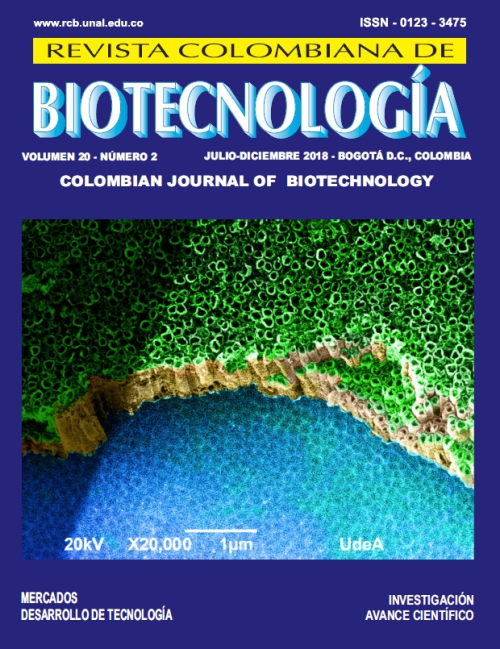
Publicado
Caracterización molecular de aguacate criollo de Nuevo León, México
Molecular characterization of wild avocado from Nuevo León, México
DOI:
https://doi.org/10.15446/rev.colomb.biote.v20n2.69551Palabras clave:
RAPD´s, Diversidad Genética, Contenido de Información Polimórfica (PIC), Índice de Marcador (MI), Poder de Resolución (PR). (es)RAPD's, Genetic Diversity, Polymorphic Information Content (PIC), Marker Index (MI), Power of Resolution (PR). (en)
Referencias
Acosta, D.E., Hernández, T. I., & Almeyda, L. I. H. 2012. Evaluación de aguacates criollos en Nuevo León, México: región sur. Revista Mexicana de Ciencias Agrícolas 3:245-257.
Acosta, D. E., Almeyda, L. I. H., & Hernández, T. I. 2013. Evaluación de aguacates criollos en Nuevo León, México: Región Norte. Revista Mexicana de Ciencias Agrícolas 4(4):531-542.
Agrama, H. A., & Tuinstra, M. R. 2003. Phylogenetic diversity and relationships among sorghum accessions using SSRs and RAPDs. Afr J Biotechnol 2:334–340.
Almeyda, L. I. H., Rocha, P. M. A., Piña, R. J., & Martínez, S., J.P. 2001. The use of polymerase chain reaction and molecular hybridization for detection of Phytoplasma sp. in different plant species in México. 2001. Revista Mexicana de fitopatología 19:1-9.
Ashworth, V. E., & Clegg, M. T. 2003. Microsatellite markers in avocado (Persea americana Mill.): Genealogical relationships among cultivated avocado genotypes. J. Hered. 94:407-41.
Barrientos, P. A. F., & López, L. L. 2001. Historia y genética del aguacate. En: Téliz, D. (ed). El aguacate y su manejo integrado. Ediciones Mundi-Prensa. México. pp 19-30.
Barrientos, P. A. F., Reyes A. J. C., & Aguilar, M. J. J. 2010. Manual gráfico para la descripción varietal de Aguacate; Graphic Handbook for the Description of Avocado Varieties. Servicio Nacional de Inspección y Certificación de Semillas - Secretaría de Agricultura, Ganadería, Desarrollo Rural, Pesca y Alimentación (SNICS-SAGARPA) y la Universidad Autónoma Chapingo (UACh). Tlalnepantla, Estado de México, México. 136 p.
Bensch, S., & Akesson, M. 2005. Ten years of AFLP in ecology and evolution: why so few animals?. Mol. Ecol. 14, 2899-2914.
Campos, R. E., Espíndola, B. M. C., & Mijares, O. P. 2008. Diversidad del género Persea y sus usos. Fundación Salvador Sánchez Colín CICTAMEX, S.C. Coatepec, Harinas. México. 59 p.
Casas, G. G. P, Galindo, L. L. F., Arango, I. R., & Saldamando, B. C. I. 2015. Diversidad genética de cultivares de aguacate (Persea americana) en Antioquia, Colombia. Agron. Mesoam. 26(1):129-143.
Cazares, A. N. P., Gutiérrez, V. E. E., Verde, S. J., Pecina, Q. V. & Almeyda, L. I. H. 2010. Caracterización molecular y producción de aceites esenciales de diferentes genotipos de orégano (Lippia spp.). Revista mexicana de Ciencias Forestales 1:85-94.
Cuiris, P. H., Guilllén, A. H., Pedraza, S. M. E., López, M. J., & Vidales, F. I. 2009. Genetic variability within mexican race avocado (Persea americana Mill) germplasm collections determined by ISSR. Rev. Chapingo. Serie Hort. 15:169-175.
Doyle, J. J. & Doyle, J. L.1987. A rapid DNA isolation procedure for small quantities of fresh leaf tissue Phytochemical Bulletin, Vol 19 p 11-15.
Felsenstein, J, 1985. Confidence limits on phylogenies: an approach using the bootstrap. Evolution. 39, 783-791.
Foster, J. T., Allan, G. J., Chan, A. P., Rabinowics, P. D., Ravel, J., Jackson, P. J., & Keim, P., 2010. Single nucleotide polymorphism for assessing genetic diversity in castor bean (Ricinus communis). BMC Plant Biol. 10, 1-11.
Gutiérrez, D. A., Martínez de la Cerda, J., García Z. E. A., Iracheta D. L., Ocampo M. J. D. & Cerda H. I. M. 2009. Estudio de la diversidad genética del aguacate en Nuevo León, México. Rev. Fitotec. Mex. 32 (1):9-18.
Gutiérrez, D. A., Sánchez, G. J. A., Torres, C. J. A., Cerda, H. I. M., & Ojeda, Z. Ma. del C. 2015. Genetic diversity of Mexican avocado in Nuevo Leon. In: Molecular Approaches to Genetic Diversity. Mahmut Caliskan, Guul Cevahir Oz, I. Halil Kavakli and Birguul Ozcan (editors). Publisher: InTech. pp. 141-159.
Kopp, L. E. 1966. A taxonomic revision of the genus Persea in the western hemisphere (Perseae–Laurac.
Laurentini, H., & Karlovsky, P. 2007. AFLP fingerprinting of sesame (Sesamum indicumL.) cultivars: identification, genetic relationship and comparison of AFLP informativeness parameters. Genet. Resour. Crop Ev. 54, 1437–1446.
López, G. R., Torres, C. Y., Chávez, M. M, Salgado, G. R., Jiménez, M. B., Corona, A. G., & Herrera, E. L. 2007. Genómica del fruto de aguacate criollo (Persea americana Mill. var. Drymifolia. In: Proceedings VI World Avocado Congress (Actas VI Congreso Mundial del Aguacate). Viña Del Mar, Chile. 12 – 16 Nov.
Martínez, V. M., Campos, R. E., Ayala, A. J., Barrientos, P. A. F., & Espíndola, B. M. C. 2016. Diversidad y distribución del género Persea Mill., en México. In: Agroproductividad 9 (4): 72-77.
Mijares, O. P., & López, L. L. 1998. Variedades de aguacate y su producción en México. Departamento de Fitotecnia. Memoria 1998 de la Fundación Salvador Sánchez Colín. Centro de Investigaciones y Tecnológicas del Aguacate en el Estado de México. Coatepec de Harinas. México. pp. 88-99.
Newett, S. D. E., Crandy, J. H., & Balerdi, C. F. 2002. Cultivars and rootstocks. In: Whiley, A. W., Schaffer, B. and Wolstenholme, B. N. (Eds.), Avocado: Botany, Production and Uses. CAB Publishing, pp. 161-187.
Pavlicek, A., Hrda, S., & Flegr, J. 1999. Free Tree - Freeware program for construction of phylogenetic trees on the basis of distance data and bootstrap/jackknife analysis of the tree robustness. Application in the RAPD analysis of the genus Frenkelia. Folia Biologica (Praha) 45, 97-99.
Powell, W., Morgante, M., & Andre, C. 1996. The comparison of RFLP, RAPD, AFLP and SSR (microsatellite) markers for germplasm analysis. Mol. Breeding. 2, 119–122.
Prevost, A., & Wilkinson M. J. 1999. A new system of comparing PCR primers applied to ISSR fingerprinting of potato cultivars. Theoretical and Applied Genetics 98: 107-112.
Rincón, H., C. A., Sánchez, P. J. de la L., & Espinosa, G. F. J. 2011. Caracterización química foliar de los árboles de aguacate criollo (Persea americana var. drymifolia) en los bancos de germoplasma de Michoacán, México. Revista Mexicana de Biodiversidad 82:395-412.
Rohwer, J. G. 2009 Lauraceae. In: K. Kubitzki, J. Rohwer & V. Bittrich (eds.), The families and genera of vascular plants II. SpringerVerlag, Berlin. pp: 366-391.
Roldán, R. I., Dendaum, J., Van Bockstaele, E., Depicker, A., & De Loose, M. 2000. AFLP markers reveal high polymorphic rates in ryegrasses (Lolium ssp.). Molecular Breeding. 6:125-134.
Secretaría de Agricultura, Ganadería Desarrollo Rural, Pesca y Alimentación (SAGARPA). 2007 http://www.siap.sagarpa.gob.mx/ar_comdeagr.html.
Sánchez, P. J. de la L. 1999. Recursos genéticos de aguacate (Persea americana Mill.) y especies afines en México. Rev. Chapingo S. Hort. 5:7-18.
Sánchez, P., J. de la L. 2007. Identificación de marcadores asociados a la resistencia de aguacate raza mexicana (Persea americana Mill. var drymifolia) al oomiceto hytophtota cinnamomi Rands. Tesis de Doctorado. UMSNH. Morelia, Michoacán, México. 106 p.
Tatikonda, L., Wani, S. P., Kannan, S., Beerelli, N., Sreedevi, T. K., Hoisington, D. A., Devi, P., & Varshney, R.K., 2009. AFLP-based molecular characterization of an elite germoplasm collection of Jatropha curcas L., a biofuel plant. Plant Sci. 176, 505-513.
Van der Werff, H. 2002. A synopsis of Persea (Lauraceae) in Central America. Novon 12: 575-86.
Varshney, R. K., Chabane, K., Hendre, P. S., Aggarwal, R. K., & Graner, A., 2007. Comparative assessment of EST-SSR, EST-SNP and AFLP markers for evaluation of genetic diversity and conservation of genetic resources using wild, cultivated and elite barley. Plant Sci. 173, 638–649.
Cómo citar
APA
ACM
ACS
ABNT
Chicago
Harvard
IEEE
MLA
Turabian
Vancouver
Descargar cita
CrossRef Cited-by
1. Graciela Guadalupe López Guzmán, Yolotzin Apatzingan Palomino-Hermosillo, Rosendo Balois-Morales, Pedro Ulises Bautista-Rosales, José Orlando Jiménez-Zurita. (2021). Diversidad genética del aguacate criollo en Nayarit, México, determinada por ISSR. Ciencia & Tecnología Agropecuaria, 22(1), p.1. https://doi.org/10.21930/rcta.vol22_num1_art:1686.
2. Guillermina Areli Tochihuitl-Martiñón, Crescenciano Saucedo-Veloz , Alfredo López-Jiménez , Sergio Humberto Chávez-Franco , Gregorio Arellano-Ostoa , Diana Guerra-Ramírez. (2023). Calidad y vida de anaquel de tres estados fisiológicos de frutos de aguacate variedad Lonjas. Revista Mexicana de Ciencias Agrícolas, 14(4), p.555. https://doi.org/10.29312/remexca.v14i4.3252.
3. Joel E. Corrales-García, María del Rosario García-Mateos, Eslí Martínez-López, Alejandro F. Barrientos-Priego, María Carmen Ybarra-Moncada, Emmanuel Ibarra-Estrada, Sergio M. Méndez-Zúñiga, Diana Becerra-Morales. (2019). Anthocyanin and Oil Contents, Fatty Acids Profiles and Antioxidant Activity of Mexican Landrace Avocado Fruits. Plant Foods for Human Nutrition, 74(2), p.210. https://doi.org/10.1007/s11130-019-00721-1.
4. Benta Sina, Hewan Demissie Degu, Yayis Rezene, Marie Kalousová, José Alejandro Ruiz-Chután, Bohdan Lojka. (2025). DArTseq SNP-based markers revealed high genetic diversity and population structure in avocado (Persea americana Mill.) germplasm collections from southern Ethiopia. Genetic Resources and Crop Evolution, 72(S1), p.83. https://doi.org/10.1007/s10722-025-02593-8.
Dimensions
PlumX
Visitas a la página del resumen del artículo
Descargas
Licencia
Derechos de autor 2018 Revista Colombiana de Biotecnología

Esta obra está bajo una licencia internacional Creative Commons Atribución 4.0.
Esta es una revista de acceso abierto distribuida bajo los términos de la Licencia Creative Commons Atribución 4.0 Internacional (CC BY). Se permite el uso, distribución o reproducción en otros medios, siempre que se citen el autor(es) original y la revista, de conformidad con la práctica académica aceptada. El uso, distribución o reproducción está permitido desde que cumpla con estos términos.
Todo artículo sometido a la Revista debe estar acompañado de la carta de originalidad. DESCARGAR AQUI (español) (inglés).