Correo Electrónico
 DNINFOA - SIA
 Bibliotecas
 Convocatorias
 Identidad U.N.


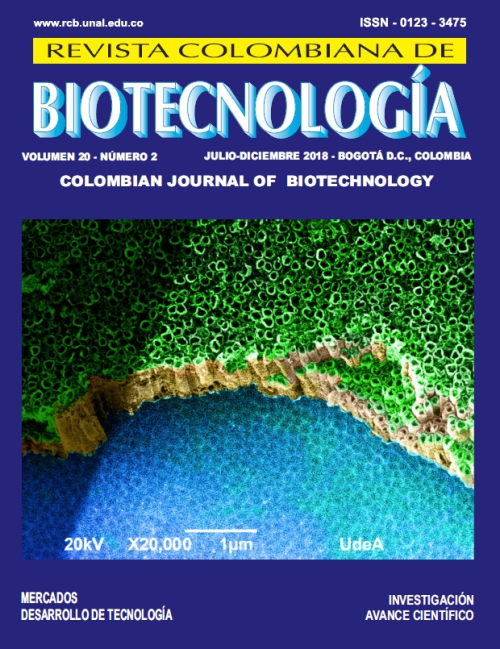
Publicado
Evaluación técnico-económica y diseño conceptual de una planta de biofertilizantes líquidos
Techno-economic evaluation and conceptual design of a liquid biofertilizer plan
Avaliação técnico-econômica e projeto conceitual de uma planta de biofertilizante líquida
DOI:
https://doi.org/10.15446/rev.colomb.biote.v20n2.77053Palabras clave:
Biofertilizante, simulación, diseño conceptual, costos. (es)Biofertilizer, simulation, conceptual design, economics (en)
Biofertilizante, simulação, projeto conceitual, custos (pt)
Biofertilizers have become an effective, eco-friendly and low cost alternative to chemical fertilizers. Process engineering and cost models for a biofertilizer plant with a production capacity of 44 tons of liquid biofertilizer per year (568 kg/batch) were developed. The models were obtained using process simulator (SuperPro Designer®), version 8.5 (Intelligen, 2012), while the 3D conceptual design and layout of the biofertilizer plant was developed with (OptiPlant®) software (ASD Global, 2015). The total capital investment required to erect the plant is $ 3 975 000, the unit production cost of one 1.5 L bottle of liquid biofertilizer is $ 24.009, while the economic indicators Net Present Value (NPV) and Internal Rate of Return (IRR) had values of $ 716 000 and 2.55%, respectively. Also, the total revenues are $ 985 000/year, the Return on Investment (ROI) is 14.93 %, and the payback time is 6.70 years.
Referencias
Albareda, M., Rodriguez-Navarro, D. N., Camacho, M., & Temprano, F. J. (2008). Alternatives to peat as a carrier for rhizobia inoculant: solid and liquid formulations. Soil Biol Biochem., 40, 2771–2779.
ASD Global. (2015). OptiPlant® Software. Walnut Creek, United States: ASD Global. (www.asdglobal.com).
Baca, G. (2010). Evaluación de proyectos (6ta ed.). México, D. F.: McGraw-Hill/Interamericana Editores S.A. DE C.V.
Baldani, V. L. D., Baldani, J. I. & Döbereiner, J. (1983). Effects of Azospirillum inoculation on root infection and nitrogen incorporation in wheat. Canadian Journal of Microbiology, 29, 924–929.
Bashan, Y., Holguin, G. & Lifshitz, R. (1993). Isolation and characterization of plant growth-promoting rhizobacteria. In: Glick B. R., Thompson J. E. (eds) Methods in Plant Molecular Biology and Biotechnology, Boca Raton: CRC Press, p. 382.
Bashan, Y., Trejo, A. & de-Bashan, L. E. (2011). Development of two culture media for mass cultivation of Azospirillum spp. and for production of inoculants to enhance plant growth. Biol Fertil Soils, 47, 963–969.
Bashan, Y. & de-Bashan, L. E. (2015). Inoculant Preparation and Formulations for Azospirillum spp. In: Cassán F. D. et al., (eds.) Handbook for Azospirillum: Technical Issues and Protocols. Switzerland: Springer International Publishing, p. 515.
Biwer, A. & Heinzle, E. (2004). Process modeling and simulation can guide process development: case study α-cyclodextrin. Enzyme and Microbial Technology, 34, 642–650.
Dimian, A. C., & Bildea, C. S. (2008). Chemical Process Design: Computer-Aided Case Studies. Germany, Weinheim: WILEY-VCH Verlag GmbH and Co. KGaA, p 529.
Ernst, S., Garro, O. A., Winkler, S., Venkataraman, G., Langer, R., Cooney, C. L. & Sasisekharan, R. (1997). Process Simulation for Recombinant Protein Production: Cost Estimation and Sensitivity Analysis for Heparinase I Expressed in Escherichia coli. Biotechnol. Bioeng., 53, 575–582.
Fages, J. (1992). An industrial view of Azospirillum inocullants: production and application in technology can stimulate plants. Symbiosis, 13, 15–26.
Farid, S. S. (2007). Process economics of industrial monoclonal antibody manufacture. Journal of Chromatography B., 848, 8–18.
Gódia, F. & López J. (1989). Ingeniería Bioquímica. Editorial Síntesis, Madrid, p. 350.
ICIDCA. (2000). Manual de los Derivados de la Caña de Azúcar. La Habana, Cuba: Instituto Cubano de Investigaciones de los Derivados de la Caña de Azúcar, p 421.
Intelligen. (2012). SuperPro Designer® (Version 8.5). Scotch Plains, United States: Intelligen Inc. (www.intelligen.com)
Krajnc, D., Mele, M. & Glavič, P. (2007). Improving the economic and environmental performances of the beet sugar industry in Slovenia: increasing fuel efficiency and using by-products for ethanol. Journal of Cleaner Production, 15, 1240-1252.
Kwiatkowski, J. R., McAloon, A. J., Taylor, F. & Johnston, D. B. (2006). Modeling the process and costs of fuel ethanol production by the corn dry-grind process. Industrial Crops and Products, 23, 288–296.
Marchetti, J. M., Miguel, V. U. & Errazu, A. F. (2008). Techno-economic study of different alternatives for biodiesel production. Fuel Processing Technology, 89, 740-748.
Mishra, B. K. & Dadhich, S. K. (2010). Methodology of nitrogen biofertilizer production. J. Adv. Dev. Res., 1 (1), 3-6.
Okon, Y. & Vanderleyden, J. (1985). Azospirillum as a potential inoculant for agriculture. Trends in Biotechnology, 3, 223–228.
Perry, R. H. & Green, D. W. (2008). Chemical Engineers’ Handbook, 8th Ed. New York: McGraw Hill Inc. p. 2 655.
Peters, M., Timmerhaus, K. & West, R.. (2003). Plant Design and Economics for Chemical Engineers. New York: McGraw-Hill. p. 988.
Prabavathy, V. R. Rengalakshmi, R. & Nair, S. (2007). Decentralised Production of Biofertilisers – Azospirillum and Phosphobacteria. Chennai, India: JRD Tata Ecotechnology Centre, p. 36.
Ramirez, E. C., Johnston, D. B., McAloon, A. J., Yee, W. & Singh, V. (2008). Engineering process and cost model for a conventional corn wet milling facility. Industrial Crops and Products, 27, 91-97.
Roldán, M., Valdez, N., Monterrubio, C., Sánchez, E., Salinas, C., Cabrera, R., Gamboa, R., Marin Palacio, L., Villegas, J. & Cabrera, A. B. (2013). Scale-up from shake flasks to pilot-scale production of the plant growth-promoting bacterium Azospirillum brasilense for preparing a liquid inoculant formulation. Appl. Microbiol. Biotechnol., 97 (22), 9665-9674.
Rouf, S. A., Douglas, P. L., Moo-Young, M. & Scharer, J. M. (2001). Computer simulation for large scale bioprocess design. Biochemical Engineering Journal, 8, 229-234.
Sinnot, R. K. (2005). Coulson & Richardson’s Chemical Engineering: Chemical Engineering Design, Vol. 6, 4th. Ed. Oxford: Elsevier Butterworth-Heinemann. p. 1055.
Spaepen, S, Van Derleyden, J. & Okon, Y. (2009). Plant growth-promoting actions of rhizobacteria. Adv. Bot. Res., 51, 283–320.
Taurian, T., Anzuay, M. S., Angelini, J. G., Tonelli, M. L., Ludueña, L., Pena, D., ... & Fabra, A. (2010). Phosphate-solubilizing peanut associated bacteria: screening for plant growth-promoting activities. Plant and Soil, 329 (1-2), 421-431..
Tien, T. M., Gaskins, M. H. & Hubbell, D. H. (1979). Plant growth substances produced by Azospirillum brasilense and their Effect on the growth of Pearl Millet (Pennisetum americanum L.). Applied and Environmental Microbiology, 37 (5), 1016-1024.
Towler, G., & Sinnott, R. (2008). Chemical Engineering Design-Principles, Practice and Economics of Plant and Process Design. London: Butterworth-Heinemann, p. 1266.
Cómo citar
APA
ACM
ACS
ABNT
Chicago
Harvard
IEEE
MLA
Turabian
Vancouver
Descargar cita
CrossRef Cited-by
1. Fatma Masmoudi, Shoyeb Khan, Mahmoud Ibrahim Taher, Probir Das, Imen Saadaoui. (2026). Techno-economic assessment of Bacillus cabrialesii HB7-based biofertilizer production. Bioresource Technology Reports, 34, p.102670. https://doi.org/10.1016/j.biteb.2026.102670.
2. Réka Czinkóczky, Áron Németh. (2020). Techno-economic assessment of Bacillus fermentation to produce surfactin and lichenysin. Biochemical Engineering Journal, 163, p.107719. https://doi.org/10.1016/j.bej.2020.107719.
3. Rafael Jorge León Morcillo, Edurne Baroja-Fernández, Lidia López-Serrano, Jesús Leal-López, Francisco José Muñoz, Abdellatif Bahaji, Alberto Férez-Gómez, Javier Pozueta-Romero. (2022). Cell-free microbial culture filtrates as candidate biostimulants to enhance plant growth and yield and activate soil- and plant-associated beneficial microbiota. Frontiers in Plant Science, 13 https://doi.org/10.3389/fpls.2022.1040515.
4. Leandro Israel da Silva, Danilo José Machado de Abreu, Ederson da Conceição Jesus, Elisângela Elena Nunes Carvalho, Marlon Correa Pereira, Anita Fernanda dos Santos Teixeira, Moacir Pasqual, Joyce Dória. (2026). Berry Best Buddies: Friendly Bacteria Enhance Strawberry Production, Quality, and Fertilizer Use Efficiency. Journal of Soil Science and Plant Nutrition, https://doi.org/10.1007/s42729-026-03177-w.
5. Chinnathambi Velu, Samuel Cirés, Diane L. Brinkman, Kirsten Heimann. (2020). Bioproduct Potential of Outdoor Cultures of Tolypothrix sp.: Effect of Carbon Dioxide and Metal-Rich Wastewater. Frontiers in Bioengineering and Biotechnology, 8 https://doi.org/10.3389/fbioe.2020.00051.
6. Lai‐Yee Phang, Suraini Abd‐Aziz, Misri Gozan, Mohamad F. Ibrahim. (2024). Chemical Substitutes from Agricultural and Industrial By‐Products. , p.355. https://doi.org/10.1002/9783527841141.ch18.
7. Mehran Taherkhani, Niels Hanau, Ralf Ehret. (2025). Ecologic and Economic Evaluation of Combined Green Methanol Synthesis from CO2 and Biotechnological Upgrading to Value Products, Part 2: Economic Impact. Chemie Ingenieur Technik, 97(8-9), p.797. https://doi.org/10.1002/cite.12010.
Dimensions
PlumX
Visitas a la página del resumen del artículo
Descargas
Licencia
Derechos de autor 2018 Revista Colombiana de Biotecnología

Esta obra está bajo una licencia internacional Creative Commons Atribución 4.0.
Esta es una revista de acceso abierto distribuida bajo los términos de la Licencia Creative Commons Atribución 4.0 Internacional (CC BY). Se permite el uso, distribución o reproducción en otros medios, siempre que se citen el autor(es) original y la revista, de conformidad con la práctica académica aceptada. El uso, distribución o reproducción está permitido desde que cumpla con estos términos.
Todo artículo sometido a la Revista debe estar acompañado de la carta de originalidad. DESCARGAR AQUI (español) (inglés).