Correo Electrónico
 DNINFOA - SIA
 Bibliotecas
 Convocatorias
 Identidad U.N.


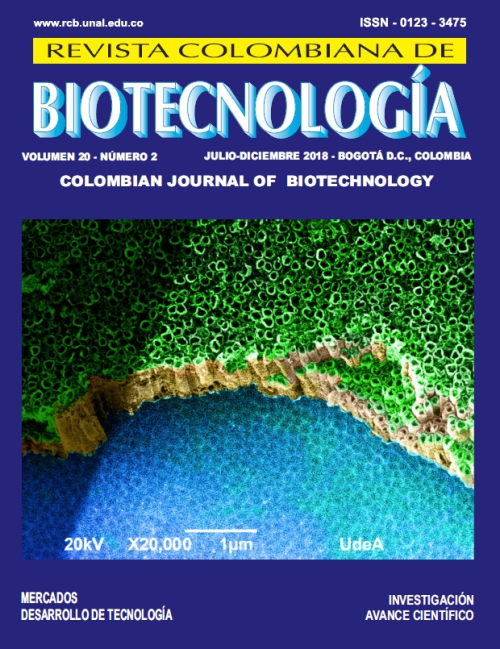
Publicado
Evaluación del crecimiento de fibroblastos humanos en andamios de fibroína de Bombyx mori L.
Evaluation of the growth of human fibroblasts on fibroin scaffolds from Bombyx mori L.
Avaliação do crescimento de fibroblastos humanos em scaffolds de fibroína de Bombyx mori L.
DOI:
https://doi.org/10.15446/rev.colomb.biote.v20n2.77062Palabras clave:
biotecnologia, biomaterial, ingeniería tisular, medicina regenerativa, fibroina, multiplicación celular (es)biotechnology, biomaterial, tissue engineering, regenerative medicine (en)
biotecnologia, biomaterial, engenharia de tecidos, medicina regenerativa, fibroína, multiplicação celular (pt)
La fibroína de Bombyx mori L., es un biomaterial que se ha utilizado por sus características físico/químicas que la hacen útil para la curación de múltiples tejidos. En el contexto de la medicina regenerativa caracterizar a nivel físico y biológico nuevos soportes preparados a partir de fibroína de seda y evaluar su capacidad para la proliferación de fibroblastos humanos, brinda una gran oportunidad para encontrar nuevos biomateriales con aplicaciones favorables en la curación de heridas. Se utilizó fibroína regenerada al 17% para la fabricación de matrices. Estas fueron caracterizadas teniendo en cuenta: estabilidad en condiciones de cultivo, ultraestructura, porosidad, ángulo de contacto y propiedades mecánicas. El grosor promedio de las matrices de fibroína fue 30,1µm, con una estabilidad superior a 4 semanas en condiciones de cultivo, porosidad del 51% y una capacidad de retención de líquidos del 95%, un ángulo de contacto de 44,5° y un módulo de elasticidad de aproximadamente 200 MPa. Finalmente se evaluó la capacidad del andamio para soportar el crecimiento de fibroblastos humanos. Identificando que los andamios permiten la multiplicación celular, mostrando bajos índices de citotoxicidad (<5%); las células establecieron interacciones fuertes con el andamio, mediante la producción de filopodios y la producción de matriz extracelular propia. Concluyendo esto, que es un andamio compatible de fibroblastos humanos en los procesos para el crecimiento y multiplicación celular en procesos de medicina regenerativa.
The fibroin of Bombyx mori L., has been used for its physical / chemical characteristics as a biomaterial with applications in the healing of multiple tissues. In the context of regenerative medicine, characterizing at a physical and biological level new supports prepared from silk fibroin and evaluating their capacity for the proliferation of human fibroblasts, offers a very attractive opportunity to find new biomaterials with favorable applications in the healing of wounds. 17% regenerated fibroin was used for the manufacture of matrices. The matrices constructed were characterized in aspects such as: stability under growing conditions, ultra-structure, porosity, contact angle and mechanical properties. Finally, the ability of the scaffold to support the growth of human fibroblasts was evaluated. The average thickness of the fibroin matrices was 30.1 μm, with a stability greater than 4 weeks under culture conditions, porosity of 51% and a liquid retention capacity of 95%, a contact angle of 44.5 ° and a modulus of elasticity of ± 200 MPa. It was identified that the scaffolds allow cell multiplication, showing low cytotoxicity indexes (<5%); the cells established strong interactions with the scaffold, through the production of filopodia and the production of their own extracellular matrix. Constructed scaffolds allow the multiplication of human cells with low cytotoxicity and these establish a close relationship at the cellular level with the biomaterial. This can be used as a compatible scaffold for the growth and multiplication of human cells in a regenerative medicine process of epithelial tissue.
A fibroína de Bombyx mori L. é um biomaterial que tem sido utilizado por suas características físico-químicas que o tornam útil para a cicatrização de múltiplos tecidos. No contexto da medicina regenerativa caracterizar nível físico e biológico novo preparado a partir de fibroína de seda e avaliar a sua capacidade de proliferação de fibroblastos humanos suportes, oferece uma grande oportunidade para encontrar novos biomateriais com aplicações favoráveis na cicatrização de feridas. Utilizou-se 17% de fibroína regenerada para o fabrico de matrizes. Estes foram caracterizados levando-se em consideração: estabilidade nas condições de cultivo, ultraestrutura, porosidade, ângulo de contato e propriedades mecânicas. A espessura média das matrizes foi fibroína 30,1μm com uma estabilidade de mais de 4 semanas em condições de cultura, a porosidade de 51% e uma capacidade de retenção de 95%, um ângulo de contacto de 44,5 ° e um módulo de elasticidade de aproximadamente 200 MPa. Finalmente, a capacidade do suporte para suportar o crescimento de fibroblastos humanos foi avaliada. Identificar que os scaffolds permitem a multiplicação celular, mostrando baixos índices de citotoxicidade (<5%); as células estabeleceram fortes interações com o arcabouço, através da produção de filopódios e da produção de sua própria matriz extracelular. Concluindo isso, que é um andaime compatível de fibroblastos humanos nos processos de crescimento e multiplicação celular em processos de medicina regenerativa.
Referencias
Aramwit, P., Kanokpanot, S., De-Eknamkul, W., & Srichana, T. (2009). Monitoring of inflammatory mediators induced by silk sericin. Journal of Bioscience and Bioengineering, 107(5), 556-561.
Caballero M.L., Rivera C.J., & Gaviria A.D. (2016). Evaluación de la fibroína de seda como biomaterial de soporte para el crecimiento de células mesenquimales estromales de pulpa dental. ARS MEDICA Revista de Ciencias Médicas, 41(1), 5-13.
Chen, B.Q., Kankala, R.K., Chen, A.Z., Yang, D.Z., Cheng, X.X., Jiang, N.N., et al. (2017). Investigation of silk fibroin nanoparticle-decorated poly(l-lactic acid) composite scaffolds for osteoblast growth and differentiation. International Journal of Nanomedicine, 12, 1877-1890.
Cwikelt, D., Zhao, Q., Liu, C., Su, X., & Marmun, A. (2010). Comparing contact angle measurements and surface tension assessments of solid surfaces. Langmuir, 26(19), 15289-15294.
Drury, J.L., & Mooney, D.J. (2003). Hydrogels for tissue engineering: scaffold design variables and applications. Biomaterials, 24(24), 4337-4351.
Farokhi, M., Mottaghitalab, F., Samani, S., Shokrgozar, M.A., Kundu, S.C., Reis, R. L., et al. (2018). Silk fibroin/hydroxyapatite composites for bone tissue engineering. Biotechnology Advances, 36(1), 68-91.
Garreta, E., Oria, R., Tarantino, C., Pla-Roca, M., Prado, P., Fernández-Avilés, F., Campistol, J.M., Samitier, J., Montserrat, N. (2017). Tissue engineering by decellularization and 3D bioprinting. Materials Today, 20(4), 166-178
Gaviria A.D., & Caballero M.L. (2015). Uso de biomateriales a partir de la fibroína de gusano de seda (Bombyx mori L.) para procesos de medicina regenerativa basada en ingeniería de tejidos. Revista Médica de Risaralda, 21(1), 38-47.
Gil, E.S., Panilaitis, B., Bellas, E., & Kaplan, D.L. (2013). Functionalized silk biomaterials for wound healing. Advanced Healthcare Materials, 2(1), 206-217.
Hardy, J.G., Römer, L.M., & Scheibel, T.R. (2008). Polymeric materials based on silk proteins. Polymer, 49(20). 4309-4327.
Hoffmann, B., & Schäfer, C. (2010). Filopodial focal complexes direct adhesion and force generation towards filopodia outgrowth. Cell Adhesion & Migration, 4(2), 190-193.
Ki, S.B., Singh, D., Kim, S.C., Son, T.W., & Han, S.S. (2012). Effect of cross‐linkers in fabrication of carrageenan–alginate matrices for tissue engineering application. Biotechnology and Applied Biochemistry, 60(6), 589-595.
Kim, U.J., Park, J., Kim, H.J., Wada, M., & Kaplan, D.L. (2005). Three-dimensional aqueous-derived biomaterial scaffolds from silk fibroin. Biomaterials. 26(15): 2775-2785.
Kojthung, A., Meesilpa, P., Sudatis, B., Treeratanapiboon, L., Udomsangpetch, R., & Ookhanond, B. (2008). Effects of gamma radiation on biodegradation of Bombyx mori silk fibroin. International Biodeterioration & Biodegradation, 62(4), 487-490.
Kundu, B., Rajkhowa, R., Kundu, S.C., & Wang, X. (2013). Silk fibroin biomaterials for tissue regenerations. Advanced Drug Delivery Reviews, 65(4), 457-470.
Kunz, R.I., Costa Brancalhao, R.M., Chasko Ribeiro, L.D., & Marcal Natali, M.R. (2016). Silkworm sericin: properties and biomedical applications. BioMed Research International, 2016 (8175701), 19.
Kweon, H., Ha, H.C., Um, I.C., & Park, Y.H. (2001). Physical properties of silk fibroin/chitosan blend films. Journal of Applied Poymer Science, 80(7), 928-934.
Lawrence, B.D., Wharram, S., Kluge, J.A., Leisk, G.G., Omenetto, F.G., Rosenblatt, M., et al. (2010). Effect of hydration on silk film material properties. Maccromolecular Bioscencience, 10(4), 393-403.
Liu, T.L., Miao, J.C., Sheng, W.H., Xie, Y.F., Huang, Q., Shan, Y.B., et al. (2010). Cytocompatibility of regenerated silk fibroin film: a medical biomaterial applicable to wound healing. Journal of Zhejiang University Science B, 11(1), 10-16.
Lu, Q., Zhang, B., Li, M., Zuo, B., Kaplan, D.L., Huang, Y., et al. (2011). Degradation mechanism and control of silk fibroin. BioMacromolecules, 12(4), 1080-1086.
Makaya, K., Terada, S., Ohgo, K., & Tetsuo, A. (2009). Comparative study of silk fibroin porous scaffolds derived from salt/water and sucrose/hexafluoroisopropanol in cartilage formation. Journal of Bioscience and Bioengineering, 108(1), 68-75.
Melke, J., Midha, S., Ghosh, S., Ito, K., & Hofmann, S. (2016). Silk fibroin as biomaterial for bone tissue engineering. Acta Biomaterialia, 31, 1-16.
Nazarov, R., Jin, H.J., & Kaplan, D.L. (2004). Porous 3-D scaffolds from regenerated silk fibroin. BioMacromolecules, 5(3), 718-726.
Numata, K., Cebe, P., & Kaplan, D.L. (2010). Mechanism of enzymatic degradation of beta-sheet crystals. Biomaterials, 31(10), 2926-2933.
Rockwood, D.N., Preda, R.C., Yücel, T., Wang, X., Lovett, M.L., & Kaplan, D.L. (2011). Materials fabrication from Bombyx mori silk fibroin. Nature Protocols, 6(10), 379.
Sheikh, F.A., Woo J.H., Min L.J., Moon, B. M., Parks, H.J., Lee, O.J., et al. (2015). 3D electrospun silk fibroin nanofibers for fabrication of artificial skin. Nanomedicine: Nanotechnology, Biology and Medicine, 11(3), 681-691.
Stark, Y., Suck, K., Kasper, C., Wieland, M., Van Griensven, M., & Scheper, T. (2006). Application of collagen matrices for cartilage tissue engineering. Experimental and Toxicologic Pathology, 57(4), 305-311.
Vepari, C., & Kaplan, D.L. (2007). Silk as a biomaterial. Progress in Polymer Science, 32(8-9), 991-1007.
Vyas, K.S., & Vasconez, H.C. (2014). Wound healing: biologics, skin substitutes, biomembranes and scaffolds. Healthcare, 2(3), 356-400.
Wang, Y., Wang, X., Shi, J., Zhu, R., Zhang, J., Zhang, Z., et al. (2016). A biomimetic silk fibroin/sodium alginate composite scaffold for soft tissue engineering. Scientific Reports, 6(39477), 1-13.
Zhao, Z., Li, Y., & Xie, M.B. (2015). Silk fibroin-based nanoparticles for drug delivery. International Journal of Molecular Sciences, 16(13), 4880-4903.
Zhou, F., Zhang, X., Cai, D., Li, J., Mu, Q., Zhang, W., et al. (2017). Silk fibroin chondroitin sulfate scaffold with immuno-inhibition property for articular cartilage repair. Acta Biomaterialia, 63, 64-75.
Cómo citar
APA
ACM
ACS
ABNT
Chicago
Harvard
IEEE
MLA
Turabian
Vancouver
Descargar cita
CrossRef Cited-by
1. V. Perez-Puyana, J.F. Rubio-Valle, M. Jiménez-Rosado, A. Guerrero, A. Romero. (2020). Chitosan as a potential alternative to collagen for the development of genipin-crosslinked scaffolds. Reactive and Functional Polymers, 146, p.104414. https://doi.org/10.1016/j.reactfunctpolym.2019.104414.
Dimensions
PlumX
Visitas a la página del resumen del artículo
Descargas
Licencia
Derechos de autor 2018 Revista Colombiana de Biotecnología

Esta obra está bajo una licencia internacional Creative Commons Atribución 4.0.
Esta es una revista de acceso abierto distribuida bajo los términos de la Licencia Creative Commons Atribución 4.0 Internacional (CC BY). Se permite el uso, distribución o reproducción en otros medios, siempre que se citen el autor(es) original y la revista, de conformidad con la práctica académica aceptada. El uso, distribución o reproducción está permitido desde que cumpla con estos términos.
Todo artículo sometido a la Revista debe estar acompañado de la carta de originalidad. DESCARGAR AQUI (español) (inglés).