Correo Electrónico
 DNINFOA - SIA
 Bibliotecas
 Convocatorias
 Identidad U.N.


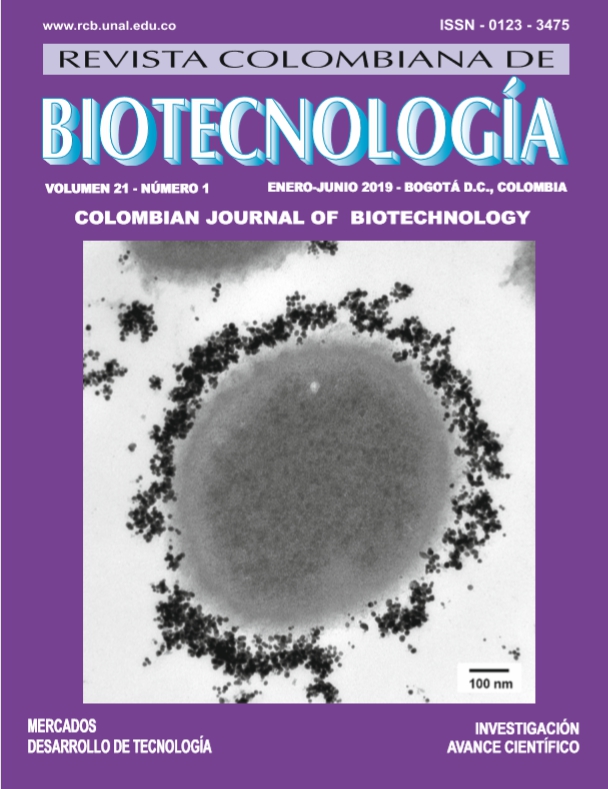
Publicado
Control biológico: Camino a la agricultura moderna
Biological control: Path to modern agriculture
DOI:
https://doi.org/10.15446/rev.colomb.biote.v21n1.80860Palabras clave:
editorial (es)editorial (en)
Referencias
Ab Rahman, S. F. S., Singh, E., Pieterse, C. M., & Schenk, P. M. (2018). Emerging microbial biocontrol strategies for plant pathogens. Plant Science, 267, 102-111.
Balouiri, M., Sadiki, M., & Ibnsouda, S. K. (2016). Methods for in vitro evaluating antimicrobial activity: A review. Journal of pharmaceutical analysis, 6(2), 71-79.
Cahill, D. M., Rookes, J. E., Wilson, B. A., Gibson, L., & McDougall, K. L. (2008). Phytophthora cinnamomi and Australia’s biodiversity: impacts, predictions and progress towards control. Australian Journal of Botany, 56(4), 279-310.
Dita, M., Barquero, M., Heck, D., Mizubuti, E. S., & Staver, C. P. (2018). Fusarium wilt of banana: Current knowledge on epidemiology and research needs toward sustainable disease management. Frontiers in plant science, 9.
Donnelly, J. S. (2002). Great Irish Potato Famine. The History Press.
Environmental Protection Agency (2019). Biopesticide Active Ingredients. URL: https://www.epa.gov/ingredients-used-pesticide-products/biopesticide-active-ingredients
Fravel, D. R. (2005). Commercialization and implementation of biocontrol. Annu. Rev. Phytopathol., 43, 337-359.
Instituto Colombiano Agropecuario (2019). Productos registrados de bioinsumos-2018. URL:https://www.ica.gov.co/getdoc/2ad9e987-8f69-4358-b8a9-e6ee6dcc8132/productos-bioinsumos-mayo-13-de-2008.aspx
Ingram, J. (2011). A food systems approach to researching food security and its interactions with global environmental change. Food Security, 3(4), 417-431.
Nihorimbere, V., Ongena, M., Smargiassi, M., & Thonart, P. (2011). Beneficial effect of the rhizosphere microbial community for plant growth and health. Biotechnologie, Agronomie, Société et Environnement, 15(2), 327-337.
Padmanabhan, S. Y. (1973). The great Bengal famine. Annual Review of Phytopathology, 11(1), 11-24.
Pal, K. K., & Gardener, B. M. (2006). Biological control of plant pathogens. Plant Health Instructor. 2, 1117-1142.
Pedraza-Zapata D.M, Sanchez-Garibello M., Quevedo-Hidalgo B., Moreno-Sarmiento N. & Gutierrez-Rojas I. (2017). Promising cellulolytic fungi isolates for rice straw degradation. Journal of Microbiology. 55(9), 711–719
Pérez, C., & Saavedra, E. (2011). Avances en el manejo integrado de la bacteria Burkholderia glumae en el cultivo de arroz en el Caribe colombiano. Revista Colombiana de Ciencia Animal-RECIA, 111-124.
Pliego, C., Ramos, C., de Vicente, A., & Cazorla, F. M. (2011). Screening for candidate bacterial biocontrol agents against soilborne fungal plant pathogens. Plant and soil, 340(1-2), 505-520.
Roberts, M. J., Schimmelpfennig, D. E., Ashley, E., Livingston, M. J., Ash, M. S., & Vasavada, U. (2006). The value of plant disease early-warning systems: a case study of USDA's soybean rust coordinated framework (No. 1477-2016-121162).
Rockström, J., Williams, J., Daily, G., Noble, A., Matthews, N., Gordon, L., ... & de Fraiture, C. (2017). Sustainable intensification of agriculture for human prosperity and global sustainability. Ambio, 46(1), 4-17.
Savary, S., Ficke, A., Aubertot, J. N., & Hollier, C. (2012). Crop losses due to diseases and their implications for global food production losses and food security.
United Nations. Department of Economic and Social Affairs. Population Division. (2017). World population prospects: The 2017 revision. UN. URL: http://www.un.org/en/development/desa/population/events/pdf/other/21/21June_FINAL%20PRESS%20RELEASE_WPP17.pdf
Cómo citar
APA
ACM
ACS
ABNT
Chicago
Harvard
IEEE
MLA
Turabian
Vancouver
Descargar cita
CrossRef Cited-by
1. Daniel Perales-Rosas, Mairel Valle-de la Paz. (2025). Reducing Food Loss and Waste. , p.147. https://doi.org/10.1007/978-3-031-91693-9_7.
2. Carolina Martínez-Sánchez, Ana Tarín Gutiérrez-Ibáñez, Claudia Saavedra-Guevara, Luz Raquel Martínez-Bernal, Francisco Ramírez-Dávila, Martha Lidya Salgado-Siclán. (2026). Actividad antifúngica de aislamientos autóctonos de Trichoderma spp. contra fitopatógenos. Revista Mexicana de Ciencias Agrícolas, 17(1), p.e3987. https://doi.org/10.29312/remexca.v17i1.3987.
3. Diana Cristina Medina Valencia, Erika Tatiana Obando Anaya. (2022). Microorganismos de montaña, una alternativa para la biofertilización de cultivos agrícolas. https://doi.org/10.22490/ecapma.5800.
4. Teresa de Jesús Lira Hernández, Beatriz Gutiérrez Rivera, Ángel Cárdenas Cágal, Ana Line Vázquez Larios, Francisco Hernández Rosas, Marlom Julio Vergara Monterroza. (2025). Evaluación del antagonismo de Bacillus spp. sobre hongos fitopatógenos de lima persa (Citrus x latifolia Tan.) . Revista Bio Ciencias, https://doi.org/10.15741/revbio.12.e1806.
5. Stefany Motta Escobar, Lizeth D. Salazar Cabezas, Ligia C. Sánchez Leal. (2022). Perspectiva del uso de Pseudomonas spp. como biocontrol de fitopatógenos en cultivos de hortalizas en Colombia: una revisión sistemática. Revista Mutis, 12(2) https://doi.org/10.21789/22561498.1862.
6. Lourdes Adriano-Anaya, Luis Fernando Pardo-Girón, Miguel Salvador-Adriano, Miguel Salvador-Figueroa, Isidro Ovando-Medina, Benjamin Moreno-Castillo. (2024). Effectiveness of Bacillus subtilis ANT01 and Rhizobium sp. 11B on the control of fusarium wilt in pineapple (Ananas comosus). PeerJ, 12, p.e16871. https://doi.org/10.7717/peerj.16871.
7. María Estela López-López, Carmen Lizette Del-Toro-Sánchez, Melesio Gutiérrez-Lomelí, Salvador Ochoa-Ascencio, José Antonio Aguilar-López, Miguel Angel Robles-García, Maribel Plascencia-Jatomea, Ariadna Thalia Bernal-Mercado, Oliviert Martínez-Cruz, María Guadalupe Ávila-Novoa, Jean Pierre González-Gómez, Pedro Javier Guerrero-Medina. (2022). Isolation and Characterization of Trichoderma spp. for Antagonistic Activity against Avocado (Persea americana Mill) Fruit Pathogens. Horticulturae, 8(8), p.714. https://doi.org/10.3390/horticulturae8080714.
8. Rafael Diego Rodríguez-Málaga, Dinorah Lissette Lima-Rivera, Fernando Hernández-Baz, Alejandro Salinas-Castro, Daniel López-Lima. (2025). Evaluation of Trichoderma spp. and Bacillus subtilis to reduce citrus gummosis damage in Persian lemon trees. Revista Biológico Agropecuaria Tuxpan, 13(1), p.89. https://doi.org/10.47808/revistabioagro.v13i1.614.
Dimensions
PlumX
Visitas a la página del resumen del artículo
Descargas
Licencia
Derechos de autor 2019 Revista Colombiana de Biotecnología

Esta obra está bajo una licencia internacional Creative Commons Atribución 4.0.
Esta es una revista de acceso abierto distribuida bajo los términos de la Licencia Creative Commons Atribución 4.0 Internacional (CC BY). Se permite el uso, distribución o reproducción en otros medios, siempre que se citen el autor(es) original y la revista, de conformidad con la práctica académica aceptada. El uso, distribución o reproducción está permitido desde que cumpla con estos términos.
Todo artículo sometido a la Revista debe estar acompañado de la carta de originalidad. DESCARGAR AQUI (español) (inglés).