Correo Electrónico
 DNINFOA - SIA
 Bibliotecas
 Convocatorias
 Identidad U.N.



Publicado
The effects of fixed-term contracts on workers in Colombia
Los efectos de los contratos a término fijo sobre los trabajadores en Colombia
Os efeitos dos contratos a prazo fixo nos trabalhadores na Colômbia
DOI:
https://doi.org/10.15446/cuad.econ.v33n63.45340Palabras clave:
Types of contracts, labor contracts, fixed-term and indefinite contract, wage gap, instrumental variable (en)Tipos de contrato, contratos laborales, contratos a término fijo e indefinido, brecha salarial, variable instrumental (es)
Tipos de contrato, contratos trabalhistas, contratos a prazo fixo e indeterminado, brecha salarial, variável instrumental (pt)
Descargas
The effects of fixed-term contracts on workers in Colombia
Les effets des contrats à durée déterminée sur les travailleurs en Colombie.
Los efectos de los contratos a término fijo sobre los trabajadores en Colombia.
Os efeitos dos contratos a prazo fixo nos trabalhadores na Colômbia.
Luz Karime Abadía Alvaradoa
a Professor and Director of the Undergraduate Program in Economics, Pontificia Universidad Javeriana - Bogotá, Colombia. Mail: labadia@javeriana.edu.co.
I am grateful to Sara de la Rica at University of the Basque Country for her comments and important contributions.
Abstract
This paper studies the effects of fixed-term contracts on workers. Specifically, the paper analyzes their impact on wages and on satisfaction levels. Regulations governing fixed-term and indefinite contracts in Colombia and the main labor reforms related to these two types of contract are analyzed. Women, young and low-educated workers, who work in small firms, in the private sector and in construction or manufacturing are most likely to have fixed-term contracts. In terms of wages, we found a significant raw and adjusted wage gap against workers with fixed-term contracts. Finally, we found, as expected, evidence that fixed-term contracts reduce the level of worker satisfaction.
Keywords: Types of contracts, labor contracts, fixed-term and indefinite contract, wage gap, instrumental variable.
JEL: J01, J23, J31, J41.
Resumen
Este artículo estudia los efectos de los contratos a término fijo en los trabajadores en cuanto a su impacto en salarios y nivel de satisfacción. Se analizan las principales reformas laborales relacionadas con contratos indefinidos y a término fijo. Mujeres, jóvenes y trabajadores con bajos niveles de educación, que trabajan en firmas pequeñas, en el sector público y en los sectores de construcción o industria manufacturera son los más propensos a tener contratos a término fijo. Se encuentra además, una importante brecha salarial observada y ajustada en contra de trabajadores con contrato a término fijo, así como menores niveles de satisfacción para estos.
Palabras clave: tipos de contrato, contratos laborales, contratos a término fijo e indefinido, brecha salarial, variable instrumental.
JEL: J01, J23, J31, J41.
Résumé
Cet article étudie les effets des contrats à durée déterminée pour les travailleurs dans leur impact sur les salaires et le niveau de satisfaction. L'article analyse également les principales réformes du travail en relation avec les contrats à durée indéterminée et à durée déterminée. Femmes, jeunes et travailleurs ayant un faible niveau d'éducation, qui travaillent dans de petites entreprises, dans le secteur public et dans la construction où l'industrie manufacturière sont ceux qui ont le plus de probabilités d'avoir des contrats à durée déterminée. En outre on retrouve aussi un écart salarial important, observé et ajusté au détriment des travailleurs avec un contrat à durée déterminée, ainsi qu'un moindre niveau de satisfaction.
Mots-clés : Types de contrat, contrats de travail, contrats à durée déterminée et indéterminée, écart salarial, variable instrumentale.
JEL : J01, J23, J31, J41.
Resumo
Este artigo estuda os efeitos dos contratos a prazo fixo nos trabalhadores quanto ao seu impacto em salários e nível de satisfação. São analisadas as principais reformas trabalhistas relacionadas com contratos a prazo indeterminado e a prazo fixo. Mulheres, jovens e trabalhadores com baixos níveis de educação, que trabalham em firmas pequenas, no setor público e nos setores da construção ou indústria manufatureira, que são os mais propensos a terem contratos a prazo fixo. Além disso, também é encontrada uma importante brecha salarial, observada e ajustada contra trabalhadores com contrato a prazo fixo, bem como menores níveis de satisfação para eles.
Palavras-chave: Tipos de contrato, contratos trabalhistas, contratos a prazo fixo e indeterminado, brecha salarial, variável instrumental.
JEL: J01, J23, J31, J41.
Este artículo fue recibido el 26 de agosto de 2013, ajustado el 15 de noviembre de 2013 y su publicación aprobada el 18 de noviembre de 2013.
INTRODUCTION
In Colombia 31% of salaried workers have fixed-term contracts. This is much higher than the rate observed in European countries such as the United Kingdom (6%), Germany (13%), France (15%) and Italy (15%), but similar to that found before the current recession in Spain, where the fixed-term contracts decreased from 30% in 2007 to 25% in 2011 (OECD, 2011).
Given that in Colombia fixed-term contracts entail lower dismissal costs than indefinite contracts, firms make use of them to increase labor force flexibility. Fixed-term contracts allow firms to adapt their particular economic situation more closely to general trends. In this sense, firms may use fixed-term contracts to deal with cyclical peaks in demand or changes in technology. Moreover, firms may use fixed-term contracts as a way to hedge against the risk faced by adverse selection problem. Due to the lack of information about the real productivity of aspirants, to begin with, workers may be hired on fixed-term contracts and a lower wage with the possibility of obtaining indefinite contracts once they have acquired experience in the firm.
Theoretically, under the hedonic theory of wages, which is developed under the neoclassical paradigm, a worker should be willing to accept a job with a fixed-term contract instead of an indefinite one if he/she is offered a wage premium in return. However, in practice this condition does not hold. Booth, Francesconi and Frank (2002) argue that reasons such as different rates of accumulation of specific human capital and differences in ability between fixed-term and indefinite employees could explain at least part of the wage differentials observed.
The microeconomic and macroeconomic effects of fixed-term contracts on workers have been widely studied in Spain, Germany, the United Kingdom and the United States. There is strong evidence of a wage penalty for workers with fixed-term contracts. After personal and job characteristics are controlled for, on average, fixed-term contract workers receive hourly wages that are between 10 and 12% lower than those of indefinite contract holders in Spain (De la Rica, 2006; Jimeno & Toharia, 1993). In Western Germany, Mertens and McGinnity (2005) affirm that the hourly wages of male fixed-term contract holders are 15% lower than those of indefinite contract employees; and in Britain, Booth et al. (2002) report an indefinite/fixed-term wage gap of 17% for men and 14% for women.
There are also effects on the human capital accumulation of fixed-term workers. Firms have less incentive to promote and provide job training for fixed-term contract holders. These lower rates of specific human capital accumulation have negative effects on the wages of fixed-term workers.
In addition, workers with fixed-term contracts face instability in employment because they can be fired at any time or their contract may not be renewed. This instability affects family decisions such as the number of children that workers have and the amount of money that they save. De la Rica and Iza (2005) show that, in Spain, female workers with fixed-term contracts delay maternity in all age ranges in comparison to workers with indefinite contracts, which clearly decreases the overall fertility rate for these workers. Also, insecurity in employment and lower wages faced by workers with fixed-term contracts encourage precautionary savings, reducing present consumption to hedge against the risk of a possible loss of employment. Barceló and Villanueva (2010) found that in Spain, 30% more annual labor income is devoted to building wealth in households where the householder or second income earner has a fixed-term job than in households where the householder or second income earner has an indefinite contract.
With respect to employment, the existence of fixed-term contracts may increase rotation of workers from unemployment to employment and vice versa, but it also affects the probability of exiting unemployment. Firstly, fixed-term contracts may increase the overall level of employment in upward cycles and reduce it in declining economic cycles. Secondly, fixed-term contracts may have effects on the probability of exiting unemployment. Güell (2000) found that in Spain, the introduction of fixed-term contracts changed the distribution of the duration of unemployment, increasing the unemployment duration of the long-term unemployed and reducing that of the short-term unemployed, because the shortterm unemployed are preferred by employers. Moreover, the existence of fixed-term contracts allows firms to replace indefinite-contract workers by fixed-term ones, in which case, there is no increase in the total level of employment.
The transition of workers from fixed-term to indefinite contracts has also been documented by some studies. Booth et al. (2002) found that the median duration of fixed-term contracts before they turn into indefinite jobs is of around 3 years for men and 3.5 years for women in the United Kingdom. They concluded that fixed-term jobs are a stepping-stone to indefinite-term work. In the USA, the median duration between these types of contract is 1 year (Segal & Sullivan, 1997).
By contrast, authors Giesecke and Groβ (2003, 2004); Gebel and Giesecke (2008) argue that the existence of fixed-term contracts or the relaxation of regulations against their use, contribute to strengthening segmentation in labor market, due to the fact that those workers with indefinite contracts face "good jobs", yielding stable and well-paid employment, whereas fixed-term contracts are often considered inferior or "bad jobs", which are unstable and low-paid jobs in comparison with indefinite ones. Giesecke and Groβ (2003) conclude that in Germany and the UK, fixed-term contracts increase the risk of finding another temporary job or of becoming unemployed after termination of the contract. Moreover, Gebel and Giesecke (2008) studied the evolution of fixed-term contracts in West Germany during the 1989-2005 period. They found that despite the significant relaxation of regulations against the use of fixed-term contracts, the overall share of temporal jobs only slightly increased. However, this change affected the risk of holding a fixed-term contract of young and low educated persons and, thus, increasing social inequality.
This analysis of the effects of fixed-term contracts in Colombia seeks to further our understanding of an important aspect of the labor market, which has not been studied in depth to date. As mentioned above, several studies have identified significant effects of fixed-term contracts on the labor market in countries with much lower rates of fixed-term jobs than Colombia. Therefore, given the scale of fixed-term employment in Colombia, this issue deserves to be given attention in research.
The main aim of this paper is to study what types of workers are most affected by fixed-term contracts in Colombia, and what their impact is on wages and on workers´ levels of satisfaction.1 We also analyze the regulations governing fixed-term and indefinite contracts in Colombia and the main labor reforms related to these two types of contract carried out to date.
The paper is organized as follows: Section 2 describes labor regulations related to indefinite and fixed-term contracts and the main changes in legislation in the last two decades in Colombia. Section 3 presents data and descriptive statistics, in Section 4 the probability of having a fixed-term contract is presented, and Section 5 analyzes the impact of fixed-term contracts on wages and on the level of job satisfaction. Finally, section 6 concludes.
LEGAL FRAMEWORK
In this section, the institutional and legal environment surrounding the different types of work contracts in Colombia are presented, to gain a better understanding of the prevalence of fixed-term employment in the country.
Types of Contract in Colombia
Article 23 of the Colombian Labor Code2 establishes three requirements for the existence of a labor contract:
1) Subordination or dependency of the worker to the employer.
2) A wage paid for the work done, and
3) Definition of activities or tasks to be carried out by worker.
Contracts can be classified as: written or verbal, direct or indirect and indefinite or fixed-term.
A written contract is a written agreement which is signed by both employer and employee, where all the conditions of the contract related to wages, period of payments, working day, tasks, workplace, etc., are stipulated. A verbal contract is a non-written agreement between an employer and employee in which employers and employees agree on the type of labor, the workplace, the remuneration and the duration of the contract. Verbal contracts are legal in Colombia and they are defined in article 38 of Labor Code. With both written and verbal contracts, the employee must receive all legal contributions related to social security, pensions, vacations, Christmas bonus and compulsory unemployment savings. However, an unfair dismissal claim is harder to prove under a verbal contract than under a written one.
A direct contract is a contract in which a worker works for the same company or entity which signed the contract, whereas in an indirect contract the worker is contracted by one company to work for another.
Finally, an indefinite contract sets no limits on its duration whereas a fixed-term contract is a written contract for a limited term, but which can be renewed. All fixed-term contracts must be written contracts in Colombia and they can be either direct (when workers work for the same company that hired them) or indirect through Temporary Services Companies (TSCs) (where workers work for a company or entity other than the one that hired them).
Users of Temporary Services Companies can only hire workers in three cases:
1) To carry out casual, one-off or transitory work.
2) To replace staff on vacation, sickness or maternity leave.
3) To meet increases in production, transportation, sales or seasonal harvest periods.
Therefore TSCs can only provide fixed-term workers, i.e. workers hired on fixedterm contracts.
This paper focuses on fixed-term and indefinite contracts. Given that fixed-term contracts must be written contracts, only written indefinite contracts are taken into account so as to ensure comparability.
In Colombia, fixed-term contracts cannot exceed three years, but they can be renewed indefinitely. Contracts with a term of less than one year can be extended no more than three times with an equal or shorter term. The fourth renewal cannot be for less than one year.
If a worker is hired to cope with increases in production, transportation, sales or seasonal harvest periods via a direct or indirect fixed-term contract, the term of the contract must be six months, renewable for up to a further six months. In the case of casual, one-off or transitory work, the term cannot be more than 1 month.
In 2011, 61% of fixed-term contracts were for twelve months, 15% for six months and 10% for three months.
Today in Colombia, workers hired under fixed-term contracts (including those hired through a Temporary Services Company) have the right to the same statutory contributions related to social security, pensions and vacations as employees on indefinite-term contracts.
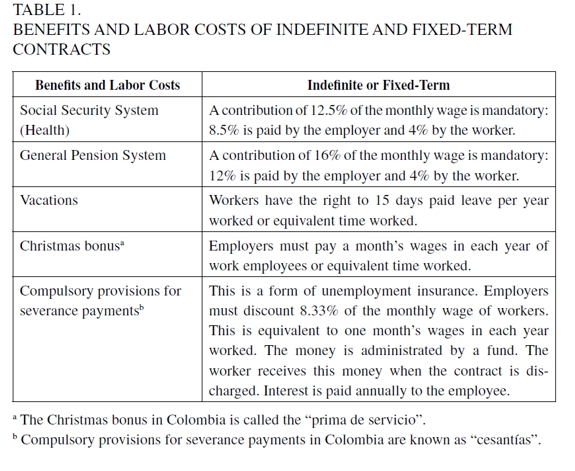
The Table 1 summarizes the benefits and labor costs of hiring a worker in Colombia under an indefinite or fixed-term contract.
Main Labor Law Reforms related to Fixed-Term and Indefinite Contracts
The Labor Code, i.e. the set of laws governing employer-employee relations in Colombia, was signed in 1950 and, since that year, the regulation of fixed-term contracts (article 46) has changed three times,3 in 1954, 1965 and 1990. These reforms have eliminated the minimum and extended the maximum possible term of fixed-term contracts making this type of hiring more flexible. Moreover, the 2002 law changed the regulation of indefinite contracts. The Decree of 1954 imposed a minimum duration of four months for fixed-term contracts. In 1965, a new decree increased the minimum term of fixed-term contracts to one year and the maximum from two to three years. However, this decree allowed firms to sign fixed-term contracts for less than one year only for casual, one-off and temporary work.
The Table 2 summarizes the main changes directly related to the regulation offixed-term contracts.

In 1990, Law 50 was passed just when Colombia was beginning to open up its economy. Hence, the goal of the law was to increase flexibility in hiring conditions, improve the competitiveness of firms and enable them to adapt better to international trade.
As shown in the table above, this law allows workers to be hired on fixed-term contracts for less than 1 year for jobs not entailing only casual, one-off or temporary labor as regulated by the decree of 1965. In other words, Law 50 "decausalizes" fixed-term contracts.
Law 50 also limited the use of fixed-term contracts through intermediary companies and created the so-called Temporary Services Companies - TSCs. From that moment on, firms could hire workers through TSC only for casual work, to replace staff and to cater for increases in production as mentioned above. This law regulated the indirect hiring of workers and obliged TSCs to pay wages equivalent to those of indefinite workers and other legal payments (vacation payand Christmas bonuses). Moreover, it obliged them to offer the same benefits as indefinite contract workers in terms of transport, food and recreation. Before law 50, an intermediary company could hire workers with fixed-term contracts with similar characteristics of those with indefinite contracts, but with lower wages and without paying social security contributions even though workers with fixed-term contracts did similar work to indefinite contract holders.
Law 50 of 1990 also introduced the "integrated wage". This type of wage includes the proportional part of the legal monthly contributions to Christmas bonuses,compulsory severance provisions and interest on them in monthly payments. This type of wage applies to amounts more than 10 times the legal minimum wage. Before 1990, this "integrated wage" salary did not exist.
The latest reform (Law 789) of contracts was introduced in Colombia in 2002. In that year, Colombia had an unemployment rate of 17.9% and an underemployment rate of 32%. Accordingly, Law 789 of 2002 was passed with the main goal of reducing the unemployment rate by encouraging firms to hire workers, especiallyheads of households, the over-50s and the unemployed. Moreover, this law increased the maximum working day by 4 hours allowing a reduction in labor costs for firms associated with night work, which in Colombia is paid at 35% more than the daytime rate4.
Law 789 did not change the regulations on fixed-term contracts, i.e. Article 46 of the Labor Code (unlike the previous reforms listed in Table 2), but dealt with labor costs of indefinite contracts via a change in the rate of indemnity.
Among the changes related to indefinite contracts, this law reduced firing costs for firms in cases of unfair dismissal. It established compensations for wages below and above 10 times the legal minimum wage, considerably reducing compensation for workers who earn 10 times the legal minimum or more.
Before 2002, indemnity in case of unfair dismissal of workers with indefinite contracts did not discriminate between workers who gained more or less than 10 times the legal minimum wage. In any case, firms had to pay according to the following rules:
a) 45 days' wages for workers with 1 year of tenure or less.
b) A further 15 days' wages over the basic 45 days for each year of work in addition to the first year, for workers with more than 1 year and less than 5 years of tenure.
c) A further 20 days' wages over the basic 45 days for each year of work in addition to the first year for workers with more than 5 years and less than 10 years of tenure.
d) A further 40 days' wages over the basic 45 days for each year of work in addition to the first year for workers with more than 10 year of tenure.
Law 789 established compensation for workers with indefinite contracts as follows:
1) For workers who earn 10 times the legal minimum wage per month or less:
a) 30 days' wages for workers with 1 year of tenure or less.
b) A further 20 days' wages over the basic 30 days for each year of work in addition to the first year for workers with more than 1 year of tenure.
2) For workers who earn more than 10 times the legal minimum wage per month:a) 20 days' wages for workers 1 year of tenure or less.
b) A further 15 days' wages over the basic 20 days for each year of work in addition to the first year for workers with more than 1 year of tenure.
The following table summarizes the cost of indemnity before and after law 789 of 2002.
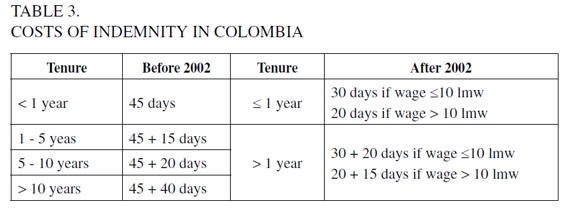
This law, therefore, considerably reduced the costs of indemnity borne by firms, reducing the number of days' wages for indemnity. So, for example, an unfairly dismissed worker with 11 years of tenure before law 789 of 2002 received the equivalent of 445 (45 + 10 * 40) days' wages, but now receives 230 (30 + 20 * 10) if he/she earns less than 10 times the legal minimum wage and 170 (20 + 15 * 10) if he/she earns 10 time the legal minimum wage or more.
When a worker with a fixed-term contract is laid off before the end of the contract,the severance payment due is the amount in wages equivalent to the remaining period up to the end of the contract. However, compensation cannot be less than 15 days' wages.
So the main difference between indefinite and fixed-term contracts is in the dismissal costs borne by firms. This enormous difference clearly encourages firms to use fixed-term contracts, and turns fixed-term contracts into a form of permanent hiring but with lower costs than indefinite contracts. In Colombia, labor flexibility may have contributed to an increase in the number of fixed-term contracts, which may, in part, have replaced recruitment through indefinite contracts.
DATA AND DESCRIPTIVE STATISTICS
The data are drawn from the Colombian Household Survey, carried out by the Colombian National Statistical Department (DANE). This survey contains individual information about the size and structure of the labor force, living conditions and the structure of incomes and expenditures of Colombian households. This survey is cross-sectional and it does not contain information about the work history of employees.
The information used here is for the second quarter of 2011, the latest household survey available. Previous years are not used because at least for the last 5 years, for which comparable data are available, the proportion of fixed-term contracts has barely changed - it increased from 28% in 2007, to 31% in 2011. Needless to say, it would have been very interesting to measure the impact of fixed-term contracts before and after the reforms, but comparable data from the Colombian Household Survey are not available for the years before 2007. Hence, this study is limited to measuring the impact of fixed-term contracts in a static framework and in the most recent context.
The sample is restricted to public and private sector salaried employees who have a written contract (representing 82% of workers), aged between 18 and 65 who work between 16 and 84 hours per week5 and live in the 13 largest metropolitan areas: Barranquilla, Bucaramanga, Bogotá, Bolívar, Manizales, Medellín, Cali, Córdoba, Pasto, Villavicencio, Pereira, Tolima and Cúcuta (people living in these cities account for 78% of the population of Colombia, according to the 2005 census6).
The survey enquires about workers' the monthly wage. Therefore, hourly wages are computed by dividing the monthly wage by the average number of weeks in a month (4.28 weeks by month) times worked hours. Variable tenure measures the number of months of experience in the current job. Age is measured in years and age squared is used for checking the non-linear effect of age. Indicators of gender, marital status, education, type of employment, size of firm, economic sector, occupation and region are dummy variables.
The corresponding sample weights are applied in all descriptive statistics.
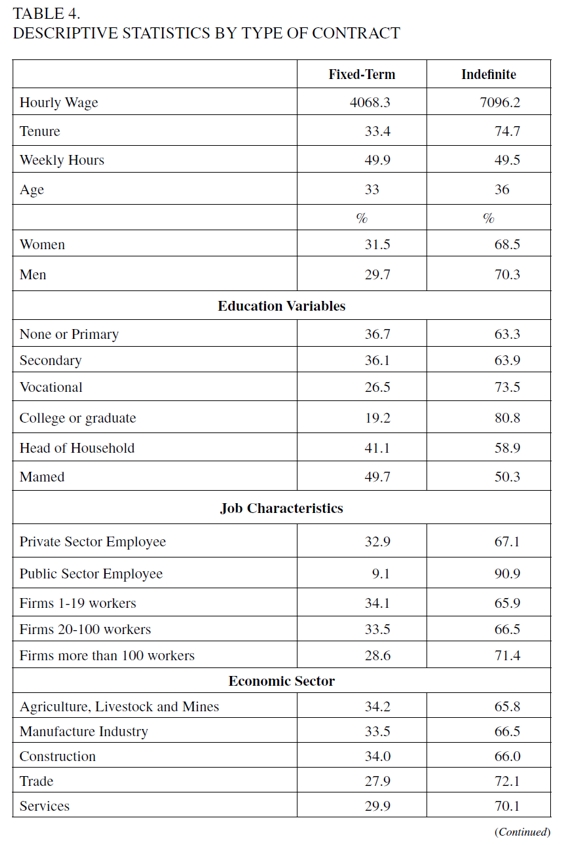
Table 4 presents descriptive statistics by type of contract. There are major differences in wages per type of contract. Workers with fixed-term contracts earn lower hourly wages than those with indefinite contracts - the raw gap is around 43%. On average, workers with fixed-term contract are 3 years younger, have less than half of the tenure and work almost the same hours per week than workers with indefinite contracts.
By educational levels, the least educated workers are most likely to have fixed-term contracts. 37% of workers with primary education or less and 36% of those with secondary education have fixed-term contracts, while for vocational qualification holders and college graduates the figures are 26% and 19% respectively.
The proportion of workers with fixed-term contracts is greater in the private sector at 33%, compared to 9% in the public sector. The lower percentage of workers with fixed-term contracts in the public sector is a standard fact: most public-sector workers are civil servants, who by definition have indefinite contracts.
Small firms (those with less than 20 employees) have a greater proportion of fixed-term contracts than larger firms. The overall proportions are 34% for small firms, the same figure for medium-sized firms, and 29% for firms with more than 100 employees.
The sectors of the economy with the highest proportions of fixed-term contract holders are, Agriculture, Livestock and Mines (34.2%), Construction (34%) and the Manufacturing Industry (33.5%).
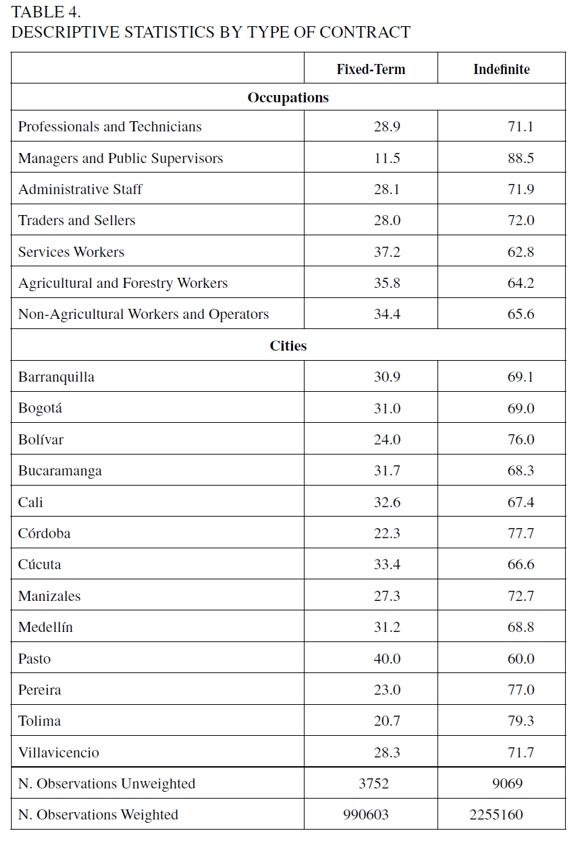
With respect to occupations, the highest proportions of fixed-term contract holders are found in Services (37%), followed by Agricultural and Forestry Workers (35%) and Non-Agricultural Workers and Operators (34%). The lowest figure is found among Managers and Public Supervisors at around 12%.
The metropolitan area with the highest proportion of fixed-term contracts is Pasto,with 40%, followed by Cúcuta and Cali with 33% each. The lowest proportions are found in the cities of Tolima (21%), Córdoba (22%) and Pereira (23%). In the capital city, Bogotá, 31% of workers have fixed-term contracts.
In general, the groups with the highest proportions of fixed-term contract holders are women, young workers, with secondary education or less, working in the private sector, in small firms, in economic sectors such as Agriculture, Livestock and Mines and Construction, and in occupations such as Agricultural and Forestry Workers and Non-agricultural workers and operators.
PROBABILITY OF HAVING A FIXED-TERM CONTRACT
The group of workers most exposed to fixed-term contracts is identified above. However, the statistics shown are descriptive and no controls for observed characteristics are included. Therefore, this section compares the probabilities of having fixed-term contracts among workers who share similar personal, demographic and other job characteristics.
The dependent variable takes the value of one for workers with fixed-term contracts and zero for those with indefinite contracts. Dummies for female gender, age group, education, marital status, size of firm, type of employment, economic sector, occupation and metropolitan area are included.
Marginal effects of probit estimations are reported in Table 5.
Female workers are 3% more likely to have fixed-term contracts than men with similar observed characteristics. Moreover, one additional year of age decreases the probability of having a fixed-term contract and the effect is concave and small.
The probability of having a fixed-term contract decreases as worker education levels increase, i.e. highly educated workers are less likely to have fixed-term contracts than those with primary or less education. Workers with secondary education are 3.2% less likely to have such contracts, and graduate workers are 12% less likely.
Workers with more months of tenure have lower probability as well as those who are heads of household and married, but the effect is small.
In the case of labor characteristics, results show that being a private sector employee increases the probability of having a fixed-term contract by 19.3% in comparison to public employee status, whereas the size of firms is not relevant in probability.
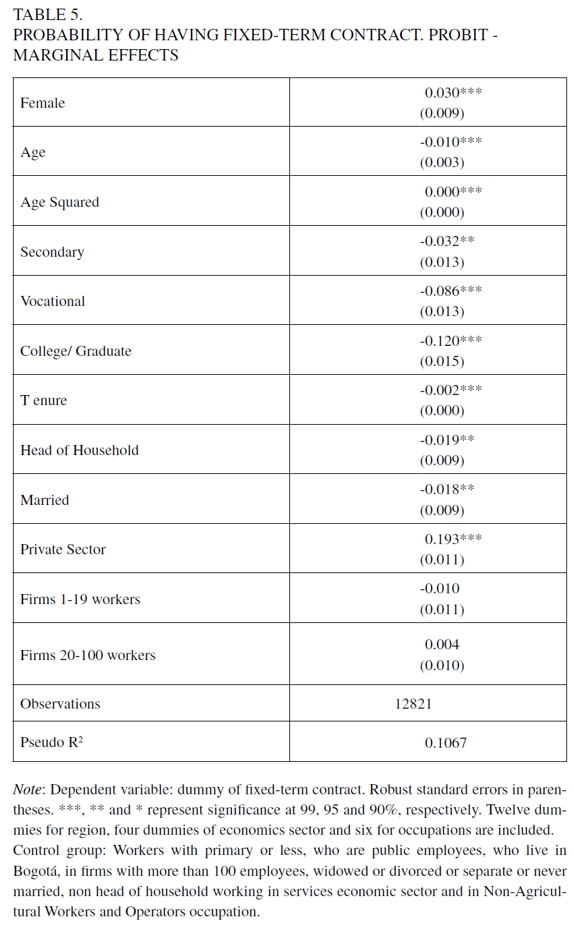
Workers employed in the Agriculture, Livestock and Mines and in the Manufacturing Industry sector are more likely to have fixed-term contracts than those in Services and less likely than those in Trade. Results in Agriculture, Livestock and the Mining sector can be explained, in part, by the increase in the proportion of fixed-term contracts due to the mining boom in the country in recent years.
So far, results show that being a woman, private employee and working in some economic sectors all increase the probability of having a fixed-term contract, whereas age, tenure and having more than a primary education decrease it.
These results are in the line with authors Gebel and Giesecke (2008) whose findings showed that young and people with a low level of education faced an increasing risk of holding a fixed-term contract in Germany, which, in turn, increases social inequalities.
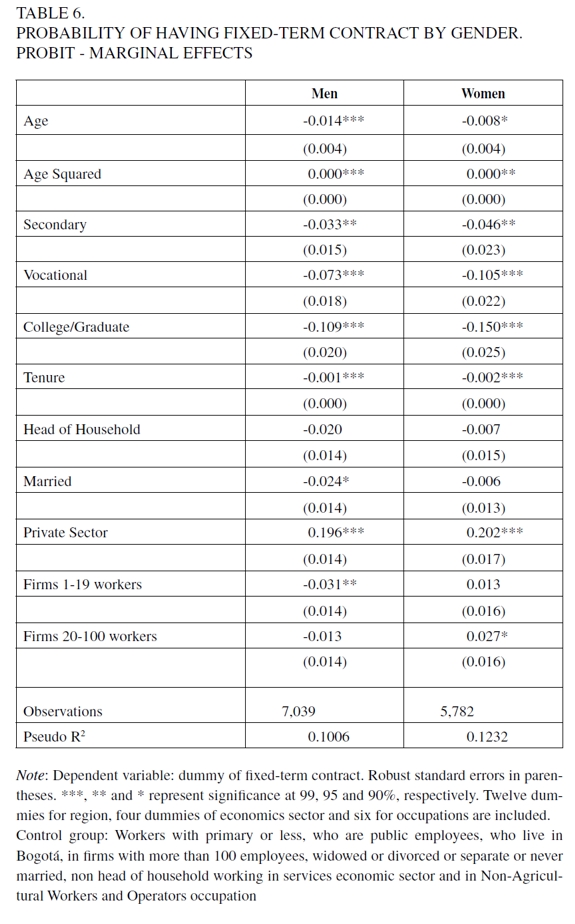
Table 6 presents estimations of the probability of having a fixed-term contract for men and women separately to check for any potential differential effects by gender. Results are very similar in terms of sign and magnitude of regressors, except in education variables where the effect of human capital accumulation is stronger in reduction probability for women than for men.
THE IMPACT OF FIXED-TERM CONTRACTS
As mentioned above, the negative effects of fixed-term contracts on wages, job training, promotion and family decisions are well documented in some European countries and in the USA. In Colombia, the effects on workers of the different types of contract are a relevant aspect of the labor market which has not been analyzed in depth in spite of its prevalence. Therefore, the analysis of the impact of fixed-term contracts on labor and other sociodemographic issues in Colombia deserves special attention.
Unfortunately, the Colombian household survey does not contain information which would enable the effects of fixed-term contracts to be factored into relevant aspects such as promotion, job training and other household decisions, e.g., number of children and level of savings. However, given the information available, it is possible to analyze the effects of fixed-term contracts on wages and on the level of job satisfaction of workers.
Wages and Fixed-Term Contacts
Empirical research into the effects of types of contract in European countries reveals that on average fixed-term contract holders earn less than similar workers with indefinite contracts.
For Spain, De la Rica (2006) reports an observed (raw) wage gap between fixedterm and indefinite contract holders of 12%, but interestingly the gap increases when workers with similar characteristics are compared. Using OLS estimation the author reports that fixed-term contract workers receive hourly wages, which are on average 15% lower than those of similar workers with indefinite contracts.
For West Germany, Mertens and McGinnity (2005) found that the hourly wages of men with fixed-term contracts are 32% lower than those of employees with indefinite contracts; however, the gap falls to 15% when personal and job characteristics are controlled for. They use OLS estimation and quantile regression to compute the wage penalty of fixed-term contracts across the wage distribution, and conclude that workers with fixed-term contracts at the high end of the distribution earn slightly less than those with indefinite contracts. However, the gap increases notably when workers at the low end are considered. Mertens, Gash, and McGinnity (2007) perform the same analysis comparing wage penalty of fixed-term contract across the wage distribution of Germany and Spain.
For Britain, Booth et al. (2002) show that male fixed-term contract holders earn (per hour) 16% less than indefinite contract holders whereas female fixed-term contract holders earn 13% more than their indefinite-contract holding counterparts. However, using OLS estimation, authors show that the indefinite/fixed-term wage gap is 17% for men and 14% for women.
For Colombia, on average, workers with fixed-term contracts earn 43% less than workers with indefinite contracts. However this is the raw gap. Personal and job characteristics must be controlled for and the gap computed for comparisons of similar workers (adjusted gap).
First, an estimation of the wage gap using OLS is shown and then the potential problem of endogeneity is analyzed.
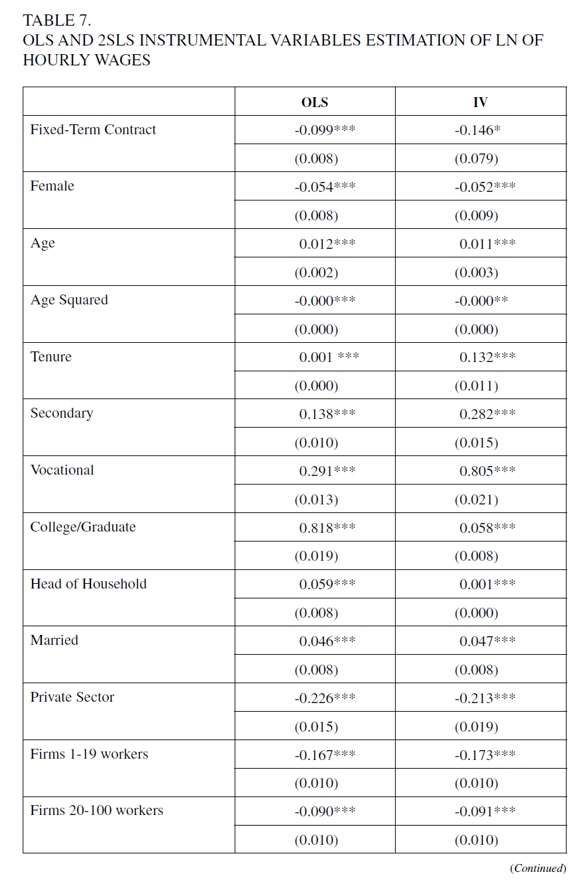
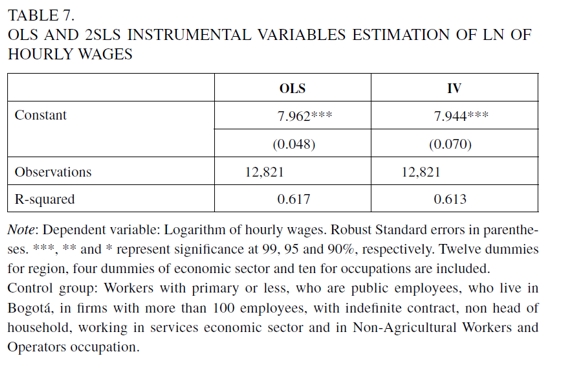
The first columns of Table 7 report estimated hourly wages per type of contract by OLS, once a set of personal and job characteristics are also included as regressors. Robust standard errors are reported in brackets. The coefficient of the variable fixed-term contract is negative and statistically significant. Quantitatively, the adjusted gap between fixed-term and indefinite contracts is of around 10%. These findings are similar to the results reported by Booth et al. (2002); Mertens and McGinnity (2005), where differences seen in personal and job characteristics, explain an important part of the raw wage gap by type of contract7.
Addressing Unobserved Heterogeneity across Individuals by Type of Contract
The assumption behind the last OLS estimation of wages is that once observed characteristics are controlled for, there are no unobserved differences in productivity which might determine wage gaps between workers with fixed-term and indefinite contracts. However, if this assumption is not satisfied and there is unobserved heterogeneity across individuals, the coefficients reported for the fixed-term contract variable is biased. If fewer productive workers are more likely to have fixed-term contracts and therefore obtain lower wages, this may be a result of those workers being less productive and not of their having (exogenously) a different contract. In this scenario, the error term of the estimation would be correlated with fixed-term dummy variable generating an estimation bias.
In order to check the endogeneity problem of the fixed-term contract regressor, a robust Durbin-Wu-Hausman test was performed. The result leads to a clear rejection of the null hypothesis that the dummy for fixed-term contracts is an exogenous variable. In order to solve this problem and to obtain the causal effect of having a fixed-term contract on wages; that is, to measure the true wage gap by type of contract when there are in theory no productivity differences between workers, fixed-term contract variable is instrumented and the gap is estimated using an Instrumental Variable Method. The lag rate of fixed-term contracts by region and economic sector is used. Accordingly, the proportion of fixed-term contracts per region and economic sector for 2010 is used.
The condition for the validity of the instrument holds if the instrument is correlated with having a fixed-term contract, but not related to individual productivity. The identification assumption is that there is high persistency from one year to another in the proportion of fixed-term contracts per region and economic sector, and those employees who live in a particular region and work in a particular economic sector where there is a high proportion of fixed-term contracts are more likely to be hired via such contracts. Correlation between the instrument and the endogenous variable is 0.3310. Information on the F-statistic in the first stage is used to check that the chosen instrumental variable is not weakly correlated with the regressors.8
To further check the robustness of the instrument, a conditional analysis is performed. We estimate the impact of the instrumental variable on hourly wages once we control for all explanatory variables, joint with the indicator about whether worker has a fixed-term contract. Given that coefficient of the instrumental variable is not significant predictor of hourly wages, we can conclude that the lag rate of fixed-term contracts by region and economic sector can be used as an instrument.
The endogenous variable is a dummy variable, so the Two Stage Least Square Instrumental Variable method (2sls IV) cannot be used directly, because the correct specification of the first stage must be a nonlinear estimation, such as a Probit model. However 2sls IV is only guaranteed to produce first-stage residuals that are uncorrelated with fitted values and covariates if the first stage is estimated by OLS. Therefore, following Angrist and Pischke (2008) the gap per type of contract is estimated as following: i) the fixed-term contract indicator is regressed on a set of exogenous control variables, including the instrument, using a probit model; ii) the nonlinear fitted values (those obtained in the first stage) are then used as the instrument to estimate the wage gap by the conventional 2sls IV procedure9. Therefore, instead of using the lag rate of fixed-term contracts in the region and economic sector directly as an instrument, it is used to get the nonlinear fitted values.
Second column of Table 4 reports 2sls IV estimated coefficients. The wage penalty for having a fixed-term contract is around 15%, which is bigger than the one obtained when unobserved heterogeneity across the productivity of individuals is not controlled for10. Therefore, the OLS approach underestimated the real impact of fixed-term contract on wages. Workers with fixed-term contract, but similar personal and other job characteristics receive on average 15% lower hourly wages than those with an indefinite contract.
Level of Satisfaction
Booth et al. (2002) used an ordered probit model to estimate different components of job satisfaction, such as promotion prospects, total pay, relationship with the boss, security, initiative, work itself and hours worked. They found no difference in overall job satisfaction between fixed-term and indefinite contract holders in Britain. However, they found that workers with fixed-term contracts are less satisfied than permanent workers in aspects such as promotion prospects and job security.
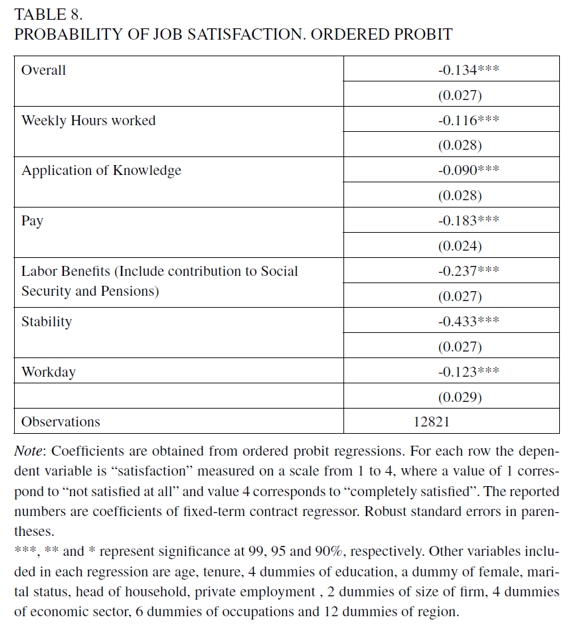
The Colombian household survey asks workers about six different levels of job satisfaction as well as an overall measure such as: weekly hours worked, application of knowledge, pay, labor benefits (including contribution to social security and pensions), stability and workday. Each aspect of job satisfaction is measured on a scale of 1 to 4, where value 1 corresponds to "not satisfied at all" and value 4 corresponds to "completely satisfied". Despite its measurement problems and despite being a subjective measure, this may help provide an understanding of the differential effects of fixed-term versus indefinite contracts in the labor market.
To the extent that fixed-term contract holders perceive important disadvantages in the labor market in comparison with indefinite contract holders, they are likely to report lower levels of satisfaction.
In order to measure how the level of job satisfaction is affected by holding a fixed-term contract, an ordered probit model is estimated in this section. Each row of Table 5 shows coefficients of fixed-term contract variable on the probability of satisfaction. Observable personal and job characteristics such as gender, age, education, head of household, marital status, tenure, economic sector and occupation are included as regressors. Once these controls are included, in all estimations, results reveal that fixed-term contracts workers are significantly less likely to be satisfied than indefinite contract workers. Women report lower levels of satisfaction than men except in overall measure, application of knowledge, and stability estimations where there are no differences by gender.
These findings confirm that workers perceive disadvantages in having fixed-term contracts as compared to indefinite contracts.
CONCLUSIONS
Around 31% of workers in Colombia have fixed-term contracts. This proportion is high compared to some European countries, where fixed-term hiring has been widely studied. Given that in Colombia there is no published research into the effects of fixed-term contracts on workers, this paper analyzes the impact of fixedterm contracts on wages and worker satisfaction levels.
The labor reforms of the past 20 years have reduced the labor costs of hiring workers and have led to a more flexible way of hiring, given that, in general, they have been aimed at allowing firms to use fixed-term contracts with no need for specific reasons. Given that fixed-term contracts clearly entail lower dismissal costs than indefinite contracts and can be renewed indefinitely, firms have incentives to use them.
Estimations of a probit model confirm that women, young, low-educated workers, in the private sector and in Agriculture, Livestock and Mines and in the Manufacturing Industry are most likely to have fixed-term contracts. Moreover, accumulation of human capital has a major effect on reducing that likelihood, especially for women.
The impact of fixed-term contracts on wages and on job satisfaction is also analyzed.
The raw wage penalty of workers with fixed-term contracts is 43% in 2011, but when differences in observable personal and job characteristics are controlled for, that penalty falls to 10%, according to OLS estimation. However, the endogeneity test confirms the need to use an Instrumental Variable method, since the hypothesis of exogeneity of fixed-term contracts is rejected. This confirms that the use of OLS underestimates the wage gap per type of contract. When IV estimates are used, the adjusted wage penalty increases to 15%.
Finally, results confirm that having a fixed-term contract makes it less likely that workers will be satisfied with different aspects of their job such as: weekly hours worked, application of knowledge, pay and other labor benefits, stability, workday and with the job as an overall measure. Women are less likely to be satisfied in the majority of these measures.
Overall, these findings are consistent with theories of temporary work. Workers with fixed-term contracts in Colombia have clear disadvantages in the labor market because they receive lower wages and report lower levels of job satisfaction.
Future research should attempt to analyze whether fixed-term contracts in Colombia are a stepping-stone to an indefinite contract or a trap whereby once a worker gets this type of contract, it makes it very hard for him/her to obtain an indefinite one (In the line of the authors Scherer, 2004 and Pavlopoulos, 2009).
FOOTNOTES
1 Unfortunately, available data is cross-sectional and it does not contain information about work history of employees, which does not allow study other type of effects of fixed-term contracts on workers in Colombia.
2 The Labor Code was drawn up in 1950 to compile the laws governing employer-employee relations in Colombia.
3 The fixed-term contract existed before 1950 and there was a regulation for it in Colombia, which was incorporated into the Labor Code.
4 The Labor Code establishes that night work in Colombia must be paid at a higher rate than the hourly wage for daytime work. Before 2002, the working day was defined as running from 6 a.m. to 6 p.m. With the introduction of Law 789 it now runs from 6 a.m. to 10 p.m.
5 The survey contains employees who report to work between 1 and 130 hours per week; however, employees who work less than 16 and more than 84 hours per week are excluded from the sample in order to avoid outliers.
6 Because fixed-term contracts must be written contracts, workers with verbal contracts are excluded, as are domestic workers since most of them have verbal contracts.
7 The same estimation, but including an interaction of a fixed-term dummy with female gender was carried out in order to determine whether the impact of the type of contract on wages differs with gender. Given that the interaction variable is not statistically significant, it is concluded that the negative impact of fixed-term contracts is similar for men and women. Moreover, estimations of wage penalty by type of contract separately for men and women show that its magnitude is the same.
8 The null hypothesis of this test is that the instrument be irrelevant in the first stage. Given that in this case, the F-statistic is much larger than 10, following Staiger and Stock (1997) it is possible to conclude that the instrument is a good predictor of the fixed-term variable.
9 Conventional 2sls IV estimates the effect of the endogenous regressor on outcome in two stages: i) in the first stage, the endogenous variable is regressed against the instrument and a set of exogenous covariates using OLS; ii) in the second stage, the dependent variable is estimated by OLS against the same set of exogenous covariates as in the first stage and using information from the first estimation to instrument the endogenous variable.
10As in the case of the OLS estimation, the interaction variable of female with fixed-term contract is not statistically significant. The estimation of 2sls IV with the interaction variable follows the same procedure but with two instruments, one for each endogenous variable. Given that interaction is also an endogenous variable, the nonlinear fitted values times the dummy for female gender is used as the instrument of the endogenous interaction variable and the nonlinear fitted values as the instrument of the dummy fixed-term contract variable.
REFERENCES
[1] Angrist, J., & Pischke, J. (2008). Mostly harmless econometrics: An empiricist's Companion. London, UK.: Princeton University Press.
[2] Barceló, C., & Villanueva, E. (2010). The response of household wealth to the risk of losing the job: Evidence from differences in firing costs (Documentos de Trabajo 1002). Banco de España.
[3] Booth A., Francesconi, M., & Frank, J. (2002). Temporary jobs: Stepping stone or dead ends?. The Economic Journal, 112(480), 189-213.
[4] De la Rica, S., & Iza, A. (2005). Career planning in Spain: Do fixed-term contracts delay marriage and parenthood? Review of the Economics of the Household, 3, 49-73.
[5] De la Rica, S. (2006). La penalización salarial de temporalidad: ¿Qué efectos tiene en las decisiones familiares?, propuesta de reactivación laboral, Propuesta para la reactivación laboral en España. Libro Electrónico. Fedea.
[6] Gebel, M., & Giesecke, J. (2008). Labour market flexibility and inequality: The changing risk patterns of temporary employment in Germany (Working Paper 112). Mannheimer Zentrum für Europäische Sozialforschung.
[7] Giesecke, J., & Groβ, M. (2003). Temporary employment: Chance or risk. European Sociological Review, 19(2), 161-177.
[8] Giesecke, J., & Groβ, M. (2004). External labour market flexibility and social inequality. European Societies, 6(3), 347-382.
[9] Güell, M. (2000). Fixed-term contracts and the duration distribution of unemployment (Working Paper 443). Princeton University.
[10] Jimeno, J., & Toharia, L. (1993). The effect of fixed-term employment on wages: Theory and evidence from Spain. Investigaciones Económicas, 17(3), 475-494.
[11] Mertens, A., & McGinnity, F. (2005). "A Two-Tier" labour market for fixed-term jobs. Evaluating evidence from west Germany using quantile regression (Working Paper 1). Of the project employment relationships at risk, Schmollers Jahrbuch.
[12] Mertens, A., Gash, V., & McGinnity, F. (2007). The cost of flexibility at the margin. Comparing the wage penalty for fixed-term contracts in Germany and Spain using quantile regression. Labour 21, 637-666.
[13] OECD (2011).
[14] Segal, L., & Sullivan, D. (1997). The growth of temporary services work. The Journal of Economic Perspectives, 11(2), 117-136.
[15] Scherer, S. (2004). Stepping-stones or traps? The consequences of labour market entry positions on future careers in west Germany, great Britain and Italy. Work, Employment and Society, 18(2), 369-394.
[16] Staiger, D., & Stock, J. (1997). Instrumental variables regression with weak instruments. Econometrica, 65(3), 557-586.
[17] Pavlopoulos, D. (2009). Starting your career with a fixed-term job: Stepping-Stone or "Dead End"? SOEP papers on Multidisciplinary Panel Data Research 228, DIW Berlin, The German Socio-Economic Panel (SOEP).
Referencias
Angrist, J., & Pischke, J. (2008). Mostly harmless econometrics: An empiricist's Companion. London, UK.: Princeton University Press.
Barceló, C., & Villanueva, E. (2010). The response of household wealth to the risk of losing the job: Evidence from differences in firing costs (Documentos de Trabajo 1002). Banco de España.
Booth A., Francesconi, M., & Frank, J. (2002). Temporary jobs: Stepping stone or dead ends?. The Economic Journal, 112(480), 189-213.
De la Rica, S., & Iza, A. (2005). Career planning in Spain: Do fixed-term contracts delay marriage and parenthood? Review of the Economics of the Household, 3, 49-73.
De la Rica, S. (2006). La penalización salarial de temporalidad: ¿Qué efectos tiene en las decisiones familiares?, propuesta de reactivación laboral, Propuesta para la reactivación laboral en España. Libro Electrónico. Fedea.
Gebel, M., & Giesecke, J. (2008). Labour market flexibility and inequality: The changing risk patterns of temporary employment in Germany (Working Paper 112). Mannheimer Zentrum für Europäische Sozialforschung.
Giesecke, J., & Groβ, M. (2003). Temporary employment: Chance or risk. European Sociological Review, 19(2), 161-177.
Giesecke, J., & Groβ, M. (2004). External labour market flexibility and social inequality. European Societies, 6(3), 347-382.
Güell, M. (2000). Fixed-term contracts and the duration distribution of unemployment (Working Paper 443). Princeton University.
Jimeno, J., & Toharia, L. (1993). The effect of fixed-term employment on wages: Theory and evidence from Spain. Investigaciones Económicas, 17(3), 475-494.
Mertens, A., & McGinnity, F. (2005). "A Two-Tier" labour market for fixed-term jobs. Evaluating evidence from west Germany using quantile regression (Working Paper 1). Of the project employment relationships at risk, Schmollers Jahrbuch.
Mertens, A., Gash, V., & McGinnity, F. (2007). The cost of flexibility at the margin. Comparing the wage penalty for fixed-term contracts in Germany and Spain using quantile regression. Labour 21, 637-666.
OECD (2011).
Segal, L., & Sullivan, D. (1997). The growth of temporary services work. The Journal of Economic Perspectives, 11(2), 117-136.
Scherer, S. (2004). Stepping-stones or traps? The consequences of labour market entry positions on future careers in west Germany, great Britain and Italy. Work, Employment and Society, 18(2), 369-394.
Staiger, D., & Stock, J. (1997). Instrumental variables regression with weak instruments. Econometrica, 65(3), 557-586.
Pavlopoulos, D. (2009). Starting your career with a fixed-term job: Stepping-Stone or "Dead End"? SOEP papers on Multidisciplinary Panel Data Research 228, DIW Berlin, The German Socio-Economic Panel (SOEP).
Cómo citar
APA
ACM
ACS
ABNT
Chicago
Harvard
IEEE
MLA
Turabian
Vancouver
Descargar cita
CrossRef Cited-by
1. Luz Karime Abadía Alvarado, Sara De la Rica. (2020). The evolution of the gender wage gap in Colombia: 1994 and 2010. Cuadernos de Economía, 39(81), p.857. https://doi.org/10.15446/cuad.econ.v39n81.73820.
2. Máté Vörös, Zsófia Ásványi, Diána Ivett Fűrész. (2022). The Hard Truth on Fixed-Term Employment and Organizational Performance – Survey-Based Evidence from Hungary. Zagreb International Review of Economics and Business, 25(2), p.165. https://doi.org/10.2478/zireb-2022-0020.
Dimensions
PlumX
Visitas a la página del resumen del artículo
Descargas
Licencia
Derechos de autor 2014 Cuadernos de EconomíaCuadernos de Economía a través de la División de Bibliotecas de la Universidad Nacional de Colombia promueve y garantiza el acceso abierto de todos sus contenidos. Los artículos publicados por la revista se encuentran disponibles globalmente con acceso abierto y licenciados bajo los términos de Creative Commons Atribución-No_Comercial-Sin_Derivadas 4.0 Internacional (CC BY-NC-ND 4.0), lo que implica lo siguiente: