Correo Electrónico
 DNINFOA - SIA
 Bibliotecas
 Convocatorias
 Identidad U.N.



Publicado
Cambiando de perspectiva en la economía de la mitigación del cambio climático
Changing of perspective in the economics of climate change mitigation
Mudando de perspectiva na economia da mitigação da mudança climática
DOI:
https://doi.org/10.15446/cuad.econ.v36n70.49726Palabras clave:
cambio climático, inequidad intergeneracional, tasa de descuento, incertidumbre, sostenibilidad (es)Climate change, intergenerational inequality, discount rate, uncertainty, sustituibility (en)
Mudança climática, desigualdade intergeracional, taxa de desconto, incerteza, sustentabilidade (pt)
Este artículo plantea una discusión de las corrientes de la economía que han abordado la relación entre el cambio climático (CC) con el sistema económico. Se realiza un análisis crítico de la economía del bienestar, que ve el CC como una externalidad y se enfoca en el valor presente el bienestar futuro por medio de la tasa social de descuento, y se plantea un giro hacia la economía ecológica, fundamentada en la sostenibilidad fuerte, la incertidumbre irreductible y una base normativa diferente. Con esto, se cuestiona la relevancia del crecimiento del consumo como fundamento del desarrollo. Al final del artículo, se enfatiza sobre la importancia de este giro para la investigación y la evaluación de la política climática.
Cambiando de perspectiva en la economía de la mitigación del cambio climático
Changing of perspective in the economics of climate change mitigation
Changement de perspective dans l'économie de la mitigation du changement climatique
Mudando de perspectiva na economia da mitigação da mudança climática
Alejandro Mora-Motta a
Nohra León Rodríguez b
aEconomista, magíster en Medio Ambiente y Desarrollo, candidato a PhD, Centro de Estudios para el Desarrollo, Universidad de Bonn, Alemania. Correo electrónico: amoramo@unal.edu.co.
b PhD en Ciencias Económicas, directora del Departamento de Geografía, Facultad de Ciencias Humanas, Universidad Nacional de Colombia. Correo electrónico: nleonr@unal.edu.co.
El presente trabajo deriva de la tesis de maestría de Alejandro Mora-Motta (2014), bajo la dirección de Nohra León Rodríguez. Los autores agradecen a Jairo Sánchez, Andrea Lampis, Carmenza Castiblanco y Carlos Díaz por sus comentarios a este documento.
Sugerencia de citación: Mora-Motta, A., & León Rodríguez, N. (2017). Cambiando de perspectiva en la economía de la mitigación del cambio climático. Cuadernos de Economía, 36(70), 169-195. doi: 10.15446/cuad.econ.v36n70.49726
Resumen
Este artículo plantea una discusión de las corrientes de la economía que han abordado la relación entre el cambio climático (CC) con el sistema económico. Se realiza un análisis crítico de la economía del bienestar, que ve el CC como una externalidad y se enfoca en el valor presente el bienestar futuro por medio de la tasa social de descuento, y se plantea un giro hacia la economía ecológica, fundamentada en la sostenibilidad fuerte, la incertidumbre irreductible y una base normativa diferente. Con esto, se cuestiona la relevancia del crecimiento del consumo como fundamento del desarrollo. Al final del artículo, se enfatiza sobre la importancia de este giro para la investigación y la evaluación de la política climática.
Palabras clave: cambio climático, inequidad intergeneracional, tasa de descuento, incertidumbre, sustituibilidad.
JEL: Q01, Q54, Q56, Q57.
Abstract
This paper presents a discussion of the economic theories that have addressed the relationship between climate change (CC) and the economic system. The document critically analyses the welfare economics viewpoint, which sees CC as an externality and focuses on the present value of future welfare by using a social discount rate. We propose a shift towards ecological economics, which is founded on strong sustainability, the irreducibility of uncertainty, and a different normative basis. As such, we discuss the relevancy of growth consumption as a fundament for development. The paper concludes by emphasizing the relevance of this shift for climate research and policy evaluation.
Keywords: Climate change, intergenerational inequality, discount rate, uncertainty, sustituibility.
JEL: Q01, Q54, Q56, Q57.
Résumé
Cet article propose une discussion sur les courants de l'économie qui ont traité de la relation entre le changement climatique (CC) et le système économique. Il est procédé à une analyse critique de l'économie du bien-être qui voit le CC comme une externalité et pointe la valeur actuelle du bien-être futur au moyen du taux social de décompte, et envisage un virage vers l'économie écologique fondée sur la forte soutenabilité, l'incertitude irréductible et une base normative différente, ce qui remet en question la pertinence de la croissance de la consommation comme base du développement. Pour finir, l'article souligne l'importance de ce virage pour la recherche et l'évaluation de la politique climatique.
Mots-clés : Changement climatique, inégalité intergénérationnelle, taux de décompte, incertitude, soutenabilité.
JEL : Q01, Q54, Q56, Q57.
Resumo
Este artigo propõe um debate sobre as correntes da economia que têm abordado a relação entre a mudança climática (MC) com o sistema econômico. É feita uma análise crítica da economia do bem-estar, que vê essa mudança como uma externalidade e se centra no valor presente ou bem-estar futuro mediante a taxa social de desconto e é proposta uma virada para a economia ecológica, fundamentada na sustentabilidade forte, a incerteza irredutível e uma base normativa diferente. Com isto, é contestada a relevância do crescimento do consumo como fundamento do desenvolvimento. No final do artigo, dá-se ênfase à importância desta virada para a pesquisa e a avaliação da política climática.
Palavras-chave: Mudança climática, desigualdade intergeracional, taxa de desconto, incerteza, sustentabilidade.
JEL: Q01, Q54, Q56, Q57.
Este artículo fue recibido el 19 de marzo de 2015, aceptado el 9 de septiembre de 2015 y su publicación aprobada el 24 de septiembre de 2015.
INTRODUCCIÓN
El cambio climático (CC) es reconocido hoy como uno de los principales problemas del desarrollo, pues no hay duda respecto a que las emisiones de gases efecto invernadero (GEI) provenientes de los diferentes sistemas económicos son la causa principal del aumento generalizado de las temperaturas (calentamiento global). La variación de las temperaturas incide sobre la variabilidad de los regímenes de lluvias, el derretimiento de los glaciares, acidificación de océanos y alteración en frecuencia de eventos climáticos de gran magnitud, que han venido en aumento; asimismo, estos procesos afectan cada vez más el bienestar de los diferentes grupos sociales alrededor del mundo (Banco Mundial, 2010; Fleurbaey et al., 2014; IPCC, 2007, 2013; PNUD, 2007; Schneider y Mastrandrea, 2010).
El CC es un fenómeno de largo plazo atribuido principalmente a los sistemas económicos, tanto en la generación de emisiones de GEI como en el deterioro de los ecosistemas, con los cuales el sistema climático interactúa. El sistema climático es altamente complejo, con ciertas características caóticas gobernadas por retroalimentaciones que impiden su total predictibilidad. Sus múltiples componentes en interacción pueden llevar a cambios drásticos al traspasar umbrales críticos, llevando incluso a generar cambios abruptos, como ha ocurrido en la historia climática (Alley et al., 2003; Rial et al., 2004; Rind, 1999). El sistema climático tiene puntos de inflexión (tipping-points), que ante una leve perturbación llevan a alterar seriamente el estado o desarrollo del sistema (Lenton et al., 2008). Cuenta, además,con la propiedad de ser altamente irreversible, pues al acumularse el calor en la atmósfera y los océanos se genera una inercia de muy largo plazo, incluso 1.000 años (Solomon, Plattner, Knutti y Friedlingstein, 2009). Pero aunque exista esta inercia, la modelación del CC tiene aún incertidumbres porque no ha podido incluir la ignorancia irreductible asociada a complejidad (Curry, 2011).
Los procesos de desarrollo económico, después de la revolución industrial, han representado un deterioro generalizado tanto del sistema climático como de las funciones ecosistémicas relacionadas. Lo anterior, sumado a la transformación en cuanto a la extracción de recursos y la generación de residuos en una escala continuamente creciente (Krausmann et al., 2013), ha llevado a la presente crisis en la cual el CC es la manifestación de la transgresión de varios límites sistémicos, tanto así, como para considerar que la especie humana se ha convertido en una fuerza capaz de incidir sobre los procesos geológicos (Steffen et al., 2011).
Pese a estas interacciones de muy largo plazo entre el CC y el proceso de desarrollo económico, las preocupaciones teóricas desde la economía se remontan a la década de los ochenta; pero solo hasta después de la Cumbre de Rio 92 y la creación de la Convención Marco de las Naciones Unidas para el Cambio Climático a inicios de los años noventa, la economía abre las puertas a los análisis integrados con la intención de guiar las políticas de mitigación del CC, para alcanzar los objetivos de reducir y limitar la cantidad de GEI que son emitidos anualmente a la atmósfera, procurando que la capacidad de asimilación del sistema climático y los sistemas relacionados absorba dichas emisiones, y así progresivamente se reduzca su saturación en la atmósfera, disminuyendo el efecto invernadero (Spash, 2002). Con la publicación del Informe Stern (Stern, 2006), el debate que suscitó y la adjudicación del Nobel de Paz para el estudio del Panel Intergubernamental sobre el Cambio Climático (IPCC, 2007), así como la proliferación de estudios y modelos para analizar esta temática, se consolidó el estudio del CC como un problema económico ya entrado el siglo xxi.
Existen dos alternativas teóricas para analizar la relación del sistema económico con el CC. Por una parte, está la economía ambiental, que deriva de la economía neoclásica al analizar el problema desde la perspectiva de las externalidades y sugerir una política óptima. Por otra, la economía ecológica, que aborda el CC como un resultado del funcionamiento normal del sistema económico, y sugiere que no es suficiente con un reordenamiento del sistema de precios para enfrentar este problema, sino que además se requiere de un reordenamiento del sistema de valores e instituciones.
El presente artículo plantea una discusión de estas dos corrientes teóricas, analizando los aportes de cada una y finalizando con un balance de ellas. Analiza los aportes de la economía ambiental y resalta que dentro de esta perspectiva, aun con modelos similares, las sugerencias de política pueden ser opuestas, particularmente en torno a las divergencias éticas de la elección de una tasa pura de descuento. Propone una crítica fundamentada en la economía ecológica, dando un giro en la discusión hacia la sustituibilidad de los factores, la irreversibilidad de los procesos y la incertidumbre fuerte1. Al contrastar las perspectivas, el artículo resalta que la diferencia entre las dos corrientes se encuentra en la noción de desarrollo: mientras la economía ambiental busca mitigar el CC para que no afecte el crecimiento del consumo -proceso que se percibe como aumento de bienestar-, la economía ecológica argumenta que se debe replantear o incluso abandonar el concepto de desarrollo, pues el crecimiento del consumo, en últimas, es la causa del CC.
El documento está compuesto por cuatro secciones después de esta sección introductoria. La segunda expone la aproximación de la economía ambiental al CC. La tercera presenta la aproximación de la economía ecológica al CC. La cuarta sección plantea la discusión en torno al crecimiento del consumo como pilar del desarrollo. Finalmente, se entrega una conclusión.
LA PERSPECTIVA DE LA ECONOMÍA DEL BIENESTAR
Los principales estudios sobre la relación CC-proceso económico han sido los modelos integrados, que buscan representar un balance de las opciones presentes frente a los impactos que cada una tendría sobre el futuro. Se han fundamentado en la economía ambiental, basada en la economía del bienestar. En este contexto, "las emisiones de gases de efecto invernadero son externalidades y representan la mayor falla de mercado que el mundo haya visto" [TP2] (Stern, 2008, p. 1). Mediante la utilización de modelos de crecimiento económico óptimo, inspirado en el modelo de Ramsey (1928), y desde perspectivas utilitaristas, se proponen políticas óptimas para internalizar la externalidad climática.
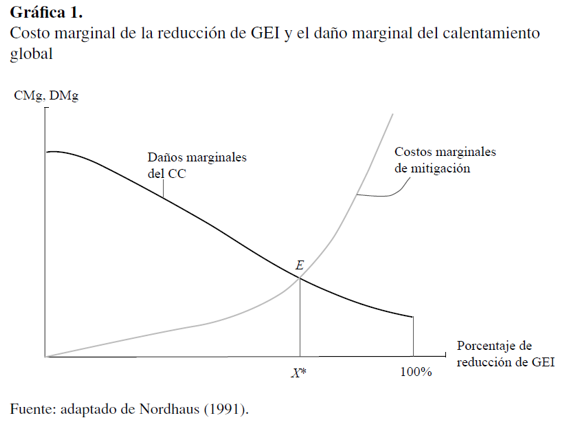
En este contexto las decisiones racionales son vistas como un trade-off, o disyuntiva, entre la elección de dedicar recursos a la mitigación y en consecuencia disminuir el ritmo del crecimiento del consumo (función de costos de mitigación) frente a la magnitud de los impactos que se tendría si no se dedicaran recursos a la mitigación (función de daños). El análisis juicioso de esta disyuntiva en los modelos integrados requiere construir una función de daños que se manifestarían por los siguientes cien o más años, valorarlos en términos monetarios y representarlos en valor presente de modo que pueda compararse con los costos de mitigación (véase Gráfica 1). Los diferentes autores coinciden en que la mayor dificultad radica aquí, pues acarrea la integración de modelos sobre el funcionamiento del sistema climático global, su relación con el sistema económico global y la extrapolación de sus interacciones al futuro lejano, de modo que tienen un alto grado de incertidumbre asociado.
Varios autores se han referido al Informe Stern (Stern, 2006) como el detonante de las controversias sobre la perspectiva económica frente al CC (Arrow, 2007; Cline, 2007; Mendelsohn, 2007; Neumayer, 2007; Nordhaus, 2007; Spash, 2007; Weitzman, 2007; Yohe y Tol, 2008). La controversia se generó porque el informe, que utilizó el modelo integrado PAGE (Hope, 2007) y una tasa social de descuento baja, recomendó una acción inmediata y radical antes de que los efectos negativos del CC fueran irreversibles, mientras los estudios previos habían llegado, en general (hay excepciones, véase en Spash, 2002), a recomendar una acción moderada dado que los efectos del CC en el futuro no superaban por mucho los costos de mitigar las emisiones de GEI (Norgaard, 2011).
Entre las perspectivas críticas al informe se puede resaltar la de Nordhaus (2007), quien elaboró el modelo integrado DICE y basado en sus resultados recomendó una acción contraria frente al CC; es decir, inicialmente pequeña, pero que aumente lenta y progresivamente conforme se vayan manifestando los efectos del fenómeno. De forma similar, Yohe y Tol (2008) mencionan que Stern sobreestima el impacto del CC y subestima los costos de reducir las emisiones. Mendelsohn (2007) es más cauteloso, pero resalta que hace falta validar los supuestos del estudio. Algunos autores respaldaron el abordaje de Stern (Cline, 2007) y otros lo criticaron por razones diferentes, que se ampliarán más adelante (Neumayer, 2007; Spash, 2007). Pese a las críticas, Stern (2008; 2013a; 2013b) ratificó los supuestos asumidos.
A juzgar por las conclusiones, pareciera que los modelos y marcos analíticos fueran diametralmente opuestos. Sin embargo, como resalta Dasgupta (2008), las diferencias radicales entre perspectivas como la de Nordhaus, por una parte, y la de Stern, por otra, dependen en el fondo de la elección de los pequeños parámetros de distribución intertemporal que componen la tasa social de descuento. Por lo demás, son muy parecidos, pues utilizan el mismo marco normativo utilitarista, en el cual los individuos racionales buscan maximizar su nivel de utilidad mediante el consumo de bienes y servicios; por tanto, la sociedad, entendida como la agregación de los individuos, tiene un nivel de bienestar equivalente al nivel de consumo agregado. Con esto, los enfoques consideran que el aumento del consumo tiene una relación funcional directa con el aumento del bienestar.
Elementos básicos de los modelos utilizados
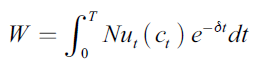
Si bien existen diversas aproximaciones a la modelación (Botzen y Van den Bergh, 2014), aquí se asume un modelo básico con un ánimo ilustrativo, teniendo en cuenta que este tipo de modelos han sido usados por importantes estudios. Un modelo general de bienestar asume que todos los agentes tienen la misma función de utilidad, que depende del consumo. Y el consumo es de un solo bien homogéneo. Así, para el individuo i la utilidad que obtiene del consumo es ui(c), y para  , por lo que el bienestar en un período de tiempo dado es
  , para i = 1, 2,...N. Ahora, para T períodos de tiempo y con una población constante, el bienestar actualizado (en valor presente) en una versión continua está dado por la ecuación (1):
 | [1] |
Se hace el supuesto de una utilidad constante en el tiempo y la forma funcional más común de la utilidad (isoelástica) es 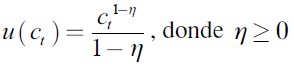 , es la elasticidad de la utilidad marginal del consumo con respecto al consumo. Esta forma de utilidad isoelástica fue utilizada por Stern (2006) y por Nordhaus (2007), así como los supuestos expuestos anteriormente. La discordia entre las posiciones de los autores dentro de la economía del bienestar consiste en los criterios para realizar la distribución intertemporal, esto es, la tasa social de descuento.
La tasa social de descuento
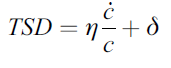
La tasa social de descuento (TSD), que deriva de (1) (véase Anexo), refleja el valor relativo que se le da a los flujos de bienestar futuro respecto a los del presente y está constituida por tres elementos: la elasticidad de la utilidad marginal del consumo respecto al consumo (η), el crecimiento del consumo en el tiempo  y la tasa pura de descuento (δ) -ecuación (2)-. Este criterio, por pequeño que parezca, lleva a grandes diferencias en los resultados y su abordaje permanece como una discusión abierta (Arrow et al., 2012; Stern, 2013a, 2013b). Para dar una rápida ilustración, supóngase un daño realizado por el CC dentro de cien años valorado en $ 1.000.000, η = 1 y = 2% ; así, con δ = 4% (TSD = 6%) el valor presente de ese daño sería de $ 3.124,1, pero si δ = 0,1% (TSD = 2,1%) entonces el valor presente de ese daño sería de $ 127.776,7. El ejemplo ilustra por qué Nordhaus (2007), que tomó una tasa de descuento alta, llegó a sugerir que es mejor actuar después (el valor del futuro es menor), mientras que Stern (2006) sugirió que había que actuar inmediatamente (el valor del futuro es mayor).
 | [2] |
Existe una perspectiva que argumenta que el problema de estimar la tasa de descuento es técnico y que, así como se aplica en las evaluaciones de proyectos privados o sociales de pequeña escala, la tasa de descuento se puede aproximar por la rentabilidad de las inversiones de más largo plazo en los mercados. Nordhaus (2007) en el modelo DICE utiliza los retornos de capital de mercado estimados como tasa de descuento que, en promedio, son de 4% (5,5% para los primeros cincuenta años). Esta perspectiva asume que la mejor decisión de distribución intergeneracional se logra extrayendo preferencias de los individuos reveladas en los mercados. Esto es equivalente a asumir que por medio de la disposición a pagar, la impaciencia individual se transforma en una característica de la decisión social. La principal razón expuesta por Nordhaus para argumentar una tasa de descuento igual a la rentabilidad de los mercados, consiste en que
(...) la tasa de descuento es alta para reflejar el hecho de que las inversiones para reducir los daños derivados del clima en el futuro sobre el maíz y los árboles deberían competir con las inversiones en semillas mejoradas, mejoramiento de equipo y otras inversiones de alta rentabilidad [TP] (2007, p. 14),
luego la productividad de esas inversiones debe ser suficiente para reparar los daños futuros.
Otra perspectiva argumenta que cuando se habla de la sociedad en su conjunto en el muy largo plazo no tiene sentido sacar ese parámetro de los mercados que solo representan las preferencias actuales. En cambio, su elección debe seguir un criterio ético escogiendo la tasa pura de descuento cercana a cero para dar un valor igual a cada generación. A continuación se exponen las razones presentadas por Stern (2006, 2008, 2013a, 2013b), para realizar dicha elección ética en vez de usar los mercados:
1) La economía no es perfecta: además de la externalidad climática, existen bienes públicos y otras imperfecciones como en las redes de información e ideas, las redes físicas de transporte y las eléctricas. Además existe riesgo en los mercados financieros, así como bienes sin precio, como la biodiversidad o la seguridad energética, que interactúan en la conformación de la externalidad climática.
2) Las preferencias que se expresan en los mercados no representan a las generaciones futuras: la razón es que la sociedad como tal, al decidir sobre el muy largo plazo, no puede usar como criterio la rentabilidad de los mercados para descontar, pues se incurre en el problema ético de valorar menos a las generaciones futuras que a las presentes por medio de un mecanismo que solo representa a estas últimas -la posición es respaldada por trabajos como el de Dasgupta (2008) o Heal (2007)-. Este problema se ha discutido desde hace algún tiempo en la literatura bajo el nombre de la dictadura del presente, ya que las generaciones futuras no pueden participar en las decisiones porque son incapaces de revelar sus preferencias en los mercados de hoy.
3) El análisis de las opciones que se sopesan con el CC es de un carácter no marginal: un análisis marginal representa la posibilidad de generar modificaciones dentro de una senda de crecimiento. En cambio, las decisiones que deben tomarse respecto al CC corresponden a la elección entre sendas. En últimas, lo que se tiene que decidir es qué estructura económica prevalece.
4) Los bienes no son homogéneos: de hecho, tanto la estabilidad como la regulación climática, desde la economía del bienestar, deben entenderse como un bien público y como tal la rentabilidad de los mercados no las favorece aunque sean necesarias para el bienestar de la sociedad. En este contexto, cada tipo de bien tiene un tipo diferente de consumo (Roemer, 2011) y por ello se debe escoger una senda de crecimiento diferente en cada caso. Esto implica elegir distintas tasas de descuento para cada tipo de consumo (Heal, 2007) y existirían tasas específicas para el caso de los bienes y servicios ambientales, cuyas características sobre el bienestar pueden verse como directas e indirectas: son medios, en tanto constituyen el material para hacer otros bienes, y fines, ya que se disfrutan directamente sus servicios.
El futuro es incierto
El criterio de elección de la tasa ve su reto más grande al enfrentar la incertidumbre de un fenómeno tan complejo, su interacción con la economía y su dimensión espacial, que hacen que los flujos de bienestar futuro sean altamente impredecibles. Como afirman Ackerman, DeCanio, Howarth y Sheeran (2009), el punto de la incertidumbre es uno de los que está menos desarrollado en los diferentes modelos integrados. Pero estos enfoques se enfrentan a la característica impredecible del clima, que es la combinación de lo que no se conoce con el conocimiento sobre las dinámicas caóticas y los efectos umbral asociados a las no linealidades que lo caracterizan, y por tanto las predicciones son indeterminadas. Además, Ackerman et al. (2009) resaltan otro inconveniente de los modelos respecto al futuro incierto y es que normalmente especifican arbitrariamente una función de daños, y añaden que "la combinación de distribuciones de probabilidad desconocidas y resultados potencialmente desastrosos provee una fuerte motivación para una política de precaución, como seguro frente a tales desastres" [TP] (p. 310). Dasgupta va en dirección similar cuando concluye que con la incertidumbre en cuanto a las innovaciones tecnológicas:
(...) es posible creer que la Humanidad debería invertir mucho más en la reducción del cambio climático que el 2% del PIB de los países ricos que propuso el Informe Stern. Puede sostenerse dicha creencia aun cuando no sea posible justificarla desde el modelamiento formal [TP] (2008, p. 27).
Otra crítica a los modelos integrados deterministas (como el DICE), es que no incluyen apropiadamente las posibilidades de eventos catastróficos, con altos potenciales de daño pero con baja probabilidad, por lo que las funciones de sensibilidad y las de daños subvaloran o excluyen efectos de retroalimentación rápida y consecuencias desastrosas de aumentos radicales en las temperaturas. Una forma de lidiar con esto es introduciendo funciones de densidad de probabilidad con colas anchas (fat-tails), que permiten dar mejor cuenta de estos efectos y son más coherentes con lo que menciona la evidencia científica. Con esto, la incertidumbre respecto a las tasas de descuento, implica que estas deben descender progresivamente hasta su valor mínimo posible, de modo que se resalte el valor de los eventos futuros, lo que equivaldría a asegurarse en contra del CC (Gollier y Weitzman, 2010; Weitzman, 2007, 2011).
Este tipo de afirmaciones lleva a examinar alternativas a la búsqueda de una senda eficiente mediante la elección de una tasa de descuento apropiada y gira la discusión hacia el manejo apropiado de las incertidumbres.
DE LA ECONOMÍA AMBIENTAL A LA ECONOMÍA ECOLÓGICA
Esta sección presenta los referentes conceptuales de la economía ecológica como corriente alternativa. Para ello analiza el giro del debate de la eficiencia al de la sostenibilidad, enfatiza en la incertidumbre irreductible y luego enfatiza sobre discusión ética.
Referentes conceptuales de la economía ecológica
El cambio de perspectiva tiene una base material, que se refleja en la siguiente cita de Georgescu-Roegen (1975):
Dado que la ley de la entropía no admite manera alguna de enfriar un planeta que es calentado de forma continua, la polución térmica podría probar ser un obstáculo más crucial para el crecimiento que finitud de los recursos accesibles... La verdad sobria es que, a pesar de nuestros esfuerzos, la acumulación de la polución puede... convertirse en la primera crisis ecológica seria [TP] (pp. 358-359).
El CC es la manifestación de esa crisis, que deriva de una acumulación de polución inmanejable. La diferencia teórica fundamental respecto a la visión de la economía ambiental está en la concepción de externalidad. Daly y Cobb (1997) mencionaban lo siguiente:
Distinguiremos entre las exterioridades localizadas y las generalizadas. Las primeras pueden corregirse, por lo menos en una medida razonable, ajustando los precios o mediante otros cambios que no son radicales. En cambio, las exterioridades generalizadas tienen un alcance mucho más amplio y no pueden corregirse efectivamente mediante cambios de los precios relativos. Se requieren límites cuantitativos o profundos cambios institucionales [cursiva original] (p. 57).
Así, para enfrentar el CC se requiere un cambio radical que reconozca los límites cuantitativos del crecimiento del sistema económico y para ello es imperativo un nuevo sistema institucional. Vatn y Bromely (1997), en línea con Boulding (1966) y Kapp (1974, 1978), argumentaron que el concepto mismo de externalidad es incoherente con el fenómeno de la contaminación, pues el desplazamiento de costos hacia terceros es en sí una actividad racional del agente económico, luego la contaminación no debe verse como un "fallo del sistema", sino como un producto del sistema.
El CC es una consecuencia del proceso económico, entendiendo este proceso desde un sistema que puede producir bienestar material haciendo uso de la biosfera tanto para extraer materiales, energía y servicios ecosistémicos, como para decantar residuos degradados, no aprovechables o de alta entropía; pero las dinámicas de distribución y acumulación de los residuos y las de retroalimentación con las funciones asimiladoras terminan afectando al sistema social y la calidad de vida de los individuos, generando injusticias y conflictos (Ayres y Kneese, 1969; Georgescu-Roegen, 1975; Kapp, 1974; Martínez-Alier, 2010; O'Hara, 2009). Dicho proceso sistémico está acotado por un grupo de límites que caracterizan cierta escala de producción económica o umbral crítico y, al sobrepasarlos, la irrupción en los ecosistemas conlleva un deterioro de la calidad de vida de la sociedad. De este modo, el crecimiento de la economía se torna en contra del bienestar de la sociedad, por haber superado la escala óptima de la economía con respecto a la biosfera (Daly, 2007; Max-Neef, 1995).
Esta es la base de la economía del estado estacionario, en la que sobresalen tres elementos: a) minimizar los flujos de materia y energía que ingresan y salen del sistema, de modo que se mantengan las capacidades de asimilación y regeneración de la biosfera, b) mantener stocks estables de capital hecho por el hombre y capital natural, luego no es posible la sustitución absoluta del uno por el otro y c) mantener una escala de funcionamiento óptimo de la economía, es decir, que no supere los límites de los ecosistemas. Esto último por medio del mantenimiento estable de la población y de las dos formas de capital (Daly, 1974, 2007; O'Neill, 2012).
El decrecimiento es una propuesta más radical que ha planteado seriamente las posibilidades de reducir el tamaño físico de la economía y su metabolismo (principalmente de las economías del Norte), dadas las consecuencias negativas tanto biofísicas como sociales. Pero más allá de ser una simple reducción del tamaño físico de la economía, que por sí sola puede resultar catastrófica, encierra un entramado de propuestas relacionadas con el establecimiento de nuevos valores, instituciones, políticas y prácticas que viabilicen el respeto por los límites. El decrecimiento surge como una posición política que cuestiona las bases materialistas de un sistema sustentado en el crecimiento del consumo, y dentro de sus propuestas exige la revalorización de lo común, de la revalorización de los proyectos propios de cada sociedad, así como la búsqueda de una autolimitación de la sociedad (Gadrey, Marcellesi y Barragué, 2013; Gorz, 2011; Kallis, Demaria y D'Alisa, 2015; Latouche, 2010; Van den Bergh y Kallis, 2012; Victor, 2012).
El respeto por los límites de los ecosistemas, y los efectos sociales de transgredirlos, no son capturados por los indicadores de crecimiento económico. Por ello se han planteado alternativas. Unas consisten en modificaciones al producto interno bruto (PIB), pero considerando la distribución de la riqueza y la destrucción del capital natural. Daly y Cobb (1997) se basaron en el concepto de ingreso hicksiano para establecer el índice de bienestar económico sostenible, que permitió plantear la hipótesis del umbral, según la cual una vez alcanzado el umbral de crecimiento físico, más crecimiento no aporta bienestar o incluso genera su pérdida (Max-Neef, 1995).
La contabilidad biofísica es otro abordaje alternativo importante. La huella ecológica, como una forma de analizar el espacio utilizado y contrastarlo frente a la biocapacidad y la apropiación humana de la producción primaria neta, como indicador del dominio humano de la naturaleza, son ejemplos con amplia tradición (Haberl, Wackernagel, Krausmann, Erb y Monfreda, 2004). La huella ecológica sirvió de base conceptual para estudios que calculan una huella de carbono (Hertwich y Peters, 2009), que es una aproximación biofísica para generar información en la toma de decisiones al contrastar con la capacidad de asimilación, pero más que todo como indicador de responsabilidad. Los análisis de la producción primaria neta facilitan comprender la relación de las emisiones contenidas en el comercio internacional de productos agrícolas (Gavrilova, Jonas, Erb y Haberl, 2010).
Recientemente se han desarrollado propuestas que reflejen mejor la diversidad de factores que componen el bienestar. O'Neill (2012, 2015) plantea una metodología basada en indicadores para la transición hacia una economía dentro del estado estacionario. Propone dos bloques de indicadores para evaluar la transición hacia el estado estacionario: a) indicadores biofísicos, entendidos como medios para alcanzar un fin y se dividen en medios fundamentales, que son recursos naturales para sostener la vida y las actividades económicas, y medios intermedios, que son los medios de transformación de los medios fundamentales y b) indicadores sociales, entendidos como fines y se dividen en fines fundamentales, que consisten en los objetivos que no tienen un valor en función de otra cosa (tienen un valor intrínseco), y fines intermedios, que son los objetivos que se espera alcance la economía (tienen un valor funcional).
De la eficiencia a la sostenibilidad
Una de las implicaciones de ver el problema del CC como una externalidad, es que la sostenibilidad solo puede lograrse mediante una mejora de la eficiencia en términos sociales. Es el caso de Stern (2013b), quien asumió la sostenibilidad de forma equivalente a la eficiencia paretiana, de modo que la ineficiencia generada hoy por el CC pudiera llevar tanto a mejorar su posición como la de las futuras generaciones, mediante cambios que escoja la generación presente sobre producción y consumo.
Contrario a esta perspectiva, varios autores han argumentado que el criterio de la sostenibilidad no es el mismo de la eficiencia, pues tiene cualidades diferentes enfocadas en la equidad de las distintas generaciones. Roemer (2011) argumenta a favor de la sostenibilidad débil bajo el criterio ético rawlsiano, partiendo de la consideración de que nada asegura que las generaciones futuras sean más ricas que las presentes. En esta perspectiva, el problema pasa de encontrar la senda de crecimiento del consumo óptimo a encontrar la senda que maximice el mínimo bienestar de cualquiera de las generaciones (criterio maximin).
Para Norgaard (2011), el problema de la sostenibilidad es de distribución intertemporal de derechos y no solo de eficiencia. Argumenta que las perspectivas convencionales del análisis costo-beneficio en el contexto del CC se centran exclusivamente en ganar eficiencia y no integran el problema de los umbrales que implica la sostenibilidad. Este autor afirma que esto se debe a que esos modelos no permiten comprender que el CC no solo afecta unos precios, con todo lo demás constante, sino que también afecta al sistema general de precios, así como múltiples valores fuera del mercado.
De acuerdo con Neumayer (1999, 2007), el debate de la tasa de descuento no debería ser el centro de la discusión, pues en últimas no existe una tasa de descuento adecuada porque esta depende de criterios normativos. De hecho, dice que la sustituibilidad de factores es el fundamento teórico detrás de la tasa de descuento; por tanto, considera que tanto Nordhaus como Stern asumen que los factores son sustituibles. En cambio, propone centrarse en "qué tanto el cambio climático infringe daños irreversibles y no sustituibles, así como pérdidas sobre el capital natural" [TP] (2007, p. 299). En esta perspectiva, el autor menciona que hay dos formas de entender la no sustituibilidad: a) la perspectiva utilitarista, en la cual el crecimiento del consumo no compensa la utilidad de las pérdidas futuras en capital natural que afecten la utilidad misma. Stern (2013a) menciona por momentos esta perspectiva, aunque el concepto de la no sustituibilidad no queda integrado en su modelo. Weitzman (2011), en cambio, expone explícitamente el tema y Dasgupta (2008) lo refiere implícitamente y b) la perspectiva deontológica, que se refiere a la imposibilidad de las generaciones futuras de hacer valer sus derechos, producto del CC, y además resulta imposible compensar esta falencia con mayor consumo. Los trabajos de Howarth (1997), Norgaard (2011) o de Sen (2013) presentan versiones de esta perspectiva.
Efectivamente, Nordhaus (2007) asume que el capital natural es totalmente sustituible por aquel hecho por el hombre, como lo deja ver cuando argumenta que las inversiones en capital natural compiten directamente con las demás. Stern, en cambio, considera las características de diferentes bienes y también los efectos irreversibles y, en ese sentido, admite una menor sustituibilidad que Nordhaus, y, como reconoce Neumayer (2007), hay varias pistas en este sentido en el Informe Stern, pero al transformar los impactos sobre el ambiente en fracciones del PIB asume que el dinero es un buen sustituto del ambiente o, como lo dijo Van den Bergh, "que el dinero puede 'comprar de vuelta' la estabilidad climática" [TP] (2004, p. 387).
Howarth (1997) plantea un enfoque "contractualista", donde las oportunidades de vida deben ser mantenidas de modo no decreciente, y argumenta que la incertidumbre implica asumir una posición desde la sostenibilidad fuerte, proponiendo criterios prácticos como el principio de precaución o los estándares mínimos de seguridad, así como medidas institucionales que aseguren los derechos de las generaciones futuras. Van den Bergh (2004) relaciona la no sustituibilidad con la incertidumbre, argumentando que el papel de la incertidumbre extrema asociada al CC y de las posibles catástrofes, hacen que los criterios de eficiencia no ayuden a saber si una senda es o no sostenible y, por tanto, una perspectiva de la sostenibilidad fuerte consiste en adoptar el principio de precaución.
Estos argumentos son muy cercanos a las perspectivas de dos de los pioneros de la economía ecológica. Por una parte, Kapp planteó que los límites ecológicos deben reconocerse como mínimos sociales del bienestar para sostener la vida o como necesidades sociales y en este sentido "... es esencial derivar estándares objetivos en la forma de límites apropiados de niveles máximos tolerables o aceptables de concentración de contaminantes" [TP] (1974, p. 70). Para el autor, esto implica alejarse del criterio racional puro de la eficiencia. Por otra, para Georgescu-Roegen, "en vez del principio de comportamiento racional -ese de maximizar la utilidad (¡sea cual sea su significado!) nuestra política hacia los recursos naturales en relación con las generaciones futuras debe buscar el mínimo arrepentimiento" [TP, cursiva original] (1977, p. 113).
Es decir, la distribución intertemporal debe seguir el criterio ético de prevenir situaciones indeseables para las generaciones futuras. De acuerdo con Georgescu-Roegen (1996), debe haber una diferenciación de los factores del sistema económico entre flujos, stocks y fondos. Un bien fondo es aquel que entra en el proceso económico y aporta un flujo durante un período de tiempo, pero el bien permanece cuantitativamente igual aunque cualitativamente transformado; en cambio, un stock es la acumulación de un flujo y si un bien fluye de un stock, este sí cambia cuantitativamente (se desacumula). Las funciones de regulación climática así como otros bienes y servicios fluyen de los ecosistemas, de modo que en el contexto del CC la perspectiva de minimizar consecuencias indeseables está fuertemente atada al mantenimiento de los ecosistemas como bienes fondo, pues producen un flujo de bienestar, conceptualizados como servicios ecosistémicos.
La perspectiva de las oportunidades como libertades, de acuerdo con Sen (2004, 2013), implica que la riqueza material de una generación no puede intercambiarse por la libertad de disfrutar de "aire limpio". Así, implícitamente se asume la no sustituibilidad de factores, por lo menos no perfectamente.
Con esto, queda claro que uno de los puntos más representativos del CC, a saber, la sostenibilidad -en su sentido fuerte- es un concepto diferente al de la eficiencia y resulta más apropiado, pues representa la necesidad ética de la distribución intertemporal y espacial de los mínimos biofísicos que se deterioran progresivamente por los procesos metabólicos asociados al CC. En este sentido, los enfoques de las perspectivas biofísicas resaltadas en la sección anterior, dan una base operativa a las perspectivas que procuran mantener una base mínima en la distribución intertemporal.
De la incertidumbre débil a la incertidumbre fuerte
La economía ecológica se sustenta en la ciencia Pos-Normal, caracterizada por tratar con hechos inciertos, valores en disputa, mucho en juego y decisiones urgentes, como en el caso del CC (Funtowicz y Ravetz, 1993). En esta perspectiva, la precaución es la principal guía de política y la consulta extendida (no solo a expertos académicos) es la mejor forma de integrar dichos valores.
Funtowicz y Ravetz (1994) hicieron unas críticas particulares al estudio de Nordhaus (1991). Se basaban en el exceso de precisión de un modelo inmerso en un marco de incertidumbres gigantescas. De forma algo similar, el estudio de Weitzman (2011) resalta incertidumbres estructurales con relación al modelamiento del CC, basando su crítica en los modelos convencionales (como el DICE de Nordhaus).
Cuando las incertidumbres son tan grandes, se hace inviable sopesar alternativas, particularmente en caso de eventos extremos e irreversibles. En vez de esto, cualquier análisis debería envolver principalmente el proceso histórico en el cual unos países realizaron su desarrollo industrial generando a flujos de GEI por décadas. Más que una política óptima, la responsabilidad histórica consiste en una disputa normativa, que en buena medida ha sido marginal en los modelos integrados (Van den Bergh, 2004).
De forma similar, Spash (2002, 2007) plantea críticas que tienen que ver con el tratamiento de la incertidumbre por parte de los estudios sobre el CC. El autor divide la incertidumbre en dos, incertidumbre débil e incertidumbre fuerte. La primera, asumida por estudios como del bienestar pero también por el del IPCC (2007), consiste en asignar una probabilidad a la ocurrencia de los eventos futuros y asumir que con la investigación esta incertidumbre es reductible. En este sentido, la incertidumbre es tratada como riesgo. La perspectiva fuerte se caracteriza por un conocimiento imperfecto sobre los sistemas relacionados con el clima y su evolución y puede ser entendida conceptualmente como ignorancia parcial e irreductible, de modo que los resultados son indeterminados y por ende impredecibles3.
La ética detrás de la técnica
Precisamente, en cuanto a los valores, Spash (2002, 2007) resalta que los modelos integrados de la economía del bienestar asumen que todas las categorías sujetas de ser beneficiadas o afectadas son conmensurables y, por ende, pueden reducirse a una unidad única de valor. El autor plantea el problema ético cuando señala que la estructura de los modelos económicos está cargada de juicios de valor, pues siempre hay un factor normativo en las decisiones sociales.
Si solo importan las diferencias de elección en los parámetros, como δ, entonces, ¿qué otras disputas normativas se encuentran en la discusión? La respuesta a este interrogante viene del examen de los supuestos básicos de los modelos de bienestar, que parten de una teoría particular del comportamiento humano, de aquello que es sujeto de ser valorado y una relación específica individuo-sociedad.
Los supuestos básicos que respaldan a la economía ambiental son: a) un individuo solo valora aquellas cosas (objetos de valor) que le representan una utilidad, b) las cosas que valora son todos los bienes y servicios que puede consumir, c) más consumo de un objeto de valor proporciona siempre un mayor nivel de utilidad y d) el bienestar de cada cohorte es la agregación de la utilidad de los individuos de esa cohorte.
Respecto al primer supuesto, los modelos neoclásicos que analizan el CC asumen que esos objetos de valor son todos transformables en una unidad común, el dinero. Pero los valores asociados a la vida, al ambiente y al bienestar humano son inconmensurables, en tanto no pueden ser traducidos a una única medida de valor (Kapp, 1974; Martínez-Alier, 2010); por ello, puede decirse que dichas perspectivas que sufren del efecto Midas, que representa la tendencia de los ejercicios económicos a transformar todas las formas de valor en dinero, hacen explícita la imposibilidad de reconocer valores intrínsecos y umbrales críticos (Foster, Clark y York, 2009). El ejemplo más discutido de este tipo de ejercicios, es el valor de la vida humana, que debe entrar como una cantidad monetaria en los ejercicios que buscan cuantificarla como un daño (Stanton y Ackerman, 2009).
El supuesto d) refleja la posición atomista, en la cual el todo es la simple agregación de sus partes. Frente a esto, la economía ecológica reconoce el carácter complejo de la relación economía-biosfera y encuentra una tendencia a rescatar el papel de los procesos sociales en la constitución de juicios y acuerdos, así como de incidir de forma conjunta sobre instituciones que modelan el comportamiento humano (Norgaard y Baer, 2005). Entendidas así, estas formas serían propiedades emergentes que se separan de la simple agregación de las partes. Sin embargo, es sobre los supuestos b) y c) que se sustenta una de las grandes controversias, que serán discutidas en el siguiente apartado.
¿MAYOR CONSUMO SIGNIFICA MÁS BIENESTAR?
Detrás de los supuestos relacionados al consumo se encuentra un ideal de desarrollo, que se sustenta en la expansión del consumo como un principio universalmente válido y socialmente deseable. Sin embargo, este es un concepto pre-analítico4, pues la expansión del consumo es causa del CC; por tanto, su expansión no conlleva necesariamente un mayor bienestar. Roemer (2011) resalta este punto, a propósito del análisis de Nordhaus cuando señala: "¡La única manera en la cual una cosa puede ser mala, si lo único que puede producir bienestar es el consumo de commodities, es si esta reduce la posibilidad de consumir!" [TP] (p. 379).
En el fondo, lo que se está cuestionando es la insaciabilidad, es decir, que más consumo siempre traiga más bienestar. Al respecto, los estudios empíricos han mostrado que el bienestar humano se ha ido separando de la expansión material. Los estudios sobre la paradoja del bienestar, que en términos generales se refiere a que el bienestar subjetivo no aumenta o incluso decrece cuando el ingreso y el consumo crecen (Easterlin, 2003; Easterlin, Angelescu, Switek, Sawangfa y Smith, 2010; Jackson, 2008), dan una base sólida a este argumento, dan fuerza a perspectivas que se enfocan al estudio del bienestar de forma multidimensional, como las necesidades fundamentales (Max-Neef, 2010) o las capacidades (Sen, 2013).
Consciente de la necesidad de un cambio, Stern (2013a, 2013b) considera que las políticas frente al CC requieren romper el vínculo entre las actividades económicas y las emisiones, lo que representaría una nueva revolución energética-industrial. Sin embargo, el sustento de la propuesta es la hipótesis del desacople, que sostiene que es posible aumentar los niveles de producción y consumo, sin generar emisiones o incluso reduciéndolas. Así, el crecimiento económico es la solución al problema del CC.
Proponer que haya más crecimiento sin emisiones, proviene de la idea de que puede llegarse a internalizar toda la externalidad mediante una revolución tecnológica y organizacional: sustentada en un optimismo tecnológico. Sin embargo -como se mencionó-, el problema de las emisiones está muy atado al sistema económico y nada garantiza que una nueva revolución industrial lleve al completo desacople. De hecho, Jackson (2009) hace una crítica fundamental al desacople, dividiendo el concepto entre relativo y absoluto. El desacople relativo, que es un indicador de eficiencia, significa que el nivel de emisiones se reduce respecto al crecimiento económico, o sea, su tasa de crecimiento es menor, aunque siga creciendo. El desacople absoluto tiene que mostrar un descenso general en las emisiones respecto al consumo. El autor menciona que si bien está ocurriendo cierto nivel de desacople relativo con relación a las emisiones de GEI, el desacople absoluto no ocurrirá dentro del actual sistema económico. Por tanto, contrario a Stern, Jackson menciona que no se necesita una época de progreso y crecimiento sin emisiones, eso sería imposible, sino una redefinición de la idea de progreso sin necesidad de crecimiento material.
Así, desde la economía ambiental, el crecimiento del consumo está en riesgo con el CC y, a su vez, es el principal elemento para enfrentarlo, luego debe ser potenciado para garantizar el bienestar. En cambio, la economía ecológica considera el crecimiento material del consumo como causa de la crisis que representa el CC; por tanto, mejorar el bienestar requiere detener su expansión e incluso su reducción. Esta es la principal diferencia entre ambos marcos analíticos, la interpretación normativa de la función de la materialidad para la sociedad.
Consideramos que el cambio planteado por la economía ecológica abre la puerta a la comprensión de la problemática desde un punto de vista más apropiado, si de lo que se trata es de cambiar el sistema de valores, instituciones y prácticas, al reconocer que: a) la eficiencia pura debe reemplazarse por la sostenibilidad en su versión fuerte, dadas las irreversibilidades asociadas al proceso y la imposibilidad de reemplazar la pérdida de la estabilidad climática, b) la incertidumbre debe dejar de ser entendida como riesgo y debe reconocerse que se está frente a un futuro indeterminado, de modo que la precaución es el mejor principio de política, de la mano con la participación amplia en la toma de decisiones, c) los dilemas normativos no solo obedecen a una ética imbuida en decisiones sobre los parámetros, sino también a aquellos conceptos y supuestos que conforman los marcos analíticos y d) la expansión material no es algo positivo para la sociedad per se, de hecho puede ser algo dañino en términos socioambientales, luego se requiere redefinir el concepto normativo de desarrollo (véase Tabla 1).

Redefinir la noción de progreso, cuestionar el crecimiento económico, las posibilidades y efectos de abandonarlo hoy día, consiste en la mejor política de precaución ante los efectos destructivos que supone el CC. Este cambio de base teórica se requiere si se busca superar las recomendaciones de política que sugieren más crecimiento de las bases productivas, relegando a un segundo plano las consecuencias biofísicas y sociales.
CONCLUSIONES
Este artículo se centra en el análisis de dos cuerpos teóricos que abordan la relación economía-CC. Primero, se ocupa de resaltar los puntos más importantes de los modelos que han incidido en la política climática desde la economía ambiental y, posteriormente, se plantean los elementos alternativos para abordar la relación desde la economía ecológica.
El artículo realiza un aporte en el análisis de aquellos elementos en los cuales difieren las dos perspectivas teóricas a propósito del CC, y apuesta por un giro hacia la economía ecológica. Esta perspectiva teórica resulta más apropiada para abordar el reto que representa el CC por varios motivos (véase Tabla 1), pero principalmente porque su marco analítico permite capturar elementos como la sostenibilidad fuerte y la incertidumbre irreductible. En el fondo, al asumir esta visión teórica se abre la puerta a una discusión normativa sobre el deber ser del mismo proceso económico, cuestionando el papel del crecimiento económico como generador de bienestar y así como la base del concepto de desarrollo.
Hay que resaltar, como lo hace Hulm, que "[u]na de las razones por las que estamos en desacuerdo sobre el cambio climático es porque entendemos de forma diferente el desarrollo" [TP] (2009, p. 251). En efecto, el presente artículo llama la atención sobre esas diferencias y reclama que a la luz de los complicados ejercicios que supone analizar el CC, queda a veces escondido el marco normativo que respalda las sugerencias de política. No obstante, queda mucho trabajo por delante en cuanto a esta redefinición de progreso y, en especial, al papel que deberían desempeñar los llamados países "en desarrollo".
ANEXO
Este anexo deriva de la tasa social de descuento con un fin ilustrativo, partiendo del modelo presentado en la ecuación (1) y siguiendo a Stern (2008). Si tomamos el valor social del consumo (VSC) de un período específico t de (1), se tiene:
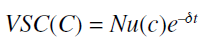 | [A-2] |
Donde N es la población, C el consumo agregado y c = C/N el consumo per cápita. El factor social de descuento (λ), entendido como la utilidad marginal del consumo (C) en el tiempo t = 0, es:
 | [A-3] |
Así, la tasa social de descuento (TSD) es la tasa de decaimiento de l; es decir, la disminución marginal respecto al tiempo de la utilidad marginal del consumo con respecto a su propio valor (TSD = -λ./λ):
 | [A-4] |
Al desarrollar la parte derecha de (A-4) se llega a:
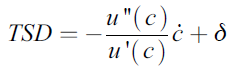 | [A-5] |
Donde 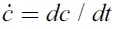 y si llamamos η a la elasticidad de la utilidad marginal del consumo con respecto al consumo
  , puede mostrarse que la TSD es:
| [A-6] |
Donde δ es la tasa pura de descuento. Los parámetros δ y η son los denominados paramentos éticos. La elección de δ tiene que ver con qué tanto valor se le asigna a los flujos futuros de bienestar, o más coloquialmente, el valor de las generaciones futuras. La elección de η tiene varios sentidos, uno muy importante es su interpretación como la aversión a la inequidad. El modelo que se presentó es un modelo muy básico. Por ejemplo, Heal (2007) incluye en la función de utilidad u(c, s) una variable estado s que puede interpretarse como un bien ambiental agotable, y en consecuencia llega a una TSD con un parámetro adicional (A-7):
| [A-7] |
En este caso, ηc,c es la elasticidad de la utilidad marginal del consumo con respecto al consumo y ηc,s es la elasticidad de la utilidad marginal del consumo en cuanto a la variable estado (s). Lo que muestra este nuevo parámetro es la sensibilidad de la tasa al deterioro de s.
NOTAS AL PIE
1 Término propuesto por Spash (2002) y explicado más adelante.
2 Traducción personal (TP).
3 Esta es la noción de incertidumbre que plantearan Knight y Keynes.
4 En el sentido de Schumpeter.
REFERENCIAS
[1] Ackerman, F., DeCanio, S., Howarth, R., & Sheeran, K. (2009). Limitations of integrated assessment models of climate change. Climatic Change, 95(3-4), 297-315. doi: 10.1007/s10584-009-9570-x.
[2] Alley, R. B., Marotzke, J., Nordhaus, W. D., Overpeck, J. T., Peteet, D. M., Pielke, R. A.,..., & Wallace, J. M. (2003). Abrupt climate change. Science, 299(5615), 2005-2010. doi: 10.1126/science.1081056.
[3] Arrow, K. (2007). Global climate change: A challenge to policy. The Economists' Voice, 4(3), artículo 2. doi: 10.2202/1553-3832.1270.
[4] Arrow, J. K., Cropper, M. L., Gollier, C., Groom, B., Heal, G. M., Newell, R. G., & Weitzman, M. L. (2012). How should benefits and costs be discounted in an intergenerational context?: The views of an expert panel (Discussion Paper RFF-DP 12-53). Recuperado del sitio web de Resources for the Future: http://www.rff.org/RFF/Documents/RFF-DP-12-53.pdf.
[5] Ayres, R. U., & Kneese, A. V. (1969). Production, consumption, and externalities. American Economic Review, 59(3), 282-297. Recuperado de http://www.jstor.org/stable/1808958.
[6] Banco Mundial. (2010). Informe sobre el desarrollo mundial 2010: desarrollo y cambio climático. Colombia: Banco Mundial, Mundi Prensa y Mayol Eds.
[7] Botzen, W. J., & Van den Bergh, J. C. (2014). Specifications of social welfare in economic studies of climate policy: Overview of criteria and related policy insights. Environmental and Resource Economics, 58(1), 1-33. doi: 10.1007/s10640-013-9738-8.
[8] Boulding, K. (1966). The economics of the coming spaceship earth. En H. Jarret (ed.), Environmental quality in a growing economy (pp. 3-14). Baltimore, MD: Resources for the future by Johns Hopkins University Press. Recuperado de http://arachnid.biosci.utexas.edu/courses/THOC/Readings/Boulding_SpaceshipEarth.pdf.
[9] Cline, W. (2007, February). Chapter 6. En Yale symposium on the Stern Review. Simposio realizado por el Yale Center for the Study of Globalization. Recuperado de http://piketty.pse.ens.fr/files/SternReviewYaleSymposium2007.pdf.
[10] Curry, J. (2011). Reasoning about climate uncertainty. Climatic Change, 108(4), 723-732. doi: 10.1007/s10584-011-0180-z.
[11] Daly, H. E. (1974). The economics of the steady state. The American Economic Review, 64(2), 15-21. Recuperado de: http://www.jstor.org/stable/1816010.
[12] Daly, H. E. (2007). Ecological economics and sustainable development: Selected essays of Herman Daly. Cheltenham, UK and Northampton, MA, USA: Edward Elgar Publishing Ltd.
[13] Daly, H. E., & Cobb, J. B. (1997). Para el bien común: reorientando la economía hacia la comunidad, el ambiente y el futuro sostenible. Bogotá: Fondo de Cultura Económica.
[14] Dasgupta, P. (2008). Discounting climate change. Journal of Risk and Uncertainty, 37(2-3), 141-169. doi: 10.1007/s11166-008-9049-6.
[15] Easterlin, R. A. (2003). Explaining happiness. PNAS, 100(19), 11176-11183. doi: 10.1073/pnas.1633144100.
[16] Easterlin, R. A., Angelescu, L., Switek, M., Sawangfa, O., & Smith, J. (2010). The happiness-income paradox revisited. PNAS, 107(52), 22463- 22468. doi:10.1073/pnas.1015962107.
[17] Fleurbaey, M., Kartha, S., Bolwig, S., Chee, Y. L., Chen, Y., Corbera, E.,..., & Sagar, A. D. (2014). Sustainable development and equity. En O. Edenhofer, R. Pichs-Madruga, Y. Sokona, E. Farahani, S. Kadner, K. Seyboth & J. C. Minx (eds.), Climate change 2014: Mitigation of climate change. Contribution of Working Group III to the Fifth Assessment Report of the Intergovernmental Panel on Climate Change. Cambridge, UK y Nueva York, USA: Cambridge University Press.
[18] Foster, J. B., Clark, B., & York, R. (2009). The Midas effect: A critique of climate change economics. Development and Change, 40(6), 1085-1097. doi: 10.1111/j.1467-7660.2009.01613.x.
[19] Funtowicz, S. O., & Ravetz, J. R. (1993). Science for the post-normal age. Futures, 25(7), 739-755. doi: https://doi.org/10.1016/0016-3287(93)90022-L.
[20] Funtowicz, S. O., & Ravetz, J. R. (1994). The worth of a songbird: Ecological economics as a post-normal science. Ecological Economics, 10(3), 197-207. doi: https://doi.org/10.1016/0921-8009(94)90108-2.
[21] Gadrey, J., Marcellesi, F., & Barragué, B. (2013). Adiós al crecimiento: vivir en un mundo solidario y sostenible. Madrid: El Viejo Topo.
[22] Gavrilova, O., Jonas, M., Erb, K., & Haberl, H. (2010). International trade and Austria's livestock system: Direct and hidden carbon emission flows associated with production and consumption of products. Ecological Economics, 69(4), 920-929. doi: 10.1016/j.ecolecon.2009.11.015.
[23] Georgescu-Roegen, N. (1975). Energy and economic myths. Southern Economic Journal, 41(3), 347-381. doi: 10.2307/1056148.
[24] Georgescu-Roegen, N. (1977). What thermodynamics and biology can teach economists. Atlantic Economic Journal, 5(1), 13-21. doi: 10.1007/BF02315384.
[25] Georgescu-Roegen, N. (1996). La ley de la entropía y el proceso económico. Madrid: Fundación Argentaria y Visor Distribuciones.
[26] Gollier, C., & Weitzman, M. (2010). How should the distant future be discounted when discount rates are uncertain? Economics Letters, 107(3), 350-353. doi: https://doi.org/10.1016/j.econlet.2010.03.001.
[27] Gorz, A. (2011). Ecológica. Buenos Aires: Capital Intelectual.
[28] Haberl, H., Wackernagel, M., Krausmann, F., Erb, K., & Monfreda, C. (2004). Ecological footprints and human appropriation of net primary production: A comparison. Land Use Policy, 21(3), 279-288. doi:10.1016/j.landusepol.2003.10.008.
[29] Heal, G. (2007). Discounting: A review of basic economics. The University of Chicago Law Review, 74(1), 59-77. Recuperado de https://lawreview. uchicago.edu/sites/lawreview.uchicago.edu/files/uploads/74.1/74_1_Heal.pdf.
[30] Hertwich, E. G., & Peters, G. (2009). Carbon footprint of nations: A global, trade-linked analysis. Environmental Science and Technology, 43(16), 6414-6420. doi: 10.1021/es803496a.
[31] Hope, C. (2007, February). Chapter 2: PAGE modelling system. En Yale symposium on the Stern Review. Simposio realizado por el Yale Center for the Study of Globalization. Recuperado de http://piketty.pse.ens.fr/files/SternReviewYaleSymposium2007.pdf.
[32] Howarth, R. B. (1997). Sustainability as opportunity. Land Economics, 73(4), 569-579. doi: 10.2307/3147246.
[33] Hulm, M. (2009). Why we disagree about climate change: Understanding controversy, inaction and opportunity. Cambridge, UK: Cambridge University Press.
[34] Jackson, T. (2008). Where is the "wellbeing dividend"? Nature, structure and consumption inequalities. Local Environment: The International Journal of Justice and Sustainability, 13(8), 703-723. doi: 10.1080/13549830802475625.
[35] Jackson, T. (2009). Prosperity without growth: Economics for a finite planet. Londres, UK: Earthscan.
[36] Kallis, G., Demaria, F., & D'Alisa, G. (2015). Decrecimiento. En G. D'Alisa, F. Demaria & G. Kallis (eds.), Decrecimiento: un vocabulario para una nueva era (pp. 35-58). Barcelona: Ícara.
[37] Kapp, K. W. (1974). Environmental disruption: Challenge to social science. En K. W. Kapp, Environmental policies and development planning in contemporary China and other essays (pp. 57-75). París: Mouton.
[38] Kapp, K. W. (1978). The social costs of bussines enterprice. Nottingham, UK: Russel Press Ltd.
[39] Krausmann, F., Erb, K.-H., Gingrich, S., Haberl, H., Bondeau, A., Gaube, V., & Searchinger, T. D. (2013). Global human appropriation of net primary production doubled in the 20th century. PNAS, 110(25), 10324-10329. doi: 10.1073/pnas.1211349110.
[40] Latouche, S. (2010). Editorial: Degrowth. Journal of Cleaner Production, 18(6), 519-522. doi: 10.1016/j.jclepro.2010.02.003.
[41] Lenton, T. M., Held, H., Kriegler, E., Hall, J. W., Lucht, W., Rahmstorf, S., & Schellnhuber, H. J. (2008). Tipping elements in the Earth's climate system. PNAS, 105(6), 1787-1793. doi:10.1073/pnas.0705414105.
[42] Martínez-Alier, J. (2010). El ecologismo de los pobres: conflictos ambientales y lenguajes de valoración. Lima: Espiritrompa Ediciones.
[43] Max-Neef, M. (1995). Economic growth and quality of life: A threshold hypothesis. Ecological Economics, 15(2), 115-118. doi: 10.1016/0921-8009(95)00064-X.
[44] Max-Neef, M. (2010). The world on a collision course and the need for a new economy. AMBIO: A Journal of the Human Environment, 39(3), 200-210. doi: 10.1007/s13280-010-0028-1.
[45] Mendelsohn, R. (2007). A critique of the Stern Report. Regulation Magazine, 29(4), 42-46. Recuperado de https://environment.yale.edu/files/biblio/YaleFES-00000260.pdf.
[46] Mora-Motta, A. (2014). El cambio climático y la inequidad en Colombia: tendencias recientes y perspectivas futuras (Tesis de Maestría). Recuperado del repositorio institucional de la Universidad Nacional de Colombia, http://www.bdigital.unal.edu.co/40026/1/905203.2014.pdf.
[47] Neumayer, E. (1999). Global warming: Discounting is not the issue, but substitutability is. Energy Policy, 27(1), 33-43. doi: 10.1016/S0301-4215(98)00063-9.
[48] Neumayer, E. (2007). A missed opportunity: The Stern Review on climate change fails to tackle the issue of non-substitutable loss of natural capital. Global Environmental Change, 17(3-4), 297-301. doi: 10.1016/j.gloenvcha.2007.04.001.
[49] Nordhaus, W. (1991). To slow or not to slow: The economics of the greenhouse effect. The Economic Journal, 101(407), 920-937. doi: 10.2307/2233864.
[50] Nordhaus, W. (2007). The challenge of global warming: Economic models and environmental policy (200 pp.). New Haven, Connecticut USA: Yale University. Recuperado de http://aida.econ.yale.edu/~nordhaus/homepage/dice_mss_091107_public.pdf.
[51] Norgaard, R., & Baer, P. (2005). Collectively seeing climate change: The limits of formal models. BioScience, 55(11), 961-966. doi: 10.1641/0006-3568(2005)055[0961:CSCCTL]2.0.CO;2.
[52] Norgaard, R. B. (2011). Wheighing climate futures: A critical review of the evaluation of economic evaluation. En J. S. Dryzek, R. B. Norgaard & D. Scholsberg (eds.), The Oxford Handbook of Climate Change and Society (pp. 190-204). Oxford, UK: Oxford University Press.
[53] O'Hara, P. A. (2009). Political economy of climate change, ecological destruction and uneven development. Ecological Economics, 69(2), 223-234. doi: 10.1016/j.ecolecon.2009.09.015.
[54] O'Neill, D. W. (2012). Measuring progress in the degrowth transition to a steady state economy. Ecological Economics, 84, 221-231. doi: 10.1016/j.ecolecon.2011.05.020.
[55] O'Neill, D. W. (2015). The proximity of nations to a socially sustainable steady-state economy. Journal of Cleaner Production, 108, Part A, 1213-1231. doi: 10.1016/j.jclepro.2015.07.116.
[56] Panel intergubernamental de expertos sobre el cambio climático (IPCC) (2007). Cambio climático 2007: informe de síntesis. Contribución de los grupos de trabajo I, II y III al Cuarto informe de evaluación del Grupo Intergubernamental de Expertos sobre el Cambio Climático [R. K. Pachauri, & A. Reisinger (dirs.)]. IPCC, Ginebra, Suiza, 104 pp.
[57] Panel intergubernamental de expertos sobre el cambio climático (IPCC) (2013). Summary for policymakers. En T. F. Stocker, D. Qin, G.-K. Plattner, M. Tignor, S. K. Allen, J. Boschung, A. Nauels & P. M. Midgley (eds.), Climate change 2013: The physical science basis. Contribution of Working Group I to the Fifth Assessment Report of the Intergovernmental Panel on Climate Change. Cambridge, Reino Unido y Nueva York, NY, USA: Cambridge University Press.
[58] Programa de las Naciones Unidas para el Desarrollo (PNUD). (2007). Informe de desarrollo humano 2007-2008. La lucha contra el cambio climático: solidaridad frente a un mundo dividido. Nueva York, USA: PNUD.
[59] Ramsey, F. R. (1928). A mathematical theory of savings. The Economic Journal, 38(152), 543-559. doi: 10.2307/2224098.
[60] Rial, J., Pielke Sr, R., Beniston, M., Claussen, M., Canadell, J., Cox, P., & Salas, J. D. (2004). Nonlinearities, feedbacks and critical thresholds within the earth's climate system. Climate Change, 65(1-2), 11-38. doi: 10.1023/B:CLIM.0000037493.89489.3f.
[61] Rind, D. (1999). Complexity and climate. Science, 284(5411), 105-107. doi: 10.1126/science.284.5411.105.
[62] Roemer, J. E. (2011). The ethics of intertemporal distribution in a warming planet. Environmental and Resource Economics, 48(3), 363-390. doi: 10.1007/s10640-010-9414-1.
[63] Schneider, S., & Mastrandrea, M. D. (2010). Risk, uncertainty, and assessing dangerous climate change. En S. H. Schneider, A. Rosencranz, J. O. Niles, M. Mastrandrea & K. Kuntz-Duriseti (eds.). Climate change science and policy (pp. 162-174). Washington, Covelo & Londres: Island Press.
[64] Sen, A. (2004). Why we should preserve the spotted owl. London Review of Books, 26(3), 10-11.
[65] Sen, A. (2013). The ends and means of sustainability. Journal of Human Development and Capabilities: A Multi-Disciplinary Journal for People-Centered Development, 14(1), 6-20. doi: 10.1080/19452829.2012.747492.
[66] Solomon, S., Plattner, G-K., Knutti, R., & Friedlingstein, P. (2009). Irreversible climate change due to dioxide emissions. PNAS, 106(6), 1704-1709. doi: 10.1073/pnas.0812721106.
[67] Spash, C. (2002). Greenhouse economics: Value and ethics. Londres, UK: Routledge.
[68] Spash, C. (2007). Climate change: Need for new economic thought. Economic and Political Weekly, Feb 10, 483-490.
[69] Stanton, E. A., & Ackerman, F. (2009). Climate and development economics: Balancing science, politics and equity. Natural Resources Forum, 33(4), 262-273. doi: 10.1111/j.1477-8947.2009.01251.x.
[70] Steffen, W., Persson, A., Deutsch, L., Zalasiewicz, J., Williams, M., Richardson, K., Crumley, C., & Svedin, U. (2011). The anthropocene: From global change to planetary stewardship. AMBIO, 40, 739-761. doi: 10.1007/s13280-011-0185-x.
[71] Stern, N. (2006). Stern Review: The economics of climate change. Londres, UK: HM Treasury-Cabinet Office. Recuperado de http://mudancasclimaticas.cptec.inpe.br/~rmclima/pdfs/destaques/sternreview_report_complete.pdf.
[72] Stern, N. (2008). The economics of climate change. American Economic Review: Papers & Proceedings, 98(2), 1-37. doi: 10.1257/aer.98.2.1.
[73] Stern, N. (2013a). Ethics, equity and the economics of climate change: Paper 1: Science and philosophy (Grantham Research Institute on Climate Change and the Environment Working Paper 84a). Recuperado de http://www.cccep.ac.uk/Publications/Working-papers/Papers/90-99/WP97a-Ethics,-equity-and-the-economics-of-climate-change-Paper-1.pdf.
[74] Stern, N. (2013b). Ethics, equity and the economics of climate change: Paper 2: Science and philosophy (Grantham Research Institute on Climate Change and the Environment Working Paper 84b). Recuperado de http://www.lse.ac.uk/GranthamInstitute/wp-content/uploads/2012/06/WP84b-Ethics-equity-and-the-economics-of-climate-change.-Paper-2.pdf.
[75] Van den Bergh, J. C. J. M. (2004). Optimal climate policy is a utopia: From quantitative to qualitative cost-benefit analysis. Ecological Economics, 48(4), 385-393. doi: https://doi.org/10.1016/j.ecolecon.2003.10.011.
[76] Van den Bergh, J. C. J. M., & Kallis, G. (2012). Growth, a-growth or degrowth to stay within planetary boundaries. Journal of Economic Issues, XLVI(4), 909-920. doi: 10.2753/JEI0021-3624460404.
[77] Vatn, A., & Bromely, D. (1997). Externalities - A market model failure. Environmental and Resource Economics, 9(2), 135-151. doi: 10.1023/A:1026438001650.
[78] Victor, P. A. (2012). Growth, degrowth and climate change: A scenario analysis. Ecological Economics, 84, 206-212. doi: https://doi.org/10.1016/j.ecolecon.2011.04.013.
[79] Weitzman, M. (2007). A review of the Stern Review on the economics of climate change. Journal of Economic Literature, 45(3), 703-724. doi: 10.1257/jel.45.3.703.
[80] Weitzman, M. (2011). Fat-tailed uncertainty in the economics of catastrophic climate change. Review of Environmental Economics and Policy, 5(2), 275-292. doi:10.1093/reep/rer006.
[81] Yohe, G., & Tol, R. (2008). The Stern Review and the economics of climate change: An editorial essay. Climatic Change, 89(3-4), 231-240. doi:10.1007/s10584-008-9431-z.
Recibido: 19 de marzo de 2015; Revisión recibida: 9 de septiembre de 2015; Aceptado: 24 de septiembre de 2015
Resumen
Este artículo plantea una discusión de las corrientes de la economía que han abordado la relación entre el cambio climático (CC) con el sistema económico. Se realiza un análisis crítico de la economía del bienestar, que ve el CC como una externalidad y se enfoca en el valor presente el bienestar futuro por medio de la tasa social de descuento, y se plantea un giro hacia la economía ecológica, fundamentada en la sostenibilidad fuerte, la incertidumbre irreductible y una base normativa diferente. Con esto, se cuestiona la relevancia del crecimiento del consumo como fundamento del desarrollo. Al final del artículo, se enfatiza sobre la importancia de este giro para la investigación y la evaluación de la política climática.
JEL: Q01, Q54, Q56, Q57.
Palabras clave:
cambio climático, inequidad intergeneracional, tasa de descuento, incertidumbre, sustituibilidad.Abstract
This paper presents a discussion of the economic theories that have addressed the relationship between climate change (CC) and the economic system. The document critically analyses the welfare economics viewpoint, which sees CC as an externality and focuses on the present value of future welfare by using a social discount rate. We propose a shift towards ecological economics, which is founded on strong sustainability, the irreducibility of uncertainty, and a different normative basis. As such, we discuss the relevancy of growth consumption as a fundament for development. The paper concludes by emphasizing the relevance of this shift for climate research and policy evaluation.
JEL: Q01, Q54, Q56, Q57.
Keywords:
Climate change, intergenerational inequality, discount rate, uncertainty, sustituibility.Résumé
Cet article propose une discussion sur les courants de l'économie qui ont traité de la relation entre le changement climatique (CC) et le système économique. Il est procédé à une analyse critique de l'économie du bien-être qui voit le CC comme une externalité et pointe la valeur actuelle du bien-être futur au moyen du taux social de décompte, et envisage un virage vers l'économie écologique fondée sur la forte soutenabilité, l'incertitude irréductible et une base normative différente, ce qui remet en question la pertinence de la croissance de la consommation comme base du développement. Pour finir, l'article souligne l'importance de ce virage pour la recherche et l'évaluation de la politique climatique.
JEL: Q01, Q54, Q56, Q57.
Mots-clés :
Changement climatique, inégalité intergénérationnelle, taux de décompte, incertitude, soutenabilité..Resumo
Este artigo propõe um debate sobre as correntes da economia que têm abordado a relação entre a mudança climática (MC) com o sistema econômico. É feita uma análise crítica da economia do bem-estar, que vê essa mudança como uma externalidade e se centra no valor presente ou bem-estar futuro mediante a taxa social de desconto e é proposta uma virada para a economia ecológica, fundamentada na sustentabilidade forte, a incerteza irredutível e uma base normativa diferente. Com isto, é contestada a relevância do crescimento do consumo como fundamento do desenvolvimento. No final do artigo, dá-se ênfase à importância desta virada para a pesquisa e a avaliação da política climática.
JEL: Q01, Q54, Q56, Q57.
Palavras-chave:
Mudança climática, desigualdade intergeracional, taxa de desconto, incerteza, sustentabilidade.INTRODUCCIÓN
El cambio climático (CC) es reconocido hoy como uno de los principales problemas del desarrollo, pues no hay duda respecto a que las emisiones de gases efecto invernadero (GEI) provenientes de los diferentes sistemas económicos son la causa principal del aumento generalizado de las temperaturas (calentamiento global). La variación de las temperaturas incide sobre la variabilidad de los regímenes de lluvias, el derretimiento de los glaciares, acidificación de océanos y alteración en frecuencia de eventos climáticos de gran magnitud, que han venido en aumento; asimismo, estos procesos afectan cada vez más el bienestar de los diferentes grupos sociales alrededor del mundo (Banco Mundial, 2010; Fleurbaey et al., 2014; IPCC, 2007, 2013; PNUD, 2007; Schneider y Mastrandrea, 2010).
El CC es un fenómeno de largo plazo atribuido principalmente a los sistemas económicos, tanto en la generación de emisiones de GEI como en el deterioro de los ecosistemas, con los cuales el sistema climático interactúa. El sistema climático es altamente complejo, con ciertas características caóticas gobernadas por retroalimentaciones que impiden su total predictibilidad. Sus múltiples componentes en interacción pueden llevar a cambios drásticos al traspasar umbrales críticos, llevando incluso a generar cambios abruptos, como ha ocurrido en la historia climática (Alley et al., 2003; Rial et al., 2004; Rind, 1999). El sistema climático tiene puntos de inflexión (tipping-points), que ante una leve perturbación llevan a alterar seriamente el estado o desarrollo del sistema (Lenton et al., 2008). Cuenta, además,con la propiedad de ser altamente irreversible, pues al acumularse el calor en la atmósfera y los océanos se genera una inercia de muy largo plazo, incluso 1.000 años (Solomon, Plattner, Knutti y Friedlingstein, 2009). Pero aunque exista esta inercia, la modelación del CC tiene aún incertidumbres porque no ha podido incluir la ignorancia irreductible asociada a complejidad (Curry, 2011).
Los procesos de desarrollo económico, después de la revolución industrial, han representado un deterioro generalizado tanto del sistema climático como de las funciones ecosistémicas relacionadas. Lo anterior, sumado a la transformación en cuanto a la extracción de recursos y la generación de residuos en una escala continuamente creciente (Krausmann et al., 2013), ha llevado a la presente crisis en la cual el CC es la manifestación de la transgresión de varios límites sistémicos, tanto así, como para considerar que la especie humana se ha convertido en una fuerza capaz de incidir sobre los procesos geológicos (Steffen et al., 2011).
Pese a estas interacciones de muy largo plazo entre el CC y el proceso de desarrollo económico, las preocupaciones teóricas desde la economía se remontan a la década de los ochenta; pero solo hasta después de la Cumbre de Rio 92 y la creación de la Convención Marco de las Naciones Unidas para el Cambio Climático a inicios de los años noventa, la economía abre las puertas a los análisis integrados con la intención de guiar las políticas de mitigación del CC, para alcanzar los objetivos de reducir y limitar la cantidad de GEI que son emitidos anualmente a la atmósfera, procurando que la capacidad de asimilación del sistema climático y los sistemas relacionados absorba dichas emisiones, y así progresivamente se reduzca su saturación en la atmósfera, disminuyendo el efecto invernadero (Spash, 2002). Con la publicación del Informe Stern (Stern, 2006), el debate que suscitó y la adjudicación del Nobel de Paz para el estudio del Panel Intergubernamental sobre el Cambio Climático (IPCC, 2007), así como la proliferación de estudios y modelos para analizar esta temática, se consolidó el estudio del CC como un problema económico ya entrado el siglo XXI.
Existen dos alternativas teóricas para analizar la relación del sistema económico con el CC. Por una parte, está la economía ambiental, que deriva de la economía neoclásica al analizar el problema desde la perspectiva de las externalidades y sugerir una política óptima. Por otra, la economía ecológica, que aborda el CC como un resultado del funcionamiento normal del sistema económico, y sugiere que no es suficiente con un reordenamiento del sistema de precios para enfrentar este problema, sino que además se requiere de un reordenamiento del sistema de valores e instituciones.
El presente artículo plantea una discusión de estas dos corrientes teóricas, analizando los aportes de cada una y finalizando con un balance de ellas. Analiza los aportes de la economía ambiental y resalta que dentro de esta perspectiva, aun con modelos similares, las sugerencias de política pueden ser opuestas, particularmente en torno a las divergencias éticas de la elección de una tasa pura de descuento. Propone una crítica fundamentada en la economía ecológica, dando un giro en la discusión hacia la sustituibilidad de los factores, la irreversibilidad de los procesos y la incertidumbre fuerte1. Al contrastar las perspectivas, el artículo resalta que la diferencia entre las dos corrientes se encuentra en la noción de desarrollo: mientras la economía ambiental busca mitigar el CC para que no afecte el crecimiento del consumo -proceso que se percibe como aumento de bienestar-, la economía ecológica argumenta que se debe replantear o incluso abandonar el concepto de desarrollo, pues el crecimiento del consumo, en últimas, es la causa del CC.
El documento está compuesto por cuatro secciones después de esta sección introductoria. La segunda expone la aproximación de la economía ambiental al CC. La tercera presenta la aproximación de la economía ecológica al CC. La cuarta sección plantea la discusión en torno al crecimiento del consumo como pilar del desarrollo. Finalmente, se entrega una conclusión.
LA PERSPECTIVA DE LA ECONOMÍA DEL BIENESTAR
Los principales estudios sobre la relación CC-proceso económico han sido los modelos integrados, que buscan representar un balance de las opciones presentes frente a los impactos que cada una tendría sobre el futuro. Se han fundamentado en la economía ambiental, basada en la economía del bienestar. En este contexto, "las emisiones de gases de efecto invernadero son externalidades y representan la mayor falla de mercado que el mundo haya visto" [TP2] (Stern, 2008, p. 1). Mediante la utilización de modelos de crecimiento económico óptimo, inspirado en el modelo de Ramsey (1928), y desde perspectivas utilitaristas, se proponen políticas óptimas para internalizar la externalidad climática.
En este contexto las decisiones racionales son vistas como un trade-off, o disyuntiva, entre la elección de dedicar recursos a la mitigación y en consecuencia disminuir el ritmo del crecimiento del consumo (función de costos de mitigación) frente a la magnitud de los impactos que se tendría si no se dedicaran recursos a la mitigación (función de daños). El análisis juicioso de esta disyuntiva en los modelos integrados requiere construir una función de daños que se manifestarían por los siguientes cien o más años, valorarlos en términos monetarios y representarlos en valor presente de modo que pueda compararse con los costos de mitigación (véase Gráfica 1). Los diferentes autores coinciden en que la mayor dificultad radica aquí, pues acarrea la integración de modelos sobre el funcionamiento del sistema climático global, su relación con el sistema económico global y la extrapolación de sus interacciones al futuro lejano, de modo que tienen un alto grado de incertidumbre asociado.
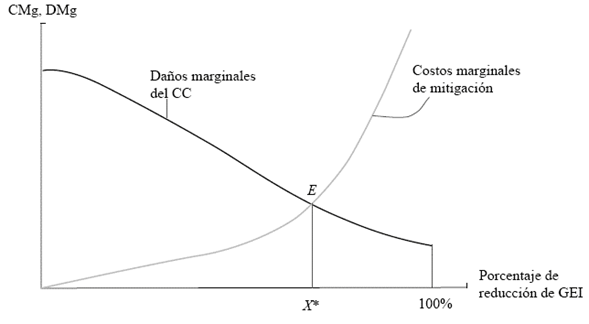
Gráfica 1: Costo marginal de la reducción de GEI y el daño marginal del calentamiento global.
Varios autores se han referido al Informe Stern (Stern, 2006) como el detonante de las controversias sobre la perspectiva económica frente al CC (Arrow, 2007; Cline, 2007; Mendelsohn, 2007; Neumayer, 2007; Nordhaus, 2007; Spash, 2007; Weitzman, 2007; Yohe y Tol, 2008). La controversia se generó porque el informe, que utilizó el modelo integrado PAGE (Hope, 2007) y una tasa social de descuento baja, recomendó una acción inmediata y radical antes de que los efectos negativos del CC fueran irreversibles, mientras los estudios previos habían llegado, en general (hay excepciones, véase en Spash, 2002), a recomendar una acción moderada dado que los efectos del CC en el futuro no superaban por mucho los costos de mitigar las emisiones de GEI (Norgaard, 2011).
Entre las perspectivas críticas al informe se puede resaltar la de Nordhaus (2007), quien elaboró el modelo integrado DICE y basado en sus resultados recomendó una acción contraria frente al CC; es decir, inicialmente pequeña, pero que aumente lenta y progresivamente conforme se vayan manifestando los efectos del fenómeno. De forma similar, Yohe y Tol (2008) mencionan que Stern sobreestima el impacto del CC y subestima los costos de reducir las emisiones. Mendelsohn (2007) es más cauteloso, pero resalta que hace falta validar los supuestos del estudio. Algunos autores respaldaron el abordaje de Stern (Cline, 2007) y otros lo criticaron por razones diferentes, que se ampliarán más adelante (Neumayer, 2007; Spash, 2007). Pese a las críticas, Stern (2008; 2013a; 2013b) ratificó los supuestos asumidos.
A juzgar por las conclusiones, pareciera que los modelos y marcos analíticos fueran diametralmente opuestos. Sin embargo, como resalta Dasgupta (2008), las diferencias radicales entre perspectivas como la de Nordhaus, por una parte, y la de Stern, por otra, dependen en el fondo de la elección de los pequeños parámetros de distribución intertemporal que componen la tasa social de descuento. Por lo demás, son muy parecidos, pues utilizan el mismo marco normativo utilitarista, en el cual los individuos racionales buscan maximizar su nivel de utilidad mediante el consumo de bienes y servicios; por tanto, la sociedad, entendida como la agregación de los individuos, tiene un nivel de bienestar equivalente al nivel de consumo agregado. Con esto, los enfoques consideran que el aumento del consumo tiene una relación funcional directa con el aumento del bienestar.
Elementos básicos de los modelos utilizados
Si bien existen diversas aproximaciones a la modelación (Botzen y Van den Bergh, 2014), aquí se asume un modelo básico con un ánimo ilustrativo, teniendo en cuenta que este tipo de modelos han sido usados por importantes estudios. Un modelo general de bienestar asume que todos los agentes tienen la misma función de utilidad, que depende del consumo. Y el consumo es de un solo bien homogéneo. Así, para el individuo i la utilidad que obtiene del consumo es
ui(c)
, y para  , por lo que el bienestar en un período de tiempo dado es
  , para i = 1, 2,...N. Ahora, para T períodos de tiempo y con una población constante, el bienestar actualizado (en valor presente) en una versión continua está dado por la ecuación (1):

Se hace el supuesto de una utilidad constante en el tiempo y la forma funcional más común de la utilidad (isoelástica) es 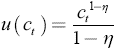 , donde η≥0 es la elasticidad de la utilidad marginal del consumo con respecto al consumo. Esta forma de utilidad isoelástica fue utilizada por Stern (2006) y por Nordhaus (2007), así como los supuestos expuestos anteriormente. La discordia entre las posiciones de los autores dentro de la economía del bienestar consiste en los criterios para realizar la distribución intertemporal, esto es, la tasa social de descuento.
La tasa social de descuento
La tasa social de descuento (TSD), que deriva de (1) (véase Anexo), refleja el valor relativo que se le da a los flujos de bienestar futuro respecto a los del presente y está constituida por tres elementos: la elasticidad de la utilidad marginal del consumo respecto al consumo (η), el crecimiento del consumo en el tiempo  y la tasa pura de descuento (δ) -ecuación (2)-. Este criterio, por pequeño que parezca, lleva a grandes diferencias en los resultados y su abordaje permanece como una discusión abierta (Arrow et al., 2012; Stern, 2013a, 2013b). Para dar una rápida ilustración, supóngase un daño realizado por el CC dentro de cien años valorado en $ 1.000.000, η = 1 y
  = 2%; así, con δ = 4% (TSD = 6%) el valor presente de ese daño sería de $ 3.124,1, pero si δ = 0,1% (TSD = 2,1%) entonces el valor presente de ese daño sería de $ 127.776,7. El ejemplo ilustra por qué Nordhaus (2007), que tomó una tasa de descuento alta, llegó a sugerir que es mejor actuar después (el valor del futuro es menor), mientras que Stern (2006) sugirió que había que actuar inmediatamente (el valor del futuro es mayor).

Existe una perspectiva que argumenta que el problema de estimar la tasa de descuento es técnico y que, así como se aplica en las evaluaciones de proyectos privados o sociales de pequeña escala, la tasa de descuento se puede aproximar por la rentabilidad de las inversiones de más largo plazo en los mercados. Nordhaus (2007) en el modelo DICE utiliza los retornos de capital de mercado estimados como tasa de descuento que, en promedio, son de 4% (5,5% para los primeros cincuenta años). Esta perspectiva asume que la mejor decisión de distribución intergeneracional se logra extrayendo preferencias de los individuos reveladas en los mercados. Esto es equivalente a asumir que por medio de la disposición a pagar, la impaciencia individual se transforma en una característica de la decisión social. La principal razón expuesta por Nordhaus para argumentar una tasa de descuento igual a la rentabilidad de los mercados, consiste en que
(...) la tasa de descuento es alta para reflejar el hecho de que las inversiones para reducir los daños derivados del clima en el futuro sobre el maíz y los árboles deberían competir con las inversiones en semillas mejoradas, mejoramiento de equipo y otras inversiones de alta rentabilidad [TP] (2007, p. 14), luego la productividad de esas inversiones debe ser suficiente para reparar los daños futuros.
Otra perspectiva argumenta que cuando se habla de la sociedad en su conjunto en el muy largo plazo no tiene sentido sacar ese parámetro de los mercados que solo representan las preferencias actuales. En cambio, su elección debe seguir un criterio ético escogiendo la tasa pura de descuento cercana a cero para dar un valor igual a cada generación. A continuación se exponen las razones presentadas por Stern (2006, 2008, 2013a, 2013b), para realizar dicha elección ética en vez de usar los mercados:
1) La economía no es perfecta: además de la externalidad climática, existen bienes públicos y otras imperfecciones como en las redes de información e ideas, las redes físicas de transporte y las eléctricas. Además existe riesgo en los mercados financieros, así como bienes sin precio, como la biodiversidad o la seguridad energética, que interactúan en la conformación de la externalidad climática.
2) Las preferencias que se expresan en los mercados no representan a las generaciones futuras: la razón es que la sociedad como tal, al decidir sobre el muy largo plazo, no puede usar como criterio la rentabilidad de los mercados para descontar, pues se incurre en el problema ético de valorar menos a las generaciones futuras que a las presentes por medio de un mecanismo que solo representa a estas últimas -la posición es respaldada por trabajos como el de Dasgupta (2008) o Heal (2007)-. Este problema se ha discutido desde hace algún tiempo en la literatura bajo el nombre de la dictadura del presente, ya que las generaciones futuras no pueden participar en las decisiones porque son incapaces de revelar sus preferencias en los mercados de hoy.
3) El análisis de las opciones que se sopesan con el CC es de un carácter no marginal: un análisis marginal representa la posibilidad de generar modificaciones dentro de una senda de crecimiento. En cambio, las decisiones que deben tomarse respecto al CC corresponden a la elección entre sendas. En últimas, lo que se tiene que decidir es qué estructura económica prevalece.
4) Los bienes no son homogéneos: de hecho, tanto la estabilidad como la regulación climática, desde la economía del bienestar, deben entenderse como un bien público y como tal la rentabilidad de los mercados no las favorece aunque sean necesarias para el bienestar de la sociedad. En este contexto, cada tipo de bien tiene un tipo diferente de consumo (Roemer, 2011) y por ello se debe escoger una senda de crecimiento diferente en cada caso. Esto implica elegir distintas tasas de descuento para cada tipo de consumo (Heal, 2007) y existirían tasas específicas para el caso de los bienes y servicios ambientales, cuyas características sobre el bienestar pueden verse como directas e indirectas: son medios, en tanto constituyen el material para hacer otros bienes, y fines, ya que se disfrutan directamente sus servicios.
El futuro es incierto
El criterio de elección de la tasa ve su reto más grande al enfrentar la incertidumbre de un fenómeno tan complejo, su interacción con la economía y su dimensión espacial, que hacen que los flujos de bienestar futuro sean altamente impredecibles. Como afirman Ackerman, DeCanio, Howarth y Sheeran (2009), el punto de la incertidumbre es uno de los que está menos desarrollado en los diferentes modelos integrados. Pero estos enfoques se enfrentan a la característica impredecible del clima, que es la combinación de lo que no se conoce con el conocimiento sobre las dinámicas caóticas y los efectos umbral asociados a las no linealidades que lo caracterizan, y por tanto las predicciones son indeterminadas. Además, Ackerman et al. (2009) resaltan otro inconveniente de los modelos respecto al futuro incierto y es que normalmente especifican arbitrariamente una función de daños, y añaden que "la combinación de distribuciones de probabilidad desconocidas y resultados potencialmente desastrosos provee una fuerte motivación para una política de precaución, como seguro frente a tales desastres" [TP] (p. 310). Dasgupta va en dirección similar cuando concluye que con la incertidumbre en cuanto a las innovaciones tecnológicas:
(...) es posible creer que la Humanidad debería invertir mucho más en la reducción del cambio climático que el 2% del PIB de los países ricos que propuso el Informe Stern. Puede sostenerse dicha creencia aun cuando no sea posible justificarla desde el modelamiento formal [TP] (2008, p. 27).
Otra crítica a los modelos integrados deterministas (como el DICE), es que no incluyen apropiadamente las posibilidades de eventos catastróficos, con altos potenciales de daño pero con baja probabilidad, por lo que las funciones de sensibilidad y las de daños subvaloran o excluyen efectos de retroalimentación rápida y consecuencias desastrosas de aumentos radicales en las temperaturas. Una forma de lidiar con esto es introduciendo funciones de densidad de probabilidad con colas anchas (fat-tails), que permiten dar mejor cuenta de estos efectos y son más coherentes con lo que menciona la evidencia científica. Con esto, la incertidumbre respecto a las tasas de descuento, implica que estas deben descender progresivamente hasta su valor mínimo posible, de modo que se resalte el valor de los eventos futuros, lo que equivaldría a asegurarse en contra del CC (Gollier y Weitzman, 2010; Weitzman, 2007, 2011).
Este tipo de afirmaciones lleva a examinar alternativas a la búsqueda de una senda eficiente mediante la elección de una tasa de descuento apropiada y gira la discusión hacia el manejo apropiado de las incertidumbres.
DE LA ECONOMÍA AMBIENTAL A LA ECONOMÍA ECOLÓGICA
Esta sección presenta los referentes conceptuales de la economía ecológica como corriente alternativa. Para ello analiza el giro del debate de la eficiencia al de la sostenibilidad, enfatiza en la incertidumbre irreductible y luego enfatiza sobre discusión ética.
Referentes conceptuales de la economía ecológica
El cambio de perspectiva tiene una base material, que se refleja en la siguiente cita de Georgescu-Roegen (1975):
Dado que la ley de la entropía no admite manera alguna de enfriar un planeta que es calentado de forma continua, la polución térmica podría probar ser un obstáculo más crucial para el crecimiento que finitud de los recursos accesibles... La verdad sobria es que, a pesar de nuestros esfuerzos, la acumulación de la polución puede... convertirse en la primera crisis ecológica seria [TP] (pp. 358-359).
El CC es la manifestación de esa crisis, que deriva de una acumulación de polución inmanejable. La diferencia teórica fundamental respecto a la visión de la economía ambiental está en la concepción de externalidad. Daly y Cobb (1997) mencionaban lo siguiente:
Distinguiremos entre las exterioridades localizadas y las generalizadas. Las primeras pueden corregirse, por lo menos en una medida razonable, ajustando los precios o mediante otros cambios que no son radicales. En cambio, las exterioridades generalizadas tienen un alcance mucho más amplio y no pueden corregirse efectivamente mediante cambios de los precios relativos. Se requieren límites cuantitativos o profundos cambios institucionales [cursiva original] (p. 57).
Así, para enfrentar el CC se requiere un cambio radical que reconozca los límites cuantitativos del crecimiento del sistema económico y para ello es imperativo un nuevo sistema institucional. Vatn y Bromely (1997), en línea con Boulding (1966) y Kapp (1974, 1978), argumentaron que el concepto mismo de externalidad es incoherente con el fenómeno de la contaminación, pues el desplazamiento de costos hacia terceros es en sí una actividad racional del agente económico, luego la contaminación no debe verse como un "fallo del sistema", sino como un producto del sistema.
El CC es una consecuencia del proceso económico, entendiendo este proceso desde un sistema que puede producir bienestar material haciendo uso de la biosfera tanto para extraer materiales, energía y servicios ecosistémicos, como para decantar residuos degradados, no aprovechables o de alta entropía; pero las dinámicas de distribución y acumulación de los residuos y las de retroalimentación con las funciones asimiladoras terminan afectando al sistema social y la calidad de vida de los individuos, generando injusticias y conflictos (Ayres y Kneese, 1969; Georgescu-Roegen, 1975; Kapp, 1974; Martínez-Alier, 2010; O'Hara, 2009). Dicho proceso sistémico está acotado por un grupo de límites que caracterizan cierta escala de producción económica o umbral crítico y, al sobrepasarlos, la irrupción en los ecosistemas conlleva un deterioro de la calidad de vida de la sociedad. De este modo, el crecimiento de la economía se torna en contra del bienestar de la sociedad, por haber superado la escala óptima de la economía con respecto a la biosfera (Daly, 2007; Max-Neef, 1995).
Esta es la base de la economía del estado estacionario, en la que sobresalen tres elementos: a) minimizar los flujos de materia y energía que ingresan y salen del sistema, de modo que se mantengan las capacidades de asimilación y regeneración de la biosfera, b) mantener stocks estables de capital hecho por el hombre y capital natural, luego no es posible la sustitución absoluta del uno por el otro y c) mantener una escala de funcionamiento óptimo de la economía, es decir, que no supere los límites de los ecosistemas. Esto último por medio del mantenimiento estable de la población y de las dos formas de capital (Daly, 1974, 2007; O'Neill, 2012).
El decrecimiento es una propuesta más radical que ha planteado seriamente las posibilidades de reducir el tamaño físico de la economía y su metabolismo (principalmente de las economías del Norte), dadas las consecuencias negativas tanto biofísicas como sociales. Pero más allá de ser una simple reducción del tamaño físico de la economía, que por sí sola puede resultar catastrófica, encierra un entramado de propuestas relacionadas con el establecimiento de nuevos valores, instituciones, políticas y prácticas que viabilicen el respeto por los límites. El decrecimiento surge como una posición política que cuestiona las bases materialistas de un sistema sustentado en el crecimiento del consumo, y dentro de sus propuestas exige la revalorización de lo común, de la revalorización de los proyectos propios de cada sociedad, así como la búsqueda de una autolimitación de la sociedad (Gadrey, Marcellesi y Barragué, 2013; Gorz, 2011; Kallis, Demaria y D'Alisa, 2015; Latouche, 2010; Van den Bergh y Kallis, 2012; Victor, 2012).
El respeto por los límites de los ecosistemas, y los efectos sociales de transgredirlos, no son capturados por los indicadores de crecimiento económico. Por ello se han planteado alternativas. Unas consisten en modificaciones al producto interno bruto (PIB), pero considerando la distribución de la riqueza y la destrucción del capital natural. Daly y Cobb (1997) se basaron en el concepto de ingreso hicksiano para establecer el índice de bienestar económico sostenible, que permitió plantear la hipótesis del umbral, según la cual una vez alcanzado el umbral de crecimiento físico, más crecimiento no aporta bienestar o incluso genera su pérdida (Max-Neef, 1995).
La contabilidad biofísica es otro abordaje alternativo importante. La huella ecológica, como una forma de analizar el espacio utilizado y contrastarlo frente a la biocapacidad y la apropiación humana de la producción primaria neta, como indicador del dominio humano de la naturaleza, son ejemplos con amplia tradición (Haberl, Wackernagel, Krausmann, Erb y Monfreda, 2004). La huella ecológica sirvió de base conceptual para estudios que calculan una huella de carbono (Hertwich y Peters, 2009), que es una aproximación biofísica para generar información en la toma de decisiones al contrastar con la capacidad de asimilación, pero más que todo como indicador de responsabilidad. Los análisis de la producción primaria neta facilitan comprender la relación de las emisiones contenidas en el comercio internacional de productos agrícolas (Gavrilova, Jonas, Erb y Haberl, 2010).
Recientemente se han desarrollado propuestas que reflejen mejor la diversidad de factores que componen el bienestar. O'Neill (2012, 2015) plantea una metodología basada en indicadores para la transición hacia una economía dentro del estado estacionario. Propone dos bloques de indicadores para evaluar la transición hacia el estado estacionario: a) indicadores biofísicos, entendidos como medios para alcanzar un fin y se dividen en medios fundamentales, que son recursos naturales para sostener la vida y las actividades económicas, y medios intermedios, que son los medios de transformación de los medios fundamentales y b) indicadores sociales, entendidos como fines y se dividen en fines fundamentales, que consisten en los objetivos que no tienen un valor en función de otra cosa (tienen un valor intrínseco), y fines intermedios, que son los objetivos que se espera alcance la economía (tienen un valor funcional).
De la eficiencia a la sostenibilidad
Una de las implicaciones de ver el problema del CC como una externalidad, es que la sostenibilidad solo puede lograrse mediante una mejora de la eficiencia en términos sociales. Es el caso de Stern (2013b), quien asumió la sostenibilidad de forma equivalente a la eficiencia paretiana, de modo que la ineficiencia generada hoy por el CC pudiera llevar tanto a mejorar su posición como la de las futuras generaciones, mediante cambios que escoja la generación presente sobre producción y consumo.
Contrario a esta perspectiva, varios autores han argumentado que el criterio de la sostenibilidad no es el mismo de la eficiencia, pues tiene cualidades diferentes enfocadas en la equidad de las distintas generaciones. Roemer (2011) argumenta a favor de la sostenibilidad débil bajo el criterio ético rawlsiano, partiendo de la consideración de que nada asegura que las generaciones futuras sean más ricas que las presentes. En esta perspectiva, el problema pasa de encontrar la senda de crecimiento del consumo óptimo a encontrar la senda que maximice el mínimo bienestar de cualquiera de las generaciones (criterio maximin).
Para Norgaard (2011), el problema de la sostenibilidad es de distribución intertemporal de derechos y no solo de eficiencia. Argumenta que las perspectivas convencionales del análisis costo-beneficio en el contexto del CC se centran exclusivamente en ganar eficiencia y no integran el problema de los umbrales que implica la sostenibilidad. Este autor afirma que esto se debe a que esos modelos no permiten comprender que el CC no solo afecta unos precios, con todo lo demás constante, sino que también afecta al sistema general de precios, así como múltiples valores fuera del mercado.
De acuerdo con Neumayer (1999, 2007), el debate de la tasa de descuento no debería ser el centro de la discusión, pues en últimas no existe una tasa de descuento adecuada porque esta depende de criterios normativos. De hecho, dice que la sustituibilidad de factores es el fundamento teórico detrás de la tasa de descuento; por tanto, considera que tanto Nordhaus como Stern asumen que los factores son sustituibles. En cambio, propone centrarse en "qué tanto el cambio climático infringe daños irreversibles y no sustituibles, así como pérdidas sobre el capital natural" [TP] (2007, p. 299). En esta perspectiva, el autor menciona que hay dos formas de entender la no sustituibilidad: a) la perspectiva utilitarista, en la cual el crecimiento del consumo no compensa la utilidad de las pérdidas futuras en capital natural que afecten la utilidad misma. Stern (2013a) menciona por momentos esta perspectiva, aunque el concepto de la no sustituibilidad no queda integrado en su modelo. Weitzman (2011), en cambio, expone explícitamente el tema y Dasgupta (2008) lo refiere implícitamente y b) la perspectiva deontológica, que se refiere a la imposibilidad de las generaciones futuras de hacer valer sus derechos, producto del CC, y además resulta imposible compensar esta falencia con mayor consumo. Los trabajos de Howarth (1997), Norgaard (2011) o de Sen (2013) presentan versiones de esta perspectiva.
Efectivamente, Nordhaus (2007) asume que el capital natural es totalmente sustituible por aquel hecho por el hombre, como lo deja ver cuando argumenta que las inversiones en capital natural compiten directamente con las demás. Stern, en cambio, considera las características de diferentes bienes y también los efectos irreversibles y, en ese sentido, admite una menor sustituibilidad que Nordhaus, y, como reconoce Neumayer (2007), hay varias pistas en este sentido en el Informe Stern, pero al transformar los impactos sobre el ambiente en fracciones del PIB asume que el dinero es un buen sustituto del ambiente o, como lo dijo Van den Bergh, "que el dinero puede 'comprar de vuelta' la estabilidad climática" [TP] (2004, p. 387).
Howarth (1997) plantea un enfoque "contractualista", donde las oportunidades de vida deben ser mantenidas de modo no decreciente, y argumenta que la incertidumbre implica asumir una posición desde la sostenibilidad fuerte, proponiendo criterios prácticos como el principio de precaución o los estándares mínimos de seguridad, así como medidas institucionales que aseguren los derechos de las generaciones futuras. Van den Bergh (2004) relaciona la no sustituibilidad con la incertidumbre, argumentando que el papel de la incertidumbre extrema asociada al CC y de las posibles catástrofes, hacen que los criterios de eficiencia no ayuden a saber si una senda es o no sostenible y, por tanto, una perspectiva de la sostenibilidad fuerte consiste en adoptar el principio de precaución.
Estos argumentos son muy cercanos a las perspectivas de dos de los pioneros de la economía ecológica. Por una parte, Kapp planteó que los límites ecológicos deben reconocerse como mínimos sociales del bienestar para sostener la vida o como necesidades sociales y en este sentido "... es esencial derivar estándares objetivos en la forma de límites apropiados de niveles máximos tolerables o aceptables de concentración de contaminantes" [TP] (1974, p. 70). Para el autor, esto implica alejarse del criterio racional puro de la eficiencia. Por otra, para Georgescu-Roegen, "en vez del principio de comportamiento racional -ese de maximizar la utilidad (¡sea cual sea su significado!) nuestra política hacia los recursos naturales en relación con las generaciones futuras debe buscar el mínimo arrepentimiento" [TP, cursiva original] (1977, p. 113).
Es decir, la distribución intertemporal debe seguir el criterio ético de prevenir situaciones indeseables para las generaciones futuras. De acuerdo con Georgescu-Roegen (1996), debe haber una diferenciación de los factores del sistema económico entre flujos, stocks y fondos. Un bien fondo es aquel que entra en el proceso económico y aporta un flujo durante un período de tiempo, pero el bien permanece cuantitativamente igual aunque cualitativamente transformado; en cambio, un stock es la acumulación de un flujo y si un bien fluye de un stock, este sí cambia cuantitativamente (se desacumula). Las funciones de regulación climática así como otros bienes y servicios fluyen de los ecosistemas, de modo que en el contexto del CC la perspectiva de minimizar consecuencias indeseables está fuertemente atada al mantenimiento de los ecosistemas como bienes fondo, pues producen un flujo de bienestar, conceptualizados como servicios ecosistémicos.
La perspectiva de las oportunidades como libertades, de acuerdo con Sen (2004, 2013), implica que la riqueza material de una generación no puede intercambiarse por la libertad de disfrutar de "aire limpio". Así, implícitamente se asume la no sustituibilidad de factores, por lo menos no perfectamente.
Con esto, queda claro que uno de los puntos más representativos del CC, a saber, la sostenibilidad -en su sentido fuerte- es un concepto diferente al de la eficiencia y resulta más apropiado, pues representa la necesidad ética de la distribución intertemporal y espacial de los mínimos biofísicos que se deterioran progresivamente por los procesos metabólicos asociados al CC. En este sentido, los enfoques de las perspectivas biofísicas resaltadas en la sección anterior, dan una base operativa a las perspectivas que procuran mantener una base mínima en la distribución intertemporal.
De la incertidumbre débil a la incertidumbre fuerte
La economía ecológica se sustenta en la ciencia Pos-Normal, caracterizada por tratar con hechos inciertos, valores en disputa, mucho en juego y decisiones urgentes, como en el caso del CC (Funtowicz y Ravetz, 1993). En esta perspectiva, la precaución es la principal guía de política y la consulta extendida (no solo a expertos académicos) es la mejor forma de integrar dichos valores.
Funtowicz y Ravetz (1994) hicieron unas críticas particulares al estudio de Nordhaus (1991). Se basaban en el exceso de precisión de un modelo inmerso en un marco de incertidumbres gigantescas. De forma algo similar, el estudio de Weitzman (2011) resalta incertidumbres estructurales con relación al modelamiento del CC, basando su crítica en los modelos convencionales (como el DICE de Nordhaus).
Cuando las incertidumbres son tan grandes, se hace inviable sopesar alternativas, particularmente en caso de eventos extremos e irreversibles. En vez de esto, cualquier análisis debería envolver principalmente el proceso histórico en el cual unos países realizaron su desarrollo industrial generando a flujos de GEI por décadas. Más que una política óptima, la responsabilidad histórica consiste en una disputa normativa, que en buena medida ha sido marginal en los modelos integrados (Van den Bergh, 2004).
De forma similar, Spash (2002, 2007) plantea críticas que tienen que ver con el tratamiento de la incertidumbre por parte de los estudios sobre el CC. El autor divide la incertidumbre en dos, incertidumbre débil e incertidumbre fuerte. La primera, asumida por estudios como del bienestar pero también por el del IPCC (2007), consiste en asignar una probabilidad a la ocurrencia de los eventos futuros y asumir que con la investigación esta incertidumbre es reductible. En este sentido, la incertidumbre es tratada como riesgo. La perspectiva fuerte se caracteriza por un conocimiento imperfecto sobre los sistemas relacionados con el clima y su evolución y puede ser entendida conceptualmente como ignorancia parcial e irreductible, de modo que los resultados son indeterminados y por ende impredecibles3.
La ética detrás de la técnica
Precisamente, en cuanto a los valores, Spash (2002, 2007) resalta que los modelos integrados de la economía del bienestar asumen que todas las categorías sujetas de ser beneficiadas o afectadas son conmensurables y, por ende, pueden reducirse a una unidad única de valor. El autor plantea el problema ético cuando señala que la estructura de los modelos económicos está cargada de juicios de valor, pues siempre hay un factor normativo en las decisiones sociales.
Si solo importan las diferencias de elección en los parámetros, como δ, entonces, ¿qué otras disputas normativas se encuentran en la discusión? La respuesta a este interrogante viene del examen de los supuestos básicos de los modelos de bienestar, que parten de una teoría particular del comportamiento humano, de aquello que es sujeto de ser valorado y una relación específica individuo-sociedad.
Los supuestos básicos que respaldan a la economía ambiental son: a) un individuo solo valora aquellas cosas (objetos de valor) que le representan una utilidad, b) las cosas que valora son todos los bienes y servicios que puede consumir, c) más consumo de un objeto de valor proporciona siempre un mayor nivel de utilidad y d) el bienestar de cada cohorte es la agregación de la utilidad de los individuos de esa cohorte.
Respecto al primer supuesto, los modelos neoclásicos que analizan el CC asumen que esos objetos de valor son todos transformables en una unidad común, el dinero. Pero los valores asociados a la vida, al ambiente y al bienestar humano son inconmensurables, en tanto no pueden ser traducidos a una única medida de valor (Kapp, 1974; Martínez-Alier, 2010); por ello, puede decirse que dichas perspectivas que sufren del efecto Midas, que representa la tendencia de los ejercicios económicos a transformar todas las formas de valor en dinero, hacen explícita la imposibilidad de reconocer valores intrínsecos y umbrales críticos (Foster, Clark y York, 2009). El ejemplo más discutido de este tipo de ejercicios, es el valor de la vida humana, que debe entrar como una cantidad monetaria en los ejercicios que buscan cuantificarla como un daño (Stanton y Ackerman, 2009).
El supuesto d) refleja la posición atomista, en la cual el todo es la simple agregación de sus partes. Frente a esto, la economía ecológica reconoce el carácter complejo de la relación economía-biosfera y encuentra una tendencia a rescatar el papel de los procesos sociales en la constitución de juicios y acuerdos, así como de incidir de forma conjunta sobre instituciones que modelan el comportamiento humano (Norgaard y Baer, 2005). Entendidas así, estas formas serían propiedades emergentes que se separan de la simple agregación de las partes. Sin embargo, es sobre los supuestos b) y c) que se sustenta una de las grandes controversias, que serán discutidas en el siguiente apartado.
¿MAYOR CONSUMO SIGNIFICA MÁS BIENESTAR?
Detrás de los supuestos relacionados al consumo se encuentra un ideal de desarrollo, que se sustenta en la expansión del consumo como un principio universalmente válido y socialmente deseable. Sin embargo, este es un concepto pre-analítico4, pues la expansión del consumo es causa del CC; por tanto, su expansión no conlleva necesariamente un mayor bienestar. Roemer (2011) resalta este punto, a propósito del análisis de Nordhaus cuando señala: "¡La única manera en la cual una cosa puede ser mala, si lo único que puede producir bienestar es el consumo de commodities, es si esta reduce la posibilidad de consumir!" [TP] (p. 379).
En el fondo, lo que se está cuestionando es la insaciabilidad, es decir, que más consumo siempre traiga más bienestar. Al respecto, los estudios empíricos han mostrado que el bienestar humano se ha ido separando de la expansión material. Los estudios sobre la paradoja del bienestar, que en términos generales se refiere a que el bienestar subjetivo no aumenta o incluso decrece cuando el ingreso y el consumo crecen (Easterlin, 2003; Easterlin, Angelescu, Switek, Sawangfa y Smith, 2010; Jackson, 2008), dan una base sólida a este argumento, dan fuerza a perspectivas que se enfocan al estudio del bienestar de forma multidimensional, como las necesidades fundamentales (Max-Neef, 2010) o las capacidades (Sen, 2013).
Consciente de la necesidad de un cambio, Stern (2013a, 2013b) considera que las políticas frente al CC requieren romper el vínculo entre las actividades económicas y las emisiones, lo que representaría una nueva revolución energética-industrial. Sin embargo, el sustento de la propuesta es la hipótesis del desacople, que sostiene que es posible aumentar los niveles de producción y consumo, sin generar emisiones o incluso reduciéndolas. Así, el crecimiento económico es la solución al problema del CC.
Proponer que haya más crecimiento sin emisiones, proviene de la idea de que puede llegarse a internalizar toda la externalidad mediante una revolución tecnológica y organizacional: sustentada en un optimismo tecnológico. Sin embargo -como se mencionó-, el problema de las emisiones está muy atado al sistema económico y nada garantiza que una nueva revolución industrial lleve al completo desacople. De hecho, Jackson (2009) hace una crítica fundamental al desacople, dividiendo el concepto entre relativo y absoluto. El desacople relativo, que es un indicador de eficiencia, significa que el nivel de emisiones se reduce respecto al crecimiento económico, o sea, su tasa de crecimiento es menor, aunque siga creciendo. El desacople absoluto tiene que mostrar un descenso general en las emisiones respecto al consumo. El autor menciona que si bien está ocurriendo cierto nivel de desacople relativo con relación a las emisiones de GEI, el desacople absoluto no ocurrirá dentro del actual sistema económico. Por tanto, contrario a Stern, Jackson menciona que no se necesita una época de progreso y crecimiento sin emisiones, eso sería imposible, sino una redefinición de la idea de progreso sin necesidad de crecimiento material.
Así, desde la economía ambiental, el crecimiento del consumo está en riesgo con el CC y, a su vez, es el principal elemento para enfrentarlo, luego debe ser potenciado para garantizar el bienestar. En cambio, la economía ecológica considera el crecimiento material del consumo como causa de la crisis que representa el CC; por tanto, mejorar el bienestar requiere detener su expansión e incluso su reducción. Esta es la principal diferencia entre ambos marcos analíticos, la interpretación normativa de la función de la materialidad para la sociedad.
Consideramos que el cambio planteado por la economía ecológica abre la puerta a la comprensión de la problemática desde un punto de vista más apropiado, si de lo que se trata es de cambiar el sistema de valores, instituciones y prácticas, al reconocer que: a) la eficiencia pura debe reemplazarse por la sostenibilidad en su versión fuerte, dadas las irreversibilidades asociadas al proceso y la imposibilidad de reemplazar la pérdida de la estabilidad climática, b) la incertidumbre debe dejar de ser entendida como riesgo y debe reconocerse que se está frente a un futuro indeterminado, de modo que la precaución es el mejor principio de política, de la mano con la participación amplia en la toma de decisiones, c) los dilemas normativos no solo obedecen a una ética imbuida en decisiones sobre los parámetros, sino también a aquellos conceptos y supuestos que conforman los marcos analíticos y d) la expansión material no es algo positivo para la sociedad per se, de hecho puede ser algo dañino en términos socioambientales, luego se requiere redefinir el concepto normativo de desarrollo (véase Tabla 1).
Fuente: desarrollo propio.Tabla 1: Comparación de perspectivas
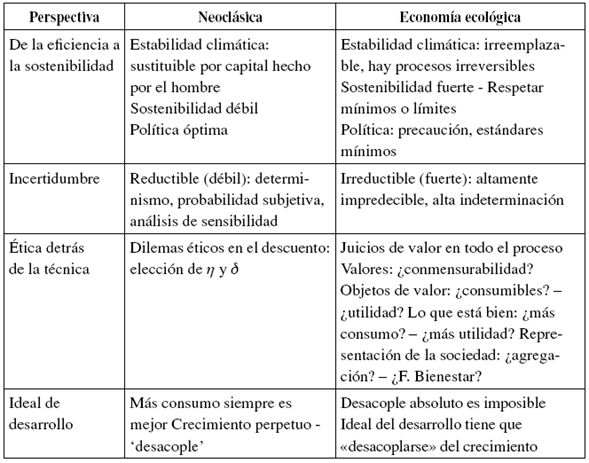
Redefinir la noción de progreso, cuestionar el crecimiento económico, las posibilidades y efectos de abandonarlo hoy día, consiste en la mejor política de precaución ante los efectos destructivos que supone el CC. Este cambio de base teórica se requiere si se busca superar las recomendaciones de política que sugieren más crecimiento de las bases productivas, relegando a un segundo plano las consecuencias biofísicas y sociales.
CONCLUSIONES
Este artículo se centra en el análisis de dos cuerpos teóricos que abordan la relación economía-CC. Primero, se ocupa de resaltar los puntos más importantes de los modelos que han incidido en la política climática desde la economía ambiental y, posteriormente, se plantean los elementos alternativos para abordar la relación desde la economía ecológica.
El artículo realiza un aporte en el análisis de aquellos elementos en los cuales difieren las dos perspectivas teóricas a propósito del CC, y apuesta por un giro hacia la economía ecológica. Esta perspectiva teórica resulta más apropiada para abordar el reto que representa el CC por varios motivos (véase Tabla 1), pero principalmente porque su marco analítico permite capturar elementos como la sostenibilidad fuerte y la incertidumbre irreductible. En el fondo, al asumir esta visión teórica se abre la puerta a una discusión normativa sobre el deber ser del mismo proceso económico, cuestionando el papel del crecimiento económico como generador de bienestar y así como la base del concepto de desarrollo.
Hay que resaltar, como lo hace Hulm, que "[u]na de las razones por las que estamos en desacuerdo sobre el cambio climático es porque entendemos de forma diferente el desarrollo" [TP] (2009, p. 251). En efecto, el presente artículo llama la atención sobre esas diferencias y reclama que a la luz de los complicados ejercicios que supone analizar el CC, queda a veces escondido el marco normativo que respalda las sugerencias de política. No obstante, queda mucho trabajo por delante en cuanto a esta redefinición de progreso y, en especial, al papel que deberían desempeñar los llamados países "en desarrollo".
REFERENCIAS
Sugerencia de citación:
ANEXO
Este anexo deriva de la tasa social de descuento con un fin ilustrativo, partiendo del modelo presentado en la ecuación (1) y siguiendo a Stern (2008). Si tomamos el valor social del consumo (VSC) de un período específico t de (1), se tiene:

Donde N es la población, C el consumo agregado y c = C/N el consumo per cápita. El factor social de descuento (λ), entendido como la utilidad marginal del consumo (C) en el tiempo t = 0, es:
Así, la tasa social de descuento (TSD) es la tasa de decaimiento de λ; es decir, la disminución marginal respecto al tiempo de la utilidad marginal del consumo con respecto a su propio valor 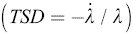 :
:
Al desarrollar la parte derecha de (A-4) se llega a:
Donde ċ = dc/dt y si llamamos η a la elasticidad de la utilidad marginal del consumo con respecto al consumo  , puede mostrarse que la TSD es:
Donde δ es la tasa pura de descuento. Los parámetros δ y η son los denominados paramentos éticos. La elección de δ tiene que ver con qué tanto valor se le asigna a los flujos futuros de bienestar, o más coloquialmente, el valor de las generaciones futuras. La elección de η tiene varios sentidos, uno muy importante es su interpretación como la aversión a la inequidad. El modelo que se presentó es un modelo muy básico. Por ejemplo, Heal (2007) incluye en la función de utilidad u(c, s) una variable estado s que puede interpretarse como un bien ambiental agotable, y en consecuencia llega a una TSD con un parámetro adicional (A-7):
En este caso, ηc,c es la elasticidad de la utilidad marginal del consumo con respecto al consumo y ηc,s es la elasticidad de la utilidad marginal del consumo en cuanto a la variable estado (s). Lo que muestra este nuevo parámetro es la sensibilidad de la tasa al deterioro de s.
Referencias
Ackerman, F., DeCanio, S., Howarth, R., & Sheeran, K. (2009). Limitations of integrated assessment models of climate change. Climatic Change, 95(3-4), 297-315. doi: 10.1007/s10584-009-9570-x.
Alley, R. B., Marotzke, J., Nordhaus, W. D., Overpeck, J. T., Peteet, D. M., Pielke, R. A.,..., & Wallace, J. M. (2003). Abrupt climate change. Science, 299(5615), 2005-2010. doi: 10.1126/science.1081056.
Arrow, K. (2007). Global climate change: A challenge to policy. The Economists' Voice, 4(3), artículo 2. doi: 10.2202/1553-3832.1270.
Arrow, J. K., Cropper, M. L., Gollier, C., Groom, B., Heal, G. M., Newell, R. G., & Weitzman, M. L. (2012). How should benefits and costs be discounted in an intergenerational context?: The views of an expert panel (Discussion Paper RFF-DP 12-53). Recuperado del sitio web de Resources for the Future: http://www.rff.org/RFF/Documents/RFF-DP-12-53.pdf.
Ayres, R. U., & Kneese, A. V. (1969). Production, consumption, and externalities. American Economic Review, 59(3), 282-297. Recuperado de http://www.jstor.org/stable/1808958.
Banco Mundial. (2010). Informe sobre el desarrollo mundial 2010: desarrollo y cambio climático. Colombia: Banco Mundial, Mundi Prensa y Mayol Eds.
Botzen, W. J., & Van den Bergh, J. C. (2014). Specifications of social welfare in economic studies of climate policy: Overview of criteria and related policy insights. Environmental and Resource Economics, 58(1), 1-33. doi: 10.1007/s10640-013-9738-8.
Boulding, K. (1966). The economics of the coming spaceship earth. En H. Jarret (ed.), Environmental quality in a growing economy (pp. 3-14). Baltimore, MD: Resources for the future by Johns Hopkins University Press. Recuperado de http://arachnid.biosci.utexas.edu/courses/THOC/Readings/Boulding_SpaceshipEarth.pdf.
Cline, W. (2007, February). Chapter 6. En Yale symposium on the Stern Review. Simposio realizado por el Yale Center for the Study of Globalization. Recuperado de http://piketty.pse.ens.fr/files/SternReviewYaleSymposium2007.pdf.
Curry, J. (2011). Reasoning about climate uncertainty. Climatic Change, 108(4), 723-732. doi: 10.1007/s10584-011-0180-z.
Daly, H. E. (1974). The economics of the steady state. The American Economic Review, 64(2), 15-21. Recuperado de: http://www.jstor.org/stable/1816010.
Daly, H. E. (2007). Ecological economics and sustainable development: Selected essays of Herman Daly. Cheltenham, UK and Northampton, MA, USA: Edward Elgar Publishing Ltd.
Daly, H. E., & Cobb, J. B. (1997). Para el bien común: reorientando la economía hacia la comunidad, el ambiente y el futuro sostenible. Bogotá: Fondo de Cultura Económica.
Dasgupta, P. (2008). Discounting climate change. Journal of Risk and Uncertainty, 37(2-3), 141-169. doi: 10.1007/s11166-008-9049-6.
Easterlin, R. A. (2003). Explaining happiness. PNAS, 100(19), 11176-11183. doi: 10.1073/pnas.1633144100.
Easterlin, R. A., Angelescu, L., Switek, M., Sawangfa, O., & Smith, J. (2010). The happiness-income paradox revisited. PNAS, 107(52), 22463- 22468. doi:10.1073/pnas.1015962107.
Fleurbaey, M., Kartha, S., Bolwig, S., Chee, Y. L., Chen, Y., Corbera, E.,..., & Sagar, A. D. (2014). Sustainable development and equity. En O. Edenhofer, R. Pichs-Madruga, Y. Sokona, E. Farahani, S. Kadner, K. Seyboth & J. C. Minx (eds.), Climate change 2014: Mitigation of climate change. Contribution of Working Group III to the Fifth Assessment Report of the Intergovernmental Panel on Climate Change. Cambridge, UK y Nueva York, USA: Cambridge University Press.
Foster, J. B., Clark, B., & York, R. (2009). The Midas effect: A critique of climate change economics. Development and Change, 40(6), 1085-1097. doi: 10.1111/j.1467-7660.2009.01613.x.
Funtowicz, S. O., & Ravetz, J. R. (1993). Science for the post-normal age. Futures, 25(7), 739-755. doi: http://dx.doi.org/10.1016/0016-3287(93)90022-L.
Funtowicz, S. O., & Ravetz, J. R. (1994). The worth of a songbird: Ecological economics as a post-normal science. Ecological Economics, 10(3), 197-207. doi: http://dx.doi.org/10.1016/0921-8009(94)90108-2.
Gadrey, J., Marcellesi, F., & Barragué, B. (2013). Adiós al crecimiento: vivir en un mundo solidario y sostenible. Madrid: El Viejo Topo.
Gavrilova, O., Jonas, M., Erb, K., & Haberl, H. (2010). International trade and Austria's livestock system: Direct and hidden carbon emission flows associated with production and consumption of products. Ecological Economics, 69(4), 920-929. doi: 10.1016/j.ecolecon.2009.11.015.
Georgescu-Roegen, N. (1975). Energy and economic myths. Southern Economic Journal, 41(3), 347-381. doi: 10.2307/1056148.
Georgescu-Roegen, N. (1977). What thermodynamics and biology can teach economists. Atlantic Economic Journal, 5(1), 13-21. doi: 10.1007/BF02315384.
Georgescu-Roegen, N. (1996). La ley de la entropía y el proceso económico. Madrid: Fundación Argentaria y Visor Distribuciones.
Gollier, C., & Weitzman, M. (2010). How should the distant future be discounted when discount rates are uncertain? Economics Letters, 107(3), 350-353. doi: http://dx.doi.org/10.1016/j.econlet.2010.03.001.
Gorz, A. (2011). Ecológica. Buenos Aires: Capital Intelectual.
Haberl, H., Wackernagel, M., Krausmann, F., Erb, K., & Monfreda, C. (2004). Ecological footprints and human appropriation of net primary production: A comparison. Land Use Policy, 21(3), 279-288. doi:10.1016/j.landusepol.2003.10.008.
Heal, G. (2007). Discounting: A review of basic economics. The University of Chicago Law Review, 74(1), 59-77. Recuperado de https://lawreview.uchicago.edu/sites/lawreview.uchicago.edu/files/uploads/74.1/74_1_Heal.pdf.
Hertwich, E. G., & Peters, G. (2009). Carbon footprint of nations: A global, trade-linked analysis. Environmental Science and Technology, 43(16), 6414-6420. doi: 10.1021/es803496a.
Hope, C. (2007, February). Chapter 2: PAGE modelling system. En Yale symposium on the Stern Review. Simposio realizado por el Yale Center for the Study of Globalization. Recuperado de http://piketty.pse.ens.fr/files/SternReviewYaleSymposium2007.pdf.
Howarth, R. B. (1997). Sustainability as opportunity. Land Economics, 73(4), 569-579. doi: 10.2307/3147246.
Hulm, M. (2009). Why we disagree about climate change: Understanding controversy, inaction and opportunity. Cambridge, UK: Cambridge University Press.
Jackson, T. (2008). Where is the "wellbeing dividend"? Nature, structure and consumption inequalities. Local Environment: The International Journal of Justice and Sustainability, 13(8), 703-723. doi: 10.1080/13549830802475625.
Jackson, T. (2009). Prosperity without growth: Economics for a finite planet. Londres, UK: Earthscan.
Kallis, G., Demaria, F., & D'Alisa, G. (2015). Decrecimiento. En G. D'Alisa, F. Demaria & G. Kallis (eds.), Decrecimiento: un vocabulario para una nueva era (pp. 35-58). Barcelona: Ícara.
Kapp, K. W. (1974). Environmental disruption: Challenge to social science. En K. W. Kapp, Environmental policies and development planning in contemporary China and other essays (pp. 57-75). París: Mouton.
Kapp, K. W. (1978). The social costs of bussines enterprice. Nottingham, UK: Russel Press Ltd.
Krausmann, F., Erb, K.-H., Gingrich, S., Haberl, H., Bondeau, A., Gaube, V., & Searchinger, T. D. (2013). Global human appropriation of net primary production doubled in the 20th century. PNAS, 110(25), 10324-10329. doi: 10.1073/pnas.1211349110.
Latouche, S. (2010). Editorial: Degrowth. Journal of Cleaner Production, 18(6), 519-522. doi: 10.1016/j.jclepro.2010.02.003.
Lenton, T. M., Held, H., Kriegler, E., Hall, J. W., Lucht, W., Rahmstorf, S., & Schellnhuber, H. J. (2008). Tipping elements in the Earth's climate system. PNAS, 105(6), 1787-1793. doi:10.1073/pnas.0705414105.
Martínez-Alier, J. (2010). El ecologismo de los pobres: conflictos ambientales y lenguajes de valoración. Lima: Espiritrompa Ediciones.
Max-Neef, M. (1995). Economic growth and quality of life: A threshold hypothesis. Ecological Economics, 15(2), 115-118. doi: 10.1016/0921-8009(95)00064-X.
Max-Neef, M. (2010). The world on a collision course and the need for a new economy. AMBIO: A Journal of the Human Environment, 39(3), 200-210. doi: 10.1007/s13280-010-0028-1.
Mendelsohn, R. (2007). A critique of the Stern Report. Regulation Magazine, 29(4), 42-46. Recuperado de https://environment.yale.edu/files/biblio/YaleFES-00000260.pdf.
Mora-Motta, A. (2014). El cambio climático y la inequidad en Colombia: tendencias recientes y perspectivas futuras (Tesis de Maestría). Recuperado del repositorio institucional de la Universidad Nacional de Colombia, http://www.bdigital.unal.edu.co/40026/1/905203.2014.pdf.
Neumayer, E. (1999). Global warming: Discounting is not the issue, but substitutability is. Energy Policy, 27(1), 33-43. doi: 10.1016/S0301-4215(98)00063-9.
Neumayer, E. (2007). A missed opportunity: The Stern Review on climate change fails to tackle the issue of non-substitutable loss of natural capital. Global Environmental Change, 17(3-4), 297-301. doi: 10.1016/j.gloenvcha.2007.04.001.
Nordhaus, W. (1991). To slow or not to slow: The economics of the greenhouse effect. The Economic Journal, 101(407), 920-937. doi: 10.2307/2233864.
Nordhaus, W. (2007). The challenge of global warming: Economic models and environmental policy (200 pp.). New Haven, Connecticut USA: Yale University. Recuperado de http://aida.econ.yale.edu/~nordhaus/homepage/dice_mss_091107_public.pdf.
Norgaard, R., & Baer, P. (2005). Collectively seeing climate change: The limits of formal models. BioScience, 55(11), 961-966. doi: 10.1641/0006-3568(2005)0550961:CSCCTL]2.0.CO;2.
Norgaard, R. B. (2011). Wheighing climate futures: A critical review of the evaluation of economic evaluation. En J. S. Dryzek, R. B. Norgaard & D. Scholsberg (eds.), The Oxford Handbook of Climate Change and Society (pp. 190-204). Oxford, UK: Oxford University Press.
O'Hara, P. A. (2009). Political economy of climate change, ecological destruction and uneven development. Ecological Economics, 69(2), 223-234. doi: 10.1016/j.ecolecon.2009.09.015.
O'Neill, D. W. (2012). Measuring progress in the degrowth transition to a steady state economy. Ecological Economics, 84, 221-231. doi: 10.1016/j.ecolecon.2011.05.020.
O'Neill, D. W. (2015). The proximity of nations to a socially sustainable steady-state economy. Journal of Cleaner Production, 108, Part A, 1213-1231. doi: 10.1016/j.jclepro.2015.07.116.
Panel intergubernamental de expertos sobre el cambio climático (IPCC) (2007). Cambio climático 2007: informe de síntesis. Contribución de los grupos de trabajo I, II y III al Cuarto informe de evaluación del Grupo Intergubernamental de Expertos sobre el Cambio Climático [R. K. Pachauri, & A. Reisinger (dirs.)]. IPCC, Ginebra, Suiza, 104 pp.
Panel intergubernamental de expertos sobre el cambio climático (IPCC) (2013). Summary for policymakers. En T. F. Stocker, D. Qin, G.-K. Plattner, M. Tignor, S. K. Allen, J. Boschung, A. Nauels & P. M. Midgley (eds.), Climate change 2013: The physical science basis. Contribution of Working Group I to the Fifth Assessment Report of the Intergovernmental Panel on Climate Change. Cambridge, Reino Unido y Nueva York, NY, USA: Cambridge University Press.
Programa de las Naciones Unidas para el Desarrollo (PNUD). (2007). Informe de desarrollo humano 2007-2008. La lucha contra el cambio climático: solidaridad frente a un mundo dividido. Nueva York, USA: PNUD.
Ramsey, F. R. (1928). A mathematical theory of savings. The Economic Journal, 38(152), 543-559. doi: 10.2307/2224098.
Rial, J., Pielke Sr, R., Beniston, M., Claussen, M., Canadell, J., Cox, P., & Salas, J. D. (2004). Nonlinearities, feedbacks and critical thresholds within the earth's climate system. Climate Change, 65(1-2), 11-38. doi: 10.1023/B:CLIM.0000037493.89489.3f.
Rind, D. (1999). Complexity and climate. Science, 284(5411), 105-107. doi: 10.1126/science.284.5411.105.
Roemer, J. E. (2011). The ethics of intertemporal distribution in a warming planet. Environmental and Resource Economics, 48(3), 363-390. doi: 10.1007/s10640-010-9414-1.
Schneider, S., & Mastrandrea, M. D. (2010). Risk, uncertainty, and assessing dangerous climate change. En S. H. Schneider, A. Rosencranz, J. O. Niles, M. Mastrandrea & K. Kuntz-Duriseti (eds.). Climate change science and policy (pp. 162-174). Washington, Covelo & Londres: Island Press.
Sen, A. (2004). Why we should preserve the spotted owl. London Review of Books, 26(3), 10-11.
Sen, A. (2013). The ends and means of sustainability. Journal of Human Development and Capabilities: A Multi-Disciplinary Journal for People-Centered Development, 14(1), 6-20. doi: 10.1080/19452829.2012.747492.
Solomon, S., Plattner, G-K., Knutti, R., & Friedlingstein, P. (2009). Irreversible climate change due to dioxide emissions. PNAS, 106(6), 1704-1709. doi: 10.1073/pnas.0812721106.
Spash, C. (2002). Greenhouse economics: Value and ethics. Londres, UK: Routledge.
Spash, C. (2007). Climate change: Need for new economic thought. Economic and Political Weekly, Feb 10, 483-490.
Stanton, E. A., & Ackerman, F. (2009). Climate and development economics: Balancing science, politics and equity. Natural Resources Forum, 33(4), 262-273. doi: 10.1111/j.1477-8947.2009.01251.x.
Steffen, W., Persson, A., Deutsch, L., Zalasiewicz, J., Williams, M., Richardson, K., Crumley, C., & Svedin, U. (2011). The anthropocene: From global change to planetary stewardship. AMBIO, 40, 739-761. doi: 10.1007/s13280-011-0185-x.
Stern, N. (2006). Stern Review: The economics of climate change. Londres, UK: HM Treasury-Cabinet Office. Recuperado de http://mudancasclimaticas.cptec.inpe.br/~rmclima/pdfs/destaques/sternreview_report_complete.pdf.
Stern, N. (2008). The economics of climate change. American Economic Review: Papers & Proceedings, 98(2), 1-37. doi: 10.1257/aer.98.2.1.
Stern, N. (2013a). Ethics, equity and the economics of climate change: Paper 1: Science and philosophy (Grantham Research Institute on Climate Change and the Environment Working Paper 84a). Recuperado de http://www.cccep.ac.uk/Publications/Working-papers/Papers/90-99/WP97a-Ethics,-equity-and-the-economics-of-climate-change-Paper-1.pdf.
Stern, N. (2013b). Ethics, equity and the economics of climate change: Paper 2: Science and philosophy (Grantham Research Institute on Climate Change and the Environment Working Paper 84b). Recuperado de http://www.lse.ac.uk/GranthamInstitute/wp-content/uploads/2012/06/WP84b-Ethics-equity-and-the-economics-of-climate-change.-Paper-2.pdf.
Van den Bergh, J. C. J. M. (2004). Optimal climate policy is a utopia: From quantitative to qualitative cost-benefit analysis. Ecological Economics, 48(4), 385-393. doi: http://dx.doi.org/10.1016/j.ecolecon.2003.10.011.
Van den Bergh, J. C. J. M., & Kallis, G. (2012). Growth, a-growth or degrowth to stay within planetary boundaries. Journal of Economic Issues, XLVI(4), 909-920. doi: 10.2753/JEI0021-3624460404.
Vatn, A., & Bromely, D. (1997). Externalities - A market model failure. Environmental and Resource Economics, 9(2), 135-151. doi: 10.1023/A:1026438001650.
Victor, P. A. (2012). Growth, degrowth and climate change: A scenario analysis. Ecological Economics, 84, 206-212. doi: http://dx.doi.org/10.1016/j.ecolecon.2011.04.013.
Weitzman, M. (2007). A review of the Stern Review on the economics of climate change. Journal of Economic Literature, 45(3), 703-724. doi: 10.1257/jel.45.3.703.
Weitzman, M. (2011). Fat-tailed uncertainty in the economics of catastrophic climate change. Review of Environmental Economics and Policy, 5(2), 275-292. doi:10.1093/reep/rer006.
Yohe, G., & Tol, R. (2008). The Stern Review and the economics of climate change: An editorial essay. Climatic Change, 89(3-4), 231-240. doi:10.1007/s10584-008-9431-z.
Cómo citar
APA
ACM
ACS
ABNT
Chicago
Harvard
IEEE
MLA
Turabian
Vancouver
Descargar cita
CrossRef Cited-by
1. Fermin Francisco Chaiña-Chura, Liz Janet Marroquín-Carlo, Edith Liz Ruelas-Ccama, Germán Belizario-Quispe, Dante Atilio Salas-Avila, Wenceslao Quispe-Borda, Beatriz Vilma Mamani-Maron, Edgar Quispe-Mamani. (2026). Climate Change Dynamics in the High-Andean Communities of Peru: Social Imaginaries and Adaptation Practices of Agricultural Producers. Environments, 13(1), p.60. https://doi.org/10.3390/environments13010060.
Dimensions
PlumX
Visitas a la página del resumen del artículo
Descargas
Licencia
Derechos de autor 2017 Cuadernos de EconomíaCuadernos de Economía a través de la División de Bibliotecas de la Universidad Nacional de Colombia promueve y garantiza el acceso abierto de todos sus contenidos. Los artículos publicados por la revista se encuentran disponibles globalmente con acceso abierto y licenciados bajo los términos de Creative Commons Atribución-No_Comercial-Sin_Derivadas 4.0 Internacional (CC BY-NC-ND 4.0), lo que implica lo siguiente: