Correo Electrónico
 DNINFOA - SIA
 Bibliotecas
 Convocatorias
 Identidad U.N.


Publicado
50 años de economía de la cultura. Explorando sus raíces en la historia del pensamiento económico
Fifty years of cultural economics. Exploring the historical roots of economic thought
50 anos de economia da cultura. Explorando as suas raízes na história do pensamento econômico
DOI:
https://doi.org/10.15446/cuad.econ.v36n70.53813Palabras clave:
bienes culturales, economía de la cultura, pensamiento económico, ocio. (es)Cultural goods, cultural economics, economic thought, leisure (en)
Bens culturais, economia da cultura, pensamento econômico, ócio (pt)
El artículo tiene por objetivo rastrear elementos clave desde el pensamiento económico que en principio limitaron y posteriormente permitieron el acercamiento de la economía al análisis de los bienes y servicios culturales. La contribución del artículo es doble. Por un lado, se sintetiza cómo se incorporó la modelización del consumo de bienes culturales al análisis económico, a partir de una selectiva revisión de la literatura de prestigiosos economistas en la historia del pensamiento económico. Por otro lado, se describen los elementos que configuran la economía de la cultura como un área dinámica de especialización, perfectamente situada y con prestigio intelectual en la economía.
50 años de economía de la cultura. Explorando sus raíces en la historia del pensamiento económico.
Fifty years of cultural economics. Exploring the historical roots of economic thought
50 années d'économie de la culture. A l'exploration de ses racines dans l'histoire de la pensée économique
50 anos de economia da cultura. Explorando as suas raízes na história do pensamento econômico
Luis F. Aguado a
Luis Palma b
Noemí Pulido Pavón c
aProfesor asociado, Departamento de Economía, Pontificia Universidad Javeriana, seccional Cali. Cali, Colombia. Correo electrónico: lfaguado@javerianacali.edu.co.
b Profesor titular, Departamento de Economía e Historia Económica, Universidad de Sevilla. Sevilla, España. Correo electrónico: lpalma@us.es.
cInvestigadora doctora, Departamento de Economía e Historia Económica, Universidad de Sevilla. Sevilla, España. Correo electrónico: npulido@us.es.
Los autores agradecen los valiosos comentarios y sugerencias de dos evaluadores anónimos. Cualquier error u omisión es responsabilidad exclusiva de los autores. Una versión previa de este artículo fue presentada como ponencia en el IX Encuentro de la Asociación Ibérica de Historia del Pensamiento Económico (AIHPE), Valencia, España, 4-5 de diciembre de 2015.
Sugerencia de citación: Aguado, L. F., Palma, L., & Pulido Pavón, N. (2017). 50 años de economía de la cultura. Explorando sus raíces en la historia del pensamiento económico. Cuadernos de Economía, 36(70), 197-225. doi: 10.15446/cuad.econ.v36n70.53813
Resumen
El artículo tiene por objetivo rastrear elementos clave desde el pensamiento económico que en principio limitaron y posteriormente permitieron el acercamiento de la economía al análisis de los bienes y servicios culturales. La contribución del artículo es doble. Por un lado, se sintetiza cómo se incorporó la modelización del consumo de bienes culturales al análisis económico, a partir de una selectiva revisión de la literatura de prestigiosos economistas en la historia del pensamiento económico. Por otro lado, se describen los elementos que configuran la economía de la cultura como un área dinámica de especialización, perfectamente situada y con prestigio intelectual en la economía.
Palabras clave: bienes culturales, economía de la cultura, pensamiento económico, ocio.
JEL: Z110, B120, B130.
Abstract
The objective of this paper is to rediscover key elements of economic thought, which first limited and then paved the way for an economic analysis of cultural goods and services. This paper contributes in two ways. Firstly, we show how modelling the consumption of cultural goods was undertaken by economic analysis. In order to do so, we have selectively used the relevant literature written by prestigious economists on the economic thought history. Secondly, we describe the elements that form the basis of cultural economics. These can be understood as a dynamic area of specialization, they are perfectly situated and are intellectually prestige within the economy.
Keywords: Cultural goods, cultural economics, economic thought, leisure.
JEL: Z110, B120, B130.
Résumé
L'objectif de l'article consiste à recenser des éléments-clef à partir de la pensée économique et qui en principe ont limité et ensuite permis le rapprochement de l'économie à l'analyse des biens et services culturels. La contribution de l'article est double. D'une part est synthétisée la manière dont est incorporée la modélisation de la consommation de biens culturels à l'analyse économique, à partir d'un examen sélectif des publications d'économistes prestigieux dans l'histoire de la pensée économique. D'autre part, sont décrits les éléments qui configurent l'économie de la culture comme un domaine dynamique de spécialisation, parfaitement située et avec un prestige intellectuel dans l'économie.
Mots-clés : Biens culturels, économie de la culture, pensée économique, temps libre.
JEL: Z110, B120, B130.
Resumo
O artigo tem a finalidade de rastrear elementos chave desde o pensamento econômico que em princípio limitaram e posteriormente permitiram a aproximação da economia à análise dos bens e serviços culturais. A contribuição do artigo é dupla. Por um lado, sintetiza-se como foi incorporada a modelização do consumo de bens culturais à análise econômica, a partir de uma seletiva revisão da literatura de prestigiosos economistas na história do pensamento econômico. Por outro lado, são descritos os elementos que configuram a economia da cultura como uma área dinâmica de especialização, perfeitamente localizada e com prestígio intelectual na economia.
Palavras-chave: Bens culturais, economia da cultura, pensamento econômico, ócio.
JEL: Z110, B120, B130.
Este artículo fue recibido el 27 de octubre de 2015, ajustado el 8 de febrero de 2016 y su publicación aprobada el 10 de febrero de 2016.
INTRODUCCIÓN
Como lo señalaron Greffe (2010) y muchos especialistas en la materia (Ginsburgh, 2001; Throsby, 1994), la llegada de los economistas al análisis del mundo artístico y cultural se produjo en 1966 con la publicación de Performing arts: The economic dilemma por parte de W. Baumol y W. Bowen. Las principales conclusiones de los autores se derivaron de la, hasta ese momento, primera aplicación de la teoría y herramientas propias del análisis económico a un bien o servicio cultural, en ese caso las artes escénicas: los costos de producir estas crecían por encima de los demás sectores de la economía (enfermedad de los costos)1 y su demanda se restringía a un reducido segmento de población (la asistencia o participación de la gente es poca en las artes). La respuesta desde la política pública no se hizo esperar a través de la financiación pública a las artes escénicas para que estas no desaparecieran y los subsidios a los precios para incrementar la participación del público.
En 2016 cumplió medio siglo la publicación de Baumol y Bowen (1966) y sus conclusiones se pueden resumir en dos grandes brechas identificadas por los autores en los bienes y servicios culturales: a) la brecha de ingresos: el incremento de los costos de producción no se puede cubrir con los precios, so pena de quedarse sin demanda y b) la brecha de participación, es decir, quienes toman la decisión voluntaria de presenciar o consumir estos bienes no constituyen una cantidad representativa de la población total y, en general, los asistentes se corresponden con un perfil socioeconómico de altos niveles de ingreso y educación. Las anteriores brechas se observan, principalmente, en aquellos bienes y servicios culturales que son producidos en el mismo momento de su consumo, el cual requiere gran dedicación de tiempo y ocurre generalmente fuera del hogar, por ejemplo, el teatro, la ópera, la danza, la música clásica.
Por su naturaleza prototípica, entre otras particulares cualidades, tales bienes y servicios al ser de oferta única (no reproducibles) y su consumo presentan características aditivas, cuando menos les parecieron raros a grandes economistas y pensadores, como Smith, Ricardo y Marshall, quienes plantearon una paradoja, que se explica más adelante en el artículo, por no considerarlos de interés para aplicar la naciente economía política pero sí claves para el logro de una buena sociedad. La explicación de estos fenómenos ha implicado diez lustros de literatura teórica y empírica y la configuración de una nueva subdisciplina en la economía denominada "economía de la cultura", que continúa buscando las respuestas.
En este contexto, el presente artículo tiene por objetivo rastrear elementos clave desde el pensamiento económico que en principio limitaron y posteriormente permitieron el acercamiento de la economía al análisis de los bienes y servicios culturales. La contribución de este artículo es doble. En primer lugar, a partir de una selectiva revisión de literatura económica, se analiza la incorporación de los bienes culturales al análisis económico a través de la modelización del consumo/participación, a diferencia de los trabajos que parten del análisis de Baumol y Bowen (1966), centrados en la enfermedad de los costos y la financiación. En segundo lugar, se describen los elementos que configuran la economía de la cultura como un área dinámica de especialización, perfectamente situada y con prestigio intelectual en la economía.
El artículo se organiza en seis apartados. El primero es esta introducción. El segundo, tercero y cuarto muestran desde el pensamiento económico cómo se requirió la redefinición del ámbito de estudio de la economía, la teoría del valor y el concepto de tiempo de ocio para tender un puente que permitiera aplicar el enfoque económico al análisis y la modelización del consumo de los bienes culturales. El quinto apartado muestra que después de 1966 la economía de la cultura consolidó los elementos institucionales necesarios para constituirse como subdisciplina de la economía; entre ellos, una asociación internacional que agrupe a los especialistas que investigan en esta área, una revista científica de prestigio que refleje el progreso conceptual y empírico del área, un conjunto de ámbitos de análisis sobre el cual se despliegan las herramientas conceptuales y empíricas que se desarrollan (artes escénicas, artes visuales, patrimonio, industrias culturales y política cultural) y manuales que sintetizan el cuerpo de conocimientos alcanzados hasta ese momento. Por último, se presentan las conclusiones.
LOS BIENES CULTURALES EN LA HISTORIA DEL PENSAMIENTO ECONÓMICO
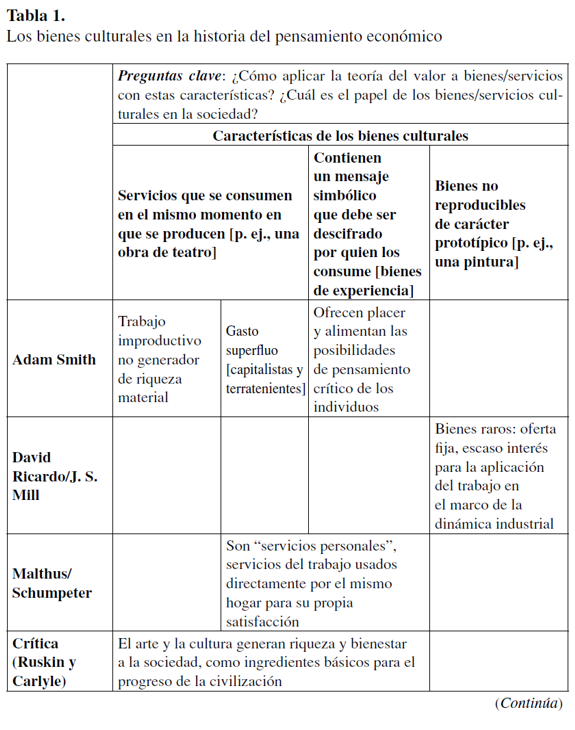
Aquí se presentan dos aspectos clave que explican cómo se incorporaron los bienes culturales al análisis económico. El primer aspecto muestra que las características y naturaleza de dichos bienes no encajaban en el esquema analítico desarrollado por los economistas en los siglos xviii y xix. En efecto, algunas características indican que los bienes culturales no son reproducibles sino de carácter prototípico (p. ej., una pintura), son servicios que se consumen en el mismo momento en que se producen (p. ej., una obra de teatro) y el fundamento de su valor está en el mensaje simbólico que emiten y que debe ser descifrado por quien los consume. Tales características hicieron que a economistas de prestigio como Smith, Ricardo y Marshall estos bienes les parecieran raros, de carácter excepcional o poco importantes para su análisis.
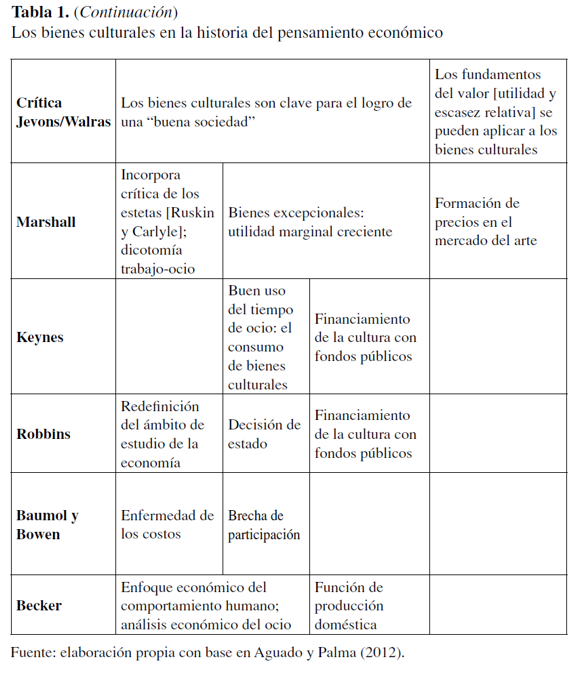
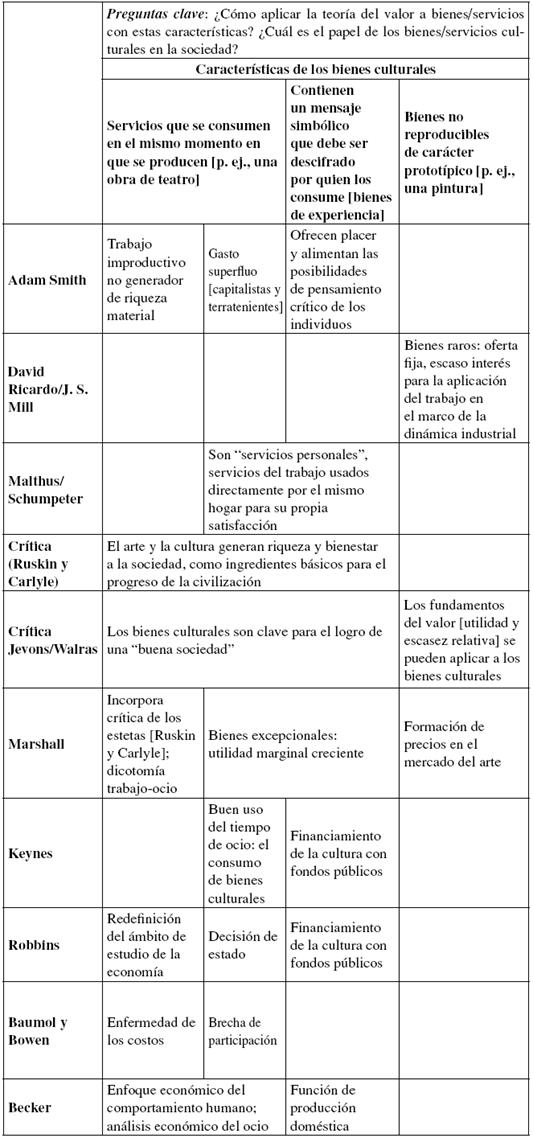
El segundo aspecto muestra que la redefinición del ámbito de estudio de la economía, las críticas a la teoría del valor trabajo y el replanteamiento del concepto de ocio generan un marco analítico que permite entender mejor las características de los bienes culturales y la modelización de su consumo con la teoría y herramientas de la economía. La Tabla 1 muestra los aspectos clave que se desarrollan en el apartado y constituye una contribución metodológicamente útil de este artículo, centrada en dos preguntas a manera de hilo conductor: ¿cómo aplicar la teoría del valor a los bienes/servicios con las características especiales arriba señaladas?, ¿cuál es el papel de los bienes/servicios culturales en la sociedad?
Los bienes culturales. Uso improductivo del tiempo de trabajo, bienes raros y excepcionales para incorporarlos al análisis económico
Quesnay ([1766] 1974) identificó los servicios y la manufactura como sectores no productivos, mientras que Smith ([1776] 1994) observó que la división del trabajo mejora la productividad de este y, por tanto, la capacidad de producir bienes que creen bienestar y riqueza a la población; además, Smith extendió dicha productividad a la manufactura y superó la restricción fisiócrata de tener presente solo como generador de riqueza al trabajo aplicado a la actividad agrícola, aunque continuó dejando al margen los servicios.
De acuerdo con Smith ([1776] 1994), el sector de los bienes y servicios culturales carece de interés al partir de una concepción material de la generación de riqueza y bienestar. Por el lado de la demanda, Smith ([1776] 1994) considera que el gasto en bienes culturales es superfluo y realizado principalmente por terratenientes y capitalistas. Incluso, Bentham ([1843], 1962), en su famosa analogía compara la poesía con el juego de bolos y sugiere que el arte no debe ser distinguido de otras formas de entretenimiento. Además, el tiempo en el cual se consumen los bienes culturales está vinculado al tiempo de ocio, entendido como tiempo de no trabajo donde no se genera un ingreso o no se produce nada para la venta que genere riqueza a la sociedad o al individuo, por lo que su mercado fue percibido como restringido al "coleccionismo o elitismo en el consumo" (Herrero, 2011, p. 180). Por el lado de la oferta, Smith ([1776] 1994) observa que la subdivisión del trabajo no podía ser aplicada en forma amplia en este tipo de bienes, como lo era en el caso de la fabricación de alfileres. Y puesto que muchas de las actividades culturales son servicios, entiende Smith que no contribuyen a la acumulación de capital y al crecimiento de la riqueza. De esta forma, no encuentran cabida más que en la honorable designación de actividades improductivas. En esta categoría incluye el producto del uso del tiempo de trabajo de actores, bufones, músicos y hombres de letras.
Ricardo ([1821], 1959, p. 20) indicó que "las estatuas y pinturas notables, monedas y libros raros" integran una parte muy pequeña del universo de bienes, no reproducibles y cuyo valor depende de la escasez, y centró su atención en aquellos bienes "que pueden producirse en mayor cantidad, mediante el ejercicio de la actividad humana, y en cuya producción opera la competencia sin restricción alguna". Tal aspecto fue retomado por Mill ([1848] 1996, p. 392) cuando expuso que la "dificultad de obtención que determina el valor [...] Algunas veces consiste en una limitación absoluta de la oferta". Mill pone como ejemplo de estos bienes a "las esculturas antiguas, los cuadros de los antiguos maestros, libros o monedas raros y otros artículos clasificados como antig¨edades"2.
En este contexto, los bienes culturales en principio no encuentran cabida en una teoría del valor centrada en bienes reproducibles. Tal como lo indicó Böhm-Bawerk ([1911] 2009, p. 44), la teoría clásica del valor deja "una especie de zona neutra [...], el territorio de los demás casos de valor de cambio [en especial] el valor de cambio de los bienes raros [estatuas y cuadros, libros y monedas antiguos, vinos de reserva]". Al respecto, Goodwin (2006, p. 46) afirma que los clásicos centraron su atención en "la mano de obra que produce las obras de arte en lugar de las obras de arte mismas".
No obstante, si bien Malthus ([1820] 1946) mantiene la división entre trabajo productivo e improductivo planteada por Smith, presenta un avance al definir como servicios personales a los servicios del trabajo usados para la propia satisfacción de los hogares:
El trabajo puede, pues, dividirse en dos clases: trabajo productivo y servicios personales; entendiendo por trabajo productivo el que es productor de riqueza material de modo tan directo que puede calcularse en la cantidad o valor del objeto producido, objeto este que puede transferirse sin la presencia del productor; y entendiendo por servicios personales esa clase de trabajo o laboriosidad que [...] no se manifiesta en ningún objeto que pueda valorarse y transferirse sin la presencia de la persona que ejecuta dicho servicio y, por consiguiente, no se le puede hacer entrar en un cálculo de la riqueza nacional (pp. 30-31).
Posteriormente, Schumpeter ([1954] 1982) aclaró la controversia que se creó con la distinción entre trabajo productivo y trabajo improductivo en la obra de Smith. En interpretación de Schumpeter, lo que Smith quiso señalar es que los servicios del trabajo que compran y consumen directamente los hogares no generan un excedente físico que se materialice en un beneficio, pues su producto no está orientado a la venta, al concretarse en la satisfacción de una necesidad para el mismo hogar. A diferencia de los servicios del trabajo comprados y consumidos por las empresas, que producen un bien final, tangible, que está destinado a la venta y se ejemplifica con el trabajo de los obreros industriales. En este caso, "los trabajadores productivos reproducen el valor del capital que los emplea arrojando además un beneficio" (Schumpeter, [1954] 1982, p. 235, pie de página 50).
La aclaración de Schumpeter junto con la observación de Malthus acerca de los servicios personales, abren la puerta a la economía para considerar y entender mejor la actividad económica que tiene lugar fuera del mercado y, en particular, la actividad económica de los hogares para la satisfacción de sus propias necesidades, que más adelante es retomada por Becker (1965).
Por su parte, las reiteradas críticas de los primeros marginalistas a las teorías del valor de Smith y Ricardo, abren las posibilidades de un mayor acercamiento de la economía al análisis de los bienes culturales. Para Jevons ([1879] 1998):
El simple hecho de que haya muchas cosas como los libros antiguos, monedas y antig¨edades raras, etc., que tienen valores altos, y que no son en absoluto susceptibles de producción actual, contradice la idea de que el valor depende del trabajo (p. 180).
Con respecto al uso productivo del capital sostiene:
Las ideas de Adam Smith parecen estar fundadas en el concepto de que el capital debe producir un ingreso o incremento de riqueza actual de la misma forma que un campo produce una cosecha de grano o hierba. [...] ¿Qué diremos, por ejemplo, de un teatro? ¿No es el producto del capital? ¿Se puede erigir sin capital? ¿No retribuye intereses, si tiene éxito, como cualquier fábrica de algodón o cualquier buque de vapor? (pp. 249-251).
Para Walras ([1900], 1987), las leyes generales del mercado pueden "aplicarse al mercado de diamantes, al de cuadros de Rafael, al de tenores y divas" (p. 183). No obstante, Marshall ([1890] 2005) observó dos particularidades que trató como casos excepcionales en los bienes culturales y no les prestó mayor atención. Primera, en la exposición de la ley de la utilidad marginal decreciente, no constituye "una excepción a la ley el hecho de que el hombre que oye con frecuencia interpretar buena música ve aumentar su afición por ella" (pp. 121-122).
Segunda, las transacciones
referentes a cuadros de viejos maestros, monedas antiguas [...] El precio a que se venda cada uno de ellos dependerá mucho de que una persona rica esté presente en la venta; de lo contrario, será comprada probablemente por negociantes que confían poder venderla con algún beneficio (p. 382).
Las observaciones de Marshall se han convertido en temas centrales de análisis en economía de la cultura: ¿qué sucede si las preferencias cambian como resultado de la experiencia en el consumo? (Lévy-Garboua y Montmarquette, 2003; McCain, 1979; Stigler y Becker, 1977) y ¿cómo se forman los precios en el mercado del arte? (Stein, 1977).
Los bienes culturales como el "producto más deseable de la civilización"3
Para Smith ([1776] 1994), "las pinturas, la poesía, la música, el baile, el teatro" (p. 685) aportan al pensamiento crítico en la sociedad y pueden "conseguir disipar fácilmente en la mayoría del pueblo ese humor melancólico y apagado que casi siempre es el caldo de cultivo de la superstición y el fanatismo" (p. 729). Mill ([1848], 1943) abre una puerta a la consideración del arte y la cultura como bien de mérito, cuando encuentra que hay bienes como la educación, "cuyo valor no puede juzgarse por la demanda del mercado" (p. 819).
Incluso, Jevons ([1883], 2010), a finales de su vida, plantea que "entre los medios hacia el logro de una civilización superior, se puede afirmar, sin vacilar, que el cultivo deliberado de la diversión pública constituye una de las principales tareas" (pp. 28-29). Entre las actividades de diversión pública incluye la música y la existencia de bibliotecas y museos de entrada gratuita, como infraestructura cultural pública básica.
Por su parte, Marshall ([1890] 2005), incorpora la crítica de los estetas ingleses Ruskin y Carlyle en el seno de la economía: no solo el trabajo que produce bienes materiales añade bienestar y riqueza a la sociedad, también lo hacen la educación y el arte como ingredientes básicos para el progreso de la civilización:
El lucro puede destinarse a ser gastado en forma egoísta o humanitaria, para fines nobles o bajos, y aquí es donde entra en juego la variedad de la naturaleza humana; pero el motivo es suministrado por una determinada cantidad de dinero (p. 14).
Si los antiguos economistas hubieran aclarado este concepto, [...] las espléndidas enseñanzas de Carlyle y de Ruskin acerca de los rectos propósitos del esfuerzo humano no habrían sido oscurecidas por los rudos ataques dirigidos a los economistas, ataques fundados en la falsa creencia de que aquella ciencia no se ocupaba de más móviles que el deseo egoísta de riquezas (p. 20).
En la conferencia Las Posibilidades Económicas de Nuestros Nietos, Keynes ([1930] 1988b) hace una llamada de atención al hecho de que el hombre una vez liberado de las presiones económicas debe enfrentar su verdadero problema: "Cómo ocupar el ocio que la ciencia y el interés compuesto le habrán ganado, para vivir sabia y agradablemente bien" (p. 329), situación en la que el arte y la cultura ocupan un lugar central. Y a través del Bloomsbury Group recalca que el arte es un componente básico y esencial para el logro de la verdadera civilización humana (Moggridge, 2005).
Keynes (1936b) insiste en que en el siglo xix el punto de vista utilitarista del Estado impidió el uso del presupuesto público para actividades que no supusieran "la motivación de la ganancia y el éxito financiero" (pp. 341-342). Por ello, sugiere el uso con fines no económicos del gasto público para aquellas actividades "en que el hombre común puede tener su deleite y recreación después de la jornada de trabajo". Las actividades que él identifica son: la arquitectura, que es la más pública de las artes, menos íntima en sus manifestaciones y la más adecuada para dar forma y cuerpo al orgullo cívico y el sentido de la unidad social. Le siguen la música, el teatro, las artes plásticas y la artesanía, la poesía y la literatura. Y en un pasaje de la Teoría General deja ver algunas de sus ideas sobre este tipo de bienes:
El antiguo Egipto era doblemente afortunado, [...], porque poseía dos actividades: la de construir pirámides y la de buscar metales preciosos, cuyos frutos, desde el momento que no podían ser útiles para las necesidades humanas consumiéndose, no perdían utilidad por ser abundantes (Keynes [1936c] 1981, p. 122).
En el anterior contexto se encuadra la afirmación que relata Harrod (1951), vertida en el discurso pronunciado por Keynes cuando se jubiló como editor del Economic Journal en 1945: "Los economistas [...] son los garantes, no de la civilización, sino de la posibilidad de civilización" (pp. 193-194). Keynes confiaba en que el capitalismo era el sistema más eficiente para satisfacer los fines materiales, pero a su vez, también creía que proveía muy pocos recursos al arte y la cultura para alcanzar una vida satisfactoria, por lo que era necesaria la intervención del Estado4. Y en El fin del Laissez Faire presenta lo que debería ser la agenda del Gobierno propiciada por los economistas: "Nuestro problema es construir una organización social que sea lo más eficiente posible sin contrariar nuestra idea de un modo de vida satisfactorio" (Keynes [1926], 1988, pp. 294).
Robbins (1971b), al igual que Keynes, mantuvo una participación activa en diversas instituciones que administraban el arte londinense. Sin embargo, consideraba que no entraba en el campo de la economía justificar el apoyo del Gobierno a las artes: "Si la gente desea arte lo comprará; si no, ¿por qué debe ser producido? [...] ciertamente esta no es una pregunta que deba responderse haciendo referencia a la economía científica" (p. 67).
Sin embargo, Robbins en Art and the state (1963) defendió el apoyo a las artes con fondos públicos y privados sobre la base de que: a) la educación debe incluir desde edades tempranas el contacto con las artes, dado que estas contribuyen a hacer más placentera la vida y b) la infraestructura física cultural debe garantizar el conocimiento, acceso y preservación de la herencia cultural para las generaciones futuras. En resumen, Smith, Jevons, Marshall, Keynes y Robbins mantienen una tradición desde el pensamiento económico que considera que en el centro de una "buena sociedad" está el acceso a los bienes culturales.
UN APUNTE CLAVE. LA AMPLIACIÓN DEL OBJETO DE ESTUDIO DE LA ECONOMÍA
Para los padres fundadores de la ciencia económica, esta se definía por su objeto de estudio. En efecto, de acuerdo con Smith ([1776] 1994), Ricardo ([1821], 1959) y Mill ([1844] 2000) el objeto de análisis de la economía se centra en cómo se crea y distribuye la riqueza a partir de las actividades inmersas en el sistema económico (producción, distribución e intercambio de bienes), entendida la riqueza como los medios materiales de subsistencia. Con la crítica de los primeros marginalistas al objeto de la economía, se produce un viraje hacia aspectos más centrados en el método de análisis, el tipo de conducta y la motivación que la orienta (Jevons, [1879] 1998; Menger, [1871] 1997; Walras, [1900] 1987). Más concretamente, Walras ([1900] 1987) sitúa el objeto de la economía política pura en "la teoría de la determinación de los precios bajo un hipotético régimen de competencia libre perfecta". Sin embargo, es Robbins (1930a, 1930b, 1932) quien traslada el objeto de estudio de la economía al análisis de las consecuencias de la elección humana en condiciones de escasez.
El enfoque de Robbins en principio parece muy amplio, sin embargo, limita lo que "hacen los economistas" a las elecciones susceptibles de ser desarrolladas en mercados en los que existen precios explícitos. Un giro crítico clave es el planteado por Becker (1976), quien sugiere centrarse "no en la materia, sino en su enfoque"; definir la economía por la materia objeto de estudio deja fuera del ámbito de análisis muchas cuestiones y problemas sociales, con la confianza de que su análisis le corresponde más a las ciencias hermanas5 (psicología y sociología). Actualmente hay un relativo consenso con respecto a que la economía se define, más que por su materia de estudio, por su método de análisis6. Levitt y Dubner ([2005] 2006) argumentan que "la economía como ciencia consiste fundamentalmente en un conjunto de herramientas, más que una cuestión de contenido, ningún tema se halla fuera de su alcance" (p. 24).
LA LLEGADA DE LOS ECONOMISTAS. EL ANÁLISIS DEL OCIO COMO ELEMENTO ESENCIAL QUE INTEGRA A LOS BIENES CULTURALES EN EL ANÁLISIS ECONÓMICO
¿Qué es el ocio?
Siguiendo a Vogel (2001), hay actividades que la gente disfruta e intenta practicar, escuchar o ver y que se denominan "entretenimiento" (término derivado de la palabra francesa divertissement) y cuyo objetivo es el recreo (recuperación de la fuerza o del espíritu tras el cumplimiento del deber). El tiempo que los economistas llaman ocio (traducción de la palabra inglesa leisure, cuya raíz latina es licere y significa estar permitido o estar libre7) es el "espacio" en el que tienen lugar las actividades de entretenimiento. Estas emplean un recurso esencial en economía: el tiempo. Entonces, el ocio puede, en principio, ser definido en función del estado de la mente, las actividades, el tiempo o la tecnología. En el marco de análisis de la elección de los consumidores se incorpora la asignación del tiempo entre diferentes usos: de mercado, domésticos y de ocio.
El ocio desde una perspectiva económica
Los economistas han tratado el ocio con diferentes acentos y de forma residual. Desde el pensamiento económico, para Jevons ([1879] 1998) "un trabajador libre soporta lo fatigoso del trabajo porque el placer que espera recibir [...] supera el sufrimiento del esfuerzo" (p. 189). Para Marshall ([1890] 2005, libro 6, cap. 13) y Keynes ([1930b] 1988), el progreso económico, y de la civilización, se refleja en el buen uso del tiempo de ocio por parte de la población, obtenido a través de la reducción de las horas de trabajo, asociadas a la mayor productividad de este. Para Veblen ([1899] 1995), el ocio está localizado en una clase ociosa ("derrochadora") que se esfuerza en mostrar su emancipación del trabajo productivo.
Desde el análisis económico, el ocio rápidamente se enfocó como el tiempo no gastado en trabajar. En forma residual, el ocio representa el tiempo al margen de las actividades productivas que generan ingresos monetarios. Precisamente, Marshall ([1890] 2005), cuando introduce el concepto de desutilidad marginal del trabajo y plantea que la importancia de disponer de "tiempo libre de la fatiga del trabajo, [...] es una condición necesaria para un elevado nivel de vida" (p. 590), traslada un tema de discusión al análisis económico: la dicotomía trabajo-ocio. Es decir que, presumiblemente, los individuos derivan desutilidad de las horas de trabajo y utilidad del tiempo en que no trabajan. Además, Marshall ([1890] 2005) señala la dirección que podría tomar la oferta de trabajo ante un aumento en los salarios: "En términos generales es cierto que el esfuerzo que cualquier grupo de trabajadores puede hacer, aumenta o se reduce con un aumento o reducción en la remuneración que les es ofrecida" (p. 117).
El tema es rápidamente capturado por el análisis económico. Chapman (1909) destaca cómo el desarrollo industrial, asociado a una mayor productividad, recorta las horas de trabajo de la población y aumenta los salarios. El resultado esperado es "la compra de más tiempo libre" (p. 354) por parte de los trabajadores. En el mismo sentido, Knight ([1971] 1921) sostuvo que frente a un aumento en los salarios, los trabajadores "dividen su tiempo entre ganar salarios y usos no industriales [tiempo de no trabajo] de forma que les permita ganar más dinero trabajando menos horas" (pp. 117-118). Asimismo, Pigou (1920) concluye que si se sustrae una parte del ingreso del contribuyente por un impuesto, este estará dispuesto "a trabajar un poco más" (p. 593).
Robbins (1929) no tardó en evidenciar su insatisfacción. En su opinión, no es posible predecir, a priori, los cambios en las horas de trabajo por parte de los trabajadores o de los contribuyentes, ocasionados por un cambio en los salarios nominales o en los impuestos. El resultado de esta discusión se sintetiza en el trabajo de Becker (1965), quien retoma el debate iniciado por Marshall: "La asignación y el uso eficiente del tiempo no laboral pueden ser ahora más importantes para el bienestar económico que el tiempo de trabajo" (p. 493).
Michael y Becker (1973) lo exponen claramente. La teoría de la elección que recibieron de sus antecesores, que denominan "enfoque trabajo-ocio", es limitada dado que fue "formulada en función de los precios monetarios y el ingreso monetario. Por lo tanto, su aplicación ha tendido a limitarse al sector del mercado donde las transacciones son más fáciles de cuantificar por la 'vara de medir el dinero'" (pp. 380-381).
Para superar la anterior limitación, el esquema analítico desarrollado por Becker (1965), Michael y Becker (1973) y Stigler y Becker (1977) se centra en decisiones que enfrentan los individuos -y los hogares- con respecto al matrimonio, el número de hijos, profesar una religión, la salud, la comida, el altruismo, la envidia, la apreciación cultural y otros "placeres de los sentidos" que, a pesar de que se realizan en un marco de recursos limitados y fines competitivos, los economistas tradicionalmente las eludieron.
En este contexto, para modelizar el consumo de bienes y servicios culturales, resulta clave el concepto de bien básico de ocio propuesto por Becker (1965), para quien un bien básico intensivo en ingreso se caracteriza por una función de producción doméstica, en la que sus coeficientes insumo-producto son intensivos en tiempo y bienes. Así, el ocio no es más que un bien básico intensivo en ingreso. Desde esta perspectiva, un aumento en el ingreso ocasionado por mayores salarios incrementa el costo relativo del tiempo y de los bienes básicos que requieren gran dedicación de tiempo. De esta forma, bienes de mercado pueden sustituir el tiempo más caro en la producción de bienes básicos y, a su vez, bienes básicos intensivos en bienes pueden sustituir a los más costosos intensivos en tiempo8. El enfoque de Becker es el marco que se usa principalmente en la literatura teórica y empírica para analizar la asignación de recursos en decisiones al margen de los mercados explícitos.
La experiencia cultural como un bien de ocio en el enfoque de Becker
Gronau (1977), a partir del análisis de Becker, analiza la asignación de tiempo entre el trabajo en el mercado, el trabajo doméstico y el ocio. La distinción clave para Gronau es que los productos del trabajo doméstico y del trabajo comprado en el mercado son similares y hasta cierto punto son muy buenos sustitutos (p. ej., comida casera versus comida a domicilio; cuidado de niños por los padres versus niñera). No resulta lo mismo para ciertas actividades de ocio, como el consumo de bienes culturales, por ejemplo, asistir a una presentación de teatro en vivo: "No es posible disfrutar el ocio a través de otra persona" (Gronau, 1977, p. 1104). Desde esta perspectiva, el uso del tiempo en el trabajo doméstico genera un flujo de bienes básicos que pueden encontrar sustitutos cercanos en el mercado, mientras el ocio encuentra solo pobres sustitutos.
Burda, Hamermesh y Weil (2007) concluyen que lo que distingue al ocio de otras actividades de la producción doméstica es que "no se puede subcontratar" (p. 3). En el mismo sentido, Aguiar y Hurst (2007) encuentran que teóricamente una actividad se puede definir como ocio a partir del grado de sustituibilidad entre los factores -bienes- de mercado y el tiempo en el modelo de Becker (1965). Lo anterior sugiere que "el contenido de ocio de una actividad es función de la tecnología más que de las preferencias" (Aguiar y Hurst, 2006, p. 6). Así, la respuesta de los individuos a cambios en las variables del mercado (precios, salarios) depende tanto de las preferencias, reflejadas en la función de utilidad, como de la tecnología, reflejada en la función de producción doméstica (Lévy-Garboua y Montmarquette, 2003).
De esta forma, los bienes y servicios culturales son un insumo clave para "producir" el bien básico de ocio denominado experiencia cultural, en el marco de las "funciones de producción" de los hogares. Este bien se deriva de un acto intencional de los propios individuos dirigido a aumentar su acervo cultural y de conocimientos, que podemos denominar participación cultural. Más concretamente, el producto de la participación cultural para un individuo es una experiencia cultural que se produce a través de una función de producción doméstica. Por ejemplo, en el caso de escuchar música grabada, la experiencia cultural es producida por la función de producción doméstica de cada individuo, la cual tiene como argumentos el capital físico (p. ej., el dispositivo para escuchar música grabada), los bienes comprados en el mercado (p. ej., CD/DVD), el tiempo del individuo y el capital de consumo cultural acumulado. Este último permite producir con mayor eficiencia la experiencia cultural (véanse Lévy-Garboua y Montmarquette, 2003; Stigler y Becker, 1977).
INCORPORACIÓN AL CUERPO PRINCIPAL DE LA CIENCIA ECONÓMICA
Este apartado complementa el recorrido hasta ahora hecho con respecto al pensamiento económico. Se muestran los elementos centrales que indican que en la actualidad la economía de la cultura constituye un área de especialización, o subdisciplina, distintiva y con prestigio intelectual dentro del cuerpo principal de la ciencia económica9.
La subdisciplina primero se llamó economía del arte, denominación en la que el término "arte" pareciera restringirse a las artes relacionadas con la cultura de élites (escénicas, visuales y literarias), con lo que queda al margen el patrimonio cultural y las industrias culturales10. Al respecto Albi (2003) afirma: "Se utiliza el término economía de la cultura, en vez de las artes, como reflejo de la ampliación del ámbito de estudio" (p. 17). Y Throsby (2008a) precisó:
La definición de arte ha sido un enigma filosófico durante siglos, pero hay un consenso razonable sobre lo que comprenden "las artes". Incluye las artes escénicas (música, danza, ópera y teatro), las artes visuales y plásticas (pintura, dibujo, fotografía, escultura, artesanía, etc.), las artes literarias (poesía, ficción, teatro, guiones y algunas formas de no ficción como la biografía), ciertos tipos de películas y algunas prácticas nuevas como el video-arte que se derivan de las nuevas tecnologías de la información y la artículo (p. 1).
En 1973 se creó la Association for Cultural Economics, cuyos estatutos se modificaron en 1993, cuando adoptó su nombre actual: Association for Cultural Economics International (ACEI)11. La primera conferencia internacional de la asociación se realizó en 1979 y hasta 2014 se han llevado a cabo 18 conferencias internacionales sobre economía de la cultura. Mark Blaug en 1976, diez años después de la publicación del libro de Baumol y Bowen, preparó la primera compilación de artículos sobre la materia: The economics of the arts: Selected readings, en cuya introducción señaló que hasta ese momento la sustancia de la subdisciplina no justificaba un manual, pero que esta "podría un día ser una de las áreas con mayor dinámica dentro de la economía aplicada" (Blaug, 1976, p. 22)12. Las lecturas se centraron en la financiación y la justificación de la financiación pública a las artes.
El primer ejemplar del Journal of Cultural Economics (JCE)13 se publicó en mayo de 1977 y ese año fue reseñado en importantes revistas: The Economic Journal, (vol. 87, No. 346, junio de 1977); Southern Economic Journal y (vol. 44, No. 1, julio de 1977); American Journal of Economics and Sociology (vol. 36, No. 2, 1977). Fueron dos los aspectos críticos que JCE cubrió en ese momento: la naturaleza y las características de los bienes y servicios culturales y la financiación de las artes escénicas. Los textos que aparecieron a finales de la década de los setenta también pusieron el énfasis en tales asuntos (Netzer, 1978; Throsby y Withers, 1979). Sin embargo, el interés académico de los economistas por estos temas era incipiente. En 1979 un número monográfico del Journal of Behavioral Economics (JBE)14 analizó las razones por la cuales podían resultar adecuados los subsidios a las actividades culturales en Estados Unidos; en la nota del editor se aprecia la siguiente indicación:
La idea del simposio sobre las Subvenciones de las Actividades Culturales presentado en esta edición tuvo su origen durante una conversación de hace dos años entre los editores del Simposio[15] y el editor del JBE. A primera vista, puede parecer sorprendente ver un tema como este entre las áreas de interés del JBE. Sin embargo, haciendo una reflexión más profunda, debería ser fácil llegar a un acuerdo acerca de que el comercio o las instituciones relacionadas con el arte -o las artes escénicas- deben reflejar valores -y comportamientos- tanto estéticos como económicos en sus procesos de decisión [nota del editor, Journal of Behavioral Economics, 8(1), 1979, p. vi].
Shanahan y Hendon (1979), en una revisión de la literatura producida desde mediados de los sesenta hasta 1978, esbozan dieciséis ámbitos de análisis en lo que podría considerarse la primera apuesta de la reciente subdisciplina sobre temas a cubrir: las artes y la renovación urbana; historia económica de las artes; economía de la religión; aspectos culturales del desarrollo en los países en vías de desarrollo; el arte y el desarrollo de los vecindarios; análisis de impacto económico: el papel de las artes; análisis de las subvenciones públicas de las artes; análisis económico de las instituciones culturales; situación económica de los artistas; comportamiento del consumidor en las artes; economía del patrimonio histórico; gestión institucional del arte; coleccionismo y mercados del arte; planificación cultural; evaluación de necesidades de servicios culturales y relaciones intergubernamentales y las artes. Posteriormente, Hendon y Shanahan editan dos obras adicionales: Economic policy for the arts (1980) y Economics of cultural decisions (1984). Al reseñar estas obras, Holmes (1984) señala que ayudan a entender mejor una nueva subdisciplina de la economía: "The field of cultural economics".
En 1991, la economía de la cultura obtiene su reconocimiento en la taxonomía del discurso económico. En efecto, el sistema de clasificación del Journal of Economic Literature (JEL) sitúa la producción intelectual en la categoría Z (otros temas especiales), en la subcategoría Z1: economía de la cultura. Y en 2001 se creó la subcategoría Z11: economía de las artes y la literatura (Towse, 2005)16. Las primeras revisiones de literatura fueron publicadas por Throsby (1994), en el JEL, y Blaug (2001), en el Journal of Economic Surveys, donde agrupan la subdisciplina en los siguientes ámbitos de análisis:
- Throsby: formación del gusto por las artes, mercados de obras de arte, características de las artes escénicas, mercados de trabajo de los artistas y políticas públicas hacia las artes.
- Blaug: formación de gustos en las artes, oferta y demanda de bienes y servicios culturales, industria de las comunicaciones, mercado del arte, historia económica de las artes, mercado de trabajo de los artistas, enfermedad de los costos, organizaciones artísticas sin ánimo de lucro y subsidios públicos a las artes.
Ginsburgh (2001) afirmaba que la economía de la cultura aún estaba en su infancia, pues su objeto no estaba bien definido y se situaba en el cruce de varias disciplinas: historia y filosofía del arte, sociología, derecho, administración y economía. No obstante, para Blaug (2001) su posición relativa en la ciencia económica le otorgaba un amplio potencial de desarrollo:
La economía de la cultura se sitúa entre [la economía de la salud y la economía de la educación], más innovadora que la economía de la educación pero menos fértil en la explotación de su potencial que la economía de la salud, quizás algo aislada y poco dispuesta a aprender de los desarrollos de otras áreas de la economía, para no mencionar la psicología, la sociología y el análisis político, aunque encontrando nuevas aplicaciones de la economía a los temas de interés cultural (p. 133).
En efecto, Blaug (2001) distingue dos tipos de progreso: el teórico y el empírico. El primero, relacionado con la elaboración y el refinamiento de conceptos teóricos básicos (p. ej., las externalidades en el consumo de bienes culturales) y el segundo, con las estimaciones de relaciones empíricas fundamentales (p. ej., las funciones de costos de las organizaciones culturales). Según Blaug, la economía de la cultura ha progresado en ambos campos desde 1966, aunque ha avanzado más en el terreno empírico. Y sugiere seguir la dirección que abrió Towse (1997): entender que la economía de la cultura ha ampliado el campo de acción de la economía, al aplicar el análisis económico a los fenómenos del mundo artístico y cultural.
Caves (2000) llamó la atención sobre el "olvido" de los economistas que escriben acerca de las artes, más concentrados en la política pública (financiación). Para ello propone en su libro una caracterización para analizar la forma en que están organizadas, la toma de decisiones y los contratos propios de actividades en las que su principal insumo es el trabajo creativo de artistas y su relación con otros tipos de trabajo más rutinarios.
En 2006 se publicó el primer Handbook of the economics of art and culture, en la serie Handbooks in Economics editada por Kenneth Arrow y Michael Intriligator, que presenta los avances más significativos en las distintas áreas de la economía; en 2014 salió a la luz la segunda edición. En 2008 apareció por vez primera una entrada titulada "Art, economics of" en The new Palgrave dictionary of economics, escrita por David Throsby. Sin embargo, cómo lo señaló Seaman (2009), en el desarrollo y la consolidación de una subdisciplina es importante disponer de un adecuado libro de texto, que presente y sintetice los principales conceptos, ideas,metodologías y delimitación del área de estudio.
El primer libro diseñado para servir como texto introductorio a la economía de la cultura fue The economics of art and culture (Heilbrun y Gray, 2001)17, que enfatizó en los sectores tradicionales (artes escénicas, artes visuales, museos) y temas iniciales de análisis de la subdisciplina (enfermedad de los costos, participación en las artes y financiación pública). Casi una década después, en 2010, se publicaron dos libros de texto que reflejan la madurez relativa de la subdisciplina: A textbook of cultural economics de Ruth Towse y The economics of cultural policy de David Throsby.
El texto de Towse representa la síntesis de cómo desde la economía se analiza el sector cultural. Además de ofrecer un análisis de los sectores tradicionales, incluye capítulos dedicados a las denominadas industrias creativas18 y la economía de los derechos de autor. Throsby ofrece una síntesis de la evolución y del debate actual en materia de política cultural, con temas como el seminal debate sobre financiación de las artes escénicas, la financiación del patrimonio cultural y los museos y el debate más reciente en torno a los derechos de autor y la financiación de las industrias creativas. Asimismo, se introduce en una vía, actualmente exploratoria y en expansión, que plantea que la cultura es un insumo para el estímulo de la creatividad y del crecimiento económico. También incluye temas impulsados desde la Organización de las Naciones Unidas para la Educación, la Ciencia y la Cultura (Unesco), relativos a la diversidad cultural.
En un análisis bibliométrico y a partir de artículos publicados en el JCE en el período 1994-2010, Amez (2010) encuentra que estos se han centrado en análisis empíricos de demanda (museos, cine), políticas públicas (financiación) y formación de precios en las artes visuales. Por el lado de la oferta, los pocos estudios disponibles se enfocan en el análisis de la propiedad intelectual y de las industrias creativas.
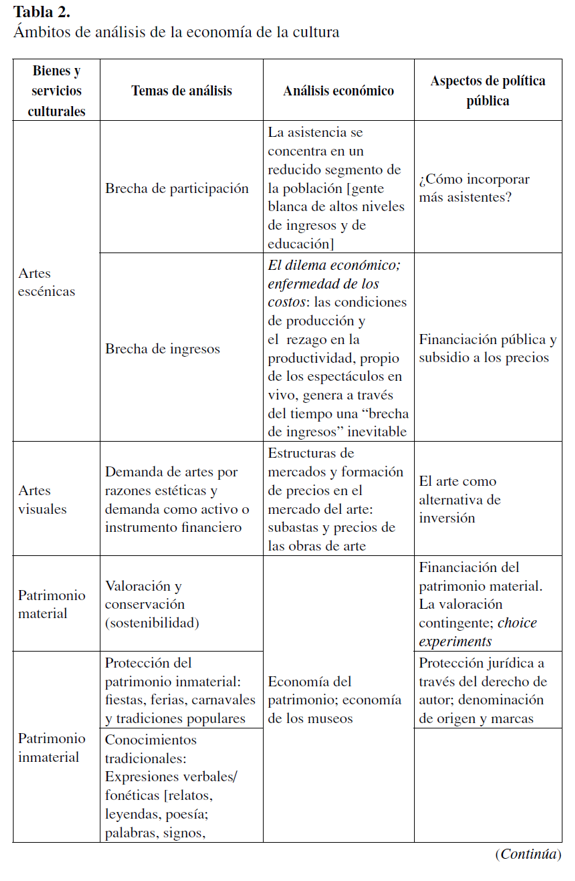
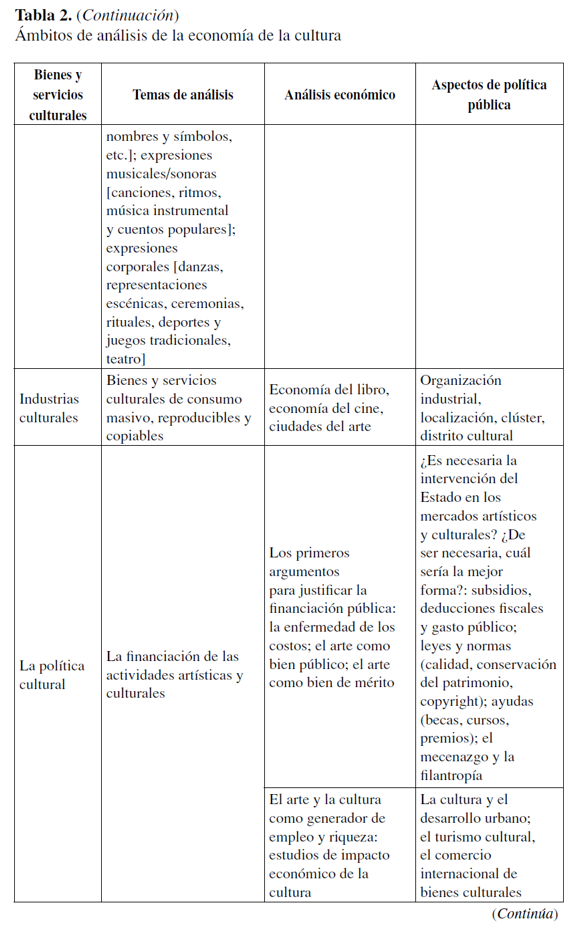
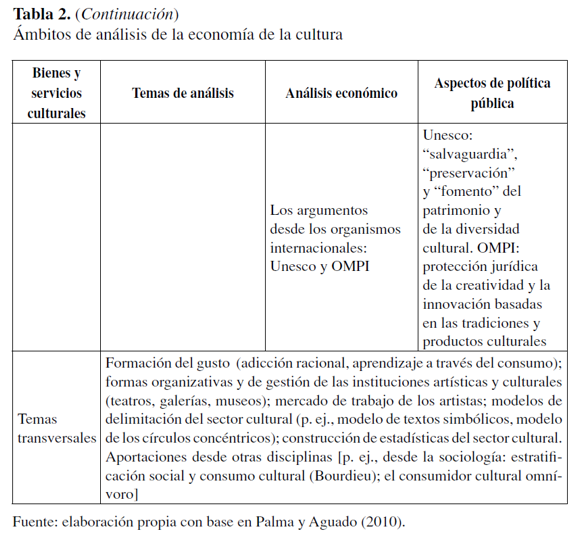
Sin duda, los hitos reseñados hasta aquí llevan a apreciar el desarrollo de la economía de la cultura como subdisciplina de la ciencia económica, con un campo de estudio definido y rasgos distintivos frente a las demás áreas de la economía (véase Tabla 2).
CONCLUSIONES
A lo largo del artículo se ha presentado una síntesis y conexión entre el pensamiento económico y el análisis económico en la configuración de la economía de la cultura como subdisciplina de la economía. A los fundadores de la economía los bienes culturales les parecieron raros y excepcionales por la dificultad inherente en dos aspectos clave: la teoría del valor y la modelización del consumo. Sin embargo, coincidieron en afirmar que estos desempeñaban un papel central en lo que debe ser una buena sociedad.
La incorporación de los bienes culturales al análisis económico pasa por una redefinición del objeto de estudio de la economía, de la teoría del valor y del concepto de ocio. Esta nueva forma de entender el ocio ha permitido un mejor análisis de las actividades que se creía operaban al margen del mercado y no se tenía claro cómo explicar su consumo por parte de los individuos. Hoy la demanda de bienes culturales resulta perfectamente analizable, teórica y empíricamente, con los instrumentos del análisis económico. En efecto, los bienes culturales como objeto de demanda son insumos para producir una experiencia cultural. Las experiencias culturales se pueden definir como un bien de ocio en el marco propuesto por Becker (1965) y Stigler y Becker (1977). Estas son inmateriales, similares a los servicios, con la diferencia de que una experiencia cultural es el resultado de descifrar e interpretar estímulos visuales, auditivos o simbólicos a través de imágenes, sonidos y signos por parte de los demandantes a través de sus funciones de producción domésticas. La Tabla 1 refleja la aportación del artículo en este ámbito.
La economía de la cultura como subdisciplina de la economía, cincuenta años después del trabajo seminal de Baumol y Bowen, cuenta con ámbitos de análisis claramente distintivos en el análisis económico y se presenta como un área dinámica de especialización perfectamente situada en la economía en temas como la formación del gusto por los bienes culturales (adicción racional, aprendizaje a través del consumo); las formas organizativas y de gestión de las instituciones artísticas y culturales (teatros, galerías, museos); el mercado de trabajo de los artistas y el análisis del proceso de creación de bienes culturales y la incorporación de los bienes culturales en los planes de desarrollo como un recurso estratégico capaz de generar riqueza y empleo. La Tabla 2 refleja esta segunda contribución.
NOTAS AL PIE
1 De acuerdo con Baumol (1967b, p. 416), las artes escénicas están integradas por "actividades que por su propia naturaleza solo permiten aumentos esporádicos en la productividad". En los trabajos iniciales de Baumol y Bowen (1965, 1966) y Baumol (1967b) sobre el "dilema económico", se desprende la brecha de ingresos que padecen las artes escénicas y que rápidamente fue asumida como problema fundacional de la naciente subdisciplina. En efecto, las reseñas de Performing arts: The economic dilemma que se produjeron casi de inmediato en importantes revistas de economía (p. ej., Goode, 1967; Peacock, 1968) destacan la brecha de ingresos y la concomitante necesidad de apoyo financiero de las artes escénicas. La literatura teórica y empírica derivada del trabajo de Baumol (1967a), que extiende este fenómeno a los servicios en general, le otorga el nombre de "enfermedad de Baumol". Es en un trabajo posterior (Baumol y Baumol, 1984) que sus autores le ponen el nombre de "enfermedad de los costos".
2 Como lo indicó Schumpeter ([1954] 1982, p. 670), este es un tributo de Mill a la "sombra de Ricardo", al otorgarle un modesto papel a la oferta y la demanda como determinantes del valor en el caso de los bienes "absolutamente limitados en cantidad".
3 Expresión tomada de Baumol (2003, p. 21).
4 Recientemente Benito, Bastida y Vicente (2013) muestran que los gobernantes locales utilizan el gasto público en cultura con fines electorales.
5 Coase (1978) usa "disciplinas contiguas" con referencia a la psicología y la sociología, principalmente.
6 Para Backhouse y Medema (2009), los economistas están lejos de aceptar una definición unánime de su objeto de estudio.
7 "Ocio" es una mala traducción de leisure, puesto que la palabra en español se refiere más bien a iddleness, es decir, inactividad (Lasuén, García y Zofío, 2005).
8 Situación que llevó a Linder (1970) a afirmar que la clase ociosa está "acosada". Baumol (1973) resume muy bien las observaciones de Linder: las actividades de consumo cuyo costo en tiempo sea alto, como las culturales, o su costo en dinero sea bajo se hacen menos atractivas para los consumidores con una renta en alza (Aguado y Palma, 2015).
9 En la introducción a sus reputados libros, Throsby y Caves recuerdan que a mediados de los setenta "pocos colegas consideraban la 'economía de la cultura' como algo más que un interés diletante, destinado siempre a situarse fuera del análisis económico serio" (Throsby, 2001, xii). Caves (2000, vii) recuerda que aplazó dos décadas su idea de trabajar sobre la organización y los contratos en las industrias creativas hasta que "fuera más cómodo poner en riesgo mi reputación de seriedad profesional".
10 Véase la introducción a las obras de Towse (1997, 2003, 2007).
11 Véase http://www.culturaleconomics.org.
12 Un análisis del aporte de Mark Blaug al establecimiento de la economía de la cultura como subdisciplina de las ciencias económicas se encuentra en Handke y Dekker (2013).
13 En 1979 el índice del Journal of Economic Literature hizo una excepción a su política de no indexar revistas de creación reciente e incluyó al JCE (Hendon, 1985).
14 Desde 1991 el JBE se denomina The Journal of Socio-Economics.
15 Los editores del Simposio fueron los profesores de economía e importantes impulsores de la economía de la cultura, James L. Shanahan y William S. Hendon de la University of Akron, en Ohio.
16 En la guía de códigos del JEL, se encuentra la siguiente orientación para los usuarios. Z110 Economía de la cultura: economía de las artes y la literatura "cubre estudios sobre cuestiones económicas relacionadas con las artes y la literatura, incluyendo la demanda, la oferta y los análisis de precios". Y propone estas palabras clave: arte, artista, enfermedad de Baumol, artes escénicas (http://www.aeaweb.org/jel/guide/jel_sub.php?class=Z1).
17 En 1993 los autores escribieron The economics of art and culture: An American perspective.
18 El concepto de industrias creativas es reciente. Nace en Australia, en 1994, con el informe Creative nation: Commonwealth cultural policy, en el que se reconoce explícitamente que "la política cultural es también una política económica. La cultura crea riqueza" (Department of Communication and the Arts [DCA], 1994). Sin embargo, el término es ampliamente utilizado a partir del Creative industries mapping document 1998, del Reino Unido, que tenía por objetivo medir la contribución de la creatividad a la economía. En el primer Creative economy report 2008 la Conferencia de las Naciones Unidas sobre Comercio y Desarrollo (Unctad) define a las industrias creativas como un conjunto de actividades que "producen bienes y servicios intelectuales o artísticos tangibles y de contenido creativo, valor económico y objetivos de mercado" (Unctad, 2008, p. 4).
REFERENCIAS
[1] Aguado, L., & Palma, L. (2012). Una interpretación metodológica sobre la incorporación de los bienes y servicios culturales al análisis económico. Lecturas de Economía, 77, 219-252.
[2] Aguado, L., & Palma, L. (2015). Factores que limitan la participación cultural. Una mirada desde la economía de la cultura. Revista de Ciencias Sociales, 31(1), 58-71.
[3] Aguiar, M., & Hurst, E. (2006). Measuring trends in leisure: The allocation of time over five decades (Working Paper 06-2). Federal Reserve Bank of Boston.
[4] Aguiar, M., & Hurst, E. (2007). Measuring trends in leisure: The allocation of time over five decades. The Quarterly Journal of Economics, 122(3), 969-1006.
[5] Albi, E. (2003). Economía de las artes y la política cultural. Madrid: Instituto de Estudios Fiscales.
[6] Amez, L. (2010). Mapping the field of arts and economics. Documento presentado en 16th International Conference on Cultural Economics, ACEI, Copenhague.
[7] Backhouse, R., & Medema, S. (2009). Retrospectives on the definition of economics. Journal of Economic Perspectives, 23(1), 221-233.
[8] Baumol, H., & Baumol, W. (1984). Inflation and the performing arts. Nueva York: Nueva York University Press.
[9] Baumol, W. J. (1967a). Macroeconomics of unbalanced growth: The anatomy of urban crisis. American Economic Review, 57(3), 415-426.
[10] Baumol, W. J. (1967b). Performing arts: The permanent crises. Business Horizons, 10(3), 47-50.
[11] Baumol, W. J. (1973). Income and substitution effects in the Linder theorem. The Quarterly Journal of Economics, 87(4), 629-633.
[12] Baumol, W. J. (2003). Applied welfare economics. En R. Towse (ed.), A Handbook of Cultural Economics (pp. 20-31). Cheltenham: Edward Elgar.
[13] Baumol, W. J., & Bowen, W. (1965). On the performing arts: The anatomy of their problems. American Economic Review, Papers and Proceedings, 55, 495-502.
[14] Baumol, W. J., & Bowen, W. (1966). Performing arts. The economic dilemma. Cambridge: Twentieth Century Found.
[15] Becker, G. S. (1965). A theory of the allocation of time. Economic Journal, 75(299), 493-517.
[16] Becker, G. S. (1976). El enfoque económico del comportamiento humano. En R. Febrero & P. Schwartz (Eds.1997), La esencia de Becker (pp. 47-58). Madrid: Ariel.
[17] Benito, B., Bastida, F., & Vicente, C. (2013). Municipal elections and cultural expenditure. Journal of Cultural Economics, 37(1), 3-32.
[18] Bentham, J. ([1843] 1962). The works of Jeremy Bentham, chapter I. Disponible en http://oll.libertyfund.org/title/1921/113884 on 2009-05-02.
[19] Blaug, M. (ed.). (1976). The economics of the arts: Selected readings. Londres: Martin Robertson & Co.
[20] Blaug, M. (2001). Where are we now in cultural economics. Journal of Economic Surveys, 15(2), 123-143.
[21] Böhm-Bawerk, E. ([1911] 2009). Valor, capital, interés. El manuscrito de 1876. Madrid: Unión Editorial.
[22] Burda, M., Hamermesh, D., & Weil, P. (2007). Total work, gender and social norms (IZA Discussion Paper 2705). Bonn: Institute for the Study of Labor.
[23] Caves, R. (2000). Creative industries. Contracts between art and commerce. Cambridge, MA: Harvard University Press.
[24] Chapman, S. (1909). Hours of labour. The Economic Journal, 19(75), 353-373.
[25] Coase, R. (1978). Economics and contiguous disciplines. The Journal of Legal Studies, 7(2), 201-211.
[26] Conferencia de las Naciones Unidas sobre Comercio y Desarrollo (Unctad). (2008). Creative economy report 2008: The challenge of assessing the creative economy towards informed policy-making. Nueva York: el autor. Disponible en http://www.unctad.org/en/docs/ditc20082cer_en.pdf.
[27] De Marchi, N., & Greene, J. (2005). Adam Smith and private provision of the arts. History of Political Economy, 37, 431-454.
[28] Department of Communication and the Arts (DCA). (1994). Creative nation: Commonwealth cultural policy. Canberra: el autor. Disponible en http://www.nla.gov.au/creative.nation/creative.html.
[29] Ginsburgh, V. (2001). Economics of art and culture. En N. Smelser & P. Baltes (eds.), International encyclopedia of the social and behavioural sciences (pp. 758-764). Ámsterdam: Elsevier.
[30] Ginsburgh, V., & Throsby, D. (eds.). (2006). Handbook of the economics of art and culture. Ámsterdam: North-Holland.
[31] Goode, R. (1967). Review: Performing arts: The economic dilemma by William J. Baumol, William G. Bowen. American Economic Review, 57(3), 667-669.
[32] Goodwin, C. (2006). Art and culture in the history of economic thought. En V. Ginsburgh & D. Throsby (eds.), Handbook of the Economics of Art and Culture (pp. 25-68). North-Holland, Ámsterdam.
[33] Greffe, X. (2010). Introduction: L'économie de la culture est-elle particulière? Revue D'économie Politique, 1(120), 1-34.
[34] Gronau, R. (1977). Leisure, home production, and work. The theory of the allocation of time revisited. Journal of Political Economy, 85(6), 1099-1123.
[35] Handke, C., & Dekker, E. (2013). From Austria to Australia: Mark Blaug and cultural economics. En M. Boumans & M. Klaes (eds.), Mark Blaug: Rebel with many causes (pp. 225-244). Cheltenham: Edward Elgar.
[36] Harrod, R. (1951). The life of John Maynard Keynes. Londres: Macmillan.
[37] Heilbrun, J., & Gray, C. (2001). The economics of art and culture, 2. Cambridge, Ma.: Cambridge University Press.
[38] Hendon, W. (1985). Arts and their impact on economic life. Poetics, 14(1-2), 123-155.
[39] Hendon, W., & Shanahan, J. (eds.). (1984). Economics of cultural decisions. Cambridge: Abt Books.
[40] Hendon, W., Shanahan, J., & MacDonald, A. (eds.). (1980). Economic policy for the arts. Cambridge: Abt Books.
[41] Herrero, L. (2011). La contribución de la cultura y las artes al desarrollo económico regional. Investigaciones Regionales, 19, 177-202.
[42] Holmes, S. (1984). The field of cultural economics. American Journal of Economics and Sociology, 43(4), 502.
[43] Howson, S. (2004). The origins of Lionel Robbins's essay on the nature and significance of economic science. History of Political Economy, 36, 413-443.
[44] Hutter M., & Shusterman, R. (2006). Value and the valuation of art in economic and aesthetic theory. En V. Ginsburgh & D. Throsby (eds.), Handbook of Cultural Economics. North-Holland, Ámsterdam.
[45] Jevons, W. S. ([1879] 1998). La teoría de la economía política. Madrid: Pirámide.
[46] Jevons, W. S. ([1883] 2010). Methods of social reform and other papers. Londres: Macmillan.
[47] Keynes, J. M. (1936a). William Stanley Jevons 1835-1882: A centenary allocation on his life and work as economist and statistician. Journal of the Royal Statistical Society, 99(3), 516-555.
[48] Keynes, J. M. ([1936b] 1981). Teoría general de la ocupación, el interés y el dinero. México: Fondo de Cultura Económica.
[49] Keynes, J. M. (1982). Art and the state. En D. Moggridge (ed.), The collected writings of John Maynard Keynes (vol. XXVIII, Social, Political and Literary Writings). Londres: Macmillan for the Royal Economic Society.
[50] Keynes, J. M. ([1926a] 1988). El fin del laissez faire. En Ensayos de persuasión (pp. 275-297). Barcelona: Barcelona Crítica.
[51] Keynes, J. M. ([1930b] 1988). Las posibilidades económicas de nuestros nietos. En Ensayos de persuasión (pp. 323-333). Barcelona: Barcelona Crítica.
[52] Knight, F. ([1971] 1921). Risk, uncertainty and profit. Chicago, IL: University of Chicago Press.
[53] Lasuén, J., García, M., & Zofío, J. (2005). Cultura y economía. Madrid: Sociedad General de Autores y Editores-Fundación Autor.
[54] Levitt, S., & Dubner, S. ([2005] 2006). Freakonomics: un economista políticamente incorrecto explora el lado oculto de lo que nos afecta. Barcelona: Ediciones B.
[55] Lévy-Garboua, L., & Montmarquette, C. (1996). A microeconometric study of theater demand. Journal of Cultural Economics, 20, 25-50.
[56] Levy-Garboua, L., & Montmarquette, C. (2003). Demand. En R. Towse R. (ed.), A Handbook of Cultural Economics (pp. 201-213). Cheltenham, UK: Edward Elgar.
[57] Linder, S. (1970). The harried leisure class. Nueva York, NY: Columbia University Press.
[58] Malthus, T. ([1820] 1946). Principios de economía política. México: Fondo de Cultura Económica.
[59] Marshall, A. ([1890] 1954). Principios de economía. Madrid: Fundación ICO.
[60] McCain, R. (1979). Reflections on the cultivation of taste. Journal of Cultural Economics, 3(1), 30-52.
[61] Menger, C. ([1871] 1997). Principios de economía política. Madrid: Unión Editorial.
[62] Michael, R., & Becker, G. (1973). On the new theory of consumer behavior. Swedish Journal of Economics, 75, 378-396.
[63] Mill, J. S. ([1848] 1943). Principios de economía política. México: Fondo de Cultura Económica.
[64] Mill, J. S. ([1844] 2000). Essays on some unsettled questions of political economy. Ontario: Batoche Books.
[65] Mitchell, W. (1912). The backward art of spending money. The American Economic Review, 2(2), 269-281.
[66] Moggridge, D. (ed.). (1982). The collected writings of John Maynard Keynes (vol. 28, cap. 3). Londres: The Macmillan Press.
[67] Moggridge, D. (2005). Keynes, the "Arts, and the State". History of Political Economy, 37(3), 535-555.
[68] Netzer, D. (1978). The subsidized muse: Public support for the arts in the United States. Cambridge: Cambridge University Press.
[69] Organización de las Naciones Unidas para la Educación, la Ciencia y la Cultura (Unesco). (2006). Guidelines for measuring cultural participation. Montreal: el autor.
[70] Palma, L., & Aguado, L. (2010). Economía de la cultura. Un área de especialización reciente de la economía. Revista de Economía Institucional, 12(22), 129-165.
[71] Peacock, A. (1968). Review, performing arts: The economic dilemma by William J. Baumol, William G. Bowen. Economica, New Series, 35(137), 100-101.
[72] Pigou, A. (1920). The economics of welfare. Londres: Macmillan.
[73] Quesnay, F. ([1766] 1974). Análisis de la formula aritmética del "Tableau Economique. De la distribución de los gastos anuales de una nación agrícola". En F. Quesnay (ed.), El tableau economique y otros escritos fisiocráticos. Barcelona: Editorial Fontamara.
[74] Ricardo, D. ([1821] 1959). Principios de economía política y tributación. México: Fondo de Cultura Económica.
[75] Robbins, L. (1929). The economic effects of variations of hours of labour. The Economic Journal, 39(153), 25-40.
[76] Robbins, L. (1930a). On the elasticity of demand for income in terms of effort. Economica, 29, 123-129.
[77] Robbins, L. (1930b). The present position of economic science. Economica, 28, 14-24.
[78] Robbins, L. ([1932] 1944). Ensayo sobre la naturaleza y significación de la ciencia económica. México: Fondo de Cultura Económica.
[79] Robbins, L. (1963). Art and the State. Politics and economics: Papers in political economy. Londres: Macmillan.
[80] Robbins, L. (1971a). Autobiography of an economist. Londres: Macmillan.
[81] Robbins, L. (1971b). Unsettled questions in the political economy of the arts. The Three Banks Review, 91, 3-19.
[82] Ruskin, J. ([1862] 2001). Unto this last: Four essays on the first principles of political economy. Disponible en http://etext.virginia.edu/toc/modeng/public/RusLast.html.
[83] Seaman, B. (2009). Cultural economics: The state of the art and perspectives. Estudios de Economía Aplicada, 27(1), 7-32.
[84] Scitovsky, T. (1976). The joyless economy: The psychology of human satisfaction. Oxford: Oxford University Press.
[85] Schumpeter, J. ([1954] 1982). Historia del análisis económico. Barcelona: Ariel.
[86] Shanahan, J., & Hendon, W. (1979). Symposium on subsidization of cultural activities. Journal of Behavioral Economics, 8(1), 1-21.
[87] Smith, A. ([1776] 1994). Investigación sobre la naturaleza y causa de la riqueza de las naciones. Madrid: Alianza.
[88] Stein, J. (1977). The monetary appreciation of paintings. Journal of Political Economy, 85(5), 1021-1035.
[89] Stigler, G., & Becker, G. (1977). De gustibus non est disputandum. American Economic Review, 67(2), 76-90.
[90] Throsby, D., & Withers, G. (1979). The economics of the performing arts. Nueva York: St. Martin's Press.
[91] Throsby, D. (1994). The production and consumption of the arts: A view of cultural economics. Journal of Economic Literature, 32(1), 1-29.
[92] Throsby, D. (2001). Economics and culture. Cambridge: Cambridge University Press.
[93] Throsby, D. (2008a). Art, economics of. En S. Durlauf & L. Blume (eds.), The new palgrave dictionary of economics (vol. 3). Hampshire: Palgrave Macmillan.
[94] Towse, R. (ed.) (1997). Cultural economics: The arts, the heritage and the media industries (2 vols.). Cheltenham: Edward Elgar Publishing.
[95] Towse, R. (ed.). (2003). A handbook of cultural economics. Cheltenham: Edward Elgar Publishing.
[96] Towse, R. (2005). Alan Peacock and cultural economics. Economic Journal, 115, F262-F276.
[97] Veblen, T. ([1899] 1995). Teoría de la clase ociosa. México: Fondo de Cultura Económica.
[98] Vogel, H. (2001). Entertainment industry economics. A guide for financial analysis. Cambridge: Cambridge University Press.
[99] Walras, L. ([1900] 1987). Elementos de economía política pura o teoría de la riqueza social. Madrid: Alianza.
Recibido: 27 de octubre de 2015; Revisión recibida: 8 de febrero de 2016; Aceptado: 10 de febrero de 2016
Resumen
El artículo tiene por objetivo rastrear elementos clave desde el pensamiento económico que en principio limitaron y posteriormente permitieron el acercamiento de la economía al análisis de los bienes y servicios culturales. La contribución del artículo es doble. Por un lado, se sintetiza cómo se incorporó la modelización del consumo de bienes culturales al análisis económico, a partir de una selectiva revisión de la literatura de prestigiosos economistas en la historia del pensamiento económico. Por otro lado, se describen los elementos que configuran la economía de la cultura como un área dinámica de especialización, perfectamente situada y con prestigio intelectual en la economía.
JEL: Z110, B120, B130.
Palabras clave:
bienes culturales, economía de la cultura, pensamiento económico, ocio.Abstract
The objective of this paper is to rediscover key elements of economic thought, which first limited and then paved the way for an economic analysis of cultural goods and services. This paper contributes in two ways. Firstly, we show how modelling the consumption of cultural goods was undertaken by economic analysis. In order to do so, we have selectively used the relevant literature written by prestigious economists on the economic thought history. Secondly, we describe the elements that form the basis of cultural economics. These can be understood as a dynamic area of specialization, they are perfectly situated and are intellectually prestige within the economy.
JEL: Z110, B120, B130.
Keywords:
Cultural goods, cultural economics, economic thought, leisure.Résumé
L'objectif de l'article consiste à recenser des éléments-clef à partir de la pensée économique et qui en principe ont limité et ensuite permis le rapprochement de l'économie à l'analyse des biens et services culturels. La contribution de l'article est double. D'une part est synthétisée la manière dont est incorporée la modélisation de la consommation de biens culturels à l'analyse économique, à partir d'un examen sélectif des publications d'économistes prestigieux dans l'histoire de la pensée économique. D'autre part, sont décrits les éléments qui configurent l'économie de la culture comme un domaine dynamique de spécialisation, parfaitement située et avec un prestige intellectuel dans l'économie.
JEL: Z110, B120, B130.
Mots-clés :
Biens culturels, économie de la culture, pensée économique, temps libre.Resumo
O artigo tem a finalidade de rastrear elementos chave desde o pensamento econômico que em princípio limitaram e posteriormente permitiram a aproximação da economia à análise dos bens e serviços culturais. A contribuição do artigo é dupla. Por um lado, sintetiza-se como foi incorporada a modelização do consumo de bens culturais à análise econômica, a partir de uma seletiva revisão da literatura de prestigiosos economistas na história do pensamento econômico. Por outro lado, são descritos os elementos que configuram a economia da cultura como uma área dinâmica de especialização, perfeitamente localizada e com prestígio intelectual na economia.
JEL: Z110, B120, B130.
Palavras-chave:
Bens culturais, economia da cultura, pensamento econômico, ócio.INTRODUCCIÓN
Como lo señalaron Greffe (2010) y muchos especialistas en la materia (Ginsburgh, 2001; Throsby, 1994), la llegada de los economistas al análisis del mundo artístico y cultural se produjo en 1966 con la publicación de Performing arts: The economic dilemma por parte de W. Baumol y W. Bowen. Las principales conclusiones de los autores se derivaron de la, hasta ese momento, primera aplicación de la teoría y herramientas propias del análisis económico a un bien o servicio cultural, en ese caso las artes escénicas: los costos de producir estas crecían por encima de los demás sectores de la economía (enfermedad de los costos)1 y su demanda se restringía a un reducido segmento de población (la asistencia o participación de la gente es poca en las artes). La respuesta desde la política pública no se hizo esperar a través de la financiación pública a las artes escénicas para que estas no desaparecieran y los subsidios a los precios para incrementar la participación del público.
En 2016 cumplió medio siglo la publicación de Baumol y Bowen (1966) y sus conclusiones se pueden resumir en dos grandes brechas identificadas por los autores en los bienes y servicios culturales: a) la brecha de ingresos: el incremento de los costos de producción no se puede cubrir con los precios, so pena de quedarse sin demanda y b) la brecha de participación, es decir, quienes toman la decisión voluntaria de presenciar o consumir estos bienes no constituyen una cantidad representativa de la población total y, en general, los asistentes se corresponden con un perfil socioeconómico de altos niveles de ingreso y educación. Las anteriores brechas se observan, principalmente, en aquellos bienes y servicios culturales que son producidos en el mismo momento de su consumo, el cual requiere gran dedicación de tiempo y ocurre generalmente fuera del hogar, por ejemplo, el teatro, la ópera, la danza, la música clásica.
Por su naturaleza prototípica, entre otras particulares cualidades, tales bienes y servicios al ser de oferta única (no reproducibles) y su consumo presentan características aditivas, cuando menos les parecieron raros a grandes economistas y pensadores, como Smith, Ricardo y Marshall, quienes plantearon una paradoja, que se explica más adelante en el artículo, por no considerarlos de interés para aplicar la naciente economía política pero sí claves para el logro de una buena sociedad. La explicación de estos fenómenos ha implicado diez lustros de literatura teórica y empírica y la configuración de una nueva subdisciplina en la economía denominada "economía de la cultura", que continúa buscando las respuestas.
En este contexto, el presente artículo tiene por objetivo rastrear elementos clave desde el pensamiento económico que en principio limitaron y posteriormente permitieron el acercamiento de la economía al análisis de los bienes y servicios culturales. La contribución de este artículo es doble. En primer lugar, a partir de una selectiva revisión de literatura económica, se analiza la incorporación de los bienes culturales al análisis económico a través de la modelización del consumo/participación, a diferencia de los trabajos que parten del análisis de Baumol y Bowen (1966), centrados en la enfermedad de los costos y la financiación. En segundo lugar, se describen los elementos que configuran la economía de la cultura como un área dinámica de especialización, perfectamente situada y con prestigio intelectual en la economía.
El artículo se organiza en seis apartados. El primero es esta introducción. El segundo, tercero y cuarto muestran desde el pensamiento económico cómo se requirió la redefinición del ámbito de estudio de la economía, la teoría del valor y el concepto de tiempo de ocio para tender un puente que permitiera aplicar el enfoque económico al análisis y la modelización del consumo de los bienes culturales. El quinto apartado muestra que después de 1966 la economía de la cultura consolidó los elementos institucionales necesarios para constituirse como subdisciplina de la economía; entre ellos, una asociación internacional que agrupe a los especialistas que investigan en esta área, una revista científica de prestigio que refleje el progreso conceptual y empírico del área, un conjunto de ámbitos de análisis sobre el cual se despliegan las herramientas conceptuales y empíricas que se desarrollan (artes escénicas, artes visuales, patrimonio, industrias culturales y política cultural) y manuales que sintetizan el cuerpo de conocimientos alcanzados hasta ese momento. Por último, se presentan las conclusiones.
LOS BIENES CULTURALES EN LA HISTORIA DEL PENSAMIENTO ECONÓMICO
Aquí se presentan dos aspectos clave que explican cómo se incorporaron los bienes culturales al análisis económico. El primer aspecto muestra que las características y naturaleza de dichos bienes no encajaban en el esquema analítico desarrollado por los economistas en los siglos XVIII y XIX. En efecto, algunas características indican que los bienes culturales no son reproducibles sino de carácter prototípico (p. ej., una pintura), son servicios que se consumen en el mismo momento en que se producen (p. ej., una obra de teatro) y el fundamento de su valor está en el mensaje simbólico que emiten y que debe ser descifrado por quien los consume. Tales características hicieron que a economistas de prestigio como Smith, Ricardo y Marshall estos bienes les parecieran raros, de carácter excepcional o poco importantes para su análisis.
El segundo aspecto muestra que la redefinición del ámbito de estudio de la economía, las críticas a la teoría del valor trabajo y el replanteamiento del concepto de ocio generan un marco analítico que permite entender mejor las características de los bienes culturales y la modelización de su consumo con la teoría y herramientas de la economía. La Tabla 1 muestra los aspectos clave que se desarrollan en el apartado y constituye una contribución metodológicamente útil de este artículo, centrada en dos preguntas a manera de hilo conductor: ¿cómo aplicar la teoría del valor a los bienes/servicios con las características especiales arriba señaladas?, ¿cuál es el papel de los bienes/servicios culturales en la sociedad?
Fuente: elaboración propia con base en Aguado y Palma (2012).Tabla 1: Los bienes culturales en la historia del pensamiento económico
Los bienes culturales. Uso improductivo del tiempo de trabajo, bienes raros y excepcionales para incorporarlos al análisis económico
Quesnay ([1766] 1974) identificó los servicios y la manufactura como sectores no productivos, mientras que Smith ([1776] 1994) observó que la división del trabajo mejora la productividad de este y, por tanto, la capacidad de producir bienes que creen bienestar y riqueza a la población; además, Smith extendió dicha productividad a la manufactura y superó la restricción fisiócrata de tener presente solo como generador de riqueza al trabajo aplicado a la actividad agrícola, aunque continuó dejando al margen los servicios.
De acuerdo con Smith ([1776] 1994), el sector de los bienes y servicios culturales carece de interés al partir de una concepción material de la generación de riqueza y bienestar. Por el lado de la demanda, Smith ([1776] 1994) considera que el gasto en bienes culturales es superfluo y realizado principalmente por terratenientes y capitalistas. Incluso, Bentham ([1843], 1962), en su famosa analogía compara la poesía con el juego de bolos y sugiere que el arte no debe ser distinguido de otras formas de entretenimiento. Además, el tiempo en el cual se consumen los bienes culturales está vinculado al tiempo de ocio, entendido como tiempo de no trabajo donde no se genera un ingreso o no se produce nada para la venta que genere riqueza a la sociedad o al individuo, por lo que su mercado fue percibido como restringido al "coleccionismo o elitismo en el consumo" (Herrero, 2011, p. 180). Por el lado de la oferta, Smith ([1776] 1994) observa que la subdivisión del trabajo no podía ser aplicada en forma amplia en este tipo de bienes, como lo era en el caso de la fabricación de alfileres. Y puesto que muchas de las actividades culturales son servicios, entiende Smith que no contribuyen a la acumulación de capital y al crecimiento de la riqueza. De esta forma, no encuentran cabida más que en la honorable designación de actividades improductivas. En esta categoría incluye el producto del uso del tiempo de trabajo de actores, bufones, músicos y hombres de letras.
Ricardo ([1821], 1959, p. 20) indicó que "las estatuas y pinturas notables, monedas y libros raros" integran una parte muy pequeña del universo de bienes, no reproducibles y cuyo valor depende de la escasez, y centró su atención en aquellos bienes "que pueden producirse en mayor cantidad, mediante el ejercicio de la actividad humana, y en cuya producción opera la competencia sin restricción alguna". Tal aspecto fue retomado por Mill ([1848] 1996, p. 392) cuando expuso que la "dificultad de obtención que determina el valor [...] Algunas veces consiste en una limitación absoluta de la oferta". Mill pone como ejemplo de estos bienes a "las esculturas antiguas, los cuadros de los antiguos maestros, libros o monedas raros y otros artículos clasificados como antigüedades"2.
En este contexto, los bienes culturales en principio no encuentran cabida en una teoría del valor centrada en bienes reproducibles. Tal como lo indicó Böhm-Bawerk ([1911] 2009, p. 44), la teoría clásica del valor deja "una especie de zona neutra [...], el territorio de los demás casos de valor de cambio [en especial] el valor de cambio de los bienes raros [estatuas y cuadros, libros y monedas antiguos, vinos de reserva]". Al respecto, Goodwin (2006, p. 46) afirma que los clásicos centraron su atención en "la mano de obra que produce las obras de arte en lugar de las obras de arte mismas".
No obstante, si bien Malthus ([1820] 1946) mantiene la división entre trabajo productivo e improductivo planteada por Smith, presenta un avance al definir como servicios personales a los servicios del trabajo usados para la propia satisfacción de los hogares:
El trabajo puede, pues, dividirse en dos clases: trabajo productivo y servicios personales; entendiendo por trabajo productivo el que es productor de riqueza material de modo tan directo que puede calcularse en la cantidad o valor del objeto producido, objeto este que puede transferirse sin la presencia del productor; y entendiendo por servicios personales esa clase de trabajo o laboriosidad que [...] no se manifiesta en ningún objeto que pueda valorarse y transferirse sin la presencia de la persona que ejecuta dicho servicio y, por consiguiente, no se le puede hacer entrar en un cálculo de la riqueza nacional (pp. 30-31).
Posteriormente, Schumpeter ([1954] 1982) aclaró la controversia que se creó con la distinción entre trabajo productivo y trabajo improductivo en la obra de Smith. En interpretación de Schumpeter, lo que Smith quiso señalar es que los servicios del trabajo que compran y consumen directamente los hogares no generan un excedente físico que se materialice en un beneficio, pues su producto no está orientado a la venta, al concretarse en la satisfacción de una necesidad para el mismo hogar. A diferencia de los servicios del trabajo comprados y consumidos por las empresas, que producen un bien final, tangible, que está destinado a la venta y se ejemplifica con el trabajo de los obreros industriales. En este caso, "los trabajadores productivos reproducen el valor del capital que los emplea arrojando además un beneficio" (Schumpeter, [1954] 1982, p. 235, pie de página 50).
La aclaración de Schumpeter junto con la observación de Malthus acerca de los servicios personales, abren la puerta a la economía para considerar y entender mejor la actividad económica que tiene lugar fuera del mercado y, en particular, la actividad económica de los hogares para la satisfacción de sus propias necesidades, que más adelante es retomada por Becker (1965).
Por su parte, las reiteradas críticas de los primeros marginalistas a las teorías del valor de Smith y Ricardo, abren las posibilidades de un mayor acercamiento de la economía al análisis de los bienes culturales. Para Jevons ([1879] 1998):
El simple hecho de que haya muchas cosas como los libros antiguos, monedas y antig¨edades raras, etc., que tienen valores altos, y que no son en absoluto susceptibles de producción actual, contradice la idea de que el valor depende del trabajo (p. 180).
Con respecto al uso productivo del capital sostiene:
Las ideas de Adam Smith parecen estar fundadas en el concepto de que el capital debe producir un ingreso o incremento de riqueza actual de la misma forma que un campo produce una cosecha de grano o hierba. [...] ¿Qué diremos, por ejemplo, de un teatro? ¿No es el producto del capital? ¿Se puede erigir sin capital? ¿No retribuye intereses, si tiene éxito, como cualquier fábrica de algodón o cualquier buque de vapor? (pp. 249-251).
Para Walras ([1900], 1987), las leyes generales del mercado pueden "aplicarse al mercado de diamantes, al de cuadros de Rafael, al de tenores y divas" (p. 183). No obstante, Marshall ([1890] 2005) observó dos particularidades que trató como casos excepcionales en los bienes culturales y no les prestó mayor atención. Primera, en la exposición de la ley de la utilidad marginal decreciente, no constituye "una excepción a la ley el hecho de que el hombre que oye con frecuencia interpretar buena música ve aumentar su afición por ella" (pp. 121-122).
Segunda, las transacciones
referentes a cuadros de viejos maestros, monedas antiguas [...] El precio a que se venda cada uno de ellos dependerá mucho de que una persona rica esté presente en la venta; de lo contrario, será comprada probablemente por negociantes que confían poder venderla con algún beneficio (p. 382).
Las observaciones de Marshall se han convertido en temas centrales de análisis en economía de la cultura: ¿qué sucede si las preferencias cambian como resultado de la experiencia en el consumo? (Lévy-Garboua y Montmarquette, 2003; McCain, 1979; Stigler y Becker, 1977) y ¿cómo se forman los precios en el mercado del arte? (Stein, 1977).
Los bienes culturales como el "producto más deseable de la civilización"3
Para Smith ([1776] 1994), "las pinturas, la poesía, la música, el baile, el teatro" (p. 685) aportan al pensamiento crítico en la sociedad y pueden "conseguir disipar fácilmente en la mayoría del pueblo ese humor melancólico y apagado que casi siempre es el caldo de cultivo de la superstición y el fanatismo" (p. 729). Mill ([1848], 1943) abre una puerta a la consideración del arte y la cultura como bien de mérito, cuando encuentra que hay bienes como la educación, "cuyo valor no puede juzgarse por la demanda del mercado" (p. 819).
Incluso, Jevons ([1883], 2010), a finales de su vida, plantea que "entre los medios hacia el logro de una civilización superior, se puede afirmar, sin vacilar, que el cultivo deliberado de la diversión pública constituye una de las principales tareas" (pp. 28-29). Entre las actividades de diversión pública incluye la música y la existencia de bibliotecas y museos de entrada gratuita, como infraestructura cultural pública básica.
Por su parte, Marshall ([1890] 2005), incorpora la crítica de los estetas ingleses Ruskin y Carlyle en el seno de la economía: no solo el trabajo que produce bienes materiales añade bienestar y riqueza a la sociedad, también lo hacen la educación y el arte como ingredientes básicos para el progreso de la civilización:
El lucro puede destinarse a ser gastado en forma egoísta o humanitaria, para fines nobles o bajos, y aquí es donde entra en juego la variedad de la naturaleza humana; pero el motivo es suministrado por una determinada cantidad de dinero (p. 14).
Si los antiguos economistas hubieran aclarado este concepto, [...] las espléndidas enseñanzas de Carlyle y de Ruskin acerca de los rectos propósitos del esfuerzo humano no habrían sido oscurecidas por los rudos ataques dirigidos a los economistas, ataques fundados en la falsa creencia de que aquella ciencia no se ocupaba de más móviles que el deseo egoísta de riquezas (p. 20).
En la conferencia Las Posibilidades Económicas de Nuestros Nietos, Keynes ([1930] 1988b) hace una llamada de atención al hecho de que el hombre una vez liberado de las presiones económicas debe enfrentar su verdadero problema: "Cómo ocupar el ocio que la ciencia y el interés compuesto le habrán ganado, para vivir sabia y agradablemente bien" (p. 329), situación en la que el arte y la cultura ocupan un lugar central. Y a través del Bloomsbury Group recalca que el arte es un componente básico y esencial para el logro de la verdadera civilización humana (Moggridge, 2005).
Keynes (1936b) insiste en que en el siglo xix el punto de vista utilitarista del Estado impidió el uso del presupuesto público para actividades que no supusieran "la motivación de la ganancia y el éxito financiero" (pp. 341-342). Por ello, sugiere el uso con fines no económicos del gasto público para aquellas actividades "en que el hombre común puede tener su deleite y recreación después de la jornada de trabajo". Las actividades que él identifica son: la arquitectura, que es la más pública de las artes, menos íntima en sus manifestaciones y la más adecuada para dar forma y cuerpo al orgullo cívico y el sentido de la unidad social. Le siguen la música, el teatro, las artes plásticas y la artesanía, la poesía y la literatura. Y en un pasaje de la Teoría General deja ver algunas de sus ideas sobre este tipo de bienes:
El antiguo Egipto era doblemente afortunado, [...], porque poseía dos actividades: la de construir pirámides y la de buscar metales preciosos, cuyos frutos, desde el momento que no podían ser útiles para las necesidades humanas consumiéndose, no perdían utilidad por ser abundantes (Keynes [1936c] 1981, p. 122).
En el anterior contexto se encuadra la afirmación que relata Harrod (1951), vertida en el discurso pronunciado por Keynes cuando se jubiló como editor del Economic Journal en 1945: "Los economistas [...] son los garantes, no de la civilización, sino de la posibilidad de civilización" (pp. 193-194). Keynes confiaba en que el capitalismo era el sistema más eficiente para satisfacer los fines materiales, pero a su vez, también creía que proveía muy pocos recursos al arte y la cultura para alcanzar una vida satisfactoria, por lo que era necesaria la intervención del Estado4. Y en El fin del Laissez Faire presenta lo que debería ser la agenda del Gobierno propiciada por los economistas: "Nuestro problema es construir una organización social que sea lo más eficiente posible sin contrariar nuestra idea de un modo de vida satisfactorio" (Keynes [1926], 1988, pp. 294).
Robbins (1971b), al igual que Keynes, mantuvo una participación activa en diversas instituciones que administraban el arte londinense. Sin embargo, consideraba que no entraba en el campo de la economía justificar el apoyo del Gobierno a las artes: "Si la gente desea arte lo comprará; si no, ¿por qué debe ser producido? [...] ciertamente esta no es una pregunta que deba responderse haciendo referencia a la economía científica" (p. 67).
Sin embargo, Robbins en Art and the state (1963) defendió el apoyo a las artes con fondos públicos y privados sobre la base de que: a) la educación debe incluir desde edades tempranas el contacto con las artes, dado que estas contribuyen a hacer más placentera la vida y b) la infraestructura física cultural debe garantizar el conocimiento, acceso y preservación de la herencia cultural para las generaciones futuras. En resumen, Smith, Jevons, Marshall, Keynes y Robbins mantienen una tradición desde el pensamiento económico que considera que en el centro de una "buena sociedad" está el acceso a los bienes culturales.
UN APUNTE CLAVE. LA AMPLIACIÓN DEL OBJETO DE ESTUDIO DE LA ECONOMÍA
Para los padres fundadores de la ciencia económica, esta se definía por su objeto de estudio. En efecto, de acuerdo con Smith ([1776] 1994), Ricardo ([1821], 1959) y Mill ([1844] 2000) el objeto de análisis de la economía se centra en cómo se crea y distribuye la riqueza a partir de las actividades inmersas en el sistema económico (producción, distribución e intercambio de bienes), entendida la riqueza como los medios materiales de subsistencia. Con la crítica de los primeros marginalistas al objeto de la economía, se produce un viraje hacia aspectos más centrados en el método de análisis, el tipo de conducta y la motivación que la orienta (Jevons, [1879] 1998; Menger, [1871] 1997; Walras, [1900] 1987). Más concretamente, Walras ([1900] 1987) sitúa el objeto de la economía política pura en "la teoría de la determinación de los precios bajo un hipotético régimen de competencia libre perfecta". Sin embargo, es Robbins (1930a, 1930b, 1932) quien traslada el objeto de estudio de la economía al análisis de las consecuencias de la elección humana en condiciones de escasez.
El enfoque de Robbins en principio parece muy amplio, sin embargo, limita lo que "hacen los economistas" a las elecciones susceptibles de ser desarrolladas en mercados en los que existen precios explícitos. Un giro crítico clave es el planteado por Becker (1976), quien sugiere centrarse "no en la materia, sino en su enfoque"; definir la economía por la materia objeto de estudio deja fuera del ámbito de análisis muchas cuestiones y problemas sociales, con la confianza de que su análisis le corresponde más a las ciencias hermanas5 (psicología y sociología). Actualmente hay un relativo consenso con respecto a que la economía se define, más que por su materia de estudio, por su método de análisis6. Levitt y Dubner ([2005] 2006) argumentan que "la economía como ciencia consiste fundamentalmente en un conjunto de herramientas, más que una cuestión de contenido, ningún tema se halla fuera de su alcance" (p. 24).
LA LLEGADA DE LOS ECONOMISTAS. EL ANÁLISIS DEL OCIO COMO ELEMENTO ESENCIAL QUE INTEGRA A LOS BIENES CULTURALES EN EL ANÁLISIS ECONÓMICO
¿Qué es el ocio?
Siguiendo a Vogel (2001), hay actividades que la gente disfruta e intenta practicar, escuchar o ver y que se denominan "entretenimiento" (término derivado de la palabra francesa divertissement) y cuyo objetivo es el recreo (recuperación de la fuerza o del espíritu tras el cumplimiento del deber). El tiempo que los economistas llaman ocio (traducción de la palabra inglesa leisure, cuya raíz latina es licere y significa estar permitido o estar libre7) es el "espacio" en el que tienen lugar las actividades de entretenimiento. Estas emplean un recurso esencial en economía: el tiempo. Entonces, el ocio puede, en principio, ser definido en función del estado de la mente, las actividades, el tiempo o la tecnología. En el marco de análisis de la elección de los consumidores se incorpora la asignación del tiempo entre diferentes usos: de mercado, domésticos y de ocio.
El ocio desde una perspectiva económica
Los economistas han tratado el ocio con diferentes acentos y de forma residual. Desde el pensamiento económico, para Jevons ([1879] 1998) "un trabajador libre soporta lo fatigoso del trabajo porque el placer que espera recibir [...] supera el sufrimiento del esfuerzo" (p. 189). Para Marshall ([1890] 2005, libro 6, cap. 13) y Keynes ([1930b] 1988), el progreso económico, y de la civilización, se refleja en el buen uso del tiempo de ocio por parte de la población, obtenido a través de la reducción de las horas de trabajo, asociadas a la mayor productividad de este. Para Veblen ([1899] 1995), el ocio está localizado en una clase ociosa ("derrochadora") que se esfuerza en mostrar su emancipación del trabajo productivo.
Desde el análisis económico, el ocio rápidamente se enfocó como el tiempo no gastado en trabajar. En forma residual, el ocio representa el tiempo al margen de las actividades productivas que generan ingresos monetarios. Precisamente, Marshall ([1890] 2005), cuando introduce el concepto de desutilidad marginal del trabajo y plantea que la importancia de disponer de "tiempo libre de la fatiga del trabajo, [...] es una condición necesaria para un elevado nivel de vida" (p. 590), traslada un tema de discusión al análisis económico: la dicotomía trabajo-ocio. Es decir que, presumiblemente, los individuos derivan desutilidad de las horas de trabajo y utilidad del tiempo en que no trabajan. Además, Marshall ([1890] 2005) señala la dirección que podría tomar la oferta de trabajo ante un aumento en los salarios: "En términos generales es cierto que el esfuerzo que cualquier grupo de trabajadores puede hacer, aumenta o se reduce con un aumento o reducción en la remuneración que les es ofrecida" (p. 117).
El tema es rápidamente capturado por el análisis económico. Chapman (1909) destaca cómo el desarrollo industrial, asociado a una mayor productividad, recorta las horas de trabajo de la población y aumenta los salarios. El resultado esperado es "la compra de más tiempo libre" (p. 354) por parte de los trabajadores. En el mismo sentido, Knight ([1971] 1921) sostuvo que frente a un aumento en los salarios, los trabajadores "dividen su tiempo entre ganar salarios y usos no industriales [tiempo de no trabajo] de forma que les permita ganar más dinero trabajando menos horas" (pp. 117-118). Asimismo, Pigou (1920) concluye que si se sustrae una parte del ingreso del contribuyente por un impuesto, este estará dispuesto "a trabajar un poco más" (p. 593).
Robbins (1929) no tardó en evidenciar su insatisfacción. En su opinión, no es posible predecir, a priori, los cambios en las horas de trabajo por parte de los trabajadores o de los contribuyentes, ocasionados por un cambio en los salarios nominales o en los impuestos. El resultado de esta discusión se sintetiza en el trabajo de Becker (1965), quien retoma el debate iniciado por Marshall: "La asignación y el uso eficiente del tiempo no laboral pueden ser ahora más importantes para el bienestar económico que el tiempo de trabajo" (p. 493).
Michael y Becker (1973) lo exponen claramente. La teoría de la elección que recibieron de sus antecesores, que denominan "enfoque trabajo-ocio", es limitada dado que fue "formulada en función de los precios monetarios y el ingreso monetario. Por lo tanto, su aplicación ha tendido a limitarse al sector del mercado donde las transacciones son más fáciles de cuantificar por la 'vara de medir el dinero'" (pp. 380-381).
Para superar la anterior limitación, el esquema analítico desarrollado por Becker (1965), Michael y Becker (1973) y Stigler y Becker (1977) se centra en decisiones que enfrentan los individuos -y los hogares- con respecto al matrimonio, el número de hijos, profesar una religión, la salud, la comida, el altruismo, la envidia, la apreciación cultural y otros "placeres de los sentidos" que, a pesar de que se realizan en un marco de recursos limitados y fines competitivos, los economistas tradicionalmente las eludieron.
En este contexto, para modelizar el consumo de bienes y servicios culturales, resulta clave el concepto de bien básico de ocio propuesto por Becker (1965), para quien un bien básico intensivo en ingreso se caracteriza por una función de producción doméstica, en la que sus coeficientes insumo-producto son intensivos en tiempo y bienes. Así, el ocio no es más que un bien básico intensivo en ingreso. Desde esta perspectiva, un aumento en el ingreso ocasionado por mayores salarios incrementa el costo relativo del tiempo y de los bienes básicos que requieren gran dedicación de tiempo. De esta forma, bienes de mercado pueden sustituir el tiempo más caro en la producción de bienes básicos y, a su vez, bienes básicos intensivos en bienes pueden sustituir a los más costosos intensivos en tiempo8. El enfoque de Becker es el marco que se usa principalmente en la literatura teórica y empírica para analizar la asignación de recursos en decisiones al margen de los mercados explícitos.
La experiencia cultural como un bien de ocio en el enfoque de Becker
Gronau (1977), a partir del análisis de Becker, analiza la asignación de tiempo entre el trabajo en el mercado, el trabajo doméstico y el ocio. La distinción clave para Gronau es que los productos del trabajo doméstico y del trabajo comprado en el mercado son similares y hasta cierto punto son muy buenos sustitutos (p. ej., comida casera versus comida a domicilio; cuidado de niños por los padres versus niñera). No resulta lo mismo para ciertas actividades de ocio, como el consumo de bienes culturales, por ejemplo, asistir a una presentación de teatro en vivo: "No es posible disfrutar el ocio a través de otra persona" (Gronau, 1977, p. 1104). Desde esta perspectiva, el uso del tiempo en el trabajo doméstico genera un flujo de bienes básicos que pueden encontrar sustitutos cercanos en el mercado, mientras el ocio encuentra solo pobres sustitutos.
Burda, Hamermesh y Weil (2007) concluyen que lo que distingue al ocio de otras actividades de la producción doméstica es que "no se puede subcontratar" (p. 3). En el mismo sentido, Aguiar y Hurst (2007) encuentran que teóricamente una actividad se puede definir como ocio a partir del grado de sustituibilidad entre los factores -bienes- de mercado y el tiempo en el modelo de Becker (1965). Lo anterior sugiere que "el contenido de ocio de una actividad es función de la tecnología más que de las preferencias" (Aguiar y Hurst, 2006, p. 6). Así, la respuesta de los individuos a cambios en las variables del mercado (precios, salarios) depende tanto de las preferencias, reflejadas en la función de utilidad, como de la tecnología, reflejada en la función de producción doméstica (Lévy-Garboua y Montmarquette, 2003).
De esta forma, los bienes y servicios culturales son un insumo clave para "producir" el bien básico de ocio denominado experiencia cultural, en el marco de las "funciones de producción" de los hogares. Este bien se deriva de un acto intencional de los propios individuos dirigido a aumentar su acervo cultural y de conocimientos, que podemos denominar participación cultural. Más concretamente, el producto de la participación cultural para un individuo es una experiencia cultural que se produce a través de una función de producción doméstica. Por ejemplo, en el caso de escuchar música grabada, la experiencia cultural es producida por la función de producción doméstica de cada individuo, la cual tiene como argumentos el capital físico (p. ej., el dispositivo para escuchar música grabada), los bienes comprados en el mercado (p. ej., CD/DVD), el tiempo del individuo y el capital de consumo cultural acumulado. Este último permite producir con mayor eficiencia la experiencia cultural (véanse Lévy-Garboua y Montmarquette, 2003; Stigler y Becker, 1977).
INCORPORACIÓN AL CUERPO PRINCIPAL DE LA CIENCIA ECONÓMICA
Este apartado complementa el recorrido hasta ahora hecho con respecto al pensamiento económico. Se muestran los elementos centrales que indican que en la actualidad la economía de la cultura constituye un área de especialización, o subdisciplina, distintiva y con prestigio intelectual dentro del cuerpo principal de la ciencia económica9.
La subdisciplina primero se llamó economía del arte, denominación en la que el término "arte" pareciera restringirse a las artes relacionadas con la cultura de élites (escénicas, visuales y literarias), con lo que queda al margen el patrimonio cultural y las industrias culturales10. Al respecto Albi (2003) afirma: "Se utiliza el término economía de la cultura, en vez de las artes, como reflejo de la ampliación del ámbito de estudio" (p. 17). Y Throsby (2008a) precisó:
La definición de arte ha sido un enigma filosófico durante siglos, pero hay un consenso razonable sobre lo que comprenden "las artes". Incluye las artes escénicas (música, danza, ópera y teatro), las artes visuales y plásticas (pintura, dibujo, fotografía, escultura, artesanía, etc.), las artes literarias (poesía, ficción, teatro, guiones y algunas formas de no ficción como la biografía), ciertos tipos de películas y algunas prácticas nuevas como el video-arte que se derivan de las nuevas tecnologías de la información y la artículo (p. 1).
En 1973 se creó la Association for Cultural Economics, cuyos estatutos se modificaron en 1993, cuando adoptó su nombre actual: Association for Cultural Economics International (ACEI)11. La primera conferencia internacional de la asociación se realizó en 1979 y hasta 2014 se han llevado a cabo 18 conferencias internacionales sobre economía de la cultura. Mark Blaug en 1976, diez años después de la publicación del libro de Baumol y Bowen, preparó la primera compilación de artículos sobre la materia: The economics of the arts: Selected readings, en cuya introducción señaló que hasta ese momento la sustancia de la subdisciplina no justificaba un manual, pero que esta "podría un día ser una de las áreas con mayor dinámica dentro de la economía aplicada" (Blaug, 1976, p. 22)12. Las lecturas se centraron en la financiación y la justificación de la financiación pública a las artes.
El primer ejemplar del Journal of Cultural Economics (JCE)13 se publicó en mayo de 1977 y ese año fue reseñado en importantes revistas: The Economic Journal, (vol. 87, No. 346, junio de 1977); Southern Economic Journal y (vol. 44, No. 1, julio de 1977); American Journal of Economics and Sociology (vol. 36, No. 2, 1977). Fueron dos los aspectos críticos que JCE cubrió en ese momento: la naturaleza y las características de los bienes y servicios culturales y la financiación de las artes escénicas. Los textos que aparecieron a finales de la década de los setenta también pusieron el énfasis en tales asuntos (Netzer, 1978; Throsby y Withers, 1979). Sin embargo, el interés académico de los economistas por estos temas era incipiente. En 1979 un número monográfico del Journal of Behavioral Economics (JBE)14 analizó las razones por la cuales podían resultar adecuados los subsidios a las actividades culturales en Estados Unidos; en la nota del editor se aprecia la siguiente indicación:
La idea del simposio sobre las Subvenciones de las Actividades Culturales presentado en esta edición tuvo su origen durante una conversación de hace dos años entre los editores del Simposio15 y el editor del JBE. A primera vista, puede parecer sorprendente ver un tema como este entre las áreas de interés del JBE. Sin embargo, haciendo una reflexión más profunda, debería ser fácil llegar a un acuerdo acerca de que el comercio o las instituciones relacionadas con el arte -o las artes escénicas- deben reflejar valores -y comportamientos- tanto estéticos como económicos en sus procesos de decisión [nota del editor, Journal of Behavioral Economics, 8(1), 1979, p. vi].
Shanahan y Hendon (1979), en una revisión de la literatura producida desde mediados de los sesenta hasta 1978, esbozan dieciséis ámbitos de análisis en lo que podría considerarse la primera apuesta de la reciente subdisciplina sobre temas a cubrir: las artes y la renovación urbana; historia económica de las artes; economía de la religión; aspectos culturales del desarrollo en los países en vías de desarrollo; el arte y el desarrollo de los vecindarios; análisis de impacto económico: el papel de las artes; análisis de las subvenciones públicas de las artes; análisis económico de las instituciones culturales; situación económica de los artistas; comportamiento del consumidor en las artes; economía del patrimonio histórico; gestión institucional del arte; coleccionismo y mercados del arte; planificación cultural; evaluación de necesidades de servicios culturales y relaciones intergubernamentales y las artes. Posteriormente, Hendon y Shanahan editan dos obras adicionales: Economic policy for the arts (1980) y Economics of cultural decisions (1984). Al reseñar estas obras, Holmes (1984) señala que ayudan a entender mejor una nueva subdisciplina de la economía: "The field of cultural economics".
En 1991, la economía de la cultura obtiene su reconocimiento en la taxonomía del discurso económico. En efecto, el sistema de clasificación del Journal of Economic Literature (JEL) sitúa la producción intelectual en la categoría Z (otros temas especiales), en la subcategoría Z1: economía de la cultura. Y en 2001 se creó la subcategoría Z11: economía de las artes y la literatura (Towse, 2005)16. Las primeras revisiones de literatura fueron publicadas por Throsby (1994), en el JEL, y Blaug (2001), en el Journal of Economic Surveys, donde agrupan la subdisciplina en los siguientes ámbitos de análisis:
-
Throsby: formación del gusto por las artes, mercados de obras de arte, características de las artes escénicas, mercados de trabajo de los artistas y políticas públicas hacia las artes.
-
Blaug: formación de gustos en las artes, oferta y demanda de bienes y servicios culturales, industria de las comunicaciones, mercado del arte, historia económica de las artes, mercado de trabajo de los artistas, enfermedad de los costos, organizaciones artísticas sin ánimo de lucro y subsidios públicos a las artes.
Ginsburgh (2001) afirmaba que la economía de la cultura aún estaba en su infancia, pues su objeto no estaba bien definido y se situaba en el cruce de varias disciplinas: historia y filosofía del arte, sociología, derecho, administración y economía. No obstante, para Blaug (2001) su posición relativa en la ciencia económica le otorgaba un amplio potencial de desarrollo:
La economía de la cultura se sitúa entre [la economía de la salud y la economía de la educación], más innovadora que la economía de la educación pero menos fértil en la explotación de su potencial que la economía de la salud, quizás algo aislada y poco dispuesta a aprender de los desarrollos de otras áreas de la economía, para no mencionar la psicología, la sociología y el análisis político, aunque encontrando nuevas aplicaciones de la economía a los temas de interés cultural (p. 133).
En efecto, Blaug (2001) distingue dos tipos de progreso: el teórico y el empírico. El primero, relacionado con la elaboración y el refinamiento de conceptos teóricos básicos (p. ej., las externalidades en el consumo de bienes culturales) y el segundo, con las estimaciones de relaciones empíricas fundamentales (p. ej., las funciones de costos de las organizaciones culturales). Según Blaug, la economía de la cultura ha progresado en ambos campos desde 1966, aunque ha avanzado más en el terreno empírico. Y sugiere seguir la dirección que abrió Towse (1997): entender que la economía de la cultura ha ampliado el campo de acción de la economía, al aplicar el análisis económico a los fenómenos del mundo artístico y cultural.
Caves (2000) llamó la atención sobre el "olvido" de los economistas que escriben acerca de las artes, más concentrados en la política pública (financiación). Para ello propone en su libro una caracterización para analizar la forma en que están organizadas, la toma de decisiones y los contratos propios de actividades en las que su principal insumo es el trabajo creativo de artistas y su relación con otros tipos de trabajo más rutinarios.
En 2006 se publicó el primer Handbook of the economics of art and culture, en la serie Handbooks in Economics editada por Kenneth Arrow y Michael Intriligator, que presenta los avances más significativos en las distintas áreas de la economía; en 2014 salió a la luz la segunda edición. En 2008 apareció por vez primera una entrada titulada "Art, economics of" en The new Palgrave dictionary of economics, escrita por David Throsby. Sin embargo, cómo lo señaló Seaman (2009), en el desarrollo y la consolidación de una subdisciplina es importante disponer de un adecuado libro de texto, que presente y sintetice los principales conceptos, ideas,metodologías y delimitación del área de estudio.
El primer libro diseñado para servir como texto introductorio a la economía de la cultura fue The economics of art and culture (Heilbrun y Gray, 2001)17, que enfatizó en los sectores tradicionales (artes escénicas, artes visuales, museos) y temas iniciales de análisis de la subdisciplina (enfermedad de los costos, participación en las artes y financiación pública). Casi una década después, en 2010, se publicaron dos libros de texto que reflejan la madurez relativa de la subdisciplina: A textbook of cultural economics de Ruth Towse y The economics of cultural policy de David Throsby.
El texto de Towse representa la síntesis de cómo desde la economía se analiza el sector cultural. Además de ofrecer un análisis de los sectores tradicionales, incluye capítulos dedicados a las denominadas industrias creativas18 y la economía de los derechos de autor. Throsby ofrece una síntesis de la evolución y del debate actual en materia de política cultural, con temas como el seminal debate sobre financiación de las artes escénicas, la financiación del patrimonio cultural y los museos y el debate más reciente en torno a los derechos de autor y la financiación de las industrias creativas. Asimismo, se introduce en una vía, actualmente exploratoria y en expansión, que plantea que la cultura es un insumo para el estímulo de la creatividad y del crecimiento económico. También incluye temas impulsados desde la Organización de las Naciones Unidas para la Educación, la Ciencia y la Cultura (Unesco), relativos a la diversidad cultural.
En un análisis bibliométrico y a partir de artículos publicados en el JCE en el período 1994-2010, Amez (2010) encuentra que estos se han centrado en análisis empíricos de demanda (museos, cine), políticas públicas (financiación) y formación de precios en las artes visuales. Por el lado de la oferta, los pocos estudios disponibles se enfocan en el análisis de la propiedad intelectual y de las industrias creativas.
Sin duda, los hitos reseñados hasta aquí llevan a apreciar el desarrollo de la economía de la cultura como subdisciplina de la ciencia económica, con un campo de estudio definido y rasgos distintivos frente a las demás áreas de la economía (véase Tabla 2).
Fuente: elaboración propia con base en Palma y Aguado (2010).Tabla 2: Ámbitos de análisis de la economía de la cultura
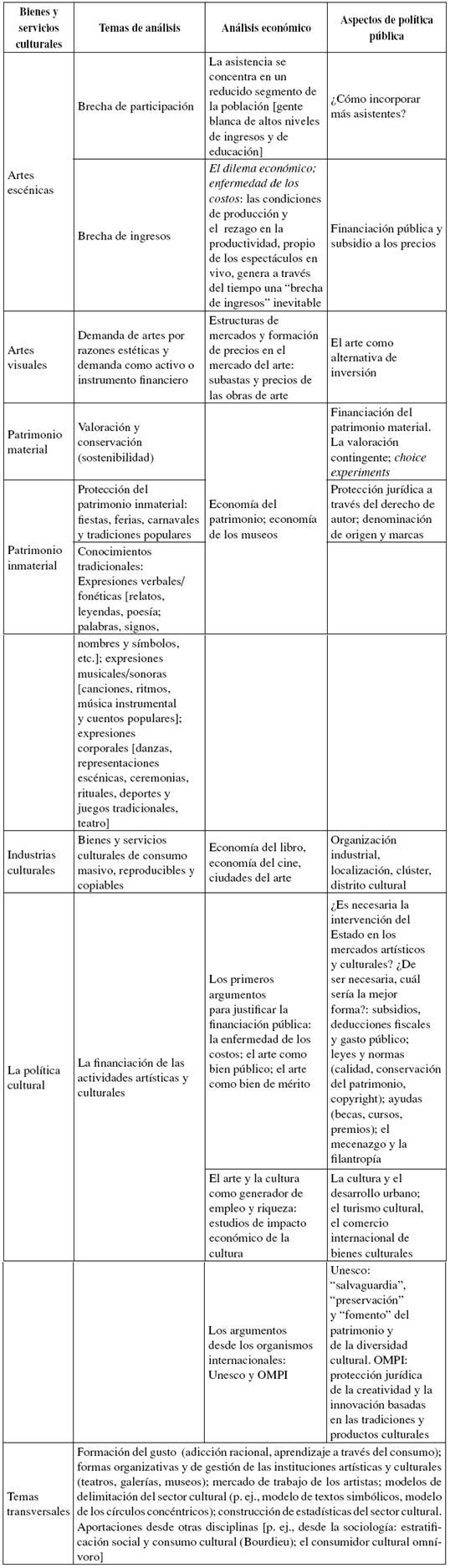
CONCLUSIONES
A lo largo del artículo se ha presentado una síntesis y conexión entre el pensamiento económico y el análisis económico en la configuración de la economía de la cultura como subdisciplina de la economía. A los fundadores de la economía los bienes culturales les parecieron raros y excepcionales por la dificultad inherente en dos aspectos clave: la teoría del valor y la modelización del consumo. Sin embargo, coincidieron en afirmar que estos desempeñaban un papel central en lo que debe ser una buena sociedad.
La incorporación de los bienes culturales al análisis económico pasa por una redefinición del objeto de estudio de la economía, de la teoría del valor y del concepto de ocio. Esta nueva forma de entender el ocio ha permitido un mejor análisis de las actividades que se creía operaban al margen del mercado y no se tenía claro cómo explicar su consumo por parte de los individuos. Hoy la demanda de bienes culturales resulta perfectamente analizable, teórica y empíricamente, con los instrumentos del análisis económico. En efecto, los bienes culturales como objeto de demanda son insumos para producir una experiencia cultural. Las experiencias culturales se pueden definir como un bien de ocio en el marco propuesto por Becker (1965) y Stigler y Becker (1977). Estas son inmateriales, similares a los servicios, con la diferencia de que una experiencia cultural es el resultado de descifrar e interpretar estímulos visuales, auditivos o simbólicos a través de imágenes, sonidos y signos por parte de los demandantes a través de sus funciones de producción domésticas. La Tabla 1 refleja la aportación del artículo en este ámbito.
La economía de la cultura como subdisciplina de la economía, cincuenta años después del trabajo seminal de Baumol y Bowen, cuenta con ámbitos de análisis claramente distintivos en el análisis económico y se presenta como un área dinámica de especialización perfectamente situada en la economía en temas como la formación del gusto por los bienes culturales (adicción racional, aprendizaje a través del consumo); las formas organizativas y de gestión de las instituciones artísticas y culturales (teatros, galerías, museos); el mercado de trabajo de los artistas y el análisis del proceso de creación de bienes culturales y la incorporación de los bienes culturales en los planes de desarrollo como un recurso estratégico capaz de generar riqueza y empleo. La Tabla 2 refleja esta segunda contribución.
REFERENCIAS
Sugerencia de citación:
Referencias
Aguado, L., & Palma, L. (2012). Una interpretación metodológica sobre la incorporación de los bienes y servicios culturales al análisis económico. Lecturas de Economía, 77, 219-252.
Aguado, L., & Palma, L. (2015). Factores que limitan la participación cultural. Una mirada desde la economía de la cultura. Revista de Ciencias Sociales, 31(1), 58-71.
Aguiar, M., & Hurst, E. (2006). Measuring trends in leisure: The allocation of time over five decades (Working Paper 06-2). Federal Reserve Bank of Boston.
Aguiar, M., & Hurst, E. (2007). Measuring trends in leisure: The allocation of time over five decades. The Quarterly Journal of Economics, 122(3), 969-1006.
Albi, E. (2003). Economía de las artes y la política cultural. Madrid: Instituto de Estudios Fiscales.
Amez, L. (2010). Mapping the field of arts and economics. Documento presentado en 16th International Conference on Cultural Economics, ACEI, Copenhague.
Backhouse, R., & Medema, S. (2009). Retrospectives on the definition of economics. Journal of Economic Perspectives, 23(1), 221-233.
Baumol, H., & Baumol, W. (1984). Inflation and the performing arts. Nueva York: Nueva York University Press.
Baumol, W. J. (1967a). Macroeconomics of unbalanced growth: The anatomy of urban crisis. American Economic Review, 57(3), 415-426.
Baumol, W. J. (1967b). Performing arts: The permanent crises. Business Horizons, 10(3), 47-50.
Baumol, W. J. (1973). Income and substitution effects in the Linder theorem. The Quarterly Journal of Economics, 87(4), 629-633.
Baumol, W. J. (2003). Applied welfare economics. En R. Towse (ed.), A Handbook of Cultural Economics (pp. 20-31). Cheltenham: Edward Elgar.
Baumol, W. J., & Bowen, W. (1965). On the performing arts: The anatomy of their problems. American Economic Review, Papers and Proceedings, 55, 495-502.
Baumol, W. J., & Bowen, W. (1966). Performing arts. The economic dilemma. Cambridge: Twentieth Century Found.
Becker, G. S. (1965). A theory of the allocation of time. Economic Journal, 75(299), 493-517.
Becker, G. S. (1976). El enfoque económico del comportamiento humano. En R. Febrero & P. Schwartz (Eds.1997), La esencia de Becker (pp. 47-58). Madrid: Ariel.
Benito, B., Bastida, F., & Vicente, C. (2013). Municipal elections and cultural expenditure. Journal of Cultural Economics, 37(1), 3-32.
Bentham, J. ([1843] 1962). The works of Jeremy Bentham, chapter I. Disponible en Disponible en http://oll.libertyfund.org/title/1921/113884 on 2009-05-02. [Full Text]
Blaug, M. (ed.). (1976). The economics of the arts: Selected readings. Londres: Martin Robertson & Co.
Blaug, M. (2001). Where are we now in cultural economics. Journal of Economic Surveys, 15(2), 123-143.
Böhm-Bawerk, E. ([1911] 2009). Valor, capital, interés. El manuscrito de 1876. Madrid: Unión Editorial.
Burda, M., Hamermesh, D., & Weil, P. (2007). Total work, gender and social norms (IZA Discussion Paper 2705). Bonn: Institute for the Study of Labor.
Caves, R. (2000). Creative industries. Contracts between art and commerce. Cambridge, MA: Harvard University Press.
Chapman, S. (1909). Hours of labour. The Economic Journal, 19(75), 353-373.
Coase, R. (1978). Economics and contiguous disciplines. The Journal of Legal Studies, 7(2), 201-211.
Conferencia de las Naciones Unidas sobre Comercio y Desarrollo (Unctad). (2008). Creative economy report 2008: The challenge of assessing the creative economy towards informed policy-making. Nueva York: el autor. Disponible en http://www.unctad.org/en/docs/ditc20082cer_en.pdf.
De Marchi, N., & Greene, J. (2005). Adam Smith and private provision of the arts. History of Political Economy, 37, 431-454.
Department of Communication and the Arts (DCA). (1994). Creative nation: Commonwealth cultural policy. Canberra: el autor. Disponible en http://www.nla.gov.au/creative.nation/creative.html.
Ginsburgh, V. (2001). Economics of art and culture. En N. Smelser & P. Baltes (eds.), International encyclopedia of the social and behavioural sciences (pp. 758-764). Ámsterdam: Elsevier.
Ginsburgh, V., & Throsby, D. (eds.). (2006). Handbook of the economics of art and culture. Ámsterdam: North-Holland.
Goode, R. (1967). Review: Performing arts: The economic dilemma by William J. Baumol, William G. Bowen. American Economic Review, 57(3), 667-669.
Goodwin, C. (2006). Art and culture in the history of economic thought. En V. Ginsburgh & D. Throsby (eds.), Handbook of the Economics of Art and Culture (pp. 25-68). North-Holland, Ámsterdam.
Greffe, X. (2010). Introduction: L'économie de la culture est-elle particulière? Revue D'économie Politique, 1(120), 1-34.
Gronau, R. (1977). Leisure, home production, and work. The theory of the allocation of time revisited. Journal of Political Economy, 85(6), 1099-1123.
Handke, C., & Dekker, E. (2013). From Austria to Australia: Mark Blaug and cultural economics. En M. Boumans & M. Klaes (eds.), Mark Blaug: Rebel with many causes (pp. 225-244). Cheltenham: Edward Elgar .
Harrod, R. (1951). The life of John Maynard Keynes. Londres: Macmillan.
Heilbrun, J., & Gray, C. (2001). The economics of art and culture, 2. Cambridge, Ma.: Cambridge University Press.
Hendon, W. (1985). Arts and their impact on economic life. Poetics, 14(1-2), 123-155.
Hendon, W., & Shanahan, J. (eds.). (1984). Economics of cultural decisions. Cambridge: Abt Books.
Hendon, W., Shanahan, J., & MacDonald, A. (eds.). (1980). Economic policy for the arts. Cambridge: Abt Books .
Herrero, L. (2011). La contribución de la cultura y las artes al desarrollo económico regional. Investigaciones Regionales, 19, 177-202.
Holmes, S. (1984). The field of cultural economics. American Journal of Economics and Sociology, 43(4), 502.
. Howson, S. (2004). The origins of Lionel Robbins's essay on the nature and significance of economic science. History of Political Economy, 36, 413-443.
Hutter M., & Shusterman, R. (2006). Value and the valuation of art in economic and aesthetic theory. En V. Ginsburgh & D. Throsby (eds.), Handbook of Cultural Economics. North-Holland, Ámsterdam.
Jevons, W. S. ([1879] 1998). La teoría de la economía política. Madrid: Pirámide.
Jevons, W. S. ([1883] 2010). Methods of social reform and other papers. Londres: Macmillan .
Keynes, J. M. (1936a). William Stanley Jevons 1835-1882: A centenary allocation on his life and work as economist and statistician. Journal of the Royal Statistical Society, 99(3), 516-555.
Keynes, J. M. ([1936b] 1981). Teoría general de la ocupación, el interés y el dinero. México: Fondo de Cultura Económica.
Keynes, J. M. (1982). Art and the state. En D. Moggridge (ed.), The collected writings of John Maynard Keynes (vol. XXVIII, Social, Political and Literary Writings). Londres: Macmillan for the Royal Economic Society.
Keynes, J. M. ([1926a] 1988). El fin del laissez faire. En Ensayos de persuasión (pp. 275-297). Barcelona: Barcelona Crítica.
Keynes, J. M. ([1930b] 1988). Las posibilidades económicas de nuestros nietos. En Ensayos de persuasión (pp. 323-333). Barcelona: Barcelona Crítica .
Knight, F. ([1971] 1921). Risk, uncertainty and profit. Chicago, IL: University of Chicago Press.
Lasuén, J., García, M., & Zofío, J. (2005). Cultura y economía. Madrid: Sociedad General de Autores y Editores-Fundación Autor.
Levitt, S., & Dubner, S. ([2005] 2006). Freakonomics: un economista políticamente incorrecto explora el lado oculto de lo que nos afecta. Barcelona: Ediciones B.
Lévy-Garboua, L., & Montmarquette, C. (1996). A microeconometric study of theater demand. Journal of Cultural Economics, 20, 25-50.
Levy-Garboua, L., & Montmarquette, C. (2003). Demand. En R. Towse R. (ed.), A Handbook of Cultural Economics (pp. 201-213). Cheltenham, UK: Edward Elgar.
Linder, S. (1970). The harried leisure class. Nueva York, NY: Columbia University Press.
Malthus, T. ([1820] 1946). Principios de economía política. México: Fondo de Cultura Económica .
Marshall, A. ([1890] 1954). Principios de economía. Madrid: Fundación ICO.
McCain, R. (1979). Reflections on the cultivation of taste. Journal of Cultural Economics, 3(1), 30-52.
Menger, C. ([1871] 1997). Principios de economía política. Madrid: Unión Editorial .
Michael, R., & Becker, G. (1973). On the new theory of consumer behavior. Swedish Journal of Economics, 75, 378-396.
Mill, J. S. ([1848] 1943). Principios de economía política. México: Fondo de Cultura Económica .
Mill, J. S. ([1844] 2000). Essays on some unsettled questions of political economy. Ontario: Batoche Books.
Mitchell, W. (1912). The backward art of spending money. The American Economic Review, 2(2), 269-281.
Moggridge, D. (ed.). (1982). The collected writings of John Maynard Keynes (vol. 28, cap. 3). Londres: The Macmillan Press.
Moggridge, D. (2005). Keynes, the "Arts, and the State". History of Political Economy, 37(3), 535-555.
Netzer, D. (1978). The subsidized muse: Public support for the arts in the United States. Cambridge: Cambridge University Press.
Organización de las Naciones Unidas para la Educación, la Ciencia y la Cultura (Unesco). (2006). Guidelines for measuring cultural participation. Montreal: el autor.
Palma, L., & Aguado, L. (2010). Economía de la cultura. Un área de especialización reciente de la economía. Revista de Economía Institucional, 12(22), 129-165.
Peacock, A. (1968). Review, performing arts: The economic dilemma by William J. Baumol, William G. Bowen. Economica, New Series, 35(137), 100-101.
Pigou, A. (1920). The economics of welfare. Londres: Macmillan.
Quesnay, F. ([1766] 1974). Análisis de la formula aritmética del "Tableau Economique. De la distribución de los gastos anuales de una nación agrícola". En F. Quesnay (ed.), El tableau economique y otros escritos fisiocráticos. Barcelona: Editorial Fontamara.
Ricardo, D. ([1821] 1959). Principios de economía política y tributación. México: Fondo de Cultura Económica .
Robbins, L. (1929). The economic effects of variations of hours of labour. The Economic Journal, 39(153), 25-40.
Robbins, L. (1930a). On the elasticity of demand for income in terms of effort. Economica, 29, 123-129.
Robbins, L. (1930b). The present position of economic science. Economica, 28, 14-24.
Robbins, L. ([1932] 1944). Ensayo sobre la naturaleza y significación de la ciencia económica. México: Fondo de Cultura Económica .
Robbins, L. (1963). Art and the State. Politics and economics: Papers in political economy. Londres: Macmillan .
Robbins, L. (1971a). Autobiography of an economist. Londres: Macmillan .
Robbins, L. (1971b). Unsettled questions in the political economy of the arts. The Three Banks Review, 91, 3-19.
Ruskin, J. ([1862] 2001). Unto this last: Four essays on the first principles of political economy. Disponible en http://etext.virginia.edu/toc/modeng/public/RusLast.html.
Seaman, B. (2009). Cultural economics: The state of the art and perspectives. Estudios de Economía Aplicada, 27(1), 7-32.
Scitovsky, T. (1976). The joyless economy: The psychology of human satisfaction. Oxford: Oxford University Press.
Schumpeter, J. ([1954] 1982). Historia del análisis económico. Barcelona: Ariel.
Shanahan, J., & Hendon, W. (1979). Symposium on subsidization of cultural activities. Journal of Behavioral Economics, 8(1), 1-21.
Smith, A. ([1776] 1994). Investigación sobre la naturaleza y causa de la riqueza de las naciones. Madrid: Alianza.
Stein, J. (1977). The monetary appreciation of paintings. Journal of Political Economy, 85(5), 1021-1035.
Stigler, G., & Becker, G. (1977). De gustibus non est disputandum. American Economic Review, 67(2), 76-90.
Throsby, D., & Withers, G. (1979). The economics of the performing arts. Nueva York: St. Martin's Press.
Throsby, D. (1994). The production and consumption of the arts: A view of cultural economics. Journal of Economic Literature, 32(1), 1-29.
Throsby, D. (2001). Economics and culture. Cambridge: Cambridge University Press .
Throsby, D. (2008a). Art, economics of. En S. Durlauf & L. Blume (eds.), The new palgrave dictionary of economics (vol. 3). Hampshire: Palgrave Macmillan.
Towse, R. (ed.) (1997). Cultural economics: The arts, the heritage and the media industries (2 vols.). Cheltenham: Edward Elgar Publishing.
Towse, R. (ed.). (2003). A handbook of cultural economics. Cheltenham: Edward Elgar Publishing.
Towse, R. (2005). Alan Peacock and cultural economics. Economic Journal, 115, F262-F276.
Veblen, T. ([1899] 1995). Teoría de la clase ociosa. México: Fondo de Cultura Económica .
Vogel, H. (2001). Entertainment industry economics. A guide for financial analysis. Cambridge: Cambridge University Press .
Walras, L. ([1900] 1987). Elementos de economía política pura o teoría de la riqueza social. Madrid: Alianza .
Cómo citar
APA
ACM
ACS
ABNT
Chicago
Harvard
IEEE
MLA
Turabian
Vancouver
Descargar cita
CrossRef Cited-by
1. Jesús Heredia Carroza, Luis Palma Martos, Luis F. Aguado. (2020). Creación e interpretación en el marco de los derechos de autor : el caso de la música popular tradicional.. Kepes, 17(21), p.113. https://doi.org/10.17151/kepes.2020.17.21.5.
2. Alan Omar Pérez Álvarez. (2024). Transdisciplina y economía. Transdisciplinar. Revista de Ciencias Sociales del CEH, 4(7), p.205. https://doi.org/10.29105/transdisciplinar4.7-94.
3. Leislie Rocío Manjarrez-Olmos, Martín Aubert Hernández Calzada, Carla Carolina Pérez Hernández, Jessica Mendoza Moheno. (2024). Economía Naranja: Metaanálisis bibliométrico, temático y semántico del constructo. Revista Venezolana de Gerencia, 29(Especial 1), p.1176. https://doi.org/10.52080/rvgluz.29.e12.19.
4. Christian Martínez Olivera, Crucita Aurora Ken Rodríguez, Andrés Enrique Miguel Velasco. (2022). Economía creativa y rezago social. El caso del estado de Oaxaca, México, 2000-2020. Economía Creativa, (16), p.151. https://doi.org/10.46840/ec.2021.16.06.
5. Alicia Orea-Giner, Carmen De-Pablos-Heredero, Trinidad Vacas Guerrero. (2021). Sustainability, economic value and socio-cultural impacts of museums: a theoretical proposition of a research method. Museum Management and Curatorship, 36(1), p.48. https://doi.org/10.1080/09647775.2019.1700468.
6. Mario Eduardo Hidalgo Villota, Jessica Mayeri Enríquez Narváez, Yamile Karolina Valenzuela Erazo. (2024). Valoración económica del Santuario de Nuestra Señora de Las Lajas en Ipiales, Colombia. Apuntes del Cenes, 43(77), p.211. https://doi.org/10.19053/uptc.01203053.v43.n77.2024.16202.
7. Vanessa Cano Mejía, Juan David Arias Suárez, Ruth Verónica Muriel López. (2025). Aproximaciones epistemológicas en torno a la gestión cultural y creativa. Análisis dialéctico-conceptual desde la economía de la cultura.. Teuken Bidikay - Revista Latinoamericana de Investigación en Organizaciones, Ambiente y Sociedad, 16(27) https://doi.org/10.33571/teuken.v16n27a2.
8. Leydi Higidio Henao. (2019). Industrias culturales y economía creativa en Latinoamérica: Desarrollo económico y social en la región. , p.103. https://doi.org/10.28970/9789585498143.3.
9. Blas DÍaz León, Ignacio Martinez Fernandez, Luis Palma Martos. (2021). Temporal Restriction and Interest for the Elderly on Cultural Participation. The Case of Spanish Performing Arts 2019. Scientific Annals of Economics and Business, 68, p.35. https://doi.org/10.47743/saeb-2021-0030.
10. Jordi Sanjuán. (2025). How do cultural and creative industries shape wellbeing? A multidisciplinary review. European Journal of Cultural Management and Policy, 15 https://doi.org/10.3389/ejcmp.2025.14774.
11. Nora Elena Espinal Monsalve, Linda Nataly Corredor-Martínez, Valentina Sarmiento-Domínguez. (2025). Estudio bibliométrico de la economía de la cultura en Colombia (2001-2023). Cuadernos de Economía, 44(95) https://doi.org/10.15446/cuad.econ.v44n95.101659.
12. Pablo Sigfrido Corte-Cruz. (2019). La demanda agregada de la cultura en México: propensión al consumo y tasa de interés para empresas culturales. Revista CEA, 5(10), p.151. https://doi.org/10.22430/24223182.1331.
13. Marbe Marticorena Robles, Marta Lucia Tostes Vieira. (2024). Co-creation of value in a cultural organizations’ ecosystem. Creative Industries Journal, , p.1. https://doi.org/10.1080/17510694.2024.2411940.
Dimensions
PlumX
Visitas a la página del resumen del artículo
Descargas
Licencia
Derechos de autor 2017 Cuadernos de EconomíaCuadernos de Economía a través de la División de Bibliotecas de la Universidad Nacional de Colombia promueve y garantiza el acceso abierto de todos sus contenidos. Los artículos publicados por la revista se encuentran disponibles globalmente con acceso abierto y licenciados bajo los términos de Creative Commons Atribución-No_Comercial-Sin_Derivadas 4.0 Internacional (CC BY-NC-ND 4.0), lo que implica lo siguiente: