Correo Electrónico
 DNINFOA - SIA
 Bibliotecas
 Convocatorias
 Identidad U.N.


Published
Critical undrained shear strength of sand-silt mixtures under monotonic loading
DOI:
https://doi.org/10.15446/esrj.v18n2.42492Keywords:
sand, silt, static liquefaction, undrained, strength, density (en)Arena, cieno, licuación estática, no drenaje, tensión, densidad (es)
This study uses experimental triaxial tests with monotonic loading to develop empirical relationships to estimate undrained critical shear strength. The effect of the fines content on undrained shear strength is analyzed for different density states. The parametric analysis indicates that, based on the soil void ratio and fine content properties, the undrained critical shear strength first increases and then decreases as the proportion of fines increases, which demonstrates the influence of fine content on a soil's vulnerability to liquefaction. A series of monotonic undrained triaxial tests were performed on reconstituted saturated sand-silt mixtures. Beyond 30% fines content, a fraction of the silt participates in the soil's skeleton chain force. In this context, the concept of the equivalent intergranular void ratio may be an appropriate parameter to express the critical shear strength of the studied soil. This parameter is able to control the undrained shear strength of non-plastic silt and sand mixtures with different densities.
https://doi.org/10.15446/esrj.v18n2.42492
Critical undrained shear strength of sand-silt mixtures under monotonic loading
Mohamed Bensoula1,2, Hanifi Missoum2, Karim Bendani2
1 Department of civil and architecture, University of Mostaganem, Bat 72 N°03 cité 05 juillet, Mostaganem 27000 Algeria, bensoulamoh@hotmail.com
2 Laboratory of Construction, Transports and Environment Protection (LCTPE), BP 227, Route de Belhacel, University of Mostaganem, CP 27000, Mostaganem, Algeria
Record
Manuscript received: 10/03/2014 Accepted for publication: 03/09/2014
ABSTRACT
This study uses experimental triaxial tests with monotonic loading to develop empirical relationships to estimate undrained critical shear strength. The effect of the fines content on undrained shear strength is analyzed for different density states. The parametric analysis indicates that, based on the soil void ratio and fine content properties, the undrained critical shear strength first increases and then decreases as the proportion of fines increases, which demonstrates the influence of fine content on a soil's vulnerability to liquefaction. A series of monotonic undrained triaxial tests were performed on reconstituted saturated sand-silt mixtures. Beyond 30% fines content, a fraction of the silt participates in the soil's skeleton chain force. In this context, the concept of the equivalent intergranular void ratio may be an appropriate parameter to express the critical shear strength of the studied soil. This parameter is able to control the undrained shear strength of non-plastic silt and sand mixtures with different densities.
Key words: sand, silt, static liquefaction, undrained, strength, density.
RESUMEN
Este estudio utiliza evaluaciones experimentales triaxiales con cargas repetitivas para desarrollar relaciones empíricas y estimar la tensión crítica de corte bajo condiciones no drenadas. El efecto de contenido de finos en la tensión de corte sin drenar se analizó en diferentes estados de densidad. El análisis paramétrico indica que, basado en la porosidad del suelo y las propiedades del material de finos, la tensión de corte sin drenar primero se incrementa y luego decrece mientras la proporción de finos aumenta, lo que demuestra la influencia de contenido de finos en la vulnerabilidad del suelo a la licuación. Una serie de las evaluaciones se realizó en mezclas rehidratadas y saturadas de arena y cieno. Másá del 30 % de los contenidos finos, una fracción del cieno hace parte principal de la cadena de fuerza del suelo. En este contexto, el concepto de porosidad equivalente intergranular puede ser un parámetro apropiado para expresar la tensión crítica de corte del suelo estudiado. Este parámetro nos permite controlar la tensión de corte sin drenar de cieno no plástico y mezclas de arena de densidades diferentes.
Palabras clave: Arena, cieno, licuación estática, no drenaje, tensión, densidad.
List of symbols
Cu: Coefficient of uniformity
Cc: Coefficient of curvature
Dr: Initial relative density
: Equivalent relative density
e: Global void ratio
emax: Maximum void ratio
emin: Minimum void ratio
es: Intergranular void ratio
e*: Equivalent void ratio
Fc: Fines content
Gs: Specific gravity of soil grain
gd: Solid dry density
p': Effective mean stress
p'cr: Effective mean stress at critical state
: Effective mean stress at steady state
q: Deviatoric stress
qcr: Deviatoric stress at critical state
qs: Deviatoric stress at steady state
Sucr: Undrained critical shear strength
ea: Axial strain
Di: Grain diameter corresponding to i% finer
sc: Confining pressure
Ip: Plasticity index
M: Slope of critical state line
fs: Mobilized angle of inter-particle friction at the steady state
Introduction
Northern Algeria is located on a tectonic plate boundary (ruptured fault), and consequently, many earthquakes occur in this region. Recent seismic activity over the last twenty years in Algeria includes the Mascara earthquake in 1994 (M: 5.6), the Algiers earthquake in1996 (M: 5.7), the Ain-Temouchent earthquake in 1999 (M: 5.8), the Beni-Ouartilane earthquake in 2000 (M: 5.4) and the Boumerdès earthquake in 2003 (M: 6.9).These earthquakes caused major structural damage to constructions and dramatic losses of human life. These events also included numerous cases of ejection of great masses of sandy soils onto the ground surface level and large displacements of equipment foundations.
The region of Mostaganem is in the northern part of the country, is situated on thick geological deposits of silty sand, and has a relatively shallow phreatic water table. These conditions enhance the liquefaction phenomena. Due to the soil failure phenomenon, there is a need to characterize this granular media as an engineering material.
Under undrained conditions, the shear resistance of sandy soils may decrease by either monotonic (e.g., erosion at toe of a slope, reservoir filling, or rapid sediment accumulation) or dynamic (e.g., earthquake, vibration, or blast) loading, leading to liquefaction. The pore water in a saturated sandy soil will increase due to volume contraction if the drainage of the water is impeded. This results in a lower effective stress and, consequently, a reduction in soil strength.
Several liquefaction flow failures can be triggered by static and cyclic mechanisms. Liquefaction may lead to catastrophic failure when the shear resistance of a soil vulnerable to liquefaction drops below the existing initial static load (e.g., driving shear stress on a slope). Many cases of static liquefaction flow failures have been reported by Olson and Stark (2003). To evaluate the occurrence of flow deformation, the undrained shear strength of sandy soils during flow failures and liquefaction is an essential parameter in undrained stability analysis. The correct estimation of the undrained liquefied strength is of paramount importance for the design of soil structures, such as earthen dams, bridge supports and building foundations, with the aim of protecting them from liquefaction failure.
The understanding of soil liquefaction is continuously being revised due to new field and laboratory observations. Obvious evidence has significantly influenced the research trend in investigations of liquefaction in natural sandy soil deposits. The effects of fines on the mechanical behavior of sandy matrix soil are not yet fully understood. Therefore, the present challenge is to improve fundamental research on the mechanical behavior of soils susceptible to liquefaction to unify the treatment of such soils.
The presence of fines may either increase or decrease liquefaction vulnerability. Many contributions have tried to characterize the influence of fines on liquefaction behavior in sandy matrix soils. The Chinese criteria (Wang, 1979) are the well-known liquefaction susceptibility identification. These criteria are essentially based on field observations. These criteria have undergone many revisions, but they still constitute the basic principles and guidelines for many methodologies. Nevertheless, recent findings suggest some inadequacy and deviation associated with the presence of fines, especially plastic fines. Due to discrepancies in the research results in the laboratory and post-liquefaction events, many researchers agreed that such procedures should be discontinued and should be reviewed in a general context (Prakash and Puri, 2010).
Silty sands are the most common type of soil involved in liquefaction flow events. Static and earthquake-induced liquefaction failure events have been described by Yamamuro and Lade (1998). Several studies have been conducted on the influence of fine particles on the liquefaction behavior of sandy soils. Seed et al. (1983) observed that certain types of soil with high contents of fines may be highly susceptible to liquefaction vulnerability. After performing several tests, Yamamuro and Lade (1997) demonstrated that an increase in silt in a sand-silt mixture leads to a decrease in undrained shear resistance of the silty sand at a constant total void ratio.
The behavior of clean sand differs from that of sand-silt mixtures. There are contradictory conclusions regarding this difference: Some researchers have concluded that silt in the sand matrix reduces the undrained shear resistance of sandy-soil mixtures, e.g., Chang et al. (1982), whereas other researchers have reached the opposite conclusion, e.g.,Troncoso and Verdugo (1985), and Vaid (1994).
Therefore, based upon the contradictory results presented in the literature, the fines content of a sandy soil does not lead to uniform behavior, and although recent advances have been achieved in this area of research, our understanding of this behavior is still non-unified and controversial.
The stability of structures built on liquefied soil depends on the post-liquefaction effects of the soil shear strength. The strength of soils at the phase transition is critical for engineering design (Ishihara, 1993). Consequently, it is important to clarify the main parameters that exert substantial influence on the shear resistance and to delineate the necessary principles for the design process. Yamamuro and Lade (1997) showed that the intergranular void ratio (es) likely controls the undrained resistance of sand-silt mixtures. This parameter, (es), represents the space within sand grains and can be computed as follows:

where e is the global void ratio and Fc is the fines content (the ratio of the silt weight to the total sample weight).
Thevanayagam et al. (2002) stated that, beyond a certain value of Fc (the threshold value), a fraction of the silt participates in the soil skeleton chain force, and these authors introduced a new parameter defined as the equivalent intergranular void ratio. This parameter is able to influence the undrained shear resistance of non-plastic silt and sand mixtures and is described by the following equation:

where e is the equivalent void ratio and a represents the silt fraction that participates in the soil skeleton strength. When a = 1, the equivalent granular void ratio is reduced to the intergranular void ratio.
This paper presents a parametric study focusing on estimating the undrained liquefied shear strength of silty sand using state parameters and the geotechnical properties of the mixtures. This work investigates the effects of non-plastic silty fines content on the undrained liquefied shear strength of silt-sand mixtures. Our main aim in this study is to introduce relationships that express the critical undrained shear resistance in terms of the various soil parameters of Mostaganem sandy soil at different relative densities and fines contents (up to 40%).
To achieve this aim, a series of monotonic undrained triaxial tests were performed on reconstituted saturated sand-silt mixtures.
Materials tested
Soil samples from the coastal region of Mostaganem were collected at various depths. In these samples, the silty fines content did not exceed 30%. In our experiments, the sand and silt were separated and used to generate the test specimens. The specific gravities of the sand and silt were 2.67 and 2.69, respectively. The tests were conducted on mixtures of the collected sand and silt. The plastic limit and liquid limit of the silt were 20% and 25%, respectively. Because most static liquefaction and earthquake-induced liquefaction occur in silty sand and sandy silt, silt contents ranging from 0% to 40% were tested. Additionally, liquefaction vulnerability is highly affected by the relative density of the soil (Yamamuro and Kelly, 2001; Maheshwari and Patel, 2010). In this work, a variety of soil density states were also studied. The geotechnical properties of the soil used in this work are presented in table 1.

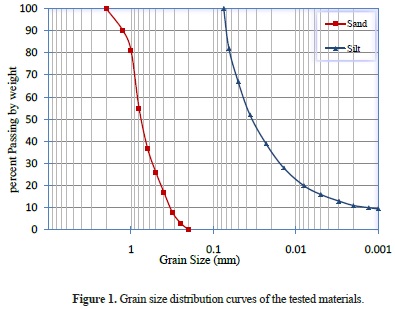
The grain size distribution curves for all sand silt mixtures under investigation are illustrated in Figure 1. Di corresponds to the soil diameter at which i% of the soil weight is finer. The plasticity index of the silt is Ip = 5%, and Cu and Cc are the coefficients of uniformity and curvature, respectively. According to the ASTM D2487-11(2011) classification, the sand under study is poorly sorted (SP), and the silt is inorganic (ML).
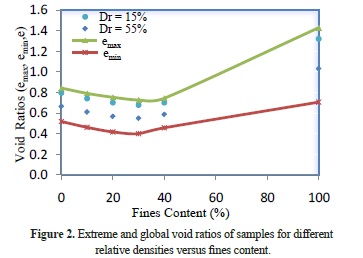
The parameter emax is the maximum void ratio (lowest density state), and emin is the minimum void ratio (densest density state). These parameters, emax and emin, are obtained by fixing the height drop of the funnel (Figure 2). The variation of emax and emin in term of the fines content Fc is shown in Figure 2. The variation in both indices clearly follows the same trend. The two indices decrease with as the fines content increases to 30% and then increase beyond this value.
Laboratory experiment procedures
Preparation method:
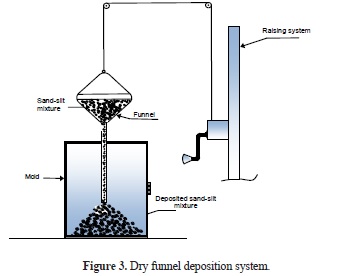
Sample preparation methods considerably affect the liquefaction behavior of soils (Ladd, 1974; Mulilis et al., 1977). The sample must be prepared in such a way as to replicate the soil conditions in the field. Therefore, the choice of proper sample preparation techniques is important in determining the liquefaction potential of sandy soils. Numerous sample reconstitution methods have been discussed for use in the laboratory, including moist tamping, dry funnel pluviation and water sedimentation. The dry pluviation deposition method tends to reproduce field performance well, as shown by Vaid et al. (1999). In this study, dry funnel pluviation was used as the sample preparation method to reproduce the soil conditions in the field. The experimental device fabricated for the dry funnel depositional method is shown in Figure 3.
Soil sample preparation:
Dry sand and silt were mixed according to the different specified weight ratios.
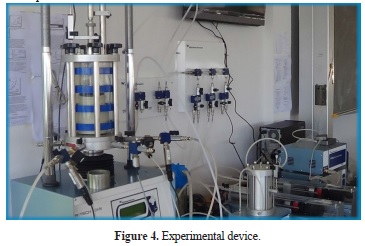
The samples were prepared by means of a mold consisting of two semi-cylindrical shells (Figure 4). The two parts of the mold can be easily joined by a hose clamp.
The samples are cylindrical in shape and are 70 mm in diameter (D) and 140 mm in height (H) (H/D=2.0). The mass of sand-silt mixture to be put inside the mold is calculated according to the required relative density (the initial volume is known). The relative density of sample is defined as follows:

where e is the global void ratio. The tests were carried out on reconstituted saturated samples.
Degree of saturation during the test:
First, the samples were purged with carbon dioxide gas for more than 30mn and subsequently saturated with de-aired water. Skempton's pore water parameter B controls the saturation state. According to ASTM D 4767-02 (2004), samples can be considered fully saturated if B is equal to or greater than 0.95. In all the undrained tests, this condition was fulfilled. In this investigation, a backpressure of 100 kPa was applied during the experiments to achieve a completely saturation state.
Consolidation and loading:
Samples were isotropically consolidated at a mean effective stress of 100 kPa and then subjected to undrained monotonic triaxial loading. A constant strain rate of 5% per hour was applied during all the tests to stabilize the pore water pressure build up throughout all the samples. All the tests reached 25% axial strain.
Estimation of undrained critical shear strength:
The behavior of saturated sand specimens in undrained triaxial tests is presented in Figure 5 (Vaid and Chern, 1983). Points A, B, and C represent isotropically compressed specimens. In undrained (constant volume) conditions, the effective mean stress decreases as excess pore water pressure develops. During this process, the soil sample reaches peak undrained shear strength Su (the yield strength) at positions A1, B1 and C1. Liquefaction is triggered when shear stress applied to the soil specimen exceeds the peak shear strength as a result of static or dynamic loading. Beyond that point, an unstable regime (Prunier et al., 2009) develops in the specimen until the critical state is reached at point D on the critical state line (CSL). This position is called steady state.
If the effective stress path reaches the flow liquefaction surface (FLS), the soil element becomes unstable and its effective stress state rapidly moves to the steady state, where the soil element undergoes sudden failure with large deformation.

In undrained situations, the shear strength at steady state is conventionally the critical shear strength. In the framework of critical state soil mechanics theory, the following relationship can be written:

where M is the slope of the critical state line.
According to Schofield and Wroth (1968) and triaxial tests,

where qs, and Φs indicate the deviatoric stress (), the effective mean principal stress , and the mobilized angle of inter-particle friction at steady state, respectively. The critical shear strength Sucr can be written as follows:

Results and discussion
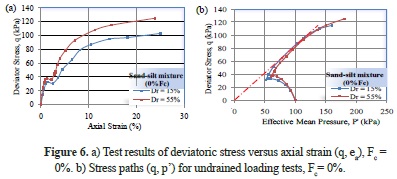
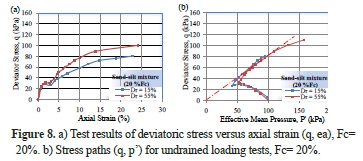
The results of the undrained monotonic compression triaxial tests performed for different fines contents (ranging from 0 to 40%) at an average confining pressure of 100 kPa within two separate density ranges (Dr = 15 and 55%) are shown in Figures 6 to 10. The stress paths (p', q) recorded during the tests, as well as the axial strain versus the deviatoric stress q, were recorded and represented graphically.
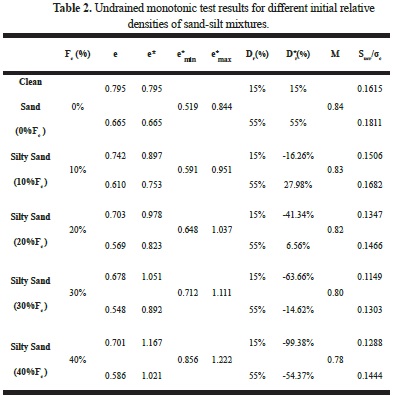
For Fc values ranging from 0% to 30%, we observe that the critical deviatoric stress (qcr) is reached for axial strain values ranging from 0.8% to 1.6% (Figure 6). When the fine fraction is Fc = 0%, the critical deviatoric stress (qcr) values are 34.12 kPa and 38.69 kPa corresponding to effective mean stress (p'cr) values of 57.86 kPa and 63.11 kPa for the initial relative densities Dr = 15% and 55%, respectively (M = 0.84, fs = 21.62°).
When the fine fraction is 10% (Figure 7), the critical deviatoric stress (qcr) values are 32.08 kPa and 35.84 kPa (M = 0.83, fs = 21.38°). For Fc = 20% (Figure 8), the critical deviatoric stress (qcr) values are 28.54kPa and 31.08 kPa (M = 0.82, fs = 21.14°), and for Fc = 30% (Figure 9), the critical deviatoric stress (qcr) values are 24.09 kPa and 27.32 kPa (M = 0.80, fs = 20.67°).


When Fc = 40% (Figure 10), the mixture exhibits a dilatant behavior and does not develop a contractile phase. The deviatoric stress (qcr) increases again and has values of 27.52 kPa and 30.85 kPa for Dr = 15% and 55%, respectively (M = 0.78, fs = 20.19°).
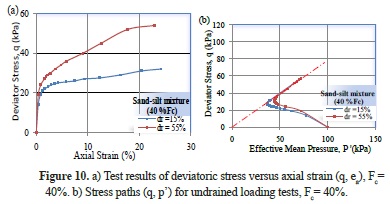
We observed that an increase in the amount of fines of 0% to 30% leads to a decrease in the deviatoric stress. This decrease occurs because of the role of the fines in reducing the soil dilatancy and amplifying the phase of contraction in the sand-silt mixtures, which leads to a reduction in the confining effective pressure and, consequently, a decrease in the peak strength of the mixtures. The stress path in the (p', q) plane clearly shows the role of the fines in the decrease in the average effective pressure and the maximum deviatoric stress (Figures 6.b-10.b). In this case, the effect of fines on the undrained behavior of the mixtures is observed for the fines contents lower than 30%. These results are in good agreement with the observations of Shen et al. (1977), Troncoso and Verdugo (1985), Koester (1994) and Kokusho et al. (2014).
When the proportion of fines is 40%, there is an increase in the deviatoric stress, which is due to the role of the fines in increasing the dilatancy in the soil and the absence of a contractile phase. This result shows that % in mixtures with greater than 30% fines, the fines participate in the strength of the mixture and reverse the behavior trend. Table 2 presents the summary of the undrained monotonic compression triaxial tests.
In this context, Holzer et al. (1999) noted that soils that would have been declared safe from liquefaction by the Chinese criteria did in fact liquefy and lead to permanent ground deformation, and many recent studies, such as Bray and Sancio (2006) and Boulanger and Idriss (2006), have recommended that workers should not rely on the Chinese criteria.
Correlation of critical undrained shear resistance (Sucr) and equivalent void ratio (e*):
In equation (1), the fine particles are simply assumed to occupy voids in the sand skeleton. The concept of the intergranular void ratio suggests that the fines fill the voids formed between the sand grains; Thus, the behavior of sand with a moderate amount of fines should be governed by the intergranular void ratio instead of the global void ratio. However, when the intergranular void ratio exceeds the maximum void ratio of the clean sand, there are sufficient fines to prevent grain-to-grain contact of the sand particles. In this case, the fines constitute the dominant structure and carry the shear forces, while the coarse grains may act as reinforcing elements (Thevanayagam and Mohan 2000). Zlatovic and Ishihara (1995) and Pitman et al. (1994) reported that fines particles started to interfere with sand particle contacts at 5% fines content and that sand particle contacts vanished completely at approximately 25% silt content. To satisfy these experimental observations (Thevanayagam et al. 2002), expression (1) was modified to equation (2).
Generally, e* is obtained from the correlation between soil sorting properties and back-analyzed values (Ni et al., 2004; Yang et al., 2006). Rahman et al. (2008) analyzed the experimental data of McGeary (1961) on binary packing studies and concluded that this parameter is dependent on both the particle size ratio and fines content, Fc. The size ratio r is defined by where D50(fine) is the median size of the fines and D10(sand) is the particle size at 10% fraction of the host sand. The correlation was suggested in the following form:

where k = 1 -r0.25 and Fthre is threshold fines content or transitional fines content, which is characterized by the predominance of fines-controlled behavior.
Thus, the value of Fthre is defined by the point at which the behavior trend reverses with further increases in fines content. Based on our tests, this transition point is located at 30% fines content for all two initial relative densities as shown in Figures 6.b to 10.b. For the studied sand-silt mixtures, r and k were calculated to be 0.100 and 0.438, respectively.
The variations in the equivalent void ratios versus fines content for the initial relative densities (Dr = 15% and 55%) are shown in Figure 11.

For all studied initial relative densities, a decrease in the global void ratio generates an increase in the equivalent or intergranular void ratio. The absolute rate of variation in both void ratios tends to decrease as long as the fines content increases.
Figure 12 shows the variation in the undrained critical shear strength versus the equivalent void ratio for the initial relative densities (Dr = 15% and 55%). It is obvious from this figure that the undrained critical shear strength decreases linearly as the equivalent void ratio decreases and fines content increases for all densities (Dr = 15% and 55% during reconstitution) up to 30% fines content. Thus, when the global void ratio decreases and the fines content increases, the undrained critical shear strength also decreases. We conclude that the global void ratio does not represent the real behavior of silty sandy soil with 0-30% fines content. Moreover, the equivalent void ratio is a key parameter for characterizing the mechanical state of clean sand and sand-silt mixtures.

The following correlation of normalized undrained shear strengths and equivalent intergranular void ratio is obtained:

Correlation of critical undrained shear resistance (Sucr) and equivalent relative density ():
Because the equivalent intergranular void ratio (e*) is presented as an essential representative parameter, the equivalent relative density should consequently be defined as follows (Thevanayagam et al., 2002, 2003; Shenthan, 2005):

where emax,cs is the maximum void ratio of clean sand and emin,cs is the minimum void ratio of clean sand. This relative index compares an equivalent granular state of sandy soils with two extreme density states of clean sand.

Figure 13 shows the variation of the normalized undrained critical shear strength in term of the equivalent relative density. A linear relationship is obtained as follows:

where d*r is the relative density expressed as a decimal ( d*r =D*r /100)
The critical undrained shear strength increases with increasing equivalent relative density for Fc ≤ 30%. In the range 0-30% fine content, we may deduce that, for both obtained relationships, the equivalent intergranular void ratio and the equivalent relative density are key parameters in characterizing such soil's susceptibility to instability.
Conclusions
A series of monotonic undrained triaxial tests were performed on reconstituted saturated sand-silt mixtures. Two levels of initial relative density (15% and 55%) and an initial effective confining stress of 100 kPa were used in the experimental program. The soil sample's proportions of fines ranged from 0% to 40%.
In the framework of the steady state concept and liquefaction susceptibility of sands, the tested sand-silt mixtures experienced limited liquefaction behavior and dilation in the present undrained triaxial tests under monotonic loading.
The obtained results show that the critical undrained shear strength is considerably affected by the fines content. The participation of silty fines in the skeleton forces in the soil depends on their content. Consequently, the equivalent intergranular void ratio was introduced to describe the fine participation. In our tests, this parameter accurately represents the soils until a fines content of 30%. The advantage of this parameter is that it may be able to define the inter-grain friction properties of sand-silt mixtures.
The critical undrained shear strength decreases in a linear manner with increasing equivalent intergranular void ratios, whereas it increases with increasing equivalent relative densities. However, this behavior is only valid for Fc ≤ 30%. The factor α should be related to the mechanical parameters of sand silt mixtures via the critical state soil mechanics framework.
In the range 0-30% fine content, we may deduce that, for both obtained relationships, the equivalent intergranular void ratio and the equivalent relative density are key parameters in characterizing such soil's susceptibility to instability.
Furthermore, these results mean that the studied soil exceeds the threshold set by the Chinese criteria (Wang, 1979) and clearly show that this soil is susceptible to liquefaction at fines content of 30%.
These results agree with recent observations reported by researchers studying static and cyclic liquefaction failures that have caused catastrophic events.
References
ASTM D2487-11(2011) "Standard Practice for Classification of Soils for Engineering Purposes (Unified Soil Classification System)" ASTM International, West Conshohocken, PA. DOI: 10.1520/D2487-11.
ASTM D4767-02 (2004). "Standard test method for consolidated undrained triaxial compression test for cohesive soils." American Society for Testing and Materials, Vol. 04.08, pp. 1-13.
Boulanger, R. W., & Idriss, I. M. (2006). "Liquefaction susceptibility criteria for silts and clays." Journal of geotechnical and geoenvironmental engineering, 132(11), 1413-1426. doi.org/10.1061/(ASCE)1090-0241(2006)132:11(1413).
Bray, J. D., & Sancio, R. B. (2006). "Assessment of the liquefaction susceptibility of fine-grained soils." Journal of Geotechnical and Geoenvironmental Engineering,132(9), 1165-1177. doi.org/10.1061/(ASCE)1090-0241(2006)132:9(1165).
Chang, N. Y., Yeh, S. T., & Kaufman, L. P. (1982). "Liquefaction potential of clean and silty sands." In Proceedings of the Third International Earthquake Microzonation Conference, Vol. 2, pp. 1017-1032.
Fourie, A. B., & Tshabalala, L. (2005). "Initiation of static liquefaction and the role of K0consolidation." Canadian geotechnical journal, 42(3), 892-906. dx.doi.org/10.1139/t05-026.
Holzer, T. L., Bennett, M. J., Ponti, D. J., & Tinsley III, J. C. (1999). "Liquefaction and soil failure during 1994 Northridge earthquake." Journal of Geotechnical and Geoenvironmental Engineering, 125(6), 438-452. doi.org/10.1061/(ASCE)1090-0241(1999)125:6(438).
Ishihara, K. (1993). "Liquefaction and Flow Failure during earthquakes." Géotechnique, 43(3),351-415. icevirtuallibrary.com/content/article/10.1680/geot.1993.43.3.351.
Koester, J. P. (1994). "The influence of fines type and content on cyclic strength." In Ground failures under seismic conditions (pp. 17-33). ASCE.
Kokusho, T., Nagao, Y., Ito, F., & Fukuyama, T. (2014). "Sand Liquefaction Observed During Recent Earthquake and Basic Laboratory Studies on Aging Effect." In Earthquake Geotechnical Engineering Design (pp. 75-92). Springer International Publishing. doi :10.1007/978-3-319-03182-8_3.
Kramer, S. L., & Seed, H. B. (1988). "Initiation of soil liquefaction under static loading conditions." Journal of Geotechnical Engineering, 114(4), 412-430. dx.doi.org/10.1061/(ASCE)0733-9410(1988)114:4(412).
Ladd, R. S. (1974). "Specimen Preparation and Liquefaction of Sands." Journal of the Geotechnical Engineering Division, 100(10), 1180-1184.
Maheshwari, B. K., & Patel, A. K. (2010). "Effects of non-plastic silts on liquefaction potential of Solani sand." Geotechnical and Geological Engineering, 28(5), 559-566.doi.org/10.1007/s10706-010-9310-z.
McGeary, R. K. (1961). "Mechanical packing of spherical particles." Journal of the American Ceramic Society, 44(10), 513-522. dx.doi.org/10.1111/j.1151-2916.1961.tb13716.x.
Mulilis, J. P., Arulanandan, K., Mitchell, J. K., Chan, C. K., & Seed, H. B. (1977). "Effects of sample preparation on sand liquefaction." Journal of the Geotechnical Engineering Division, 103(2), 91-108.
Ni, Q., Tan, T.S., Dasari, G.R., & Hight, D.W. (2004). "Contribution of fines to the compressive strength of mixed soils." Geotechnique, 54(9): 561-569. refdoc.fr/Detailnotice?idarticle=8461334.
Olson, S., & Stark, T. (2003). "Yield strength ratio and liquefaction analysis of slopes and embankments." J. Geotech. Geoenviron. Eng., 129(8), 727-737. doi.org/10.1061/(ASCE)1090-0241(2003)129:8(727).
Pitman, T. D., Robertson, P. K., & Sego, D. C. (1994). "Influence of fines on the collapse of loose sands." Canadian Geotechnical Journal, 31(5), 728-739. doi/abs/10.1139/t94-084.
Prakash, S., & Puri, V. K. (2010). "Recent advances in liquefaction of fine grained soils." In 5th international conference on recent advances in geotechnical earthquake engineering and soil dynamics, San Diego, California, pp. 1-6.
Prunier, F., Laouafa, F. & Darve, F. (2009). "Material stability analysis based on the local and global elasto-plastic tangent operators." Proceedings of the 1st International Symposium on Computational, Geomechanics (COMGEO I), pp. 215-225.
Rahman, M.M., Le, S.R., & Gnanendran, C.T. (2008) "On equivalent granular void ratio and steady state behaviour of loose sand with fines" Can Geotech J 45(10):1439-1455. dx.doi.org/10.1139/T08-064.
Seed, H. B., Idriss, I. M., & Arango, I. (1983). "Evaluation of liquefaction potential using field performance data". Journal of Geotechnical Engineering, 109(3), 458-482. doi.org/10.1061/(ASCE)0733-9410(1983)109:3(458).
Shen, C.K., Vrymoed, J.L., & Uyeno, C.K. (1977). "The effects of fines on liquefaction of sands." Proc., 9th Int. Conf. on Soil Mechanics and Foundation Engineering, Tokyo, 381-385.
Shenthan, T. (2005). "Liquefaction mitigation in silty soils using composite stone column." Ph. D. Dissertation, university at Buffalo, Buffalo, NY.
Schofield, A., & Wroth, P. (1968). "Critical state soil mechanics." London, McGraw-Hill.
Thevanayagam, S., & Mohan, S. (2000). "Intergranular state variables and stress-strain behaviour of silty sands." Geotechnique, 50(1), 1-23. doi:10.1680/geot.2000.50.1.1.
Thevanayagam, S., Shenthan, T., & Kanagalingam, T. (2003). "Role of Intergranular Contacts on Mechanisms Causing Liquefaction & Slope Failures in Silty Sands." In Final report, USGS Award No. 01HQGR0032 and 99HQGR0021. U.S. Geological Survey, Department of the Interior, Reston, Va.
Thevanayagam, S., Shenthan, T., Mohan, S., & Liang, J. (2002). "Undrained fragility of clean sands, silty sands, and sandy silts." Journal of geotechnical and geoenvironmental engineering, 128(10), 849-859.
Troncoso, J. H., & Verdugo, R. (1985). "Silt content and dynamic behavior of tailing sands." In Proc., XI Int. Conf. on Soil Mechanics and Foundation Engineering, pp. 1311-1314.
Vaid, Y.P. (1994). "Liquefaction of silty soils." In Ground Failures under Seismic Conditions. Geotechnical Special Publication No. 44. American Society of Civil Engineers. pp. 1-16.
Vaid, Y. P., & Chern, J. C. (1983). "Mechanism of deformation during cyclic undrained loading of saturated sands." International Journal of Soil Dynamics and Earthquake Engineering, 2(3), 171-177. doi.org/10.1016/0261-7277 (83) 90014-1.
Vaid, Y. P., Sivathayalan, S., & Stedman, D. (1999). "Influence of specimen-reconstituting method on the undrained response of sand." ASTM geotechnical testing journal, 22(3), 187-195. refdoc.fr/Detailnotice?idarticle=11381016.
Wang, W. S. (1979). "Some Findings in Soil Liquefaction." Water Conservancy and Hydroelectric Power Scientific Research Institute, Beijing, China.
Yamamuro, J. A., & Kelly, M. C. (2001). "Monotonic and cyclic liquefaction of very loose sands with high silt content." Journal of geotechnical and geoenvironmental engineering, 127(4), 314-324. doi.org/10.1061/(ASCE)1090-0241(2001)127:4(314).
Yamamuro, J. A., & Lade, P. V. (1997). "Static liquefaction of very loose sands." Canadian Geotechnical Journal, 34(6), 905-917. doi.org/10.1139/t97-057.
Yamamuro, J. A., & Lade, P. V. (1998). "Steady-state concepts and static liquefaction of silty sands." Journal of Geotechnical and Geoenvironmental Engineering, 124(9), 868-877. doi.org/10.1061/(ASCE)1090-0241(1998)124:9(868).
Yang, S.L., Lacasse, S., & Sandven, R.F. (2006). "Determination of the transitional fines content of mixtures of sand and non plastic fines." Geotech Test J 29(2):102-107. hrefdoc.fr/Detailnotice?idarticle=6662871.
Zlatovic, S., & Ishihara, K. (1995). "On the Influence of Non-Plastic Fines on Residual Strength." Proceedings of the first International Conference on Earthquake Geotechnical Engineering, Tokyo, pp. 14-16.
References
ASTM D2487-11(2011) "Standard Practice for Classification of Soils for Engineering Purposes (Unified Soil Classification System)" ASTM International, West Conshohocken, PA. DOI: 10.1520/D2487-11.
ASTM D4767-02 (2004). "Standard test method for consolidated undrained triaxial compression test for cohesive soils." American Society for Testing and Materials, Vol. 04.08, pp. 1-13.
Boulanger, R. W., & Idriss, I. M. (2006). "Liquefaction susceptibility criteria for silts and clays." Journal of geotechnical and geoenvironmental engineering, 132(11), 1413-1426. doi.org/10.1061/(ASCE)1090-0241(2006)132:11(1413).
Bray, J. D., & Sancio, R. B. (2006). "Assessment of the liquefaction susceptibility of fine-grained soils." Journal of Geotechnical and Geoenvironmental Engineering,132(9), 1165-1177. doi.org/10.1061/(ASCE)1090-0241(2006)132:9(1165).
Chang, N. Y., Yeh, S. T., & Kaufman, L. P. (1982). "Liquefaction potential of clean and silty sands." In Proceedings of the Third International Earthquake Microzonation Conference, Vol. 2, pp. 1017-1032.
Fourie, A. B., & Tshabalala, L. (2005). "Initiation of static liquefaction and the role of K0consolidation." Canadian geotechnical journal, 42(3), 892-906. dx.doi.org/10.1139/t05-026.
Holzer, T. L., Bennett, M. J., Ponti, D. J., & Tinsley III, J. C. (1999). "Liquefaction and soil failure during 1994 Northridge earthquake." Journal of Geotechnical and Geoenvironmental Engineering, 125(6), 438-452. doi.org/10.1061/(ASCE)1090-0241(1999)125:6(438).
Ishihara, K. (1993). "Liquefaction and Flow Failure during earthquakes." Géotechnique, 43(3),351-415. icevirtuallibrary.com/content/article/10.1680/geot.1993.43.3.351.
Koester, J. P. (1994). "The influence of fines type and content on cyclic strength." In Ground failures under seismic conditions (pp. 17-33). ASCE.
Kokusho, T., Nagao, Y., Ito, F., & Fukuyama, T. (2014). "Sand Liquefaction Observed During Recent Earthquake and Basic Laboratory Studies on Aging Effect." In Earthquake Geotechnical Engineering Design (pp. 75-92). Springer International Publishing. doi :10.1007/978-3-319-03182-8_3.
Kramer, S. L., & Seed, H. B. (1988). "Initiation of soil liquefaction under static loading conditions." Journal of Geotechnical Engineering, 114(4), 412-430. dx.doi.org/10.1061/(ASCE)0733-9410(1988)114:4(412).
Ladd, R. S. (1974). "Specimen Preparation and Liquefaction of Sands." Journal of the Geotechnical Engineering Division, 100(10), 1180-1184.
Maheshwari, B. K., & Patel, A. K. (2010). "Effects of non-plastic silts on liquefaction potential of Solani sand." Geotechnical and Geological Engineering, 28(5), 559-566.doi.org/10.1007/s10706-010-9310-z.
McGeary, R. K. (1961). "Mechanical packing of spherical particles." Journal of the American Ceramic Society, 44(10), 513-522. dx.doi.org/10.1111/j.1151-2916.1961.tb13716.x.
Mulilis, J. P., Arulanandan, K., Mitchell, J. K., Chan, C. K., & Seed, H. B. (1977). "Effects of sample preparation on sand liquefaction." Journal of the Geotechnical Engineering Division, 103(2), 91-108.
Ni, Q., Tan, T.S., Dasari, G.R., & Hight, D.W. (2004). "Contribution of fines to the compressive strength of mixed soils." Geotechnique, 54(9): 561-569. refdoc.fr/Detailnotice?idarticle=8461334.
Olson, S., & Stark, T. (2003). "Yield strength ratio and liquefaction analysis of slopes and embankments." J. Geotech. Geoenviron. Eng., 129(8), 727-737. doi.org/10.1061/(ASCE)1090-0241(2003)129:8(727).
Pitman, T. D., Robertson, P. K., & Sego, D. C. (1994). "Influence of fines on the collapse of loose sands." Canadian Geotechnical Journal, 31(5), 728-739. doi/abs/10.1139/t94-084.
Prakash, S., & Puri, V. K. (2010). "Recent advances in liquefaction of fine grained soils." In 5th international conference on recent advances in geotechnical earthquake engineering and soil dynamics, San Diego, California, pp. 1-6.
Prunier, F., Laouafa, F. & Darve, F. (2009). "Material stability analysis based on the local and global elasto-plastic tangent operators." Proceedings of the 1st International Symposium on Computational, Geomechanics (COMGEO I), pp. 215-225.
Rahman, M.M., Le, S.R., & Gnanendran, C.T. (2008) "On equivalent granular void ratio and steady state behaviour of loose sand with fines" Can Geotech J 45(10):1439-1455. dx.doi.org/10.1139/T08-064.
Seed, H. B., Idriss, I. M., & Arango, I. (1983). "Evaluation of liquefaction potential using field performance data". Journal of Geotechnical Engineering, 109(3), 458-482. doi.org/10.1061/(ASCE)0733-9410(1983)109:3(458).
Shen, C.K., Vrymoed, J.L., & Uyeno, C.K. (1977). "The effects of fines on liquefaction of sands." Proc., 9th Int. Conf. on Soil Mechanics and Foundation Engineering, Tokyo, 381-385.
Shenthan, T. (2005). "Liquefaction mitigation in silty soils using composite stone column." Ph. D. Dissertation, university at Buffalo, Buffalo, NY.
Schofield, A., & Wroth, P. (1968). "Critical state soil mechanics." London, McGraw-Hill.
Thevanayagam, S., & Mohan, S. (2000). "Intergranular state variables and stress-strain behaviour of silty sands." Geotechnique, 50(1), 1-23. doi:10.1680/geot.2000.50.1.1.
Thevanayagam, S., Shenthan, T., & Kanagalingam, T. (2003). "Role of Intergranular Contacts on Mechanisms Causing Liquefaction & Slope Failures in Silty Sands." In Final report, USGS Award No. 01HQGR0032 and 99HQGR0021. U.S. Geological Survey, Department of the Interior, Reston, Va.
Thevanayagam, S., Shenthan, T., Mohan, S., & Liang, J. (2002). "Undrained fragility of clean sands, silty sands, and sandy silts." Journal of geotechnical and geoenvironmental engineering, 128(10), 849-859.
Troncoso, J. H., & Verdugo, R. (1985). "Silt content and dynamic behavior of tailing sands." In Proc., XI Int. Conf. on Soil Mechanics and Foundation Engineering, pp. 1311-1314.
Vaid, Y.P. (1994). "Liquefaction of silty soils." In Ground Failures under Seismic Conditions. Geotechnical Special Publication No. 44. American Society of Civil Engineers. pp. 1-16.
Vaid, Y. P., & Chern, J. C. (1983). "Mechanism of deformation during cyclic undrained loading of saturated sands." International Journal of Soil Dynamics and Earthquake Engineering, 2(3), 171-177. doi.org/10.1016/0261-7277 (83) 90014-1.
Vaid, Y. P., Sivathayalan, S., & Stedman, D. (1999). "Influence of specimen-reconstituting method on the undrained response of sand." ASTM geotechnical testing journal, 22(3), 187-195. refdoc.fr/Detailnotice?idarticle=11381016.
Wang, W. S. (1979). "Some Findings in Soil Liquefaction." Water Conservancy and Hydroelectric Power Scientific Research Institute, Beijing, China.
Yamamuro, J. A., & Kelly, M. C. (2001). "Monotonic and cyclic liquefaction of very loose sands with high silt content." Journal of geotechnical and geoenvironmental engineering, 127(4), 314-324. doi.org/10.1061/(ASCE)1090-0241(2001)127:4(314).
Yamamuro, J. A., & Lade, P. V. (1997). "Static liquefaction of very loose sands." Canadian Geotechnical Journal, 34(6), 905-917. doi.org/10.1139/t97-057.
Yamamuro, J. A., & Lade, P. V. (1998). "Steady-state concepts and static liquefaction of silty sands." Journal of Geotechnical and Geoenvironmental Engineering, 124(9), 868-877. doi.org/10.1061/(ASCE)1090-0241(1998)124:9(868).
Yang, S.L., Lacasse, S., & Sandven, R.F. (2006). "Determination of the transitional fines content of mixtures of sand and non plastic fines." Geotech Test J 29(2):102-107. hrefdoc.fr/Detailnotice?idarticle=6662871.
Zlatovic, S., & Ishihara, K. (1995). "On the Influence of Non-Plastic Fines on Residual Strength." Proceedings of the first International Conference on Earthquake Geotechnical Engineering, Tokyo, pp. 14-16.
How to Cite
APA
ACM
ACS
ABNT
Chicago
Harvard
IEEE
MLA
Turabian
Vancouver
Download Citation
CrossRef Cited-by
1. Sandyapogu Peddaiah, Jyant Kumar. (2025). Effect of high frequency excitation cycles on shear moduli and damping of dry silty sand. Soil Dynamics and Earthquake Engineering, 191, p.109232. https://doi.org/10.1016/j.soildyn.2025.109232.
2. Ilyas Akram, Shahid Azam. (2023). Effect of Sample Preparation on Saturated and Unsaturated Shear Strength of Cohesionless Soils. Geotechnics, 3(2), p.212. https://doi.org/10.3390/geotechnics3020013.
3. Wenhao Huang, Youssef Shamas, Khai Hoan Tran, Saber Imanzadeh, Said Taibi, Jean-Marie Fleureau, Eduardo Souza De Cursi. (2025). Predictive modeling and experimental assessment of static liquefaction potential in unsaturated sandy soils. Soil Dynamics and Earthquake Engineering, 198, p.109651. https://doi.org/10.1016/j.soildyn.2025.109651.
4. M Akhila, K RangaSwamy, N Sankar. (2021). Liquefaction susceptibility of non-plastic silty sands using hypoplastic model simulations. International Journal of Geotechnical Engineering, 15(2), p.140. https://doi.org/10.1080/19386362.2019.1655996.
Dimensions
PlumX
Article abstract page views
Downloads
License
Copyright (c) 2015 Earth Sciences Research Journal

This work is licensed under a Creative Commons Attribution 4.0 International License.
Earth Sciences Research Journal holds a Creative Commons Attribution license.
You are free to:
Share — copy and redistribute the material in any medium or format
Adapt — remix, transform, and build upon the material for any purpose, even commercially.
The licensor cannot revoke these freedoms as long as you follow the license terms.
The Earth Sciences Research Journal is the copyright holder for these license attributes.