Correo Electrónico
 DNINFOA - SIA
 Bibliotecas
 Convocatorias
 Identidad U.N.


Published
Land ecological security assessment for Yancheng city based on catastrophe theory
DOI:
https://doi.org/10.15446/esrj.v18n2.44642Keywords:
Land ecological security evaluation, Catastrophe theory, Yancheng city (en)Evaluación de la seguridad ecológica del suelo, Teoría de las Catástrofes, Yancheng. (es)
https://doi.org/10.15446/esrj.v18n2.44642
Land ecological security assessment for Yancheng city based on catastrophe theory
Wang Liang1,2, Bian Zhengfu1, Chen Hongquan2
1 School of Environment and Spatial Informatics, China University of Mining and Technology, Xuzhou , China. E-mail: wangsantai123@163.com
2 School of Urban and Resource Environment, Yancheng Teachers University, Yancheng, China
ABSTRACT
Based on actual land use in Yancheng city, this paper establishes the ecological security of the land index system from the perspectives of economy, society and ecological environment. Using the catastrophe theory and pressure-state-response (PSR) model, the purpose of the research was to judge the degree of land ecological security in Yancheng city from 2002 to 2011 and determine the requirements to ensure the sustainable development of this region. The results showed that over the ten years, the pressure, state, response and synthetic values of the land ecological security were evaluated as safe in 2003 and 2007 and at middle level in 2002 and for 2004 to 2006 and then dropped to insecure for 2008 to 2009 and very insecure for 2011 to 2012. The ecological security level and circumstance of land use in Yancheng city has generally declined. During this period, the land use pattern of Yancheng city was under tremendous pressure from the conflict between rapid urbanization and economic development, as well as conservation and rehabilitation of the eco-environment. This research shows that conditions for the land ecosystems of Yancheng city are not optimistic and, as such, should draw the attention of responsible government departments. Future policy options should aim to mitigate these problems through the control of population growth and the improvement to quality of life, protection of wetland and forest land, application of scientific concepts of development, coordination of economic development and land utility, and strengthening the control functions of land-use planning.
Key words: Land ecological security evaluation, Catastrophe theory, Yancheng city.
RESUMEN
De acuerdo con el uso actual del suelo en la ciudad de Yancheng, en el este de China, este artículo establece la seguridad ecológica del sistema de tierras desde las perspectivas económica, social y ecológica. A partir de la Teoría de las Catástrofes y el modelo ambiental de presión-estado-respuesta (PSR), el propósito de esta investigación fue determinar el grado de seguridad ecológica del suelo en la localidad de Yancheng entre 2002 y 2011 y determinar las condiciones para asegurar el desarrollo sustentable de la región. Los resultados muestran que sobre estos diez años los valores de presión, estado, respuesta y sintéticos fueron evaluados como seguros en 2003 y 2007, como nivel medio en 2002, entre 2004 y 2006, cayeron a inseguros en 2008 y 2009, y muy inseguros para 2011 y 2012. El nivel de seguridad y las condiciones de suelo en Yancheng se han disminuido generalmente. Durante este período, el patrón de uso de la tierra en la ciudad de Yancheng estuvo bajo una gran presión por el conflicto entre la rápida urbanización y el desarrollo económico y la conservación y la rehabilitación ecoambiental. Esta investigación muestra que las condiciones para los ecosistemas terrestres no son óptimas y que por lo tanto es necesario llamar la atención de los departamentos de Gobierno responsables. Las posibles políticas futuras deben enfocarse en mitigar estos problemas a través del control al crecimiento urbano y el mejoramiento de la calidad de vida, la protección de los humedales y los bosques, la aplicación de conceptos científicos al desarrollo, la coordinación del avance económico y el suelo, y el fortalecimiento de las funciones de control en la planeación del uso de la tierra.
Palabras clave: Evaluación de la seguridad ecológica del suelo; Teoría de las Catástrofes; Yancheng.
Introduction
Land is the foundation of global development and ecological survival. Land ecosystems play a very important role in social-economic progress at the regional, national and international scales, and land ecological security is related to regional sustainable development. Currently, land ecosystems are under great stress with the intensification of agriculture, population growth, urbanization and industrialization, all of which impede human sustainable development. There is significant evidence that the land ecosystems of many regions have become highly stressed and dysfunctional due to continuous and excessive utilization and exploitation of land resources (Mark 2006; Honson and Marvin 2009; Wessels et al. 2004; Garcia et al. 2008; Su et al. 2011; Salvati and Bajocco 2011). Aggravation of the ecological environment has caused the ecological security situation to become one of the most pressing problems that society has to face and attempt to solve. In this regard, there is a necessity to develop methods and indicators to accurately diagnose the state of land ecosystems in order to prompt ecological restoration, management and regulation. Land ecological security (eco-security) assessment based on an analogy of the threat to survival is such a procedure.
Most of the currently used methods to evaluate the security of land ecosystems (fuzzy AHP, entropy method, matter element model) have disadvantages in subjectivity and complexity, especially associated with the weight determination procedure (Shi et al. 2003; Su et al. 2011). As a mathematical model characterized by dialectic and simple construction, catastrophe theory (CT) generally applies to systems that may respond to continuous changes in control variables through a discontinuous change from one equilibrium state to another. CT is naturally chosen to effectively model and analyze the discrete transition mechanism resulting from changes in the internal and external circumstances (Xu et al. 2014). By combining catastrophe theory with fuzzy mathematics and only considering the relative importance of the indices, the catastrophe method avoids the subjectivity in weight decisions. It has therefore been used in many fields, including evaluation of rural information levels (Zhang et al. 2013), business cycles (Khademian 1988), agricultural insect pest-control (Piyaratne et al. 2013) and environmental pollution assessment (Wang et al. 2011). Although the pressure-state-response (PSR) model has been developed further to the DPSIR, which includes 'Driving force' and 'Impact', the decision was made to use the PSR model framework in this research, as explained later in the paper in the section on driving force and response.
In recent years, Yancheng city has faced great change as a result of the Jiangsu coastal development to prompt urbanization and industrialization. With a huge population (the population of Yancheng city in 2011 was 8.207×10⁶ with an annual growth rate of 5.311%), this region's land eco-security level has been in continuous decline. The change in the land eco-security state can be considered as a particular catastrophic behavior, a small and gradual change in the steady equilibrium state of a sub-system can rapidly cause the whole system to reach a crash state (Su et al.2011). Following this idea, this paper proposes a catastrophe model combined with the PSR model framework for land eco-security assessment, using Yancheng city, China, as a case study. The objective is to demonstrate the method and evaluate the degree of land ecological security in Yancheng city from 2002 to 2011 as a tool to determine the requirements to ensure sustainable development of this region.
Study Area and Data
Study Area
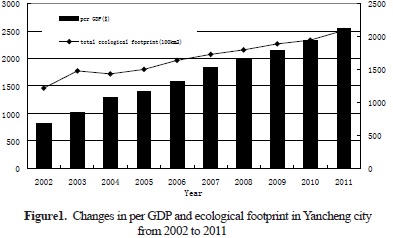
Yancheng city (32°34'∼34°28' N, 119°27'∼120°54' E), which has the largest land area (16, 972 km2) and the longest coast line in the Jiangsu Province, is located on the western side of the Yellow sea in Eastern China. The urbanization rate and gross domestic product (GDP) rate of increase for this region in 2011 was 55.9% and 12.8%, respectively. Investment in tertiary industry accounted for 37.82% of GDP, while investment in environmental protection was only 2.09%. The land ecosystems of Yancheng city have become highly stressed and dysfunctional due to this continuous, excessive utilization and exploitation of land resources. The trend for both GDP and the total ecological footprint in Yancheng city from 2002 to 2011 has steadily increased, putting still greater pressure upon the ecological environment of the region (Figure. 1). Consequently, there is considerable need for methods and indicators to accurately diagnose the state of the land ecosystem and to prompt ecological restoration, management and regulation.
Data Source
The data used in this research are from the "Statistical Yearbook of Yancheng city 2003-2012", "Statistical Yearbook of Jiangsu 2003-2012" and data supplied by the Yancheng city Prefecture Land and Resources Bureau. Some additional data were obtained from field surveys and questionnaires. All the index values are calculated based on the data collected from these sources.
Materials and Methods
Catastrophe Theory
Catastrophe theory was proposed in an attempt to rationally account for the phenomenon of discontinuous change in behaviors (outputs) resulting from continuous change in parameters (inputs) in a given system. In this section, a brief discussion of the basic assumptions and results of catastrophe theory is presented in a form useful for such applications (Woodstock and Poston 1974).
Let f: Tk×Tn
T: a smooth (infinitely differentiable) function representing a dynamical system M.
Tk: the space of input variables (controls, parameters).
Tn: the space of output variables (responses, behaviors).
The fundamental assumption is that M attempts to locally minimize f. Given any such function f, if the point c∝Tk is fixed, then a local potential function fc: Tn→T is obtained. Therefore, fc can be expressed as follows:
V=V(x,u)
Where V: the potential function, x: response variables, and u: control variables.
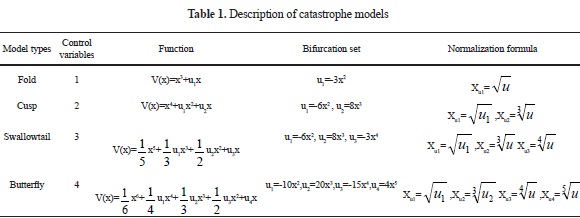
The critical points of the potential function fc form an equilibrium surface (Zeeman 1976). The equation of that surface is obtained by calculating the first derivative of fc, f′c(x)= 0, and the singularities are obtained by calculating the second derivative of fc, f′′c(x)= 0. A bifurcation set of the catastrophe system is obtained by eliminating x between f′c(x)= 0 and f′′c(x)= 0. A normalization formula is derived by decomposing the bifurcation set. The values of x and all control variables in the normalization formula range between 0 and 1. These variables are called "catastrophe progression". The catastrophe progression of each control variable can be obtained from the initial membership function using a recursive algorithm subject to the normalization formula. Supposing that the response variable is one dimensional, catastrophe models can be classified into four categories according to the dimension of control variables. Summary descriptions of these models are given in Table 1.
The PSR Model
The PSR model is based on the concept of causality: human activities exert pressures on the environment and change the quality and quantity of natural resources, which then lead to responses in human behavior. Three categories of indicators are distinguished. First, eco-environmental pressure indicators describe pressures on the environment by human activities and climate change. Second, eco-environmental state indicators describe the status quo of the natural environment and ecosystem function. Third, societal response indicators show the degree to which society responds to eco-environmental changes and concerns. This could be the number and type of measures taken, the efforts of implementing measures or the effectiveness of those measures.
Indices Selection and Standardization
Based on previous studies and the framework, as well as the principles explained above, this paper generates a set of assessment indices. Initially, a set of 55 indices was developed. Subsequently, a three-round Delphi Process (Linstone and Turoff 1975) was established, from which 28 indices were selected that favored the consensus needed to validate the analysis. Experts with skills in the appropriate fields of study evaluated the set of 28 indices for relevance to the assessment. After performing principal component analysis to reduce data dimensionality, a total of 18 indices were generated (Table 2).

Note: Development of a tertiary industry can be an effective method to alleviate deterioration of land ecosystems, so it is feasible to put C15 in the project layer of response.
As different indices have no comparability because they differ completely in dimensions, it is necessary to convert original data to a dimensionless form. The evaluating indicators can be divided into positive term targets and negative term targets. The model takes the following two forms.
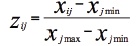
1) Standardization of positive effect indices: for some indices, the higher their value, the greater the positive effect they will bring to land ecological security, which means this type of index presents much less risk to ecological security. Their standardization method is:
2) Standardization of negative effect indices: for other indices, the higher their values, the greater the negative effect they will bring to land ecological security, which means this type of index presents much more risk to ecological security. Their standardization method is:
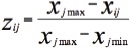
In the formula, Zij is the i standardized value of the j index included in the assessment; xij is the i th actual value; max is the biggest value of this index; and min is the minimum value of this index.
Application of Catastrophe Theory
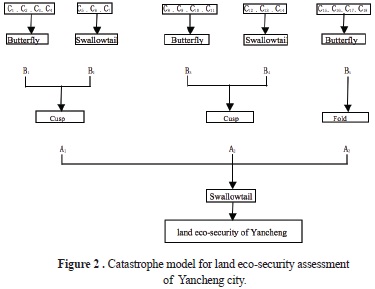
The catastrophe assessment index system can be divided into hierarchical sub-systems. If the index at a higher level (response variable) contains two lower level indices (control variable), it can be assumed as a cusp system. The relative importance of these two control variables should be determined (u1, important; u2, less important), and the control variable can then be obtained from the membership function using a recursive algorithm subject to the normalization formula. Similarly, when the index at a higher level contains one, three or four lower level indices, it can be, respectively calculated based on fold, swallowtail and butterfly membership functions. The catastrophe assessment model for Yancheng city was therefore developed using such an approach (Su et al. 2011). The catastrophe model for land eco-security assessment in Yancheng city is shown in Figure. 2.
Score Transformation
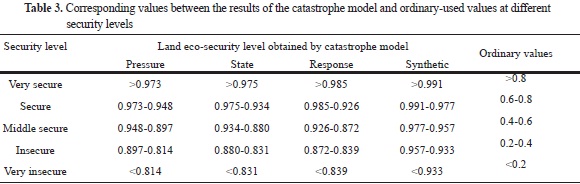
The synthetic values of catastrophe assessment are generally high, and the differences are not obvious (Poston and Ian 1978). This can be attributed to the fact that catastrophe progression is calculated based on the normalization formula (Su et al. 2003). Therefore, it is difficult to determine the actual secure level directly using the results obtained by the catastrophe assessment. Usually, the synthetic values of multi-attribute assessment are divided into five grades using an equality distribution function (Xiong et al. 2007). Accordingly, the land eco-security level can be divided into five grades: 0.2 (very insecure), 0.4 (insecure), 0.6 (middle), 0.8 (secure) and 1.0 (very secure). The problem is how to find a way to transform the results obtained by the catastrophe assessment into the ordinary-used synthetic values. The method for score transformation used in this paper is described as follows: Suppose the relative membership degree for all indices equals n, then the relative membership degree for higher level indices should also equal n. Consequently, the synthetic membership degree can be obtained by applying a suitable catastrophe model. By virtue of this method, the catastrophe progression value for each secure grade was calculated (Table 3).
Method Demonstration
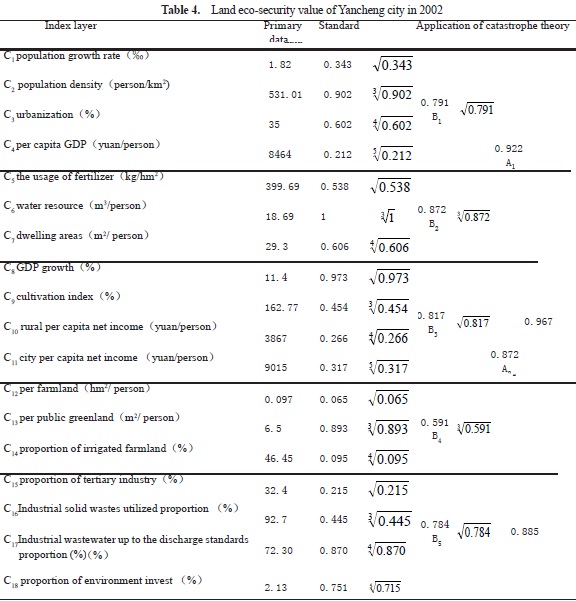
This section is provided to demonstrate this method in terms of a simple example using the 2002 data from the study area (Table 4).
Results
By using the model described above with the statistical data and other data from 2003 to 2012, the land eco-security of Yancheng city was calculated (Figure. 3).
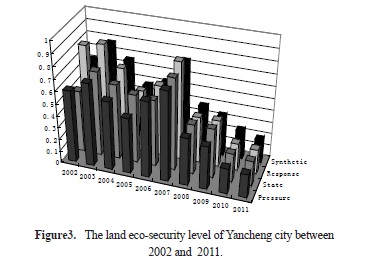
It can be seen that the land eco-security level for 'pressure' was evaluated as secure in 2003 and 2007, a middle level in 2002, 2004, 2005 and 2006, insecure in 2008 and 2009, and very insecure in 2010 and 2011. The maximum value of the land eco-security level for 'pressure' was 0.951 in 2003, and the minimum value was 0.192 in 2011. In the past decade, rapid urbanization, increasing from 35% in 2002 to 55.9% in 2011, accompanied by population growth (increasing by two hundred thousand between 2002 and 2011), has been a fundamental cause for the current land ecological problems in Yancheng city. With a high population density and increasing wealth, demands for public infrastructure (roads, water facilities, and utilities), housing, industrial and commercial growth and additional construction projects start to appear as "rural sprawl" (Mann 2009). Statistical data provide evidence that urbanization has greatly stimulated the up-scaling and expansion of the road systems in Yancheng city. The great opportunities available in the city have also attracted a significant influx of people into the city, which exerts further pressure on the land ecosystems.
In addition, overuse of chemical fertilizers, pesticides, and plastic film in croplands has led to land pollution and contributed to the degradation of land ecosystems in Yancheng city.
Similar to pressure, the land security level with regard to the 'state' index also generally decreased over the period between 2002 and 2011. The 'state' index of land eco-security was considered as very insecure in 2010 and 2011. Experience in other parts of the world suggests that intensive urbanization necessitates the transfer of significant areas of land to secondary and tertiary sectors (Chan and Shimou 1999). In many cases, farmland has to be given up for development, and large areas of high-quality farmland are lost to urban build-up (Long et al. 2009).
This is exactly the case in Yancheng city. During the studied 10 years, per capita farmland and effectively irrigated land significantly declined, posing considerable threat to regional food security. The increased concentration of factories with low treatment efficiency for waste gas, water and other wastes has also contributed to the insecure state. According to the statistics, the load of industrial wastewater increased from 28,800 ton/km2 in 2002 to 35,400 ton/km2 in 2011. The case of industrial solid wastes was even more serious, with the quantity doubling during the study period. Over the decade, there is a great difference of quality change between various land types. From 2002 to 2011, the area of farmland decreased the most in the region by 3,679.77 km2, while forest lands declined by 61.21 km2. All these phenomena indicate that the ecological service function of the land ecosystem in Yancheng city has been deteriorating rapidly. If appropriate and timely measures are not adopted, the land ecosystem will continue to degrade.
As for 'response', the security level was evaluated as secure in the initial 2 years. However, insecure and very insecure levels were identified for the following years. While it is true that Yancheng city has invested in a number of environmental protection projects and the proportion of scientific researchers has been increasing, the industrial pollution issues have not been effectively tackled. Performance evaluation by local officials is mainly associated with economic growth, and environmental protection is not listed as one of the criteria, unless serious environmental disasters are made public and raise concerns. Industry is the major sector for the local labor market and the main financial source for the local government. Most officials ignore such industrial activities, and although pollution levy systems have been introduced in the city, they are largely ineffective, as the levies are too low to give polluters an incentive to reduce emissions. Similarly, water pollution fees are small relative to the additional costs of pollution control (Sinkule and Ortolano 1995). These responses have led to the continuing decline of the land eco-security level.
Over the studied 10 years, the synthetic land eco-security was evaluated as very secure in the initial 2 years, middle and insecure from 2004 to 2009, and very insecure in the last 2 years. These results show that the land ecosystem conditions are not optimistic for Yancheng city and should be brought to the attention of policy makers and the public.
At present, serious problems, such as rapidly decreasing farmland with a significant reduction in amount of farmland per person, the high demand for construction land, prominent contradiction between land resources and population growth, land utilization increasing yearly, over-exploitation of land resources and declining ecological land, especially forest and natural reserve land, exert huge pressure on the regional environment. Land ecosystem conditions are equally pessimistic for Shanghai (Su et al.2011), Liaoning province (Han 2009) and Hubei province (Xu 2012).
Discussion and Conclusions
The catastrophe model integrated multiple assessment indices of land ecological security according to the inherent contradictions and relative importance of indices without calculating weights (Thom 1975; Vadrevu et al 2008; Weidlich and Huebner 2008; Zeeman 1976). The aim of this study on the land eco-security assessment was to develop a means of quantifying the state of land ecosystems over time. The land ecosystems of Yancheng city generally remained at or under the middle grade of eco-security across the 10 years between 2002 and 2011. During the 10 year period, the land ecosystems sustained intensified pressure, presented a worsened security state and received reduced positive responses from society. These have led to a significant decline in the synthetic land eco-security. The results presented here, showing the changes over time and the factors that have led to the present state, demonstrate a method that can be used to predict and manage land ecosystems with considerable utility. It is noted that this assessment relied mainly on the available statistical data set, and the evaluated eco-security levels, whether secure or insecure, are thus a relative concept. However, although this approach lacks absolute accuracy, the study clearly demonstrates the changes in land ecosystem conditions over time and should assist officials and citizens in resolving issues regarding regional land eco-security improvements. The land eco-security index described here should therefore be a useful tool for policy makers and land managers to develop measures that strengthen land ecosystem protection and promote ecological reconstruction. Further policy options that should be considered to mitigate the problems more thoroughly include control of population growth and in-migration; protection of wetland and forest land; application of scientific concepts of development; coordination of economic development and land utility; and strengthening the control functions of land use planning.
Acknowledgments
The study was supported by the National Natural Science Foundation of China (41071083), and the Priority Academic Program Development of Jiangsu Higher Education Institutions.
References
Chan RCK, Shimou Y.1999, Urbanization and sustainable metropolis and development in China: patterns, problems and prospects. GeoJournal 49:269-277.
García M, Oyonarte C, Villagarci'a L, Contreras S, Domingo F, Puigdefa'bregas J.2008, Monitoring land degradation risk using ASTER data: the non-evaporative fraction as an indicator of ecosystem function. Remote Sens Environ 112:3720-3736.
Han TF .2009, Assessment and early warning of land use change ecological security in Liaoning province. Doctoral Dissertation, Northeastern University.
Xu BS. 2012, Study on landscape pattern evolution of land use and ecological security assessment in Jianghan Plain. Doctoral Dissertation, Huazhong normal university.
Honson M, Marvin S.2009, Urban Ecological Security: a new urban paradigm? Int J Urban Reg Res 33:193-215.
Khademian H.1988, Catastrophe theory: an application to a business cycle model.Mathl Comput Modelling 10(4):257-262.
Linstone HA, Turoff M .1975, The Delphi method: techniques and applications.Addison-Wesley Publishing Company, Reading, MA.
Long H, Liu Y, Wu X, Dong G .2009, Spatio-temporal dynamic patterns of farmland and rural settlements in Su-Xi-Chang region: implications for building a new countryside in coastal China. Land Use Policy 26:322-333.
Mann F. 2009, Institutional causes of urban and rural sprawl in Switzerland. Land Use Policy 26:919-924.
Mark LS. 2006, Threat level green: conceding ecology for security in eastern Europe and the former Soviet Union. Global Environ Change 16:400-422.
Piyaratne MKDK, Zhao HY, Meng QX.2013, APHIDSim: A population dynamics model for wheat aphids based on swallowtail catastrophe theory. Ecological Modelling 253:9-16.
Poston T, Ian S. 1978, Catastrophe theory and application. Lord, Pitman.
Salvati L, Bajocco S. 2011, Land sensitivity to desertification across Italy: past, present, and future. Appl Geogr 31:223-231.
Shi Y, Liu Y, He J .2003, Further study on some questions of catastrophe evaluation method. Eng J Wuhan Univ 36:132-136.
Sinkule B, Ortolano L .1995,Implementing environmental policy in China. Praeger, Westport, London.
Su S, Li D, Xiang Y. 2011,Assessing land ecological security in Shanghai (China) based on catastrophe theory. Stoch Environ Res Risk Assess 25:737-746.
Thom R. 1975, Structural stability and morphogenesis. W.A. Benjamin Inc, Reading, MA.
Vadrevu KP, Cardina J, Hitzhusen F.2008,Case study of an integrated framework for quantifying agro-ecosystem health. Ecosystems 1:283-306.
Wang WJ, Liu SL, Zhang SS, Chen JW .2011, Assessment of a model of pollution disaster in near-shore coastal waters based on catastrophe theory. Ecological Modelling 222:307-312.
Weidlich W, Huebner H .2008, Dynamics of political opinion formation including catastrophe theory. J Econ Behav Organ 67:1-26.
Wessels KJ, Prince SD, Frost PE, van Zyl D. 2004, Assessing the effects of human-induced land degradation in the former homelands of northern South Africa with a 1 km AVHRR NDVI time-series. Remote Sens Environ 91:47-67.
Woodstock AER, Poston T. 1974, A geometrical study of the elementary catastrophes, Springer Lecture Notes in Math, vol. 373. Springer-Verlag, New York.
Xiong Y, Zeng G, Chen G. 2007, Combining AHP with GIS in synthetic valuation of eco-environment quality-a case study of Hunan Province, China.Ecol Model 209:97-109.
Xu Y, Hu B, Wu J, Zhang JH. 2014, Nonlinear analysis of the cooperation of strategic alliances through stochastic catastrophe theory.Physica A 400: 100-108.
Zeeman EC. 1976, Catastrophe theory. Sci Am 234:65-83.
Zhang LX, Liu X, Li DL, Fu ZT. 2013, Evaluation of the rural informatization level in four Chinese regions: A methodology based on catastrophe theory.Mathematical and Computer Modelling 58:868-876.
References
Chan RCK, Shimou Y.1999, Urbanization and sustainable metropolis and development in China: patterns, problems and prospects. GeoJournal 49:269-277.
García M, Oyonarte C, Villagarci'a L, Contreras S, Domingo F, Puigdefa'bregas J.2008, Monitoring land degradation risk using ASTER data: the non-evaporative fraction as an indicator of ecosystem function. Remote Sens Environ 112:3720-3736.
Han TF .2009, Assessment and early warning of land use change ecological security in Liaoning province. Doctoral Dissertation, Northeastern University.
Xu BS. 2012, Study on landscape pattern evolution of land use and ecological security assessment in Jianghan Plain. Doctoral Dissertation, Huazhong normal university.
Honson M, Marvin S.2009, Urban Ecological Security: a new urban paradigm? Int J Urban Reg Res 33:193-215.
Khademian H.1988, Catastrophe theory: an application to a business cycle model.Mathl Comput Modelling 10(4):257-262.
Linstone HA, Turoff M .1975, The Delphi method: techniques and applications.Addison-Wesley Publishing Company, Reading, MA.
Long H, Liu Y, Wu X, Dong G .2009, Spatio-temporal dynamic patterns of farmland and rural settlements in Su-Xi-Chang region: implications for building a new countryside in coastal China. Land Use Policy 26:322-333.
Mann F. 2009, Institutional causes of urban and rural sprawl in Switzerland. Land Use Policy 26:919-924.
Mark LS. 2006, Threat level green: conceding ecology for security in eastern Europe and the former Soviet Union. Global Environ Change 16:400-422.
Piyaratne MKDK, Zhao HY, Meng QX.2013, APHIDSim: A population dynamics model for wheat aphids based on swallowtail catastrophe theory. Ecological Modelling 253:9-16.
Poston T, Ian S. 1978, Catastrophe theory and application. Lord, Pitman.
Salvati L, Bajocco S. 2011, Land sensitivity to desertification across Italy: past, present, and future. Appl Geogr 31:223-231.
Shi Y, Liu Y, He J .2003, Further study on some questions of catastrophe evaluation method. Eng J Wuhan Univ 36:132-136.
Sinkule B, Ortolano L .1995,Implementing environmental policy in China. Praeger, Westport, London.
Su S, Li D, Xiang Y. 2011,Assessing land ecological security in Shanghai (China) based on catastrophe theory. Stoch Environ Res Risk Assess 25:737-746.
Thom R. 1975, Structural stability and morphogenesis. W.A. Benjamin Inc, Reading, MA.
Vadrevu KP, Cardina J, Hitzhusen F.2008,Case study of an integrated framework for quantifying agro-ecosystem health. Ecosystems 1:283-306.
Wang WJ, Liu SL, Zhang SS, Chen JW .2011, Assessment of a model of pollution disaster in near-shore coastal waters based on catastrophe theory. Ecological Modelling 222:307-312.
Weidlich W, Huebner H .2008, Dynamics of political opinion formation including catastrophe theory. J Econ Behav Organ 67:1-26.
Wessels KJ, Prince SD, Frost PE, van Zyl D. 2004, Assessing the effects of human-induced land degradation in the former homelands of northern South Africa with a 1 km AVHRR NDVI time-series. Remote Sens Environ 91:47-67.
Woodstock AER, Poston T. 1974, A geometrical study of the elementary catastrophes, Springer Lecture Notes in Math, vol. 373. Springer-Verlag, New York.
Xiong Y, Zeng G, Chen G. 2007, Combining AHP with GIS in synthetic valuation of eco-environment quality-a case study of Hunan Province, China.Ecol Model 209:97-109.
Xu Y, Hu B, Wu J, Zhang JH. 2014, Nonlinear analysis of the cooperation of strategic alliances through stochastic catastrophe theory.Physica A 400: 100-108.
Zeeman EC. 1976, Catastrophe theory. Sci Am 234:65-83.
Zhang LX, Liu X, Li DL, Fu ZT. 2013, Evaluation of the rural informatization level in four Chinese regions: A methodology based on catastrophe theory.Mathematical and Computer Modelling 58:868-876.
How to Cite
APA
ACM
ACS
ABNT
Chicago
Harvard
IEEE
MLA
Turabian
Vancouver
Download Citation
CrossRef Cited-by
1. Yanlong Guo, Xingmeng Ma, Yelin Zhu, Denghang Chen, Han Zhang. (2023). Assessment of Forest Ecological Security in China Based on DPSIRM Model: Taking 11 Provincial Administrative Regions along the Yangtze River Basin as Examples. ISPRS International Journal of Geo-Information, 12(7), p.272. https://doi.org/10.3390/ijgi12070272.
2. Hua Wang, Mengqi Hua, Xuefei Hong, Cunjin Wang, Jiqiang Niu, Yiwen Wang, Xiaofeng Li. (2025). Identification and driving mechanism of land use conflict in China’s South-North transition zone: A case study of Huaihe River Basin. Open Geosciences, 17(1) https://doi.org/10.1515/geo-2025-0784.
3. Liting Chen, Haisheng Cai. (2022). Study on land use conflict identification and territorial spatial zoning control in Rao River Basin, Jiangxi Province, China. Ecological Indicators, 145, p.109594. https://doi.org/10.1016/j.ecolind.2022.109594.
4. Xinrong Zhang, Yongsheng Wang, Xuefeng Yuan, Yuanyuan Yang. (2022). Regional land ecological security evaluation and ecological poverty alleviation practice: A case study of Yangxian County in Shaanxi Province, China. Journal of Geographical Sciences, 32(4), p.682. https://doi.org/10.1007/s11442-022-1967-8.
5. Mingxin Wen, Ting Zhang, Long Li, Longqian Chen, Sai Hu, Jia Wang, Weiqiang Liu, Yu Zhang, Lina Yuan. (2021). Assessment of Land Ecological Security and Analysis of Influencing Factors in Chaohu Lake Basin, China from 1998–2018. Sustainability, 13(1), p.358. https://doi.org/10.3390/su13010358.
6. Chien-Chiang Lee, Zhi-Wen He, Hai-Ping Luo. (2024). Spatio-temporal characteristics of land ecological security and analysis of influencing factors in cities of major grain-producing regions of China. Environmental Impact Assessment Review, 104, p.107344. https://doi.org/10.1016/j.eiar.2023.107344.
7. Li Wu, Binggeng Xie, Bing Xue. (2019). The variation differences of cultivated land ecological security between flatland and mountainous areas based on LUCC. PLOS ONE, 14(8), p.e0220747. https://doi.org/10.1371/journal.pone.0220747.
8. Xinmin Zhang, Xintong Dong, Fei Liu, Tiangui Lv, Zhilong Wu, Manjula Ranagalage. (2023). Spatiotemporal dynamics of ecological security in a typical conservation region of southern China based on catastrophe theory and GIS. Environmental Monitoring and Assessment, 195(1) https://doi.org/10.1007/s10661-022-10669-6.
9. Raditya Machdi Rachman, Arif Satria, Gendut Suprayitno. (2016). PERANCANGAN STRATEGI PENGUATAN IMPLEMENTASI KEBIJAKAN REHABILITASI HUTAN DAN LAHAN STUDI KASUS DI DESA BANGUNJAYA, KECAMATAN CIGUDEG, KABUPATEN BOGOR, JAWA BARAT. Jurnal Aplikasi Bisnis dan Manajemen, 2(2), p.196. https://doi.org/10.17358/JABM.2.2.196.
10. Chaoxian Liu, Xueling Wu, Lei Wang. (2019). Analysis on land ecological security change and affect factors using RS and GWR in the Danjiangkou Reservoir area, China. Applied Geography, 105, p.1. https://doi.org/10.1016/j.apgeog.2019.02.009.
11. Sheng Gao, Huihui Sun, Guangxi Cao, Lin Zhao, Runjie Wang, Min Xu. (2018). Dynamic assessment of island ecological security under urbanization: a case study of Pingtan Island in the Southeast Coast of China. Environmental Earth Sciences, 77(14) https://doi.org/10.1007/s12665-018-7706-x.
12. Dongyan Guo, Dongyan Wang, Xiaoyong Zhong, Fan Yang, Yuanyuan Yang, Hansen Jia. (2023). The Coupling Coordination and Interaction Mechanism of Land Ecological Security and High-Quality Economic Development in the Beijing–Tianjin–Hebei Region. Sustainability, 15(21), p.15670. https://doi.org/10.3390/su152115670.
13. Qian Zuo, Yong Zhou, Li Wang, Qing Li, Jingyi Liu. (2022). Impacts of future land use changes on land use conflicts based on multiple scenarios in the central mountain region, China. Ecological Indicators, 137, p.108743. https://doi.org/10.1016/j.ecolind.2022.108743.
Dimensions
PlumX
Article abstract page views
Downloads
License
Copyright (c) 2015 Earth Sciences Research Journal

This work is licensed under a Creative Commons Attribution 4.0 International License.
Earth Sciences Research Journal holds a Creative Commons Attribution license.
You are free to:
Share — copy and redistribute the material in any medium or format
Adapt — remix, transform, and build upon the material for any purpose, even commercially.
The licensor cannot revoke these freedoms as long as you follow the license terms.
The Earth Sciences Research Journal is the copyright holder for these license attributes.