Publicado
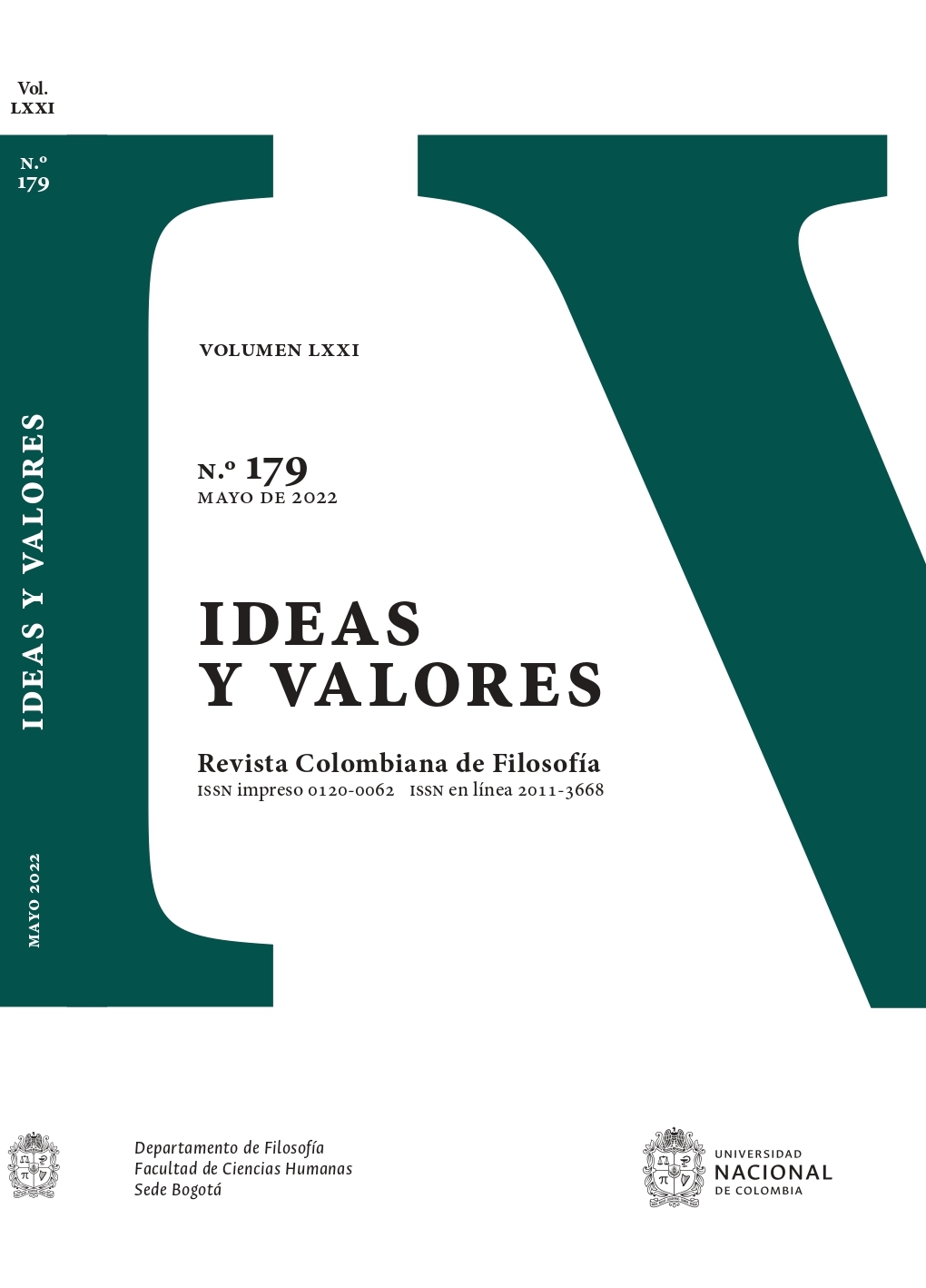
Sobre la noción de interpretación en el “ver-como” de Ludwig Wittgenstein
About the Notion of Interpretation in Ludwig Wittgenstein's “Seeing-as”
DOI:
https://doi.org/10.15446/ideasyvalores.v71n179.102685Palabras clave:
Wittgenstein, interpretación, percepción de aspectos, ver-como (es)Wittgenstein, interpretation, aspect perception, seeing-as (en)
Los casos de “ver-como”, presentados por Wittgenstein en la Segunda Parte de Philosophical Investigations, muestran que el concepto de “ver” se encuentra cercano al de “interpretar” y resiste su separación. El presente artículo propone un argumento para aclarar la noción de “interpretación” presente en estos casos, a partir de su comparación con los usos presentes en el Tractatus y en la Primera Parte de Philosophical Investigations. Se sostiene que dicha noción cumple el rol de determinar el sentido de lo visualmente experimentado. Además, “ver” e “interpretar” mantienen un tipo de relación interna y “ver-como” puede considerarse como una “representación elástica”.
The “seeing-as” cases, presented by Wittgenstein in the Second Part of Philosophical Investigations, show that the concept of ‘seeing’ is close to that of ‘interpretation’ and resists its separation. This article proposes an argument to clarify the notion of ‘interpretation’ present in these cases, from its comparison with the uses present in the Tractatus and in the First Part of Philosophical Investigations. It is argued that this notion fulfills the role of determining the sense of the visually experienced. In addition, ‘to see’ and ‘to interpret’ maintain a type of internal relationship and ‘seeing-as’ can be considered an “elastic representation”.
Referencias
Anscombe, Elizabeth. The Collected Philosophical Papers of G. E. M. Anscombe. Minneapolis: University of Minnesota Press, 1981.
Corbí, Josep. “Evidence and First-Person Authority.” Teorema xxx. 3 (2011): 51-66.
Dolby, David. “Wittgenstein on Truth.” A Companion to Wittgenstein. Edited by Glock, H-J. and Hyman, Blackwell,J. Oxford: Oxford University Press, 2017. 433-442.
Glock, Hans-Johann. A Wittgenstein Dictionary. Oxford: Wiley-Blackwell, 1996.
Hacker, Peter. “Naming, Thinking and Meaning in the Tractatus.” Philosophical Investigations 22. 2 (1999): 119-135.
Finkelstein, David. Expression and the Inner. Cambridge: Harvard u.p., 2003.
Frascolla, Pasquale. Understanding Wittgenstein’s Tractatus. London: Routledge, 2006.
Frege, Gottlob. The Foundations of Arithmetic. Evanston ii: Northwestern u.p.,1953.
Hanfling, Oswald. Wittgenstein and the Human Form of Life. London: Routledge, 2002.
Malcolm, Norman. Memory and Mind. Ithaca: Cornell University Press, 1977.
McGinn, Marie. Wittgenstein and the Philosophical Investigations. London: Routledge, 1997.
Richter, Duncan. Historical Dictionary of Wittgenstein’s Philosophy. Lanham: Rowman & Littlefield, 2014.
Tejedor, Chon. Starting with Wittgenstein. London: Continuum, 2011.
Williams, Meredith. Wittgenstein, Mind and Meaning. London: Routledge, 2002.
Winch, Peter. “Language, Thought and World in Wittgenstein’s Tractatus.” Trying to Make Sense. Blackwell: Oxford University Press, 1987. 3-18.
Wittgenstein, Ludwing. Tractatus Logico-Philosophicus. Translated by David Pears and Brian McGuinness. London: Routledge, 1961.
Wittgenstein, Ludwing. Last Writings in the Philosophy of Psychology 1. Translated by Georg Henrik von Wright and Heikki Nyman. Blackwell: Oxford University Press, 1982.
Wittgenstein, Ludwing. Philosophical Investigations. Translated by Elizabeth Anscombe. Blackwell: Oxford University Press, 2001.
Dimensions
PlumX
Visitas a la página del resumen del artículo
Descargas
Cómo citar
Licencia
Derechos de autor 2022 Los derechos son del autor(es), quien(es) puede re-publicar en parte o en su totalidad el documento ya publicado en la revista siempre y cuando se dé el debido reconocimiento a Ideas y Valores

Esta obra está bajo una licencia internacional Creative Commons Atribución-NoComercial-SinDerivadas 4.0.
De acuerdo con la Licencia Creative Commons Atribución-No Comercial-SinDerivar 4.0 Internacional. Se autoriza copiar, redistribuir el material en cualquier medio o formato, siempre y cuando se conceda el crédito a los autores de los textos y a Ideas y Valores como fuente de publicación original. No se permite el uso comercial de copia o distribución de contenidos, así como tampoco la adaptación, derivación o transformación alguna de estos sin la autorización previa de los autores y de la dirección de Ideas y Valores. Para mayor información sobre los términos de esta licencia puede consultar: http://creativecommons.org/licenses/by-nc-nd/4.0/legalcode.







.jpg)