Publicado
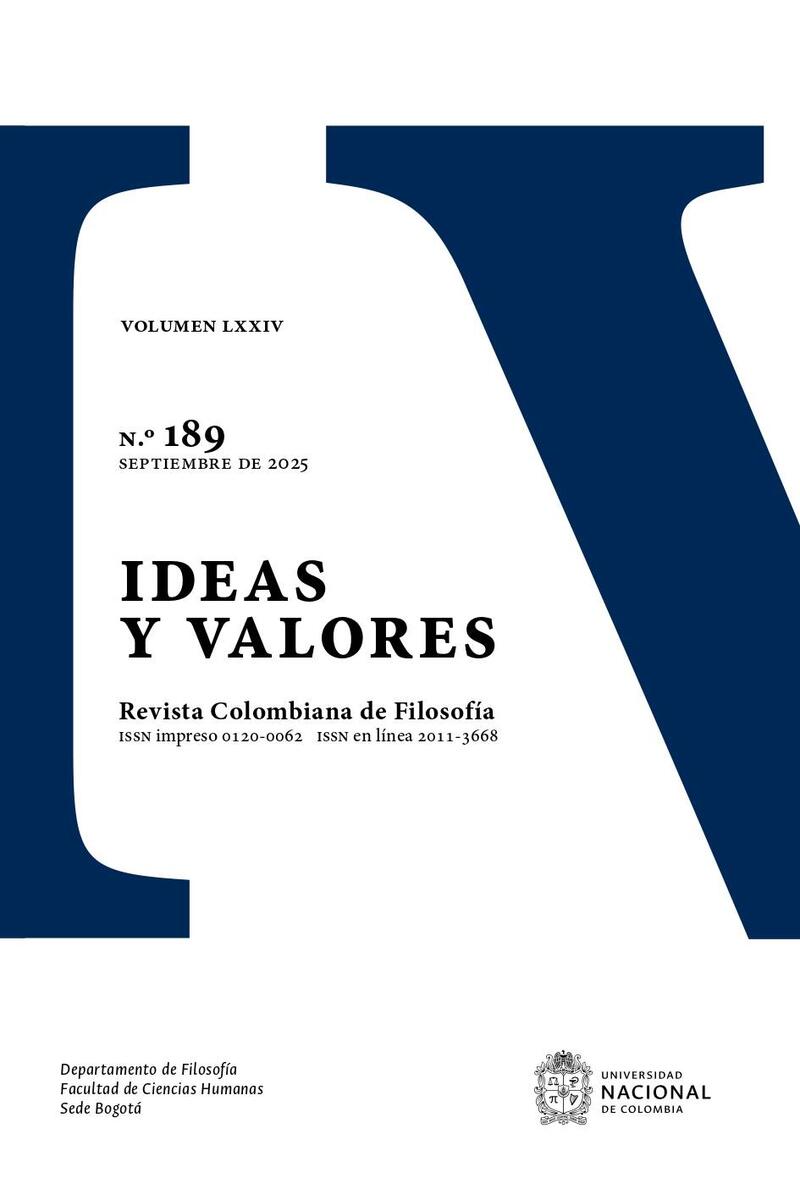
Ontología oscura. objetos, hiperobjetos y pensamiento ecologista en Timothy Morton
Dark Ontology. Objects, Hyperobjects, and Ecological Thought in Timothy Morton
DOI:
https://doi.org/10.15446/ideasyvalores.v74n189.107380Palabras clave:
T. Morton, hiperobjeto, pensamiento ecológico, solidaridad ontológica (es)T. Morton, hyperobject, ecological thought, ontological solidarity (en)
Descargas
En el presente artículo se analiza la ontología de Timothy Morton, la cual se inscribe en el marco teórico propio de la Ontología Orientada a Objetos, fundada por Graham Harman, de quien le separan algunas diferencias, entre ellas la propia noción de objeto que los citados autores manejan. Una vez aclarada la categoría de objeto en Morton, que posee un componente relacional, se estudian los hiperobjetos, término usado para delimitar ciertas entidades no tenidas en cuenta por la ontología tradicional y que ayudan tanto a revisarla como a elaborar un pensamiento ecologista de potentes repercusiones en la esfera práctica.
This article analyses Timothy Morton’s ontology, which is inscribed in the theoretical framework of the Object-Oriented Ontology, founded by Graham Harman, from whom it is separated by some differences, among them the very notion of object that the aforementioned authors handle. Once Morton's category of object, which has a relational component, has been clarified, we study hyperobjects, a term used to delimit certain entities not taken into account by traditional ontology and which help both to revise it and to elaborate an ecological thought with powerful repercussions in the practical sphere.
Referencias
Barad, Karen. Meeting the Universe Halfway. Duke University Press, 2007.
Bazzul, Jesee. “Hyperobjects, Media, and Assemblages of CollectiveLiving: Playing With Ontology as Environmental Education.” Australian Journal of Environmental Education 35.3 (2019): 213-221. https://doi.org/10.1017/aee.2019.20.
Bennett, Jane. “Systems and things: A response to Graham Harman and Timothy Morton.” New Literary History 43.2 (2012): 225-233. https://doi.org/10.1353/nlh.2012.0020.
Bjering, Jens y Mikkel Krause Frantzen. “Ecology, Capitalism and Waste: From Hyperobject to Hyperabject.” Theory, Culture & Society 37.6 (2020): 87-109. https://doi.org/10.1177/0263276420925541.
Butina, Anastasiya, Olga Kuzub y T. Medvedeva. “From ‘Deep’ to ‘Dark’: The Revision of the Anthropological Foundations of an Environmental Entity”. IOP Conference Series: Earth and Environmental Science 670 (2021). https://doi.org/10.1088/1755-1315/670/1/012033.
Bryant, Levi. The democracy of objects. Open Humanities Press, 2011.
Clark, Samantha. “Strange strangers and uncanny hammers: Morton’s The Ecological Thought and the phenomenological tradition.” Green Letters 17.2 (2013): 98-108. https://doi.org/10.1080/14688417.2013.800339.
Davis, Jack. “Two against Nature? Brecht, Morton and Contradiction.” Colloquia Germanica 53.2/3 (2021): 215-232.
DeLanda, Manuel. Intensive Science and Virtual Philosophy. Continuum, 2002.
Derrida, Jacques. Echographies de la télévision, entretiens filmés av. B. Stiegler. Galilée-INA, 1996.
Galloway, Alexander R. “The poverty of philosophy: Realism and post-Fordism.” Critical Inquiry (39.2) 20131: 347-366.
Garavaglia, Tommaso. “Abitare la fine del mondo. Pratiche di esistenza in D. Haraway e T. Morton”. Philosophy Kitchen. Rivista di filosofia contemporanea 15 (2021): 161-173.
Haraway, Donna. Seguir con el problema: generar parentesco en el Chthuluceno. Consonni, 2019.
Harman, Graham. Tool-Being. Heidegger and the Metaphysics of Objects. Open court, 2002.
Harman, Graham. Prince of networks: Bruno Latour and Metaphysics. Re.press, 2009.
Harman, Graham. Además, opino que el materialismo debe ser destruido. COCOM, 2013.
Harman, Graham. El objeto cuádruple. Una metafísica de las cosas después de Heidegger. Anthropos, 2016a.
Harman, Graham. Immaterialism. Objects and Social Theory. Polity press, 2016b.
Harman, Graham. Object-Oriented Ontology. A New Theory of Everything. Penguin Random House, 2018.
Latouche, Serge. La apuesta por el decrecimiento: ¿cómo salir del imaginario dominante? Icaria, 2009.
Latour, Bruno. Reensamblar lo social. Una introducción a la teoría del actor-red. Manantial, 2008.
Löwy, Michael. Ecosocialismo. Biblioteca Nueva, 2012.
Meillassoux, Quentin. Después de la finitud. Ensayo sobre la necesidad de la contingencia. Caja Negra, 2015.
Missiroli, Paolo. “The Image of the World in the Anthropocene.” CPCL European Journal of Creative Practices in Cities and Lanscapes 5.1 (2022) 1-13. https://doi.org/10.6092/issn.2612-0496/14658.
Mol, Annemarie. The Body Multiple. Duke University Press, 2002.
Morton, Timothy. Ecology without nature. Harvard University Press, 2009.
Morton. Timothy. Humankind. Solidarity with Nonhuman People. Verso, 2017.
Morton, Timothy. El pensamiento ecológico. Paidós, 2018.
Morton, Timothy. Ecología Oscura. Sobre la coexistencia futura. Paidós, 2019.
Morton, Timothy. Magia realista. Objetos, ontología y causalidad. Open Humanities Press, 2020.
Morton, Timothy. Hiperobjetos. Filosofía y ecología después del fin del mundo. Adriana Hidalgo Editora, 2021a.
Morton, Timothy. Reciclar la ecología. Pensar el mundo tras el fin de la naturaleza. Penguin Random House, 2021b.
Morton, Timothy y Dominic Boyer. Hyposubjects: on becoming human. Open Humanities Press, 2021.
Narkunas, J. Paul. Reified Life: Speculative Capital and the Ahuman Condition. Fordham University Press, 2018.
Polyck-O’Neill, Julia. “The Hyperobject and the White Cube: The ‘Strange Stranger’ in Douglas Coupland’s Canada House.” Open Cultural Studies 2 (2018) 406-416. https://doi.org/10.1515/culture-2018-0037.
Shiva, Vandana y María Mies. Ecofeminismo. Icaria, 2015.
Zwier, Jochem y Bas de Boer. “Earth Becomes World? Scientific Objects, Nonmodern Worlds, and the Metaphysics of the Anthropocene.” Environmental Humanities 15.1 (2023) 64-86. https://doi.org/10.1215/22011919-10216162.
Dimensions
PlumX
Visitas a la página del resumen del artículo
Descargas
Cómo citar
Licencia
Derechos de autor 2025 Los derechos son del autor(es), quien(es) puede re-publicar en parte o en su totalidad el documento ya publicado en la revista siempre y cuando se dé el debido reconocimiento a Ideas y Valores

Esta obra está bajo una licencia internacional Creative Commons Atribución-NoComercial-SinDerivadas 4.0.
De acuerdo con la Licencia Creative Commons Atribución-No Comercial-SinDerivar 4.0 Internacional. Se autoriza copiar, redistribuir el material en cualquier medio o formato, siempre y cuando se conceda el crédito a los autores de los textos y a Ideas y Valores como fuente de publicación original. No se permite el uso comercial de copia o distribución de contenidos, así como tampoco la adaptación, derivación o transformación alguna de estos sin la autorización previa de los autores y de la dirección de Ideas y Valores. Para mayor información sobre los términos de esta licencia puede consultar: http://creativecommons.org/licenses/by-nc-nd/4.0/legalcode.







.jpg)