Publicado
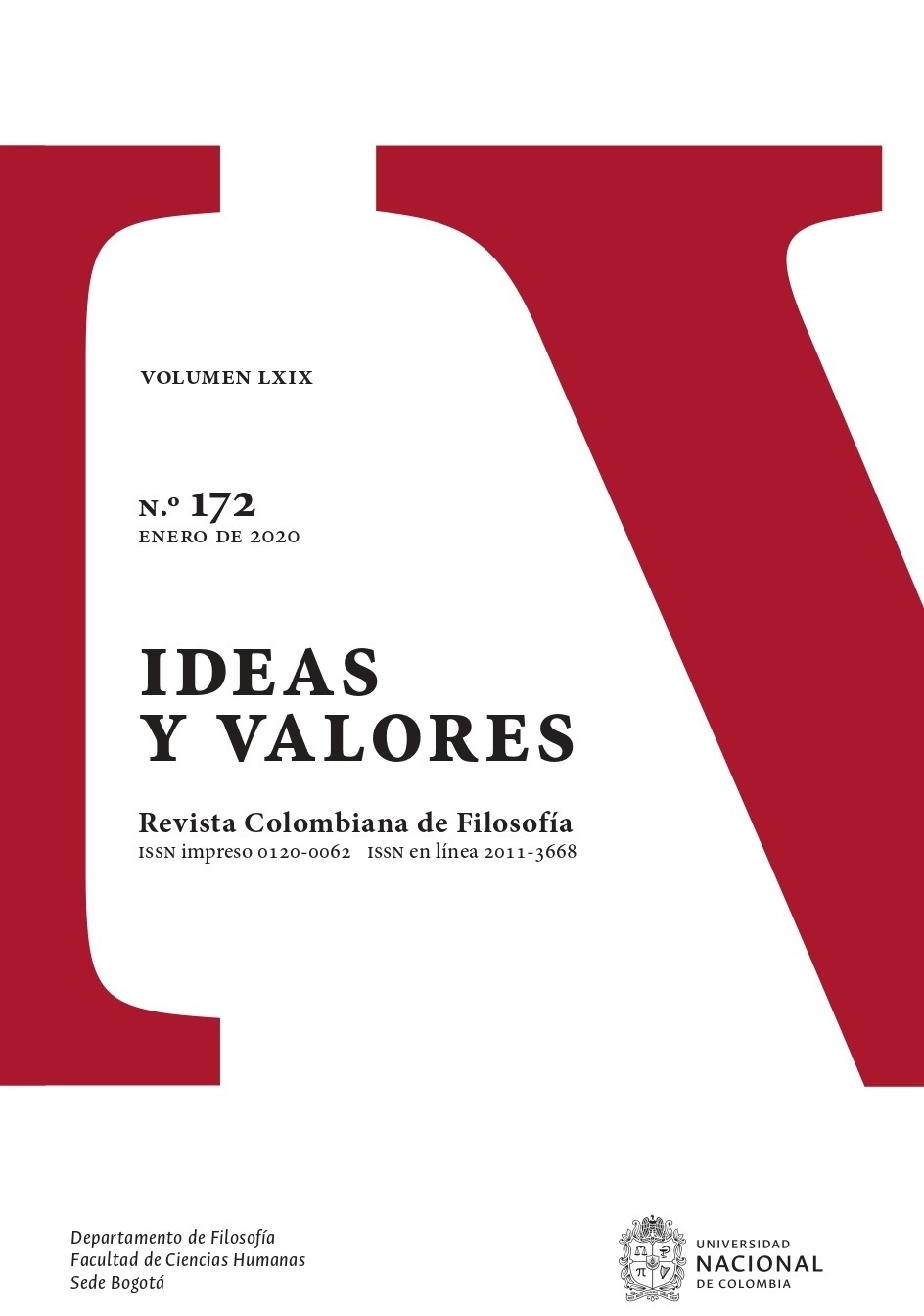
¿Se puede ser realista en torno a las leyes de la termodinámica?
Can One Be a Realist with respect to the Laws of Thermodynamics?
DOI:
https://doi.org/10.15446/ideasyvalores.v69n172.65269Palabras clave:
antirrealismo, filosofía de la ciencia, leyes naturales, realismo, termodinámica (es)antirealism, philosophy of science, natural laws, realism, thermodynamics (en)
En el estudio de las teorías filosóficas sobre las leyes naturales, se ha prestado poca atención a las leyes de la termodinámica. El artículo busca aplicar los marcos conceptuales de tres teorías relevantes, la universalista, la disposicionalista y la contrafactualista, para reformular dichas leyes, y mostrar cómo los marcos conceptuales de las dos primeras no resultan adecuados para tal reformulación, pero sí lo es el de la tercera. Si esta teoría se considera realista, se puede ser realista en este caso.
Little attention has been paid to the laws of thermodynamics in the study of philosophical theories regarding natural laws. The article seeks to apply the conceptual frameworks of three relevant theories, universalism, dispositionalism, and counterfactualism, to reformulate those laws and show that the conceptual frameworks of the first two turn out to be inadequate for that reformulation, while the third one is adequate. If this theory is considered realist, then one can be a realist in this case.
Referencias
Armstrong, D. What is a Law of Nature. Cambridge: Cambridge University Press, 1983.
Atkins, P. The Laws of Thermodynamics: A Very Short Introduction. Clarendon: Oxford University Press, 2010.
Bird, A. “The Dispositionalist Conception of Laws.” Foundations of Science 10.4 (2005a): 353-370.
Bird, A. “Laws and Essences.” Ratio 18.4 (2005b): 437-461.
Bird, A. Laws and Properties. Clarendon: Oxford University Press, 2007.
Callen, H. B. Thermodynamics and an Introduction to Thermostatistic. Toronto: John Wiley & Sons, 1985.
Dretske, F. “Laws of Nature.” Philosophy of Science 44.2 (1977): 248-268.
Hume, D. “Of the Idea of Necessary Connexion.” An Inquiry Concerning Human Understanding. Ed. Lewis A. Selby-Bigge. Oxford: Oxford University, 1902.
Kondepudi, D. Introduction to Modern Thermodynamics. New York: Wiley, 2008.
Kestin, J. A Course in Statistical Thermodynamics. New York: Academic Press, 1971.
Ellis, B., and Lierse, C. “Dispositional Essentialism.” Australasian Journal of Philosophy 72.1 (1994): 27-45.
Lange, M. “The Relation of Laws to Counterfactuals.” Natural Laws in Scientific Practice. New York: Oxford University Press, 2000. 42-94.
Lange, M. “A Note on Scientific Essentialism, Laws of Nature, and Counterfactual Conditionals.” Australasian Journal of Philosophy 82.2 (2004): 227-241.
Lange, M. “Laws and their Stability.” Synthese 144.3 (2005): 415-432.
Lange, M. “Laws and Meta-Laws of Nature, Conservation Laws and Simmetries.” Studies in History and Philosophy of Modern Physics 38.3 (2006): 457-481.
Lange, M. Laws and Lawmakers. New York: Oxford University Press, 2009.
Lewis, D. “Finkish Dispositions.” Philosophical Quarterly 47.187 (1997): 143-158.
Tooley, M. “The Nature of Laws.” Canadian Journal of Philosophy 7.4 (1977): 667-698.
Shoemaker, S. “Causality and Properties.” Time and Cause. Ed. Peter van Inwagen. Dordrecht: Reidel, 1980. 109-135.
Dimensions
PlumX
Visitas a la página del resumen del artículo
Descargas
Cómo citar
Licencia
Derechos de autor 2020 Los derechos son del autor(es), quien(es) puede re-publicar en parte o en su totalidad el documento ya publicado en la revista siempre y cuando se dé el debido reconocimiento a Ideas y Valores

Esta obra está bajo una licencia internacional Creative Commons Atribución-NoComercial-SinDerivadas 4.0.
De acuerdo con la Licencia Creative Commons Atribución-No Comercial-SinDerivar 4.0 Internacional. Se autoriza copiar, redistribuir el material en cualquier medio o formato, siempre y cuando se conceda el crédito a los autores de los textos y a Ideas y Valores como fuente de publicación original. No se permite el uso comercial de copia o distribución de contenidos, así como tampoco la adaptación, derivación o transformación alguna de estos sin la autorización previa de los autores y de la dirección de Ideas y Valores. Para mayor información sobre los términos de esta licencia puede consultar: http://creativecommons.org/licenses/by-nc-nd/4.0/legalcode.






.jpg)