Correo Electrónico
 DNINFOA - SIA
 Bibliotecas
 Convocatorias
 Identidad U.N.


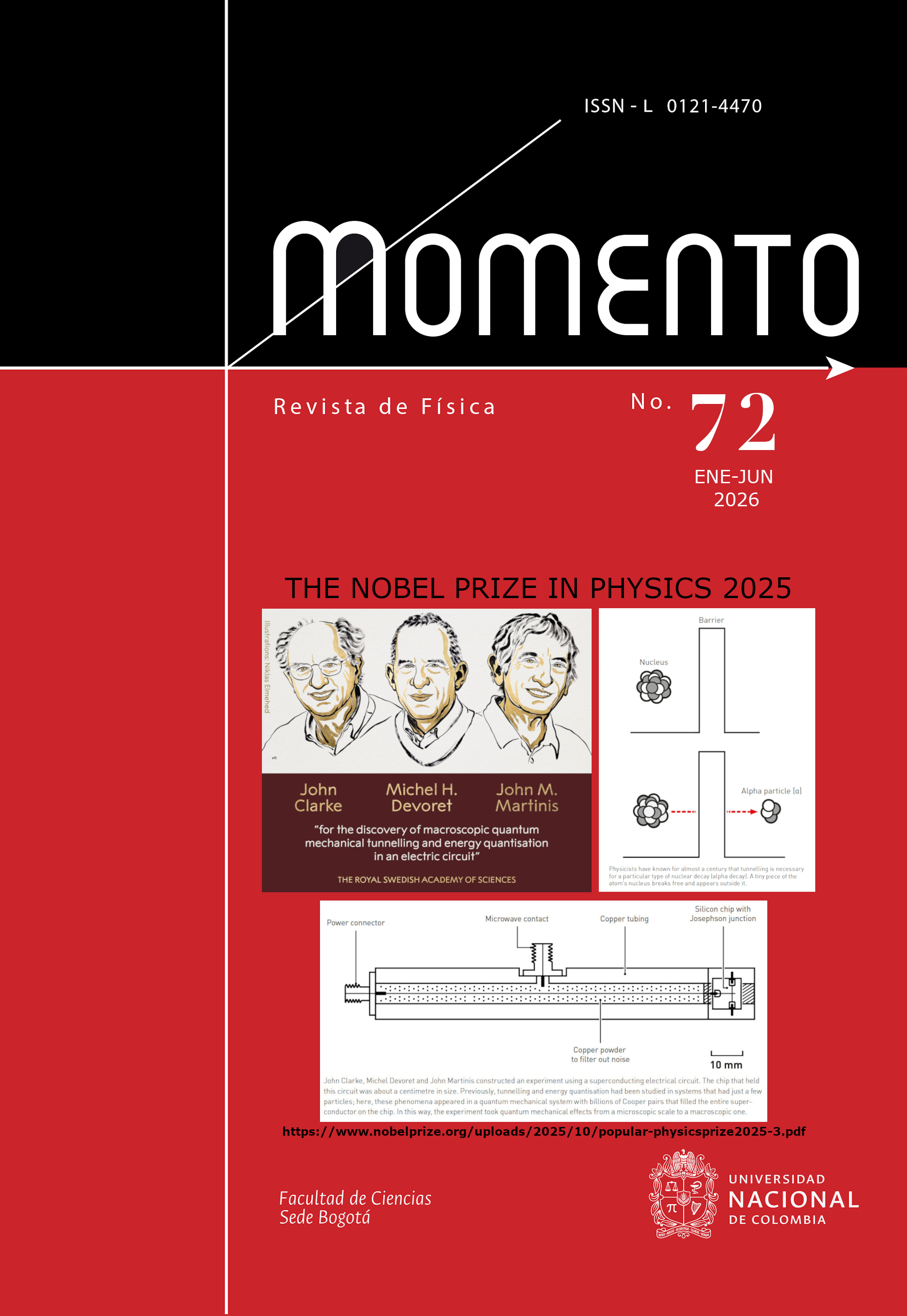
Published
THE GROUND STATE AND LOW-LYING EXCITED STATES OF THE HELIUM ATOM IN DENSE PLASMA
ESTADO FUNDAMENTAL Y ESTADOS EXCITADOS DE BAJA ENERGÍA DEL ÁTOMO DE HELIO EN PLASMA DENSO
DOI:
https://doi.org/10.15446/mo.n72.119304Keywords:
helium atom, dense plasma, exponential cosine screened Coulomb potential (en)átomo de helio, plasma denso, potencial de Coulomb apantallado exponencial-coseno, método de Monte Carlo variacional (es)
Downloads
In this paper, the energy eigenvalues of the helium atom and the helium-like ions up to Z=5 in dense plasma are investigated with screened interaction potentials using Debye-Hückel model and exponential cosine screened Coulomb potential using variational Monte Carlo method. The calculations which are carried out in this paper are based on using trial wave functions with different asymptotic behaviors, classified as polynomial correlation, exponential decreasing, and exponential increasing functions. Furthermore, the low-lying excited states of the helium atom were investigated under the same model potentials using trial wave functions for the lowest four excited states, corresponding to the configurations 1s2s and 1s2p. Interesting results are obtained in comparison with results obtained by using other trial wave functions.
En este trabajo se investigan los valores propios de energía del átomo de helio y de los iones helioides hasta Z = 5 inmersos en plasma denso, considerando potenciales de interacción apantallados descritos por el modelo de Debye–Hückel y por el potencial de Coulomb apantallado exponencial-coseno. Los cálculos se realizan mediante el método de Monte Carlo variacional empleando funciones de onda de prueba con distintos comportamientos asintóticos, clasificadas como de correlación polinómica, exponencial decreciente y exponencial creciente. Además, se estudian los estados excitados de baja energía del átomo de helio bajo los mismos potenciales modelo, utilizando funciones de onda de prueba para los cuatro estados excitados más bajos correspondientes a las configuraciones 1s2s y 1s2p. Se obtienen resultados interesantes en comparación con los obtenidos mediante otras funciones de prueba.
References
A. N. Sil, G. Barik, and et al., Few-Body Syst. 66, 8 (2025). https://link.springer.com/article/10.1007/s00601-024-01979-1
S. Mondal, A. N. Sil, and et al., Contrib. Plasma Phys. 64, e202400041 (2024). https://onlinelibrary.wiley.com/doi/10.1002/ctpp.202400041
X.Wang, Z. Jiang, and et al., At. Data Nucl. Data Tables 143, 101466 (2022). https://www.sciencedirect.com/science/article/abs/pii/S0092640X21000462?via%3Dihub
S. Kar and Y. K. Ho, Int. J. Quantum Chem. 106, 814 (2005). http://onlinelibrary.wiley.com/doi/10.1002/qua.20822
A. Ghoshal and Y. K. Ho, J. Phys. B: At. Mol. Opt. Phys. 42, 075002 (2009). https://iopscience.iop.org/article/10.1088/0953-4075/42/7/075002
S. Chowdhury, N. Mukherjee, and et al., Quantum Rep. 5, 459 (2023). https://www.mdpi.com/2624-960X/5/2/30
R. Piron, Atoms 12, 26 (2024). https://www.mdpi.com/2218-2004/12/4/26
N. Das, A. Ghoshal, and et al., Contrib. Plasma Phys. 64 (2024). https://onlinelibrary.wiley.com/doi/10.1002/ctpp.202300112
S. B. Doma, G. Roston, and et al., Phys. Scr. 100, 045406 (2025). https://iopscience.iop.org/article/10.1088/1402-4896/adbd8c
S. Doma, G. Roston, and et al., Few-Body Syst. 66 (2025). https://link.springer.com/article/10.1007/s00601-025-01981-1
S. Doma, G. Roston, and et al., J. Phys. Soc. Jpn. 93, 034301 (2024). https://journals.jps.jp/doi/10.7566/JPSJ.93.034301
H. Margenau and M. Lewis, Rev. Mod. Phys. 31, 569 (1959). https://journals.aps.org/rmp/abstract/10.1103/RevModPhys.31.569
P. K. Shukla and B. Eliasson, Phys. Lett. A 372, 2897 (2008). https://www.sciencedirect.com/science/article/abs/pii/S0375960108000340?via%3Dihub
A. K. Behera, Eur. Phys. J. Plus 139, 804 (2024). https://link.springer.com/article/10.1140/epjp/s13360-024-05593-2
N. Masanta, A. Ghoshal, and Y. K. Ho, Few-Body Syst. 65, 64 (2024). https://link.springer.com/article/10.1007/s00601-024-01935-z
S. B. Doma, M. A. Salem, and et al., Int. J. Quantum Chem. 124, e27255 (2024). https://onlinelibrary.wiley.com/doi/10.1002/qua.27255
A. Ghoshal and Y. K. Ho, Phys. Rev. A 79, 062514 (2009). https://journals.aps.org/pra/abstract/10.1103/PhysRevA.79.062514
C. Martínez-Flores and A. Jahanshir, Chem. Phys. 584, 112345 (2024). https://www.sciencedirect.com/science/article/abs/pii/S0301010424001745?via%3Dihub
L. U. Ancarani and K. V. Rodriguez, Phys. Rev. A 89, 012507 (2014). https://journals.aps.org/pra/abstract/10.1103/PhysRevA.89.012507
Y.-C. Lin, C.-Y. Lin, and Y. K. Ho, Int. J. Quantum Chem. 115, 830 (2015). https://onlinelibrary.wiley.com/doi/10.1002/qua.24911
A. K. Roy, Int. J. Quantum Chem. 116, 953 (2016). https://onlinelibrary.wiley.com/doi/10.1002/qua.25108
A. Ghoshal and Y. K. Ho, Mod. Phys. Lett. B 25, 1619 (2011). https://www.worldscientific.com/doi/abs/10.1142/S0217984911026462
V. V. Nasyrov, JETP 125, 369 (2017). https://link.springer.com/article/10.1134/S1063776117080088
D. Bressanini and G. Morosi, J. Phys. B: At. Mol. Opt. Phys. 41, 145001 (2008). https://iopscience.iop.org/article/10.1088/0953-4075/41/14/145001
K. V. Rodriguez, G. Gasaneo, and D. M. Mitnik, J. Phys. B: At. Mol. Opt. Phys. 40, 3923 (2007). https://iopscience.iop.org/article/10.1088/0953-4075/40/19/011
N. Metropolis, A. W. Rosenbluth, and et. al., J. Chem. Phys. 21, 1087 (1953). https://pubs.aip.org/aip/jcp/article-abstract/21/6/1087/202680/Equation-of-State-Calculations-by-Fast-Computing?redirectedFrom=fulltext
S. Ichimaru, H. Iyetomi, and S. Tanaka, Phys. Rep. 149, 91 (1987). https://www.sciencedirect.com/science/article/abs/pii/0370157387901256?via%3Dihub
S. B. Doma, H. S. El-Gendy, and et al., Indian J. Phys. 95, 2847 (2020). https://link.springer.com/article/10.1007/s12648-020-01920-2
S. Pottorf, A. Pudzerd, and et al., Eur. J. Phys. 20, 205 (1999). https://iopscience.iop.org/article/10.1088/0143-0807/20/3/311
M. B. Ruiz, Int. J. Quantum Chem. 101, 246 (2004). https://onlinelibrary.wiley.com/doi/10.1002/qua.20197
I. Hornyak and A. T. Kruppa, Phys. Rev. A 96, 052506 (2017). https://onlinelibrary.wiley.com/doi/10.1002/qua.20197
A. Saha, B. Talukdar, and et al., Physica A 474, 370 (2017). https://www.sciencedirect.com/science/article/abs/pii/S0378437117301152?via%3Dihub
C. L. Sech, J. Phys. B: At. Mol. Opt. Phys. 30, L47 (1997). https://iopscience.iop.org/article/10.1088/0953-4075/30/2/003
L. I. Schiff, Quantum Mechanics (McGraw Hill, New Delhi, India, 2010). https://books.google.com.co/books/about/Quantum_mechanics.html?id=XujUaYBU5oEC&redir_esc=y
C. Filippi and C. J. Umrigar, J. Chem. Phys. 105, 213 (1996). https://pubs.aip.org/aip/jcp/article-abstract/105/1/213/180186/Multiconfiguration-wave-functions-for-quantum?redirectedFrom=fulltext
S. Kar and Y. K. Ho, New J. Phys. 7, 141 (2005). https://iopscience.iop.org/article/10.1088/1367-2630/7/1/141
W. K. Hastings, Biometrika 57, 97 (1970). https://academic.oup.com/biomet/article-abstract/57/1/97/284580?redirectedFrom=fulltext
C. L. Pekeris, Phys. Rev. 112, 1649 (1958). https://journals.aps.org/pr/abstract/10.1103/PhysRev.112.1649
S. T. Dai, A. Solovyova, and et al., Phys. Rev. E 64, 016408 (2001). https://journals.aps.org/pre/abstract/10.1103/PhysRevE.64.016408
How to Cite
APA
ACM
ACS
ABNT
Chicago
Harvard
IEEE
MLA
Turabian
Vancouver
Download Citation
License

This work is licensed under a Creative Commons Attribution-NoDerivatives 4.0 International License.
Those authors who have publications with this journal, accept the following terms:
a. The authors will retain their copyright and will guarantee the publication of the first publication of their work, which will be subject to the Attribution-SinDerivar 4.0 International Creative Commons Attribution License that permits redistribution, commercial or non-commercial, As long as the Work circulates intact and unchanged, where it indicates its author and its first publication in this magazine.
b. Authors are encouraged to disseminate their work through the Internet (eg in institutional telematic files or on their website) before and during the sending process, which can produce interesting exchanges and increase appointments of the published work.