Correo Electrónico
 DNINFOA - SIA
 Bibliotecas
 Convocatorias
 Identidad U.N.


Published
LAS CELDAS SOLARES COMO ALTERNATIVA PEDAGÓGICA EN LA ENSEÑANZA DE LA ELECTRICIDAD
SOLAR CELLS AS A PEDAGOGICAL ALTERNATIVE IN THE TEACHING OF ELECTRICITY
DOI:
https://doi.org/10.15446/mo.n55.66145Keywords:
Celdas solares, recursos renovables, electricidad, aprendizaje significativo (es)Solar cells, renewable resources, electricity, meaningful learning. (en)
Downloads
En este trabajo se usan las celdas solares para enseñar a los estudiantes de educación media los conceptos básicos de electricidad y la importancia del uso de fuentes de energía renovable y no contaminante para generar electricidad. Para lograr estos objetivos se diseñó y desarrolló un programa de actividades pedagógicas en el cual se usaron diferentes metodologías y se llevaron a cabo varias actividades dentro del proceso de enseñanza-aprendizaje. Las actividades desarrolladas permitieron enseñar a las nuevas generaciones las ventajas de usar la energía solar para obtener energía eléctrica, con respecto al uso de fuentes de energía no renovables que principalmente se usan en la actualidad. Mediante el funcionamiento de un dispositivo de alta tecnología como la celda solar, se enseñaron los conceptos de corriente eléctrica, voltaje, resistencia y potencia eléctrica. La enseñanza de los conceptos de electricidad de esta forma novedosa constituye un ejemplo de innovación en el proceso de enseñanza-aprendizaje en el nivel de educación secundaria, que involucra el fomento del uso de energías provenientes de fuentes renovables en la enseñanza tradicional. El aprendizaje y la motivación de los estudiantes se evidenciaron en el desarrollo de proyectos escolares en los cuales utilizaron las celdas solares.
In this work, solar cells are used to teach middle school students the basic concepts of electricity and the importance of using renewable and clean energy sources to generate electricity. To achieve these objectives, a program of pedagogical activities was designed and developed in which different methodologies were used and several activities were carried out within the teaching-learning process. The activities taught the new generations the advantages of using solar energy to obtain electricity, over the use of non-renewable energy sources that are mainly used today. Through the operation of a high technology device such as the solar cell, concepts of electric current, voltage, resistance and electrical power were taught. Teaching of electricity concepts in this novel way is an example of innovation in the teaching-learning process at the level of secondary education, which involves the promotion of the use of energy from renewable sources in traditional teaching. Learning and motivation of students were evidenced in the development of school projects in which they used the solar cells.
Recibido: de febrero de 2017; Aceptado: de junio de 2017
Resumen
En este trabajo se usan las celdas solares para enseñar a los estudiantes de educación media los conceptos básicos de electricidad y la importancia del uso de fuentes de energía renovable y no contaminante para generar electricidad. Para lograr estos objetivos se diseñó y desarrollo un programa de actividades pedagógicas en el cual se usaron diferentes metodologías y se llevaron a cabo varias actividades dentro del proceso de enseñanza-aprendizaje. Las actividades desarrolladas permitieron enseñar a las nuevas generaciones las ventajas de usar la energía solar para obtener energía eléctrica, con respecto al uso de fuentes de energía no renovables que principalmente se usan en la actualidad. Mediante el funcionamiento de un dispositivo de alta tecnología como la celda solar, se enseñaron los conceptos de corriente eléctrica, voltaje, resistencia y potencia eléctrica. La enseñanza de los conceptos de electricidad de esta forma novedosa constituye un ejemplo de innovación en el proceso de enseñanza-aprendizaje en el nivel de educación secundaria, que involucra el fomento del uso de energías provenientes de fuentes renovables en la enseñanza tradicional. El aprendizaje y la motivación de los estudiantes se evidenciaron en el desarrollo de proyectos escolares en los cuales utilizaron las celdas solares.
Palabras clave:
Celdas solares, recursos renovables, electricidad, aprendizaje significativo.Abstract
In this work, solar cells are used to teach middle school students the basic concepts of electricity and the importance of using renewable and clean energy sources to generate electricity. To achieve these objectives, a program of pedagogical activities was designed and developed in which different methodologies were used and several activities were carried out within the teaching-learning process. The activities taught the new generations the advantages of using solar energy to obtain electricity, over the use of non-renewable energy sources that are mainly used today. Through the operation of a high technology device such as the solar cell, concepts of electric current, voltage, resistance and electrical power were taught. Teaching of electricity concepts in this novel way is an example of innovation in the teaching-learning process at the level of secondary education, which involves the promotion of the use of energy from renewable sources in traditional teaching. Learning and motivation of students were evidenced in the development of school projects in which they used the solar cells.
Keywords:
Solar cells, renewable resources, electricity, meaningful learning.1. Introducción
Uno de los mayores retos que enfrenta la humanidad es responder a la demanda constante y creciente de la producción de energía. Para soportarla se requiere del consumo de grandes cantidades de recursos naturales como el carbón y el petróleo, que a su vez requieren grandes inversiones para su extracción y refinamiento generando graves problemas de contaminación ambiental como el deterioro de la capa de ozono, aumento de la temperatura global y la perdida creciente de recursos vitales como el agua, el aire y el alimento, lo cual desequilibra los ecosistemas naturales. La solución que está a nuestro alcance es utilizar fuentes de energía renovable, entre ellas el Sol es una fuente importante de energía limpia, inagotable y sin costo; esta fuente energética unida a la tecnología de las celdas solares como instrumento para convertir la energía solar en energía eléctrica, pueden suplir la demanda energética. El uso masivo de celdas solares también contribuiría a bajar los costos de producción y consumo de la energía eléctrica y también sería un elemento determinante en la protección y conservación del medio ambiente. La máxima eficiencia de las celdas solares reportada hasta ahora es 28.8 % [1] y es mayor al usar multi-junturas y concentradores solares, se espera que la eficiencia continué aumentando a medida que avanzan las investigaciones. Los recursos naturales no renovables como el gas, el carbón y el petróleo utilizados en la generación de energía están destinados a mediano o largo plazo a desaparecer, lo cual se agrava por el desconocimiento generalizado respecto al uso de energías renovables y el hecho de utilizar en gran mayoría energías convencionales no renovables de origen fósil para generar electricidad, es así como del total de la energía consumida en el planeta el 19.2 % procede de recursos renovables y de este porcentaje solo el 1.4% proviene de energía solar, eólica y geotérmica [2]. Una forma de enfrentar inicialmente esta situación, es generar conciencia en las personas sobre la importancia y protección de los recursos naturales; por medio del sistema educativo y sus recursos pedagógicos y metodológicos se puede crear en las personas desde temprana edad la suficiente conciencia y motivación para emplear fuentes de energía renovables y utilizar nuevas tecnologías para la generación de energía eléctrica. En este trabajo se fomenta el uso de las energías renovables, principalmente la solar y se aprovecha el funcionamiento de la celda solar para ensenar conceptos básicos de electricidad como voltaje, resistencia corriente y potencia eléctrica, en estudiantes de educación media.
2. Actividades pedagógicas realizadas con los estudiantes
Las actividades se realizaron con 40 estudiantes de educación media (grados 10 y 11 de bachillerato) de un colegio de educación pública del Distrito en Bogotá, Colombia, con edades entre 15 y 18 años.
Se diseño un programa de actividades pedagógicas para que los estudiantes comprendieran los conceptos básicos de electricidad a partir del funcionamiento de las celdas solares, además de enseñar e incentivar en ellos el uso de los recursos renovables y no contaminantes como alternativa para obtener energía eléctrica. En el fomento del uso de los recursos renovables se hizo énfasis en las ventajas de usar la energía solar para generar electricidad como son: fuente inagotable, no contaminante, silenciosa, sin costo, disponible en cualquier lugar y sin necesidad extracción ni de cableado; con respecto a fuentes convencionales no renovables que se usan en la actualidad. Con el fin de que el aprendizaje de los estudiantes fuese motivante, dinámico y significativo, el programa pedagógico incluyó actividades tales como conferencias, videos, lecturas y taller experimental para elaborar proyectos escolares, como se muestra a continuación (Tabla 1).
TABLA 1: Programa pedagógico diseñado para la enseñanza de los conceptos de electricidad y el fomento del uso de los recursos renovables como la energía solar.

El programa se dividió en tres unidades: en la UNIDAD I "MODELOS ATÓMICOS Y PROPIEDADES DE LOS SEMICONDUCTORES "se dan todos los conceptos básicos necesarios para abordar el tema de las celdas solares y su funcionamiento, en la UNIDAD II "ENERGÍA SOLAR Y CELDAS SOLARES" se desarrolla el tema de la energía solar y su aprovechamiento, también se enseñan los conceptos de electricidad a través del funcionamiento de las celdas solares, y la UNIDAD III "CIRCUITOS DE CORRIENTE ELECTRICA "se dedica principalmente al tema de los circuitos de corriente eléctrica y los proyectos escolares. Antes de iniciar el programa se realizó una "Prueba Diagnóstica de los temas a tratar" de forma individual para establecer los conocimientos y conceptos previos sobre los temas de la electricidad, las celdas solares y las energías alternativas renovables y la solución ambiental que ellas aportan a la contaminación del planeta. Sus respuestas se tomaron como punto de referencia inicial para diseñar un plan de acción para relacionar los nuevos conocimientos con los ya existentes, de tal forma que la conexión formara el nuevo aprendizaje. El programa se planeó como un camino a través de un aprendizaje significativo [3], de tal forma que cada concepto nuevo fuera aprendido relacionándolo con el anterior, para que los estudiantes se apropiaran finalmente de un conocimiento sólido y duradero. La secuencia de todas las actividades realizadas dentro del programa, sus contenidos y metodología fueron planeadas teniendo en cuenta los recursos didácticos disponibles en el colegio, y para que el estudiante construyera su propio conocimiento guiado por el docente. Para diseñar el programa pedagógico el docente realizó el diagnostico de conocimientos previos de los estudiantes, estableció la estructura conceptual de lo que se enseñaría, así diferentes metodologías de enseñanza, como lecturas, videos, conferencias, talleres experimentales, que unidas propician el aprendizaje significativo. Algunos de los aspectos centrales e innovadores del programa como son la enseñanza de los conceptos de electricidad a través del funcionamiento de las celdas solares y el uso de la energía solar utilizando celdas solares en proyectos escolares se presentan a continuación.
3. Enseñanza de los conceptos de corriente eléctrica, voltaje, resistencia y potencia mediante el funcionamiento de celdas solares
Inicialmente se les presento a los estudiantes un video acerca de la energía del Sol y cómo se puede aprovechar en la Tierra, a manera de introducción al tema principal también se les dieron conferencias en las cuales se les explicaba el modelo de las bandas de energía para un material semiconductor en estado sólido y las características de los semiconductores tipo p y tipo n.
Los conceptos básicos de corriente eléctrica, resistencia eléctrica, voltaje y potencia eléctrica se enseñaron a los estudiantes mediante el funcionamiento de las celdas solares, de una forma muy básica, con apoyo en animaciones realizadas en computador y haciendo énfasis en los conceptos que se les deseaban explicar. De esta forma se les explicó que una celda solar se forma principalmente de la unión de un semiconductor tipo p y uno tipo n, en los extremos de cada semiconductor se colocan contactos eléctricos los cuales permiten la salida de las cargas eléctricas al exterior. Cuando se unen los semiconductores tipo p y tipo n hay paso de cargas eléctricas por difusión a través de la juntura debido al alto gradiente de concentración de portadores de un mismo tipo a cada lado de la unión, es decir pasan electrones libres del semiconductor tipo n al tipo p y pasan huecos del semiconductor tipo p al n, por lo tanto en la juntura del lado n se ha formado una región de carga positiva y en el lado p se ha formado una región de carga negativa, estableciéndose una diferencia de potencial denominada barrera de potencial de la juntura y generándose un campo eléctrico dirigido de la carga positiva a la negativa, la región donde se establece el campo eléctrico es conocida como "zona de carga espacial"(ZCE). La presencia del campo eléctrico en la zona de la juntura debido a la presencia de cargas eléctricas crea a su vez una corriente de arrastre de huecos de la zona n a la p y de electrones de la zona p a la n. En equilibrio térmico la corriente total, esto es la suma de las corrientes de difusión y de arrastre de electrones y de huecos, es cero. La juntura p - n se muestra en la figura 1.

Figura 1: Generación del campo eléctrico en la ZCE de la juntura p - n. NA/D = concentración de impurezas aceptoras/donadoras, q=carga electrica, δ=densidad de carga.
Una carga eléctrica que se coloque en la zona donde se encuentra el campo eléctrico (ZCE) se movería de un punto a otro debido al trabajo que realiza el campo sobre la carga. Ese trabajo por unidad de carga que realiza el campo se denomina voltaje:

En el diagrama de bandas de energía en la juntura de los semiconductores p y n el valor de ese voltaje es la diferencia energética en la curvatura de las bandas de los semiconductores dividida por la carga de un electrón, en la figura 2 ese valor se representa con Vtetxd. La curvatura de las bandas se produce al hacerse continuo el nivel de Fermi en los semiconductores p y n, por el paso de los electrones del semiconductor tipo n al tipo p al formarse la juntura.
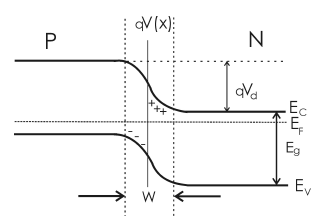
Figura 2: Representacion del voltaje (Vd) en una juntura p-n. W es el ancho de la ZCE.
Cuando incide luz sobre los semiconductores que forman la juntura p-n con la suficiente energía (hv) para que un electrón pase de la banda de valencia a la banda de conducción, el paso del electrón deja un estado energético libre el cual se denomina "hueco. en la banda de valencia. Al existir una barrera de potencial en la unión p- n, los electrones generados en la capa p (portadores minoritarios) y los huecos generados en la capa n (también portadores minoritarios), son transportados inicialmente por mecanismos de difusión hasta la zona de carga espacial (ZCE), donde son separados por el campo eléctrico arrastrando a los portadores minoritarios a través de la juntura. Los portadores minoritarios que atraviesan la juntura se desplazan por difusión hacia los electrodos (contactos ohmicos), estos portadores se concentran en los electrodos dando lugar a un voltaje o fuerza electromotriz, y si se conecta un resistor exterior (RL) a los electrodos, los portadores de carga saldrán de la celda solar dando lugar a una corriente eléctrica que circulara por el resistor. En la figura 3 se esquematiza el proceso.

Figura 3: Esquema de una celda solar mostrando la generación de corriente eléctrica (Iph) en ella, y la forma como se conecta un resistor eléctrico exterior RL por el cual circula dicha corriente.
La cantidad de carga eléctrica que atraviesa el resistor RL en un determinado tiempo t constituye la corriente eléctrica I:

La forma típica de conocer el funcionamiento adecuado de una celda solar es realizando medidas de corriente eléctrica en función del voltaje de polarización del dispositivo. La curva resultante de corriente en función del voltaje se denomina característica I-V de la celda y el producto IV se denomina potencia eléctrica. La figura 4 muestra las curvas de corriente en función del voltaje que se obtienen típicamente con una celda solar en oscuro (curva superior) y bajo iluminación (curva inferior), respectivamente. La potencia máxima que genera una celda solar PM , se obtiene en el punto de la curva I-V para el cual el área del rectángulo es mayor, este es el punto de trabajo de la celda solar (PM = VMIM).

Figura 4:
Característica I-V de una celda solar en oscuro y bajo iluminación indicando los parámetros que la caracterizan (Voc =voltaje de circuito abierto, Isc =corriente de corto circuito, IM =corriente máxima, VM =voltaje máximo).
En el funcionamiento de la celda solar conectada a un resistor RL, este dificulta el paso de la corriente eléctrica por él, esto es, el material que lo compone opone una resistencia al paso de los portadores de carga. Esta resistencia (R) depende de la resistividad eléctrica (p) y de la geometría de la resistencia por la cual pasa la corriente. La resistividad a su vez depende del material del resistor y de la temperatura. La resistencia eléctrica R de un material se expresa como:

Con L la longitud del resistor, y A el área de sección transversal del resistor a través de la cual pasa la corriente eléctrica.
Cuando los portadores de carga atraviesan el resistor RL chocan con los átomos del material del cual está hecho, aumentando su vibración y elevando la temperatura del material. De esta forma la resistencia disipa energía en forma de calor, esa energía disipada por unidad de tiempo se denomina potencia (P) y se expresa como:

Si se conectara por ejemplo un bombillo a la celda solar como resistor RL , se vería que el brillo del bombillo está relacionado directamente con la corriente que genera la celda. La energía que se disipa en la resistencia es suministrada por la celda solar al transportar las cargas eléctricas a través de la juntura p - n en su ZCE.
La enseñanza de los conceptos básicos de electricidad como se acaba de exponer, hace parte de las actividades planteadas en el programa de actividades pedagógicas presentado en la sección 2 anterior, y junto con las demás actividades previas y posteriores a esta, lleva a un cambio cognitivo en los estudiantes. De esta forma, el aprendizaje significativo de los conceptos básicos de electricidad (corriente eléctrica, voltaje, resistencia y potencia) explicados en esta sección mediante el funcionamiento de la celda solar se evidenciaron en la UNIDAD III "CIRCUITOS DE CORRIENTE ELÉCTRICA “del programa, en la cual se llevaron a cabo Talleres acerca de prácticas de circuitos de corriente eléctrica y realización de proyectos escolares. En estos Talleres fue indispensable el manejo de los conceptos básicos de electricidad previamente aprendidos, así como el conocimiento del dispositivo solar para construir circuitos eléctricos, observar y entender el fenómeno eléctrico, y calcular y medir variables físicas explicadas previamente. Para visualizar mejor los efectos de la variación de los parámetros físicos y las configuraciones de los circuitos se usaron bombillos como resistores. La evaluación de la Unidad III se hizo con cuestionarios durante el desarrollo de las prácticas y se pudo observar el cambio en el estado de conocimiento de los estudiantes al usar los conceptos aprendidos previamente en nuevas situaciones prácticas.
4. Elaboración de proyectos escolares
La explicación previa de conceptos y el estímulo creado en los estudiantes para utilizar los recursos renovables y no contaminantes como alternativa para generar electricidad permitió la realización, en talleres supervisados por el docente, de varios proyectos escolares entre los cuales se destacan: el automóvil solar, el alumbrado público utilizando celdas solares, el molino solar, el tractor solar, la casa de campo solar, entre otros. En la realización de los proyectos escolares se elaboraron maquetas donde se utilizaban las celdas solares como elemento generador de corriente eléctrica; las celdas solares se adquirieron comercialmente, debido a que la fabricación de una celda solar es un proceso muy complejo, que requiere de conocimientos especializados y de la infraestructura adecuada. Los estudiantes utilizaron la corriente y el voltaje de salida de la celda solar como fuente de potencia eléctrica, y construyeron circuitos eléctricos en serie o en paralelo y los conectaron a las celdas solares para hacer funcionar los elementos que deseaban tales como resistores, motores y bombillos; en algunos casos se requirió conectar al circuito un convertidor de voltaje continuo a voltaje alterno, teniendo en cuenta que el voltaje generado por las celdas solares es continuo, también debieron tener en cuenta el punto de máxima potencia de la celda solar (mostrado en la figura 5) para asegurar el buen funcionamiento de los elementos de los circuitos conectados. El desarrollo de los proyectos contribuyo al aprendizaje significativo de los conceptos de electricidad y del funcionamiento de las celdas solares previamente estudiados, al tener que llevar a la práctica una idea que involucrara dichos conceptos. Las imágenes de algunos de los proyectos desarrollados se muestran a continuación.

Figura 5: Imágenes de algunos proyectos desarrollados por los estudiantes usando celdas solares.
5. Conclusiones
En el trabajo realizado con estudiantes de educación media se usaron las celdas solares como una alternativa pedagógica innovadora en la enseñanza de conceptos básicos de electricidad como corriente eléctrica, voltaje, resistencia y potencia; y del efecto mediante el cual se obtiene energía eléctrica a partir de la energía solar. La celda solar por ser un dispositivo de alta tecnología se constituye en un elemento motivador y dinamizador en los procesos de enseñanza-aprendizaje.
Los estudiantes aprendieron la importancia de usar recursos renovables y no contaminantes del ambiente para la obtención de energía eléctrica; y que además de ayudar a cuidar y conservar el ambiente dichos recursos presentan ventajas económicas por su durabilidad y al evitarse procesos complejos, extracción o tendido de cableado, eliminan gastos innecesarios como los que presenta la generación de energía eléctrica de forma convencional. Mediante las actividades pedagógicas realizadas usando recursos como videos, conferencias y lecturas, los estudiantes adquirieron los conocimientos necesarios y se motivaron para realizar proyectos escolares que utilizaban celdas solares como dispositivo generador de energía eléctrica a partir de la energía del Sol. Como resultado de este aprendizaje se promovió en los estudiantes el deseo de utilizar celdas solares y recursos renovables en su entorno habitacional y en sus proyectos de investigación futuros a nivel profesional en carreras como Física, Ingeniería, Arquitectura, entre otras.
Agradecimientos
Los autores agradecen a los estudiantes del colegio Distrital La Amistad por su interés y participación en el trabajo realizado.
References
References
M. A. Green, K. Emery, Y. Hishikawa, W. Warta, and E. D.
Dunlop, Progress in Photovoltaics: Research and Applications
, 3 (2016), pIP-15-272.
R. . G. S. Report, Renewable energy policy network for the
st century (ren 21)l," (2016).
D. Ausubel, J. Novak, and H. Hanesian, Educational
Psychology: A Cognitive View (Holt, Rinehart and Winston,
.
How to Cite
APA
ACM
ACS
ABNT
Chicago
Harvard
IEEE
MLA
Turabian
Vancouver
Download Citation
CrossRef Cited-by
1. Milena Linette Zambrano Hernández, Jorge Serrano, Elsa Flores, Alejandrina Batista, Reinhardt Pinzón, Marta Álvarez, Jose Rogelio Fábrega Duque. (2025). Workshop with Hydrogen Cells: A Pedagogical and Motivating Experience for the Study of Unconventional Forms of Energy Generation in Pre-School Students in Panama City. Sustainability, 17(9), p.4149. https://doi.org/10.3390/su17094149.
Dimensions
PlumX
Article abstract page views
Downloads
License
Copyright (c) 2017 MOMENTO

This work is licensed under a Creative Commons Attribution-NoDerivatives 4.0 International License.
Those authors who have publications with this journal, accept the following terms:
a. The authors will retain their copyright and will guarantee the publication of the first publication of their work, which will be subject to the Attribution-SinDerivar 4.0 International Creative Commons Attribution License that permits redistribution, commercial or non-commercial, As long as the Work circulates intact and unchanged, where it indicates its author and its first publication in this magazine.
b. Authors are encouraged to disseminate their work through the Internet (eg in institutional telematic files or on their website) before and during the sending process, which can produce interesting exchanges and increase appointments of the published work.