Correo Electrónico
 DNINFOA - SIA
 Bibliotecas
 Convocatorias
 Identidad U.N.


Publicado
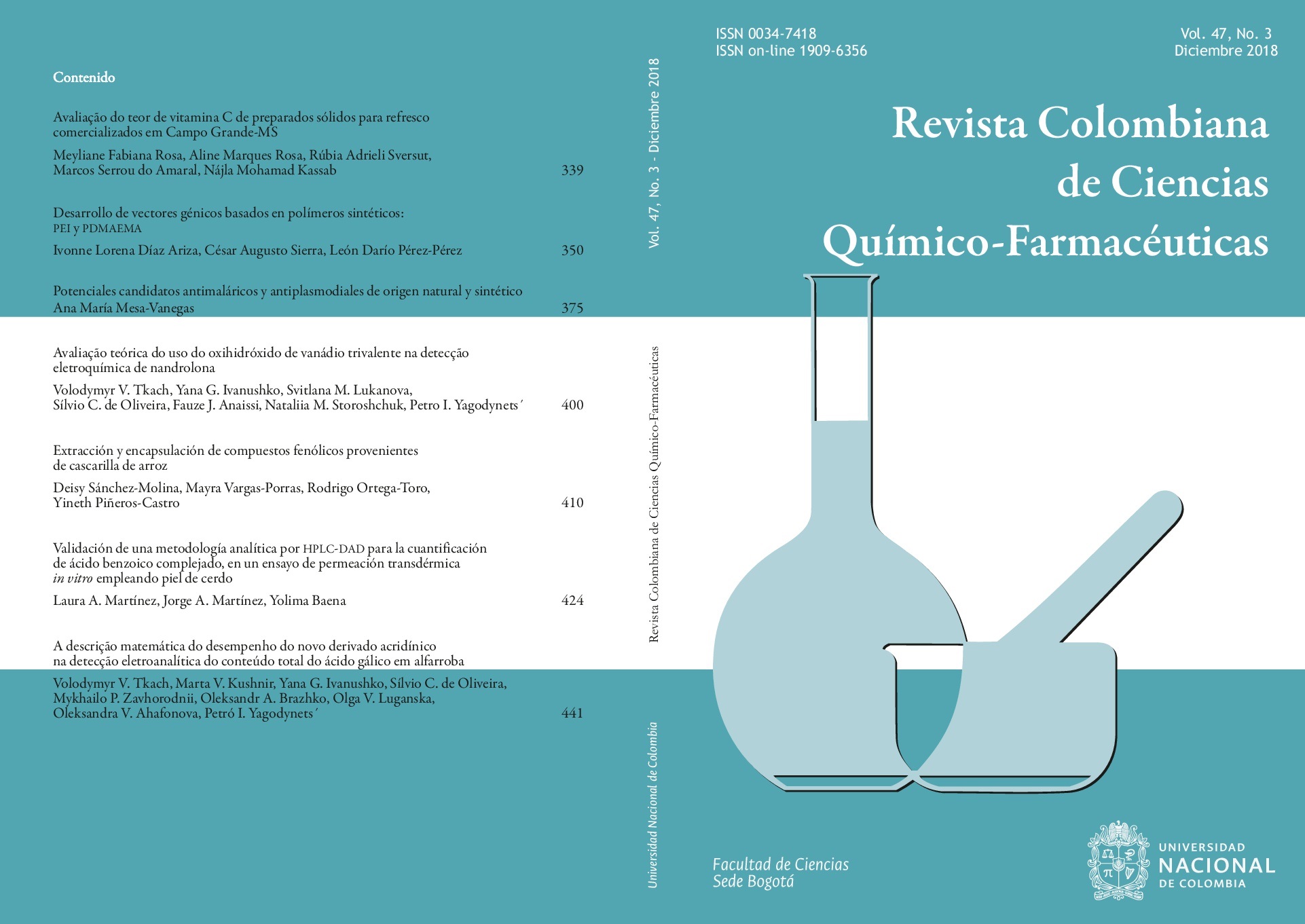
Potenciales candidatos antimaláricos y antiplasmodiales de origen natural y sintético
Potential antiplasmodial and antimalarial agents of natural and synthetic origin
DOI:
https://doi.org/10.15446/rcciquifa.v47n3.77371Palabras clave:
malaria, Plasmodium, antimalárico, quimioterapia, resistencia (es)Malaria, Plasmodium, antimalarial, chemotherapy, resistance (en)
La malaria es la enfermedad parasitaria más grave y extendida que enfrenta la humanidad, debido a su prevalencia, virulencia y al desarrollo de cepas resistentes a los medicamentos de uso común como la cloroquina. La falta de nuevos medicamentos asequibles son los factores limitantes en la lucha contra la malaria, por lo que hay una necesidad continua de investigación para nuevas clases de agentes antimaláricos. Una generación de moléculas activas contra Plasmodium basadas en el mecanismo de biocristalización del grupo hemo o en procesos metabólicos que ocurren en el parásito con los medicamentos de uso actual están siendo sintetizados y actualmente se encuentran en procesos de estudios in vitro, in vivo y estudios clínicos fase I y fase II. Esta revisión realiza una clasificación de los nuevos antimaláricos potenciales y sus modos de acción reportados en las últimas dos décadas con el fin de proporcionar una mirada al progreso significativo en el desarrollo de nuevos medicamentos antimaláricos.
Malaria is the most serious and widespread parasitic disease facing humanity, due to its prevalence, virulence and the development of strains resistant to commonly used drugs such as chloroquine. The lack of affordable new drugs are the limiting factors in the fight against malaria, so there is a continuing need for research for new classes of antimalarial agents. A generation of active molecules against Plasmodium based on the mechanism of biocrystallization of the heme group and / or on metabolic processes that occur in the parasite with the medicines of current use are being synthesized and are currently in processes of in vitro, in vivo and phase I and phase II clinical studies. This review makes a classification of the new potential antimalarial and their possible modes of action reported in the last two decades in order to provide a look at the most significant progress in the development of new antimalarial drugs.
Referencias
A. Robert, O. Dechy-Cabaret, J. Cazelles, F. Benoit-Vical y B. Meunier B., Recent Advances in Malaria Chemotherapy, J. Chinese Chem. Soc., 49, 301-310, (2002).
P. Olumese, “Guidelines for the treatment of malaria”, World Health Organization, 2006.
OMS, “Informe mundial sobre el paludismo 2014”, Ginebra, Organización Mundial de la Salud, 2014. URL: http://www.who.int/malaria/publications/world_malaria_report_2014/en
OMS, “Estrategia Técnica Mundial contra la Malaria 2016-2030”, Organización Mundial de la Salud, 2016. URL: http://www.who.int/malaria/publications/atoz/9789241564991/es/
C. Sánchez, Una mirada a las enfermedades parasitarias en el país, NOVA Publicación Científica, 4, 5(2006).
N. Arora, A.K. Banerjee, New Targets, New Hope: Novel Drug Targets for Curbing Malaria. Mini Rev. Med. Chem., 12(3), 210-226 (2012).
M.J. Meyers, The Medicinal Chemistry of Novel Approaches for the Treatment of Malaria, Curr. Top. Med. Chem., 12(5), 371 (2012).
C.W. Jefford, Synthetic Peroxides as Potent Antimalarials. News and Views, Curr. Top. Med. Chem., 12 (5), 373-399 (2012).
M. Delves, D. Plouffe, C. Scheurer, S. Meister, S. Wittlin, E. Winzeler, et al., TheActivities of Current Antimalarial Drugs on the Life Cycle Stages of Plasmodium: A Comparative Study with Human and Rodent Parasites, PloS Medicine, 9(2), 1-14 (2012).
T.T. Diagana, Supporting malaria elimination with 21st century antimalarial agent drug discovery, Drug Discovery Today, 20(10), 1265-1270 (2015).
S. Vangapandu, M. Jain, K. Kaur, P. Patil, S. Patel, R. Jain, Recent Advances in Antimalarial Drug Development, Med. Res. Rev., 27(1), 65-107 (2007).
M.L. Go, Novel antiplasmodial agents, Med. Res. Rev., 23(4), 456-487 (2003).
A.M. Mesa, Historical perspective of antimalarials of natural origin, Anal. R. Acad. Nac. Farm., 83(2), 167-174 (2017).
De, D., Krogstad, F. M., Byers, L. D., & Krogstad, D. J., Structure activity relationships for antiplasmodial activity among 7-substituted 4-aminoquinolines, J. Med. Chem., 41(25), 4918-4926 (1998).
F. Mzayek, H. Deng, F.J. Mather, W.C. Wasilevich, H. Liu, C.M. Hadi, et al., Randomized dose-ranging controlled trial of AQ-13, a candidate antimalarial and chloroquine in healthy volunteers, PloS Clinical Trials, 2(1), e6 (2007).
P.B. Madrid, N.T. Wilson, J.L. De Risi, R.K. Guy, Parallel synthesis and antimalarial screening of a 4-aminoquinoline library, J. Comb. Chem., 6, 437-442 (2004).
P.M. O’Neill, A. Mukhtar, P.A. Stocks, L.E. Randle, S. Hindley, S.A. Ward, et al., Isoquine and related amodiaquine analogues: a new generation of improved 4-aminoquinoline antimalarials, J. Med. Chem., 46, 4933-4945 (2003).
J. Watson, W.R.J Taylor, G. Bancone, C. Chu, P. Jittamala, N.J. White, Implications of current therapeutic restrictions for primaquine and tafenoquine in the radical cure of vivax malaria, PloS Negl. Trop. Dis., 12(4):e0006440 (2018).
N.T. Huy, K. Mizunuma, K Kaur, N.T. Nhien, M. Jain, D.T. Uyen, et al., 2-Tertbutyl-8-quinolinamines exhibit potent blood schizontocidal antimalarial activity via inhibition of heme crystallization, Antimicrob. Agents Chemother., 51(8), 2842-2847 (2007).
A. Martinez, C.S. Rajapakse, D. Jalloh, C. Dautriche, R.A. Sanchez-Delgado, The antimalarial activity of Ru-chloroquine complexes against resistant Plasmodium falciparum is related to lipophilicity, basicity, and heme aggregation inhibition ability near water/n-octanol interfaces, J. Biol. Inorg. Chem., 14(6), 863-871 (2009).
D.R. Brocks, Stereoselective halofantrine and desbutylhalofantrine disposition in the rat: cardiac and plasma concentrations and plasma protein binding, Biopharm. Drug Dispos., 23(1), 9-15 (2002).
E.L. Suswam, D. Kyle, N. Lang-Unnasch, Plasmodium falciparum: the effects of atovaquone resistance on respiration, Exp. Parasitol., 98(4), 180-187 (2001).
J. Berman, L. Brown, R. Miller, S.L. Andersen, P. McGreevy, B.G. Schuster, W. Ellis, A. Ager, R. Rossan, Antimalarial activity of WR 243251, a dihydroacridinedione, Antimicrob. Agents Chemother., 38, 1753-1756 (1994).
C.X. Liu, Discovery and Development of Artemisinin and Related Compounds, Chinese Herb. Med., 9(2), 101-114 (2017).
G.H. Posner, P.M. O’Neill, Knowledge of the proposed chemical mechanism of action and cytochrome p450 metabolism of antimalarial trioxanes like artemisinin allows rational design of new antimalarial peroxides, Acc. Chem. Res., 37, 397-404 (2004).
U. Eckstein-Ludwig, R.J. Webb, I.D. Van-Goethem, J.M. East, A.G. Lee, M. Kimura, et al., Artemisinins target the SERCA of Plasmodium falciparum, Nature, 424, 957-961 (2003).
J.L. Vennerstrom, S. Arbe-Barnes, R. Brun, S.A. Charman, F.C. Chiu, J. Chollet, et al., Identification of an antimalarial synthetic trioxolane drug development candidate, Nature, 430, 900-904 (2004).
I.H. Paik, S. Xie, T.A. Shapiro, T. Labonte, S.A.A. Narducci, A.C. Baege, et al., Second generation, orally active, antimalarial, artemisinin-derived trioxane dimers with high stability, efficacy, and anticancer activity, J. Med. Chem., 49(9), 2731-2734 (2006).
L.K. Basco, O. Dechy-Cabaret, M. Ndounga, F.S. Meche, A. Robert, B. Meunier, In vitro activities of DU-1102, a new trioxaquine derivative, against Plasmodium falciparum isolates, Antimicrob. Agents Chemother., 45(6), 1886-1888 (2001).
T. Fröhlich, F. Hahn, L. Belmudes, M. Leidenberger, O. Friedrich, B. Kappes, et al., Synthesis of artemisinin-derived di/tri-mers and dendrimers, investigation of their activity against P. falciparum and cytomegalovirus, and insights into their mechanisms of action, Chemistry, A Eur. J., 24(32), doi 10.1002/chem.201800729.
C. Singh, R. Kanchan, D. Srivastava, S.K. Puri, 8-(1-Naphthalen-2-yl-vinyl)-6,7,10- trioxaspiro (4.5) decane, a new 1,2,4-trioxane effective against rodent and simian malaria, Bioorg. Med. Chem. Lett., 16(3), 584-586 (2005).
R. Capela, R. Oliveira, L.M. Goncalves, A. Domingos, J. Gut, P.J. Rosenthal, et al., Artemisinin-dipeptidyl vinyl sulfone hybrid molecules: Design, synthesis and preliminary SAR for antiplasmodial activity and falcipain-2 inhibition, Bioorg. Med. Chem. Lett., 19(12), 3229-3232 (2009).
M. Calas, M.L. Ancelin, G. Cordina, P. Portefaix, G. Piquet, V. Vidal-Sailhan, et al., Antimalarial activity of compounds interfering with Plasmodium falciparum phospholipid metabolism: comparison between mono- and bisquaternary ammonium salts, J. Med. Chem., 43(3), 505-516 (2000).
H.J. Vial, S. Wein, C. Farenc, C. Kocken, O. Nicolas, M.L. Ancelin, et al., Prodrugs of bisthiazolium salts are orally potent antimalarials, Proc. Natl. Acad. Sci. U.S.A., 101(43), 15458-15463 (2004).
J. Faist, W. Seebacher, C. Schlapper, M. Kaiser, R. Brun, R. Saf, et al., Antiplasmodial and antitrypanosomal activity of bicyclic amides and esters of dialkylamino acids, Bioorg. Med. Chem. Lett., 17(10), 3595-3603 (2009).
R. Weis, W. Seebacher, New bicyclic amines: synthesis and SARs of their action against the causative organisms of malaria and sleeping sickness, Curr. Med. Chem., 16(11), 1426-1441 (2009).
C. Schlapper, W. Seebacher, J. Faist, M. Kaiser, R. Brun, R. Saf, et al., Antiplasmodial and antitrypanosomal activities of aminobicyclo[2.2.2]octyl w aminoalkanoates, Eur. J. Pharm. Sci., 44(2), 736-744 (2009).
L. Nallan, B.K. Bauer, P. Bendale, K. Rivas, K. Yokoyama, C.P. Horney, et al., Protein farnesyltransferase inhibitors exhibit potent antimalarial activity, J. Med. Chem., 48(11), 3704-3713 (2005).
M.Z. Wang, J.Y. Saulter, E. Usuki, Y.L Cheung, M. Hall, A.S. Bridges, et al., CYP4F enzymes are the major enzymes in human liver microsomes that catalyze the O-demethylation of the antiparasitic prodrug DB289 [2,5-bis(4-amidinophenyl) furan-bis-O-methylamidoxime], Drug Metab. Dispos., 34(12), 1985-1994 (2006).
R.T. Eastman, J. White, O. Hucke, K. Bauer, K. Yokoyama, L. Nallan, et al., Resistance to a protein farnesyltransferase inhibitor in Plasmodium falciparum, J. Biol. Chem., 280(14), 13554-13559 (2005).
A.M. Mathias, J.L. Holman, L.M. Sturk, M.A. Ismail, D.W. Boykin, R.R. Tidwell, et al., Accumulation and intracellular distribution of antitrypanosomal diamidine compounds DB75 and DB820 in African trypanosomes, Antimicrob. Agents Chemother., 50(6), 2185-2191 (2006).
P. Yeramian, S.R. Meshnick, S. Krudsood, K. Chalermrut, U. Silachamroon, N. Tangpukdee, et al., Efficacy of DB289 in Thai patients with Plasmodium vivax or acute, uncomplicated Plasmodium falciparum infections, J. Infect. Dis., 192(2), 319-322 (2005).
R. Ettari, N. Micale, T. Schirmeister, C. Gelhaus, M. Leippe, E. Nizi, et al., Novel Peptidomimetics Containing a Vinyl Ester Moiety as Highly Potent and Selective Falcipain-2 Inhibitors, J. Med. Chem, 52(7), 2157-2160 (2009).
K.R. Kuldeep, Targeting the active sites of malarial proteases for antimalarial drug discovery: approaches, progress and challenges, Int. J. Antimicrob. Agents, 50, 287-302 (2017).
C. Wenhua, H. Zhenghui, W. Wanyan, M. Fei, G. Longfei, Y. Tang, et al., Discovery of new antimalarial agents: Second-generation dual inhibitors against FP-2 and PfDHFR via fragments assembely, Bioorg. Med. Chem., 25(24), 6467–6478 (2017).
R. Lemmens-Gruber, M.R. Kamyar, R. Dornetshuber. Cyclodepsipeptidespotential drugs and lead compounds in the drug development process, Curr. Med. Chem., 16(9), 1122-1137 (2009).
I. El Sayed, P. Van der Veken, K. Steert, L. Dhooghe, S. Hostyn, G. Van Baelen, et al., Synthesis and Antiplasmodial Activity of Aminoalkylamino-Substituted Neocryptolepine Derivatives, J. Med. Chem., 52(9), 2979-2988 (2009).
S. Mishra, K. Karmodiya, P. Parasuraman, A. Surolia, N. Surolia, Design, synthesis, and application of novel triclosan prodrugs as potential antimalarial and antibacterial agents, Bioorg. Med. Chem., 16(10), 5536-5546 (2008).
D.A. Van Schalkwyk, W. Priebe, K.J. Saliba, The inhibitory effect of 2-halo derivatives of D-glucose on glycolysis and on the proliferation of the human malaria parasite Plasmodium falciparum, Pharmacol. Res. Perspect., 327(2), 511-517 (2008).
M. Andreas, K. Conrad. Selective inhibitors of Plasmodium falciparum glycogen synthase-3 (PfGSK-3): New antimalarial agents?, (BBA) – Proteins and Proteomics, 1854(10), 1644-1649 (2015).
M.H. Gelb, Drug discovery for malaria: a very challenging and timely endeavor, Curr. Opin. Chem. Biol., 11, 440-445 (2007).
V.V. Kouznetsov, A. Gomez-Barrio, Recent developments in the design and synthesis of hybrid molecules based on aminoquinoline ring and their antiplasmodial evaluation, Eur. J. Pharm. Sci., 44(8), 3091-3113 (2009).
C.C. Musonda, G.A. Whitlock, M.J. Witty, R. Brun, M. Kaiser, Chloroquineastemizole hybrids with potent in vitro and in vivo antiplasmodial activity, Bioorg. Med. Chem. Lett., 19(2), 481-484 (2009).
J.J. Walsh, D. Coughlan, N. Heneghan, C. Gaynora, A. Bellb, A novel artemisinin-quinine hybrid with potent antimalarial activity, Bioorg. Med. Chem. Lett.,17, 3599-3602 (2007).
V.V. Kouznetsov, A. Gomez-Barrio, Recent developments in the design and synthesis of hybrid molecules basedon aminoquinoline ring and their antiplasmodial evaluation, Eur. J. Pharm. Sci., 44(8): 3091-3113 (2009).
N. Sunduru, M. Sharma, K. Srivastava, S. Rajakumar, S. Puri, J.K. Saxena, et al., Synthesis of oxalamide and triazine derivatives as a novel class of hybrid 4-aminoquinoline with potent antiplasmodial activity, Bioorg. Med. Chem., 17(17), 6451-6462 (2009).
F. Benoit-Vical, A. Lelievre, C. Berry, O. Deymier, J. Dechy-Cabaret, J. Cazelles, et al., Trioxaquines are new antimalarial agents active on all erythrocytic forms, including gametocytes, Antimicrob. Agents Chemother., 51(4), 1463-1472 (2007).
C.C. Musonda, G.A. Whitlock, M.J. Witty, R. Brun, M. Kaiser, Chloroquineastemizole hybrids with potent in vitro and in vivo antiplasmodial activity, Bioorg. Med. Chem. Lett., 19(2), 481-484 (2009).
F.W. Muregi, A. Ishih. Next-generation antimalarial drugs: hybrid molecules as a new strategy in drug design. Drug Develop. Res., 71(1), 20-32 (2010).
C. Musonda, G. Whitlock, M. Witty, R. Brun, M. Kaiser, Chloroquine-astemizole hybrids with potent in vitro and in vivo antiplasmodial activity, Bioorg. Med. Chem. Lett., 19(2), 481-484 (2009).
N. Sunduru, M. Sharma, K. Srivastava, S. Rajakumar, S.K. Puri, J.K. Saxena, et al., Synthesis of oxalamide and triazine derivatives as a novel class of hybrid 4-aminoquinoline with potent antiplasmodial activity, Bioorg. Med. Chem., 2009, 17(17): 6451-6462.
R.H. Hans, J. Gut, P.J. Rosenthal, K. Chibale, Comparison of the antiplasmodial and falcipain-2 inhibitory activity of -amino alcohol thiolactonechalcone and isatin-chalcone hybrids, Bioorg. Med. Chem. Lett., 20(7), 2234-2237 (2010).
S. Kumar, M. Namita, R. Kanwal, S. Kumkum, S. K. Purib, Novel class of hybrid natural products derived from lupeol as antimalarial. Agents, Nat. Prod. Res., 22(4), 305-319 (2008).
R. Capela, R. Oliveira, L. Goncalves, A. Domingos, J. Gut, P. Rosenthal, et al., Artemisinin-dipeptidyl vinyl sulfone hybrid molecules: Design, synthesis and preliminary SAR for antiplasmodial activity and falcipain-2 inhibition, Bioorg.
Med. Chem. Lett., 19(12), 3229-3232 (2009).
I. El Sayed, P. Van der Veken, K. Steert, L. Dhooghe, et al., Synthesis and antiplasmodial activity of aminoalkylamino-substituted neocryptolepine derivatives, J. Med. Chem., 52(9), 2979-2988 (2009).
G.C. Kirby, A. Paine, D.C. Warhurst, B.K Noamese, J.D. Phillipson, In vitro and in vivo antimalarial activity of cryptolepine, a plant-derived indoloquinoline, Phytother. Res., 9(5), 359-363 (1995).
S. Saxena, N. Pant, D. Jain, R.S. Bhakuni, Antimalarial agents from plant sources, Current Science, 85(9), 1314-1329 (2003).
M.T. Lemma, A.M. Ahmed, M.T. Elhady, H.T. Ngo, Medicinal plants for in vitro antiplasmodial activities: A systematic review of literature, Patogenol. Int., 66(6), 713-720 (2017).
G. Kirby, A. Paine, D.C. Warhurst, B.K Noamese, J.D Phillipson, In vitro and in vivo antimalarial activity of cryptolepine, a plant-derived indoloquinoline, Phytother. Res., 9(5), 359-363 (1995).
K. Vipan, M. Aman, C. Kelly, Synthetic medicinal chemistry of selected antimalarial natural products, Bioorg. Med. Chem., 17(6), 2236-2275 (2009).
Cómo citar
APA
ACM
ACS
ABNT
Chicago
Harvard
IEEE
MLA
Turabian
Vancouver
Descargar cita
CrossRef Cited-by
1. Tafere Mulaw Belete. (2020).
Recent Progress in the Development of New Antimalarial Drugs with Novel Targets
. Drug Design, Development and Therapy, Volume 14, p.3875. https://doi.org/10.2147/DDDT.S265602.2. Amirah H. Ramli, Siti M. Mohd Faudzi. (2023). Diarylpentanoids, the privileged scaffolds in antimalarial and anti‐infectives drug discovery: A review. Archiv der Pharmazie, 356(12) https://doi.org/10.1002/ardp.202300391.
3. Diemer Muñoz-Verbel, Jorge Mendoza-Galiz, Eutimio Cueto-Almeida, Elías Romero-Cueto, Escarleth Contreras-Puentes, Neyder Contreras-Puentes. (2024). Bioactive compounds as therapeutic proposals against Plasmodium falciparum: A systematic review. Biochemical Systematics and Ecology, 115, p.104848. https://doi.org/10.1016/j.bse.2024.104848.
Dimensions
PlumX
Visitas a la página del resumen del artículo
Descargas
Licencia
Derechos de autor 2018 Revista Colombiana de Ciencias Químico-Farmacéuticas

Esta obra está bajo una licencia internacional Creative Commons Atribución 4.0.
El Departamento de Farmacia de la Facultad de Ciencias de la Universidad Nacional de Colombia autoriza la fotocopia de artículos y textos para fines de uso académico o interno de las instituciones citando la fuente. Las ideas emitidas por los autores son responsabilidad expresa de estos y no de la revista.
Todo el contenido de esta revista, excepto dónde está identificado, está bajo una Licencia Creative Commons de Atribución 4.0 aprobada en Colombia. Consulte la normativa en: http://co.creativecommons.org/?page_id=13