Correo Electrónico
 DNINFOA - SIA
 Bibliotecas
 Convocatorias
 Identidad U.N.


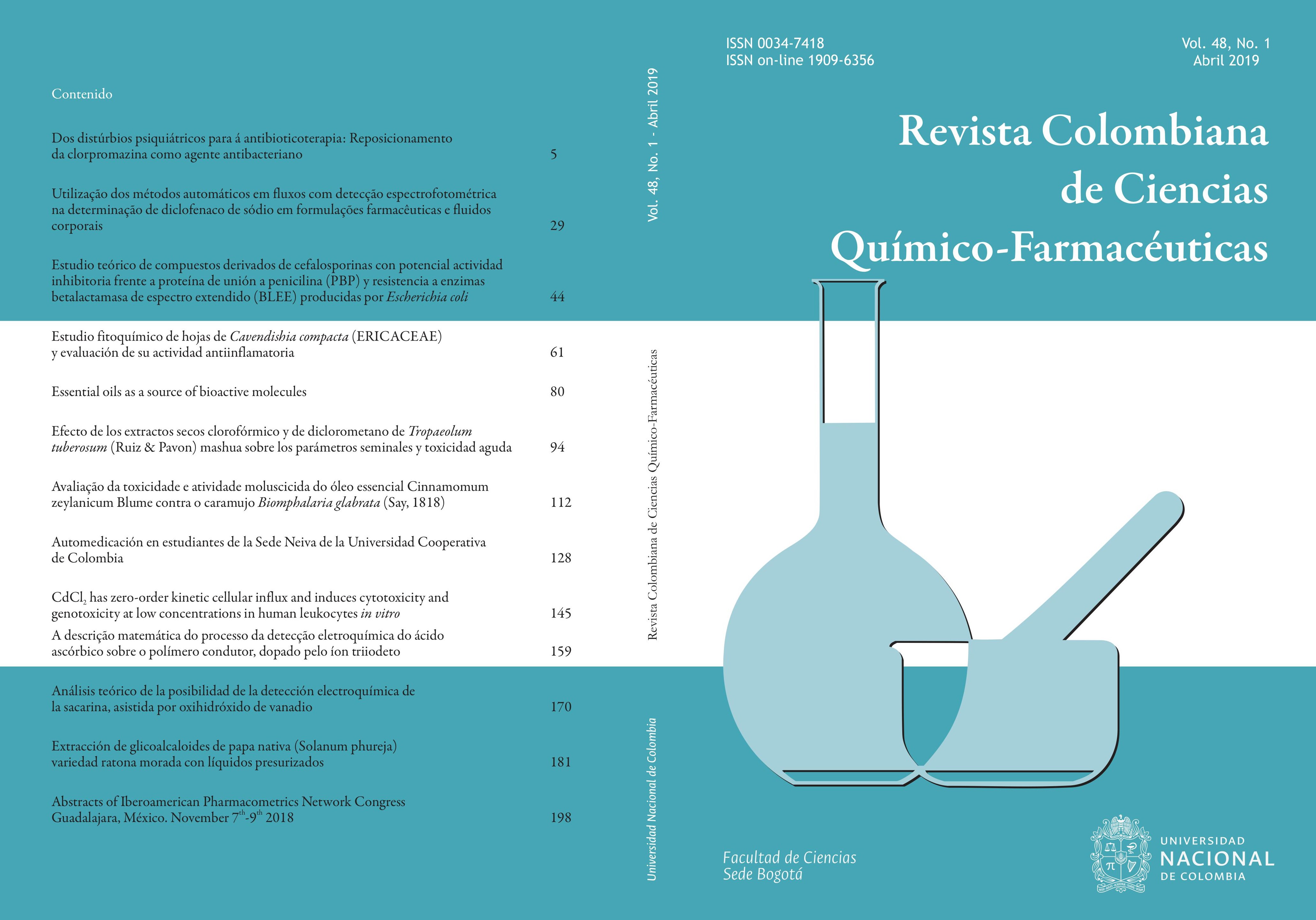
Publicado
Estudio fitoquímico de hojas de Cavendishia compacta (Ericaceae) y evaluación de su actividad antiinflamatoria
Phytochemical study of leaves of Cavendishia compacta (Ericaceae) and evaluation of its anti-inflammatory activity
DOI:
https://doi.org/10.15446/rcciquifa.v48n1.80065Palabras clave:
Cavendishia compacta, Ericaceae, actividad antiinflamatoria (es)Cavendishia compacta, Ericaceae, antiinflammatory activity (en)
Referencias
J. L. Luteyn, Ericaceae, en: N. Smith, S.A. Mori, A. Henderson, D. W. Stevenson y S. V. Heald, “Flowering plants of the neotropics. The New York Botanical Garden”, Nueva York, 2004, pp. 140-143.
Amado Ariza, S., & Chocontá López, A. (2016). Análisis fitoquímico de cinco especies nativas de las zonas rurales de Bogotá D.C. (Colombia). Boletín Semillas Ambientales, 10(1). Recuperado de https://revistas.udistrital.edu.co/ojs/index.php/bsa/article/view/10766
K. Dastmalchi, G. Flores, V. Petrova, P. Pedraza-Peñalosa, y E.J. Kennelly, Arándanos neotropicales comestibles: análisis antioxidante y compositivo de huellas dactilares. Diario de Química Agrícola y Alimentaria, 59 (7), 3020- 3026 (2011). Doi: 10.1021/jf200367j
A. Sanabria, “Análisis fitoquímico preliminar. Metodología y su aplicación en la evaluación de 40 plantas de la familia Compositae”. Universidad Nacional de Colombia, Bogotá, Colombia.
M. Garcia, et al. Antinociceptive and anti-inflammatory effect of the aqueous extract from leaves of Pimenta racemosa var. ozua (Mirtaceae), J Ethnopharmacol, 91(1),69-73 (2004). DOI: 10.1016/j.jep.2003.11.018
H. McNab, E.S.B. Ferreira, A.N. Hulme & A. Quye, Negative ion ESI-MS analysis of natural yellow dye flavonoids. An isotopic labelling study, International Journal of Mass Spectrometry, 284(1-3), 57-65 (2009).
R.L. Pelachim e R.N. Castro, MelIsolamento e Identificação do Flavonol morina em Mel de Apis mellifera. Quím. Nova, 31(Ic), 0-1 (2008).
A. Lhuillier, N. Fabre, F. Moyano, N. Martins, C. Claparols, I. Fourasté, & C. Moulis, Comparison of flavonoid profiles of Agauria salicifolia (Ericaceae) by liquid chromatography-UV diode array detection-electrospray ionisation mass spectrometry, Journal of Chromatography A., 1160(1-2), 13-20 (2007).
A.R. Bilia, J. Mendez, & I. Morelli, Phytochemical investigations of Licania genus. Flavonoids and triterpenoids from Licania carii, Pharmaceutica Acta Helvetiae 71, 191-197 (1996).
S.Y. Mok, & S. Lee, Identification of flavonoids and flavonoid rhamnosides from Rhododendron mucronulatum for albiflorum and their inhibitory activities against aldose reductase, Food Chemistry, 136(2), 969-974 (2013).
A. Dampc, & M. Luczkiewicz, Rhododendron tomentosum (Ledum palustre). A review of traditional use based on current research, Fitoterapia, 85, 130-143 (2013).
A. Andrade- Cetto, & M. Heinrich, Mexican plants with hypoglycaemic effect used in the treatment of diabetes, Journal of Ethnopharmacology, 99(3), 325-348. (2005).
A. Vijayakumar, V. Duraipandiyan, B. Jeyaraj, P. Agastian, M.K. Raj, & S. Ignacimuthu, Phytochemical analysis and in vitro antimicrobial activity of Illicium griffithii Hook. f. & Thoms extracts, Asian Pacific Journal of Tropical Disease, 2 (3), 190-199 (2012).
C. Nakano, T. Hoshino, T. Sato, T. Toyomasu, T. Dairi, & T. Sassa, Substrate specificity of the CYC2 enzyme from Kitasatospora griseola: production of sclarene, biformene, and novel bicyclic diterpenes by the enzymatic reactions of labdane- and halimane-type diterpene diphosphates, Tetrahedron Letters, 51 (1), 125-128 (2010).
I. Backlund et al., Extractive profiles of different lodgepole pine (Pinus contorta) fractions grown under a direct seeding-based silvicultural regime, Industrial Crops and Products, 58, 220-229 (2014).
I. F. Santana, “Estudio químico de la especie colombiana Pentacalia abietina (Willd. ex. Wedd) Cuatr. como nueva fuente natural de compuestos tipo kaurano y quinol”, Tesis de Maestría, Pontificia Universidad Javeriana, 2010.
S.A. Nair, B. Sabulal, J. Radhika, R. Arunkumar, & A. Subramoniam, Promising anti-diabetes mellitus activity in rats of β-amyrin palmitate isolated from Hemidesmus indicus roots, European Journal of Pharmacology, 734(1), 77-82 (2014).
K.A. da Silva, A.F. Paszcuk , G.F. Passos, E.S. Silva, A.F. Bento, F.C. Meotti, J. B. Calixto, Activation of cannabinoid receptors by the pentacyclic triterpene α,β- amyrin inhibits inflammatory and neuropathic persistent pain in mice, Pain, 152 (8), 1872-1887 (2011).
C. Zhou, X. Li, H. Li & R. Li, Chemical constituents from the leaves of Craibiodendron yunnanense, Biochemical Systematics and Ecology, 45, 179-182 (2012).
Y. Cao, Q. Chu, & J. Ye, Chromatographic and electrophoretic methods for pharmaceutically active compounds in Rhododendron dauricum, Journal of Chromatography (2004).
J.A. Balsdon, K.E Espelie,. & S.K. Braman, Epicuticular lipids from azalea (Rhododendron spp.) and their potential role in host plant acceptance by azalea lace bug, Stephanitis pyrioides (Heteroptera: Tingidae), Biochemical Systematics and Ecology, 23(5), 477-485. (1995).
D. Cunningham, et al. Constituyentes fitoquímicos del arándano americano (Vaccinium macrocarpon) y sus beneficios para la salud, Revista de Fitoterapia, 5(1) (2005).
J.A. Matulevich & E. Gil, Composición química del aceite esencial de hojas de bejaria resinosa (Ericaceae). Revista Facultad de Ciencias Básicas, Universidad Militar Nueva Granada, 10(2), 125-132 (2014).
L.G. Naso, L. Lezama, T. Rojo, S.B. Etcheverry, M. Valcarcel, M. Roura, P. Williams, Biological evaluation of morin and its new oxovanadium (IV) complex as antioxidant and specific anti-cancer agents, Chem Biol Interact, 206(2): 289- 301(2013). doi: 10.1016/j.cbi.2013.10.006
B. Sultana & F. Anwar, Flavonols (kaempeferol, quercetin, myricetin) contents of selected fruits, vegetables and medicinal plants, Food Chemistry, 108(3), 879-884 (2008).
R.P. Doss, Essential Oils and Rhododendron Scales, American Rhododendron Society, 42(1987).
D.M. Vucic, M.R. Petkovic, B.B. Rodic-Grabovac, S.M. Vasic, L. Comic, In vitro efficacy of extracts of Arctostaphylos uva-ursi on clinical isolated Escherichia coli and Enterococcus faecalis strains, Kraguievac Journal of Science, 35, 107-113 (2013).
I.Orhan, E. Küpeli, S. Terzioğlu, & E. Yesilada, Bioassay-guided isolation of kaempferol-3-O-β-d-galactoside with anti-inflammatory and antinociceptive activity from the aerial part of Calluna vulgaris L, Journal of Ethnopharmacology, 114(1), 32-37 (2007).
D. Dufour, A. Pichette, V. Mshvildadze, M.E. Bradette-Hébert, S. Lavoie, A. Longtin, J. Legault, Antioxidant, anti-inflammatory and anticancer activities of methanolic extracts from Ledum groenlandicum Retzius, Journal of Ethnopharmacology, 111(1), 22-28 (2007).
A. Ghimeray, et al., Evaluation of antioxidant and anti-inflammatory effect of rhododendron brachycarpum extract used in skin care product by in vitro and in vivo test, Technology and Investment, 6, 105-111 (2015). DOI: 10.4236/ti.2015.62011
N. Erdemoglu, E.K. Akkol, E. Yesilada, & I. Caliş, Bioassay-guided isolation of anti-inflammatory and antinociceptive principles from a folk remedy, Rhododendron ponticum L. leaves, Journal of Ethnopharmacology, 119(1), 172-178 (2008).
Cómo citar
APA
ACM
ACS
ABNT
Chicago
Harvard
IEEE
MLA
Turabian
Vancouver
Descargar cita
CrossRef Cited-by
1. Elizabeth Gil Archila, Felipe Rojas-Bautista, Nestor Garcia, Jorge Andres Carvajal Vasquez. (2022). A promising blueberry from Colombia: antioxidant activity, nutritional and phytochemical composition of Cavendishia nitida (Kunth) A.C.Sm.. Heliyon, 8(5), p.e09448. https://doi.org/10.1016/j.heliyon.2022.e09448.
2. Elizabeth Gil Archila, Felipe Rojas-Bautista, Nestor Garcia, Jorge Andres Carvajal Vasquez. (2021). A Promising Blueberry from Colombia: Antioxidant Activity, Nutritional and Phytochemical Composition of Cavendishia Nitida (Kunth) A.C.Sm. SSRN Electronic Journal , https://doi.org/10.2139/ssrn.3949262.
Dimensions
PlumX
Visitas a la página del resumen del artículo
Descargas
Licencia
Derechos de autor 2019 Revista Colombiana de Ciencias Químico-Farmacéuticas

Esta obra está bajo una licencia internacional Creative Commons Atribución 4.0.
El Departamento de Farmacia de la Facultad de Ciencias de la Universidad Nacional de Colombia autoriza la fotocopia de artículos y textos para fines de uso académico o interno de las instituciones citando la fuente. Las ideas emitidas por los autores son responsabilidad expresa de estos y no de la revista.
Todo el contenido de esta revista, excepto dónde está identificado, está bajo una Licencia Creative Commons de Atribución 4.0 aprobada en Colombia. Consulte la normativa en: http://co.creativecommons.org/?page_id=13