Correo Electrónico
 DNINFOA - SIA
 Bibliotecas
 Convocatorias
 Identidad U.N.


Publicado
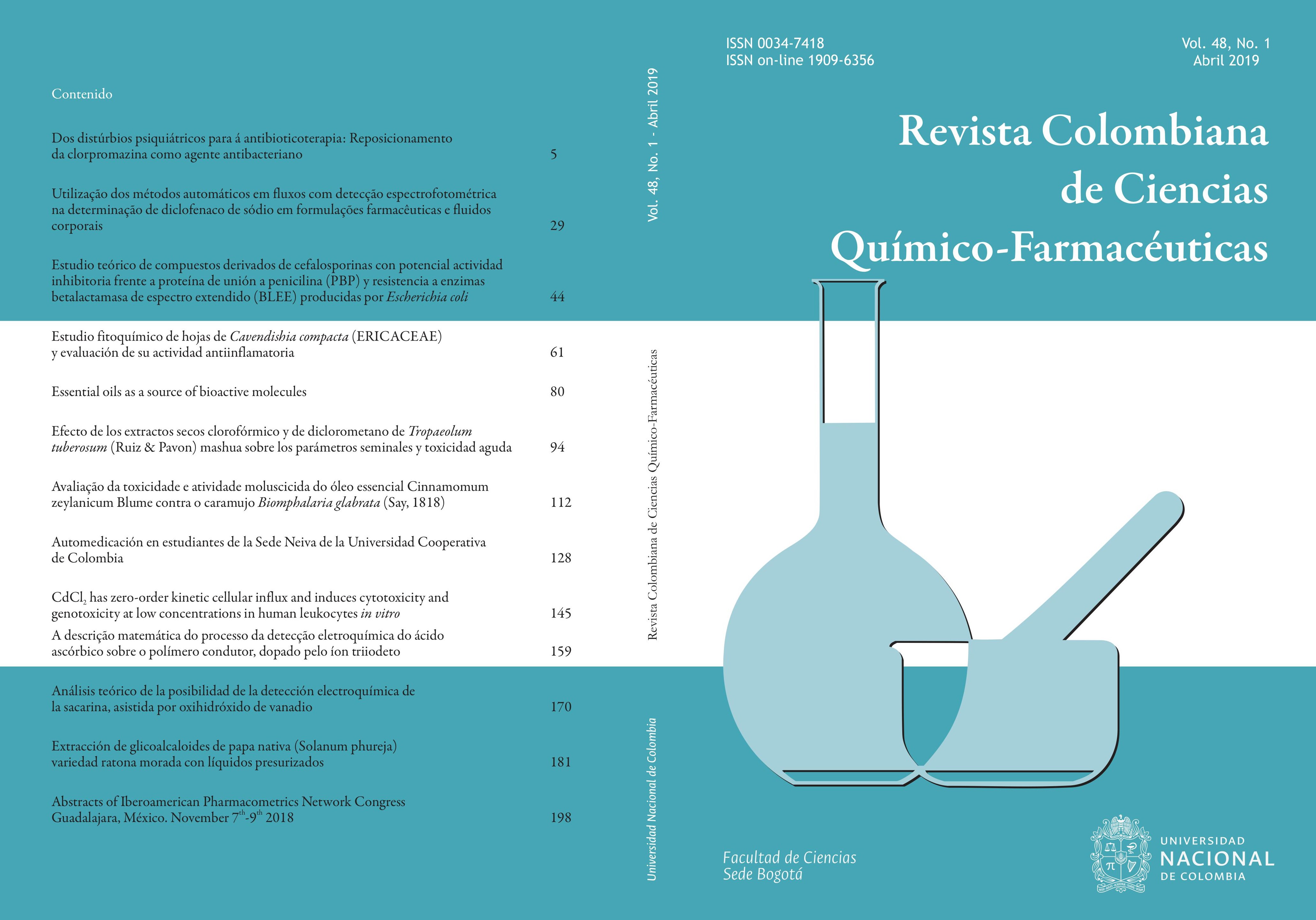
CdCl2 has zero-order kinetic cellular influx and induces cytotoxicity and genotoxicity at low concentrations in human leukocytes in vitro
El CdCl2 tiene un influjo celular cinético de orden cero e induce citotoxicidad y genotoxicidad a bajas concentraciones en leucocitos humanos in vitro
DOI:
https://doi.org/10.15446/rcciquifa.v48n1.80071Palabras clave:
Cadmium, cellular damage, DNA damage, defense cells (en)Cadmio, daño celular, daño en el ADN, células de defensa (es)
Descargas
Referencias
X. Cao, H. Wang, D. Zhuang et al., Roles of MSH2 and MSH6 in cadmiuminduced G2/M checkpoint arrest in Arabidopsis roots, Chemosphere, 201, 586-594 (2018).
J. Jean, V. Sirot, M. Hulin et al., Dietary exposure to cadmium and health risk assessment in children. Results of the French infant total diet study, Food Chem. Toxicol., 115, 358-364 (2018).
A. Waseem, J. Arshad, A review of Human Biomonitoring studies of trace elements in Pakistan, Chemosphere, 163, 153-176 (2016).
K. Ghosh, N. Indra, Cadmium treatment induces echinocytosis, DNA damage, inflammation, and apoptosis in cardiac tissue of albino Wistar rats, Environ. Toxicol. Pharmacol., 59, 43-52 (2018).
M. Panjehpour, M.A. Taher, M. Bayesteh, The growth inhibitory effects of cadmium and copper on the MDA-MB468 human breast cancer cells, J. Res. Med. Sci., 15(5), 279 (2010).
D. Belhaj, K. Athmouni, M.B. Ahmed et al., Polysaccharides from Phormidium versicolor (NCC466) protecting HepG2 human hepatocellular carcinoma cells and rat liver tissues from cadmium toxicity: Evidence from in vitro and in vivo tests, Int. J. Biol. Macromol., 113, 813-820 (2018).
D. Li, P. Wang, C. Wang, X. Fan, X. Wang, B. Hu, Combined toxicity of organophosphate flame retardants and cadmium to Corbicula fluminea in aquatic sediments, Environ. Pollut., 243, 645-653 (2018).
G.K. Bielmyer-Fraser, B. Harper, C. Picariello, A. Albritton-Ford, The influence of salinity and water chemistry on acute toxicity of cadmium to two euryhaline fish species, Comp. Biochem. Physiol. Part C: Toxicol. Pharmacol., 214, 23-27 (2018).
A. Jacquet, J. Arnaud, I. Hininger-Favier et al., Impact of chronic and low cadmium exposure of rats: Sex specific disruption of glucose metabolism, Chemosphere, 207, 764-773 (2018).
H. Chen, Y. Lu, Z. Cao et al., Cadmium induces NLRP3 inflammasome-dependent pyroptosis in vascular endothelial cells, Toxicol. Lett., 246, 7-16 (2016).
R. Fan, P.C. Hu, Y. Wang et al., Betulinic acid protects mice from cadmium chloride- induced toxicity by inhibiting cadmium-induced apoptosis in kidney and liver, Toxicol. Lett., 299, 56-66 (2018).
S. Chakraborty, A.R. Dutta, S. Sural, D. Gupta, S. Sen, Ailing bones and failing kidneys: a case of chronic cadmium toxicity. Ann. Clin. Biochem., 50(5), 492- 495 (2013).
T. Luo, J. Lee, Z. Lu et al., Effect of cadmium ion on alpha-glucosidase: an inhibition kinetics and molecular dynamics simulation integration study, Protein J., 35(3), 218-224 (2016).
M.J. Tamás, B. Fauvet, P. Christen, P. Goloubinoff, Misfolding and aggregation of nascent proteins: a novel mode of toxic cadmium action in vivo, Curr. Genet., 64(1), 177-181 (2018).
A. Sarkar, G. Ravindran, V. Krishnamurthy, A brief review on the effect of cadmium toxicity: from cellular to organ level, Int. J. Biotechnol. Res., 3(1), 17-36 (2013).
L.P. Pereira, F.E.B. Silva, E.M.M. Flores, H.S. Schrekker, M.M. Machado, L.F.S. Oliveira, In vitro ZnCl2 cytotoxicity and genotoxicity in human leukocytes: Zero-order kinetic cellular zinc influx, Acta Sci. Health Sci., 37(1), 63-68 (2015).
T. Sliwinski, A. Czechowska, M. Kolodziejczak, J. Jajte, M. Wisniewska- Jarosinska, J. Blasiak, Zinc salts differentially modulate DNA damage in normal and cancer cells, Cell Biol. Int., 33(4), 542-547 (2009).
R. Guan, T. Kang, F. Lu, Z. Zhang, H. Shen, M. Liu, Cytotoxicity, oxidative stress, and genotoxicity in human hepatocyte and embryonic kidney cells exposed to ZnO nanoparticles, Nanoscale Res. Lett., 7(1), 602 (2012).
R. Sharif, P. Thomas, P. Zalewski, M. Fenech, Zinc deficiency or excess within the physiological range increases genome instability and cytotoxicity, respectively, in human oral keratinocyte cells, Genes Nutr., 7(2), 139-154 (2012).
M.E. Burow, C.B. Weldon, Y. Tang et al., Differences in susceptibility to tumor necrosis factor α-induced apoptosis among MCF-7 breast cancer cell variants, Cancer Res., 58(21), 4940-4946 (1998).
R.R. Tice, E. Agurell, D. Anderson et al., Single cell gel/comet assay: guidelines for in vitro and in vivo genetic toxicology testing, Environ. Mol. Mutag., 35(3), 206-221 (2000).
N.P. Singh, M.T. McCoy, R.R. Tice, E.L. Schneider, A simple technique for quantitation of low levels of DNA damage in individual cells, Exp. Cell Res., 175(1), 184-191 (1988).
S. Wang, Q. Dong, Z. Wang, Differential effects of citric acid on cadmium uptake and accumulation between tall fescue and Kentucky bluegrass, Ecotoxicol. Environ. Safety, 145, 200-206 (2017).
X. Chen, Z. Wang, G. Zhu, G.F. Nordberg, T. Jin, X. Ding, The association between cumulative cadmium intake and osteoporosis and risk of fracture in a Chinese population, J. Exp. Sci. Environ. Epid., doi: 10.1038/s41370-018-0057-6
W.J. Zhao, Z.J. Zhang, Z.Y. Zhu et al., Time-dependent response of A549 cells upon exposure to cadmium, J. App.Toxicol., 38(11), 1437-1446 (2018).
J. Ramos-Trevino, S. Bassol-Mayagoitia, J.A. Hernández-Ibarra, P. Ruiz-Flores, M.P. Nava-Hernández, Toxic Effect of Cadmium, Lead, and Arsenic on the Sertoli Cell: Mechanisms of Damage Involved, DNA Cell Biol., 37(7), 600-608 (2018).
J.A. Sauvageau, C. Jumarie, Different mechanisms for metal-induced adaptation to cadmium in the human lung cell lines A549 and H441, Cell Biol. Toxicol., 29(3), 159-173 (2013).
H. Wang, Y. Yu, J. Li et al., Cadmium stimulates mouse skin fibroblast apoptosis by affecting intracellular homeostasis, Drug Chem. Toxicol., 40(1), 74-84 (2017).
Y. Lin, J.J. Huang, H.U. Dahms, J.J. Zhen, X.P. Ying, Cell damage and apoptosis in the hepatopancreas of Eriocheir sinensis induced by cadmium, Aquat. Toxicol., 190, 190-198 (2017).
S. Sarkar, P. Yadav, R. Trivedi, A.K. Bansal, D. Bhatnagar, Cadmium-induced lipid peroxidation and the status of the antioxidant system in rat tissues, J. Trace Elem. Med. Biol., 9(3), 144-149 (1995).
S.J. Stohs, D. Bagchi, Oxidative mechanisms in the toxicity of metal ions, Free Rad. Biol. Med., 18(2), 321-336 (1995).
M.W. Fariss, Cadmium toxicity: unique cytoprotective properties of alpha tocopheryl succinate in hepatocytes, Toxicol., 69(1), 63-77 (1991).
Y. Yan, J.C. Bian, L.X. Zhong, Y. Zhang, Y. Sun, Z.P. Liu, Oxidative stress and apoptotic changes of rat cerebral cortical neurons exposed to cadmium in vitro, Biomed. Environ. Sci., 25(2), 172-181 (2012).
Z. Dong, P. Saikumar, G.A. Griess, J.M. Weinberg, M.A. Venkatachalam, Intracellular Ca2+ thresholds that determine survival or death of energy-deprived cells. Am. J. Pathol., 152(1), 231-240 (1998).
B.E. Trump, I.K. Berezesky, S.H. Chang, P.C. Phelps, The pathways of cell death: oncosis, apoptosis, and necrosis, Toxicol. Pathol., 25(1), 82-88 (1997).
F. Thévenod, J. Fels, W-K. Lee, R. Zarbock, Channels, transporters and receptors for cadmium and cadmium complexes in eukaryotic cells: myths and facts, Biometals, 1, 1-21 (2019).
Cómo citar
APA
ACM
ACS
ABNT
Chicago
Harvard
IEEE
MLA
Turabian
Vancouver
Descargar cita
Licencia
Derechos de autor 2019 Revista Colombiana de Ciencias Químico-Farmacéuticas

Esta obra está bajo una licencia internacional Creative Commons Atribución 4.0.
El Departamento de Farmacia de la Facultad de Ciencias de la Universidad Nacional de Colombia autoriza la fotocopia de artículos y textos para fines de uso académico o interno de las instituciones citando la fuente. Las ideas emitidas por los autores son responsabilidad expresa de estos y no de la revista.
Todo el contenido de esta revista, excepto dónde está identificado, está bajo una Licencia Creative Commons de Atribución 4.0 aprobada en Colombia. Consulte la normativa en: http://co.creativecommons.org/?page_id=13