Correo Electrónico
 DNINFOA - SIA
 Bibliotecas
 Convocatorias
 Identidad U.N.


Publicado
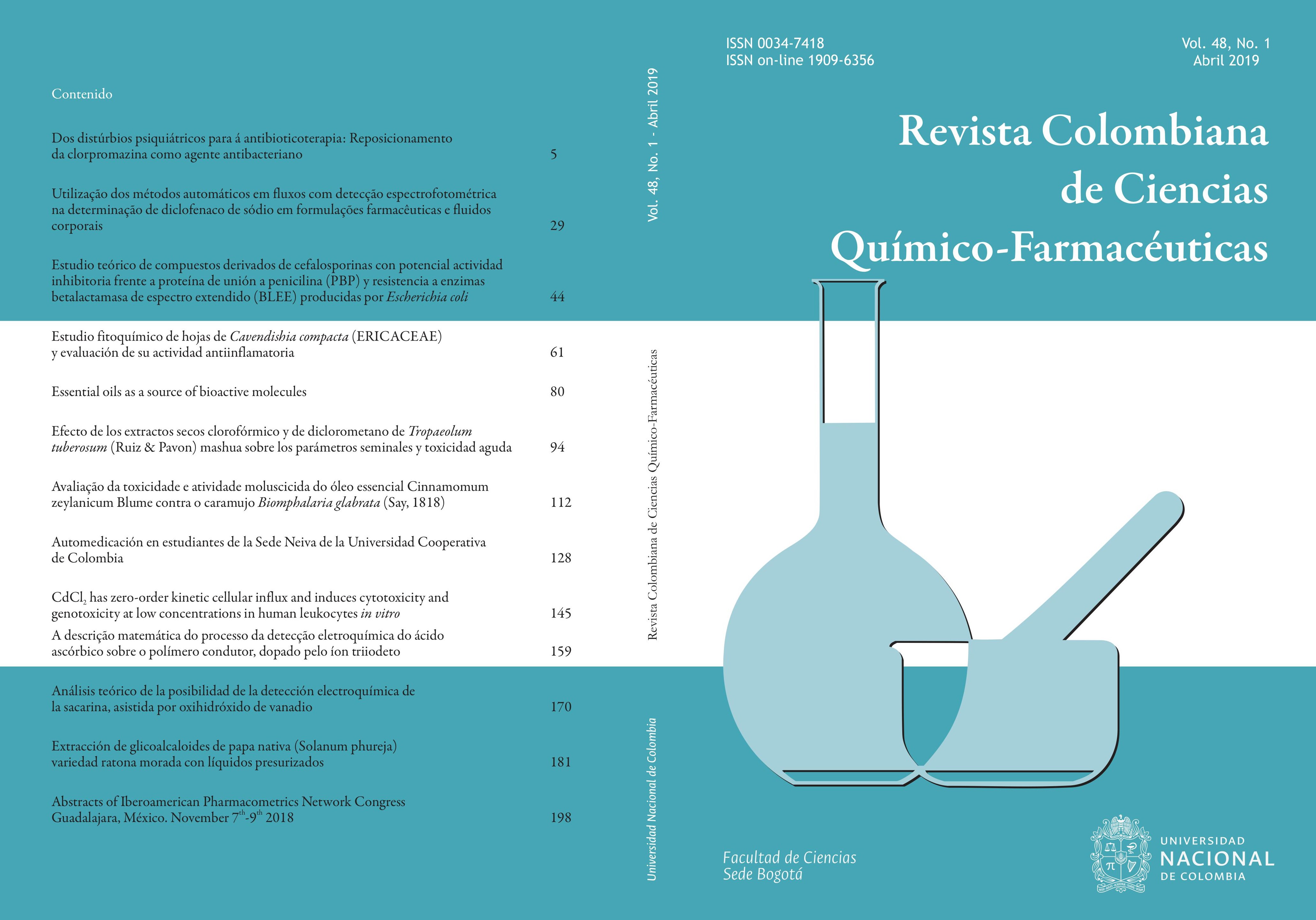
Análisis teórico de la posibilidad de la detección electroquímica de la sacarina, asistida por oxihidróxido de vanadio
The theoretical analysis of the possibility of the electrochemical determination of saccharin, assisted by vanadium (iii) oxyhydroxide
DOI:
https://doi.org/10.15446/rcciquifa.v48n1.80073Palabras clave:
Sacarina, electrodos químicamente modificados, oxihidróxido de vanadio trivalente, sensores electroquímicos, estado estacionario estable (es)Saccharin, chemically modified electrodes, trivalent vanadium oxyhydroxide, electrochemical sensors, stable steady-state (en)
Referencias
S. Miao, E.S. Beach, T. J. Sommer et al., High-Intensity Sweeteners in Alternative Tobacco Products, Nicot. Tob. Res., 23(141), 2169-2173 (2016).
V.M. Sardesai, T.H. Valdshan, Natural and synthetic intense sweeteners, J. Nutr. Biochem., 2, 236-244 (1991).
K. Rosenman, Benefits of Saccharin. A Review, Environm. Res., 15, 70-80 (1978).
S.A. Miller, V.P. Fratalli, Saccharin, Diab. Care, 12, 75-80 (1989).
K.M.A. Malik, S.Z. Haider, M.A. Hossain, Dipotassium sodium trisaccharinate monohydrate, K2Na(C7H4NO3S)3.H2O, Acta Crystall. C., 40, 1696-1698 (1984).
J. Suez, T. Korem, D. Zeevi et al., Artificial sweeteners induce glucose intolerance by altering the gut microbiot, Nature, 514, 181-186 (2014).
M.R. Torloni, M.U. Nakamura, A. Megale et al., O uso de adoçantes na gravidez: uma análise dos produtos disponíveis no Brasil, Rev. Bras. Gin. Obstetr., 29, 267-275 (2007).
A. Saad, F.A. Khan, A. Hayee, M.S. Nazir, A Review on potential toxicity of artificial sweetners vs safety of stevia: A natural bio-sweetner, J. Biol. Agr. Health, 4, 137-147 (2014).
M.R. Weinbrauch, V. Diehl, Artificial sweeteners do they bear a carcinogenic risk, Ann. Oncol., 15, 1460-1465 (2004).
J. Whysner, G.M. Williams, Saccharin mechanistic data and risk assessment: urine composition, enhanced cell proliferation, and tumor promotion, Pharmacol. Ther., 71, 225- 252 (1991).
S.N.F. Bruno, C.R. Cardoso, M.M.A. Maciel et al., Selective identification and quantification of saccharin by liquid chromatography and fluorescence detection, Food Chem., 159, 309-315 (2014).
V.N. Oliveira Fernandes, L. Bellozi Fernandes, J. Pereira Vasconsellos et al., Simultaneous analysis of aspartame, cyclamate, saccharin and acesulfame-K by CZE under UV detection, Anal. Meth., 5, 1524-1532 (2013).
K. Kh. Khamud, R.R. Neema, I.Sh. Hamza, E.A. Salih, Qualitative and Quantitative Determination of Artificial Sweetener Saccharin Sodium by FTIR Spectroscopy, Int. J. Adv. Pharm. Biol. Chem., 3, 617-622 (2014).
O. Fatibello-Filho, J. Araújo, A.J. Moraes, Flow injection potenciometric determination of saccharin in dietary products with relocation of filtration unit, Talanta, 41, 731-734 (1994).
I. Tabakovic, S. Riemer, K. Tabakovic et al., Mechanism of Saccharin Transformation to Metal Sulfides and Effect of Inclusions on Corrosion Susceptibility of Electroplated CoFe Magnetic Films, J. Electrochem. Soc., 153, 586-593 (2006).
D.P. Nikoletis, S. Pantoulias, S.J. Krull et al., Electrochemical transduction of the interactions of the sweeteners acesulfame-K, saccharin and cyclamate with bilayer lipid membranes (BLMs), Electrochim. Acta, 46, 1025-1031 (2001).
V.V. Tkach, G. Ivanushko, S. M. Lukanova et al., The Theoretical Evaluation of Saccharin Electrochemical Detection on CP-Based Diazonium Salts, Anal. Bioanal. Electrochem., 8, 1044-1054 (2016).
V.V. Tkach, G. Ivanushko, S. M. Lukanova et al., Detecção eletroquímica de sacarina em meio neutro por polímeros condutores especificamente modificados: Uma descrição matemática, Bol. Inf. Geum., 7, 12-17 (2016).
Y. Zhang, X. Jing, Hydrothermal synthesis and supercapacitor electrode of low crystallinity VOOH hollow spheres with pseudocapacitance in aqueous solution, Mat. Lett., 205, 1-5 (2017).
O. Stadnik, Synthesis, electrochemical and photoelectrochemical properties of the oxide-hydroxide compounds of cobalt, Diss. Kand. Chim. N.-Kyiv 2011.
O. Stadnik, N. Ivanova, Y. Boldyrev, 218, Int. Electrochem. Soc. Meeting. Abstract # 2240, http://ma.ecsdl.org/content/MA201002/38/2240.full.pdf accessed at 8th of August 2015.
V. Tkach, S.C. de Oliveira, F.J. Anaissi et al., The Mechanism of Electroanalytical Function of CoO(OH) in the Oxalic Acid Electrochemical Determination and its Mathematical Representation, Anal. Bioanal. Electrochem., 8, 1-11 (2016)
V. Tkach, Y. Ivanushko, S. C. de Oliveira et al., A avaliação mecanística teórica da utilização de oxihidróxido de cobalto (III) em sensores eletroquímicos de tramadol, Rev. Colomb. Cien. Quím. Farm., 46(2), 188-201 (2017).
Cómo citar
APA
ACM
ACS
ABNT
Chicago
Harvard
IEEE
MLA
Turabian
Vancouver
Descargar cita
Licencia
Derechos de autor 2019 Revista Colombiana de Ciencias Químico-Farmacéuticas

Esta obra está bajo una licencia internacional Creative Commons Atribución 4.0.
El Departamento de Farmacia de la Facultad de Ciencias de la Universidad Nacional de Colombia autoriza la fotocopia de artículos y textos para fines de uso académico o interno de las instituciones citando la fuente. Las ideas emitidas por los autores son responsabilidad expresa de estos y no de la revista.
Todo el contenido de esta revista, excepto dónde está identificado, está bajo una Licencia Creative Commons de Atribución 4.0 aprobada en Colombia. Consulte la normativa en: http://co.creativecommons.org/?page_id=13