Correo Electrónico
 DNINFOA - SIA
 Bibliotecas
 Convocatorias
 Identidad U.N.


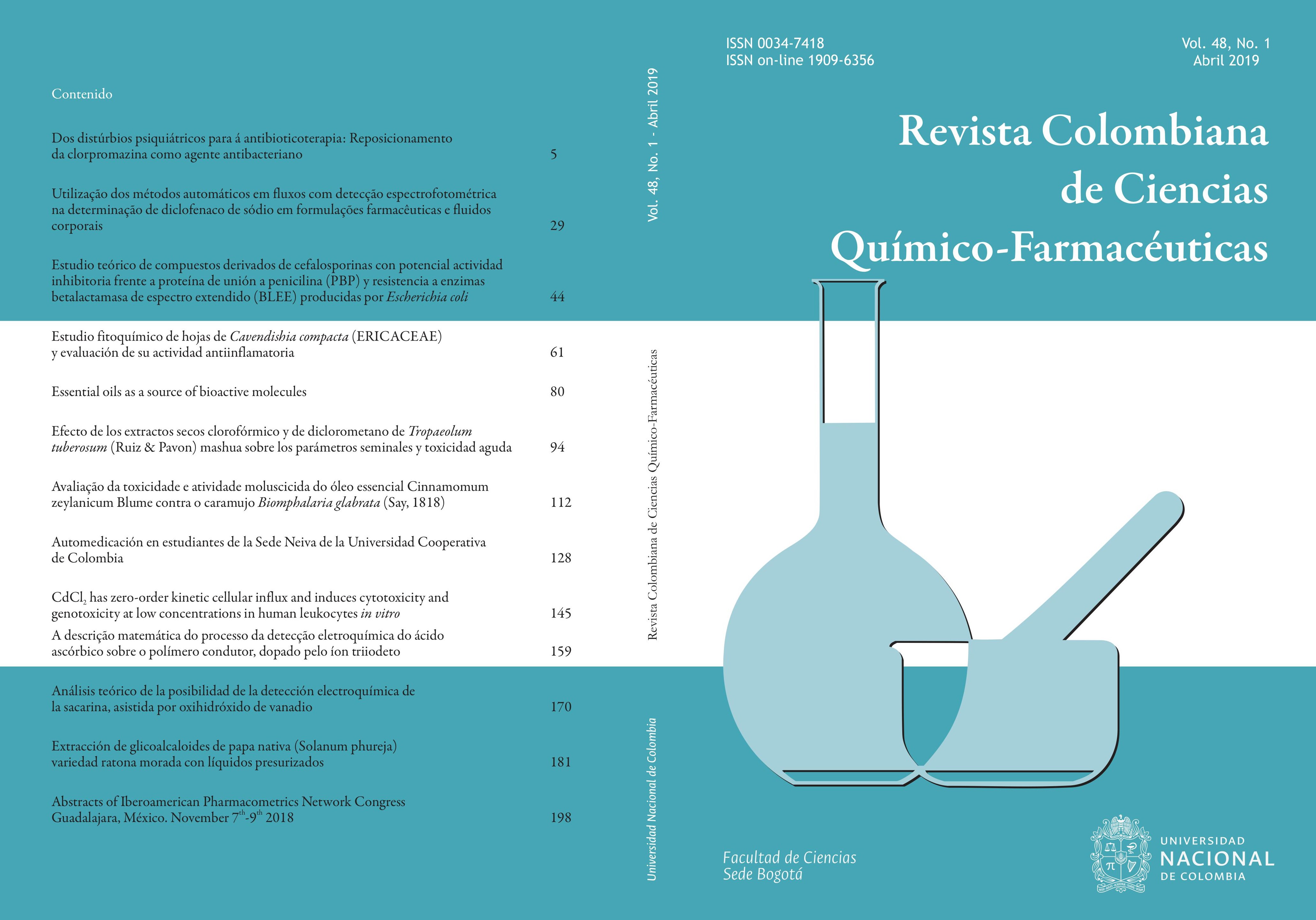
Publicado
Extracción de glicoalcaloides de papa nativa (Solanum phureja) variedad ratona morada con líquidos presurizados
Extraction of glycoalkaloids of native potato (Solanum phureja) ratona morada variety with pressurized liquids Potato peel is a waste originated by its agro-industrial processing, generating
DOI:
https://doi.org/10.15446/rcciquifa.v48n1.80074Palabras clave:
Solanum phureja, cáscara de papa, extracción con líquido presurizado, glicoalcaloides (es)Solanum phureja, potato peel, extraction with pressurized liquid, glyco¬alkaloids (en)
Referencias
H. Akyol, Y. Riciputi, E. Capanoglu, M. F. Caboni, V. Verardo, Phenolic Compounds in the Potato and Its Byproducts: An Overview, International Journal of Molecular Sciences, 17(6), 835 (2016).
A. Chandrasekara, T.J. Kumar, Roots and tuber crops as functional foods: A Review on phytochemical constituents and their potential health benefits, International Journal of Food Science, 15(2016).
N.U. Haase, Healthy aspects of potatoes as part of the human diet, Potato Research, 51(3-4), 239-258 (2008).
A. Schieber, M. Aranda, Potato peels: a source of nutritionally and pharmacologically interesting compounds-A review, Global Science Books, Food 2, 23-29 (2009).
B. Burlingame, B. Mouillé, R. Charrondière, Nutrients, bioactive non-nutrients and anti-nutrients in potatoes, Journal of Food Composition and Analysis, 22, 494-502 (2009).
C. Monteros, X. Cuesta, J. Jiménez, G. López, “Las papas nativas en el Ecuador”. INIAP - Instituto Nacional de Investigaciones Agropecuarias Ed., Quito, 2005, p. 26.
C. Fonseca, G. Burgos, F. Rodríguez, L. Muñoz, M. Ordinola, “Catálogo de variedades de papa nativa con potencial para la seguridad alimentaria y nutricional de Apurímac y Huancavelica”, Centro Internacional de la Papa (CIP) Ed., Lima, 2014, p. 29.
J. Mäder, H. Rawel, L.W. Kroh, Composition of phenolic compounds and glycoalkaloids α-solanine and α-chaconine during commercial potato processing, Journal of Agricultural and Food Chemistry, 57(14), 6292-6297 (2009).
H. Gebrechristos, W. Chen, Utilization of potato peel as eco-friendly products: A review, Food Science & Nutrition, 6, 1352-1356 (2018).
M. Friedman, C. Levin, Analysis and Biological Activities of Potato Glycoalkaloids, Calys tegine Alkaloids, Phenolic Compounds, and Anthocyanins, En: “Advances in Potato Chemistry and Technology”, Ed por J. Singh, y L. Kaur, Elsevier, Burlington MA, Massachusetts, 2009, pp. 127-161.
M. Friedman, Potato glycoalkaloids and metabolites: Roles in the plant and in the diet, Journal of Agricultural and Food Chemistry, 54(23), 8655-8681 (2006).
M. Friedman, Chemistry and anticarcinogenic mechanisms of glycoalkaloids produced by eggplants, potatoes, and tomatoes, Journal Agricultural Food Chemistry, 63, 3323-3337 (2015).
M. Friedman, K.R. Lee, H.J. Kim, I.S. Lee, N. Kozukue, N, Anticarcinogenic effects of glycoalkaloids from potatoes against human cervical, liver, lymphoma, and stomach cancer cells, Journal of Agricultural and Food Chemistry, 53, 6162- 6169 (2005).
J. Araujo, R. Salas, Actividad antimicrobiana de plantas, Revista Científica del Sur, 6, 6-18 (2008).
A. Nieto, F. Borrull, E. Pocurull, R. Marcé, Pressurized liquid extraction: A useful technique to extract pharmaceuticals and personal-care products from sewage sludge, Trends in Analytical Chemistry, 29(7), 752-764 (2010).
A. Mustafa, Ch. Turner, Pressurized liquid extraction as a green approach in food and herbal plants extraction: A review, Analytica Chimica Acta, 703, 8-18 (2011).
P. Raut, D. Bhosle, A. Janghel, S. Deo, Ch. Verma, S. Kumar, M. Agrawal, N. Amit, M. Sharma, T. Giri, D. Tripathi, A. Ajazddin, Emerging Pressurized Liquid Extraction (PLE) techniques as an innovative green technologies for the effective extraction of the active phytopharmaceuticals, Research Journal of Pharmacy and Technology, 8(6), 801-810 (2015).
M. Hossain, A. Rawson, I. Aguiló, N. Brunton, D. Rai, Recovery of steroidal alkaloids from potato peels using pressurized liquid extraction, Molecules, 20, 8560-8573 (2015).
Estándar de ASTM E 11 “Standard Specification for Wire Cloth and Sieves for Testing Purposes”, 1995.
K.E. Hellenäs, A simplified procedure for quantification of potato glycoalkaloids in tuber extracts by HPLC: comparison with ELISA and a colorimetric method, Journal of the Science of Food and Agriculture, 37 (8), 776-782 (1986).
A.O.A.C. Glycoalkaloids (α-Solanine and α-Chaconina) in Potato Tubers. Liquid Chromatographic Method. 997.13. (1997), Official methods of analysis of AOAC. International 17th edition; Gaithersburg, MD, USA Association of Analytical Communities 2000.
N.J. Miller, J.C. Miller, “Estadística y quiometría para química analítica”, Pearson educación Ed. S.A., Madrid, 2002, 4a edición.
K. Ameer, H. Muhammad, J.H. Kwon, Green extraction methods for polyphenols from plant matrices and their byproducts: A Review, Comprehensive Reviews in Food Science and Food Safety, 16, 295-315 (2017).
M. Friedman, Analysis of biologically active compounds in potatoes (Solanum tuberosum), tomatoes (Lycopersicon esculentum), and jimson weed (Datura stramonium) seeds, Journal of Chromatography A, 1054, 143-155 (2004).
A. Tajner-Czopek, M. Jarych-Szyszka, G. Lisińska, Changes in glycoalkaloids content of potatoes destined for consumption, Food Chemistry, 106(2), 706-711 (2008).
P.H. Jensen, Analysis and fate of toxic glycoalkaloids from Solanum tuberosum in the terrestrial environment. Department of Basic Sciences and Environment, University of Copenhagen, 2008, p. 79.
R. Carabias, E. Rodríguez, P. Revilla, J. Hernández, Pressurized liquid extraction in the analysis of food and biological samples, Journal of Chromatography A, 1089, 1-17 (2005).
K. Vallons, L. Ryan, E. Arendt, Pressure induced gelatinization of starch in excess water, Critical Reviews in Food Science and Nutrition, 54(3), 399-409 (2014).
S. Milner, N. Brunton, P. Jones, N. O’Brien, S. Collins, A. Maguire, Bioactivities of glycoalkaloids and their aglycones from Solanum species, Journal Agricultural Food Chemistry, 59(8), 3454-3484 (2011).
D. Matthews, H. Jones, P. Gans, S. Coates, L. Smith, Toxic secondary metabolite production in genetically modified potatoes in response to stress, Journal Agricultural Food Chemistry, 53, 7766-7776 (2005).
R. Machado, M. Toledo, L. Garcia, Effect of light and temperature on the formation of glycoalkaloids in potato tubers, Food Control, 18, 503-508 (2007).
L. Shepherd, Ch. Hackett, C. Alexander, J. McNicol, J. Sungurtas, D. McRae, K. McCue, W. Belknap, H. Davies, Impact of light-exposure on the metabolite balance of transgenic potato tubers with modified glycoalkaloid biosynthesis, Food Chemistry, 200, 263-273 (2016).
P. Jensen, B. Strobel, H. Hansen, S. Jacobsen, Fate of toxic potato glycoalkaloids in a potato field, Journal Agricultural Food Chemistry, 57, 2862-2867 (2009).
A. Sotelo, B. Serrano, High-Performance liquid chromatographic determination of the glycoalkaloids α-solanine and α-chaconine in 12 commercial varieties of Mexican potato, Journal Agricultural Food Chemistry, 48, 2472-2475 (2000).
P. Handling, N. Issue, M. Cantwell, M, A review of important facts about potato glycoalkaloids, Perishables Handling Newsletter, 2(87), 26-27 (1996).
A.F. Sánchez, E. Mudge, M.G. Gänzle, A. Schieber, Extraction and fractionation of phenolic acids and glycoalkaloids from potato peels using acidified water/ethanol-based solvents, Food Research International, 65, 27-34 (2014).
Cómo citar
APA
ACM
ACS
ABNT
Chicago
Harvard
IEEE
MLA
Turabian
Vancouver
Descargar cita
CrossRef Cited-by
1. Alex Javier Bacca Narvaez, Andrea Vásquez García, Ibeth Rodríguez , Johanna España Muñoz. (2026). Técnicas de extracción y su selección según el compuesto bioactivo de interés en residuos de frutas y verduras. Una revisión.. Revista de Ciencias, 28(1), p.e20314847. https://doi.org/10.25100/rc.v28i1.14847.
2. Diana Jimenez-Champi, Frank L. Romero-Orejon, Angie Moran-Reyes, Ana María Muñoz, Fernando Ramos-Escudero. (2023). Bioactive compounds in potato peels, extraction methods, and their applications in the food industry: a review. CyTA - Journal of Food, 21(1), p.418. https://doi.org/10.1080/19476337.2023.2213746.
3. Isabel Martínez-García, Sonia Morante-Zarcero, Isabel Sierra. (2026). Analytical strategies by liquid chromatography for the determination of glycoalkaloids in potatoes, tomatoes, eggplants and related products: Current knowledge, applications, and future perspectives. Food Chemistry, 499, p.147259. https://doi.org/10.1016/j.foodchem.2025.147259.
Dimensions
PlumX
Visitas a la página del resumen del artículo
Descargas
Licencia
Derechos de autor 2019 Revista Colombiana de Ciencias Químico-Farmacéuticas

Esta obra está bajo una licencia internacional Creative Commons Atribución 4.0.
El Departamento de Farmacia de la Facultad de Ciencias de la Universidad Nacional de Colombia autoriza la fotocopia de artículos y textos para fines de uso académico o interno de las instituciones citando la fuente. Las ideas emitidas por los autores son responsabilidad expresa de estos y no de la revista.
Todo el contenido de esta revista, excepto dónde está identificado, está bajo una Licencia Creative Commons de Atribución 4.0 aprobada en Colombia. Consulte la normativa en: http://co.creativecommons.org/?page_id=13