Published
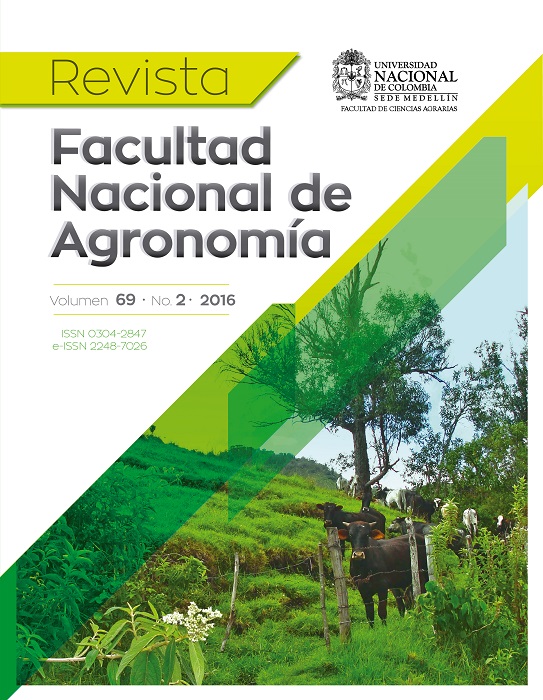
Characterization of a processed cheese spread produced from fresh cheese (quesito antioqueño)
Caracterización de un queso procesado untable elaborado a partir de queso fresco (quesito antioqueño)
DOI:
https://doi.org/10.15446/rfna.v69n2.59146Keywords:
Processed cheese, Fresh cheese, Emulsifying salts (en)Queso fundido, Queso fresco, Sal fundente (es)
References
AOAC International (AOAC). 1997. Official methods of analysis of AOACinternational.16th ed. AOAC International, Arlington, VA.
Awad R, Abdel-Hamid L and El-Shabrawy. 2001. Texture and microstructure of block type processed cheese with formulated emulsifying salt mixtures. Food Science and Technology 35(1): 54-61. doi: 10.1006/fstl.2001.0828.
Brookfield Engineering Laboratories. 2008. Brookfield DV-III Ultra Programmable Rheometer. Manual de operaciones. First edition. Middleboro. 122 p.
Bunka F, Doudová L, Weiserová E, Kuchar D, Ponízil P, Zacalova D, Nagyová G, Pachlová V and Michalék J. 2013. The effect of ternary emulsifying salt composition and cheese maturity on the textural properties of processed cheese. International Dairy Journal 29(1): 1-7. doi: 10.1016/j.idairyj.2012.09.006
Cortes M, García A and Suarez M. 2007. Fortificación de hongos comestibles (Pleurotus ostreatus) con calcio, selenio y vitamina C. VITAE, Revista de la Facultad de Química Farmacéutica 14 (1): 16-24.
Cunha C and Viotto V. 2009. Casein peptization, functional properties, and sensory acceptance of processed cheese spreads made with different emulsifying salts. Journal of Food Science 75 (1): 113-120. doi: 10.1111/j.1750-3841.2009.01444.x.
Dimitreli G and Thomareis A. 2008. Effect of chemical composition on the linear viscoelastic properties of spreadable-type processed cheese. Journal of Food Engineering 84 (1): 368-374. doi: 10.1016/j.jfoodeng.2007.05.030
FDA (Food and Drug Administration). 2013. 21 CFR, Part 133.179. Food and Drug Administration. Washington, D.C.: Dept. of Health and Human Services.
Frau S, Pece N and Font G. 2005. Determinación de parámetros reológicos de quesos untables comerciales de cabra en la provincia de Santiago del Estero. Tesis de Ingeniero de Alimentos. Instituto de Ciencia y Tecnología, Universidad Nacional de Santiago del Estero. 30 p.
Fox P, Mc Sweeney L, Cogan T and Guinee T. 2004. Capitulo II: Salt in cheese: physical, chemical and biological aspects. pp. 207-259. En: Fox PF, Mc Sweeney PLH, Cogan TM and Guinee TP (eds.). Cheese chemistry. Physics and Microbiology. Tercera edición. El Servier. Amsterdam. 609 p.
Guinee T. 2004. Salting and the role of the salt in cheese. International. Journal of Dairy Technology 57(1): 99-109. doi: 10. 1111/j.1471-0307.2004.00145.x
Hladká K, Randulová Z, Tremlová B, Ponízil P, Mancík P, Cerníková M and Bunka F. 2014. The effect of cheese maturity on selected properties of processed cheese without traditional emulsifying agents. Food Science and Technology 55(2): 650-656.doi: 10.1016/j.lwt.2013.10.023
Hoffman W, Gartner J, Luck K, Johannsen, N and Maurer A. 2012. Effect of emulsifying salts containing potassium on the quality of block-type processed cheese. International Dairy Journal 25(1): 66-72. doi: 10.1016/j.idairyj.2011.11.010
Kapoor R and Metzger L. 2008. Process cheese: scientific and technological aspects -A review. Comprehensive Reviews in Food Science and Food Safety 7(2): 194-214. doi:10.1111/j.1541-4337.2008.00040.x
Law B and Tamime A. 2010. Technology of Cheesemaking. Segunda edición. Blackwell Publishing Ltd. New Jersey. 77-79 p.
López J, Rodriguez E and Sepúlveda J. 2012. Evaluación de características físicas y texturales de pandebono. Acta Agronómica, 61(3): 273-281.
Mayer H. 2001. Bitterness in processed cheese caused by an overdose of a specific emulsifying agent?. International Dairy Journal 11(4-7): 533-542. doi: 10.1016/S0958-6946(01)00068-1
Monroy K. 2007. Propiedades funcionales de los principales quesos elaborados en el valle de Tulancingo, Hidalgo. Tesis de Licenciada en Química de Alimentos. Instituto de Ciencias Básicas e Ingeniería. Universidad Autónoma del Estado de Hidalgo. 105p.
Peláez P, Fresno M, Días C and Darias J. 2003. Caracterización físico-química de quesos frescos elaborados con leche de cabra en la isla de Tenerife. Ciencia y Tecnología Alimentaria 4(2): 103-108. doi: 10.1080/11358120309487750
Pereira R, Bennet R and Hemar Y. 2001. Rheological and microstructural characteristics of model processed cheese analogues. Journal of Texture Studies 31: 349-373. doi: 10.1111/j.17 45-4603.2001.tb01242.x
Piska I and Stetina J. 2004. Influence of cheese ripening and rate of cooling of the processed cheese mixture on rheological properties of processed cheese. Journal of food engineering 61(4): 551-555. doi: 10.1016/S0260-8774(03)00217-6
Ruiz V. 2007. Aplicación de hidrocoloides en queso procesado untable. Tesis de Licenciado en Ciencia de los Alimentos. Facultad de Ciencias Agrarias. Universidad Austral de Chile. 73 p.
Sádlíková I, Bunka F, Budinský P, Barbora V, Pavlínek V and Hoza I. 2010. The effect of selected phosphate emulsifying salts on viscoelastic properties of processed cheese. Food Science and Technology 43(8): 1220-1225. doi: 10.1016/j.lwt.2010.04.012
Sepúlveda J, 2007. Desarrollo de quesos frescos con la adición del cultivo probiótico Lactobacillus casei. Tesis de Magister en Ciencia y Tecnología de Alimentos. Instituto de Farmacia y Alimentos. Universidad de la Habana. 135p.
Sousa M, Ardo Y and McSweeney M. 2001. Advances in the study of proteolysis during cheese ripening. International Dairy Journal 11: 327-345. doi: 10.1016/S0958-6946(01)00062-0
Tamime A. 2007. Structure of dairy products. Primera edición. Blackwell Publishing Ltd. New Jersey. p 210-235.
Tamime A. 2011. Processed cheese and analogues: An overview. Primera edición. Blackwell Publishing Ltd. New Jersey. pp. 7-8.
Weiserová E, Doudová L, Galiová, Zák L, Michalék J, Janis R and Bunka F. 2011. The effect of combinations of sodium phosphates in binary mixtures on selected texture parameters of processed cheese spreads. International Dairy Journal 21(12): 979-986. doi: 10.1016/j.idairyj.2011.06.006
Zhang X, Yang Y and Zhao D. 2011. Effect of blueberry on spreadable processed cheese. Journal of Northeast Agricultural University 18(2): 73-78. doi: 10.1016/S1006-8104(12)60013-0
Dimensions
PlumX
Article abstract page views
Downloads
How to Cite
License
Copyright (c) 2016 Revista Facultad Nacional de Agronomía Medellín

This work is licensed under a Creative Commons Attribution-NonCommercial-NoDerivatives 4.0 International License.
The journal allows the author(s) to maintain the exploitation rights (copyright) of their articles without restrictions. The author(s) accept the distribution of their articles on the web and in paper support (25 copies per issue) under open access at local, regional, and international levels. The full paper will be included and disseminated through the Portal of Journals and Institutional Repository of the Universidad Nacional de Colombia, and in all the specialized databases that the journal considers pertinent for its indexation, to provide visibility and positioning to the article. All articles must comply with Colombian and international legislation, related to copyright.
Author Commitments
The author(s) undertake to assign the rights of printing and reprinting of the material published to the journal Revista Facultad Nacional de Agronomía Medellín. Any quotation of the articles published in the journal should be made given the respective credits to the journal and its content. In case content duplication of the journal or its partial or total publication in another language, there must be written permission of the Director.
Content Responsibility
The Faculty of Agricultural Sciences and the journal are not necessarily responsible or in solidarity with the concepts issued in the published articles, whose responsibility will be entirely the author or the authors.