Publicado
Costos e impacto económico del síndrome de apnea-hipopnea obstructiva del sueño (SAHOS) para la salud pública
Cost and economic impact of obstructive sleep apnea-hypopnea syndrome (OSAHS) on public health
DOI:
https://doi.org/10.15446/revfacmed.v65n1Sup.59570Palabras clave:
Apnea obstructiva del sueño, Economía, Costo de enfermedad, Sistemas de salud, Accidentes. (es)Sleep Apnea, Obstructive, Economics, Cost of Illness, Health Care Systems, Accidents. (en)
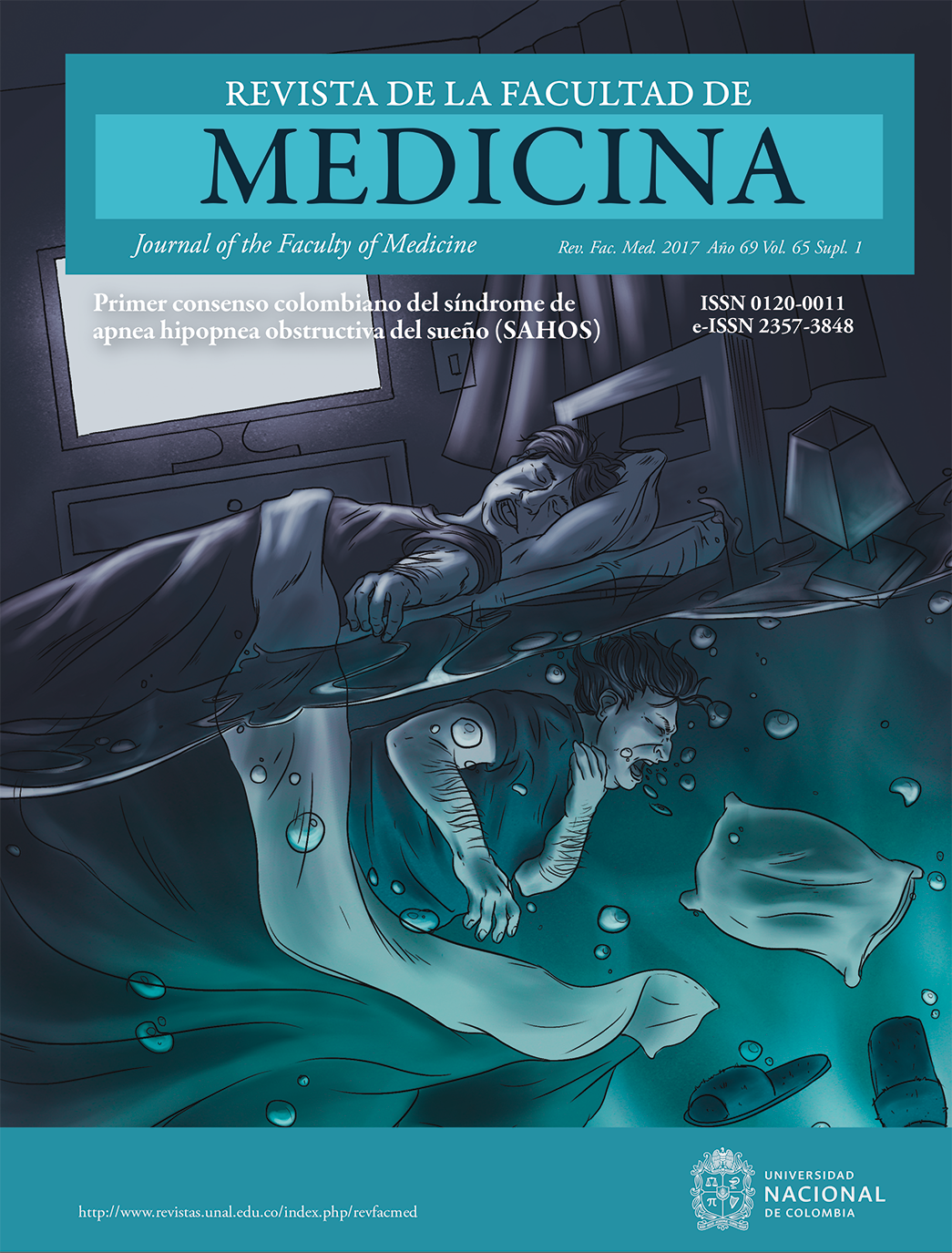
El síndrome de apnea-hipopnea obstructiva del sueño (SAHOS) no tratado se asocia con costos directos e indirectos significativos. Este trastorno también tiene un impacto negativo sobre el desempeño y la seguridad laboral y está implicado en una proporción considerable de accidentes automovilísticos. El diagnóstico oportuno y la terapia óptima han mostrado disminución en la utilización de los sistemas de salud y en los costos, al tiempo que atenúan los riesgos adversos. Del mismo modo, el SAHOS no tratado se asocia con incremento en las tasas de desempleo. Para los profesionales de la salud, tener un paciente con SAHOS involucrado en una colisión automovilística es de crucial importancia debido al daño personal y público, así como la potencial discapacidad física por el accidente. En Latinoamérica se requiere de la medición de los costos directos e indirectos dado el problema de salud pública que tiene asociado el SAHOS y las implicaciones mencionadas.
Untreated obstructive sleep apnea-hypopnea syndrome (OSAHS) is associated with significant direct and indirect medical costs. This disorder also has a significant negative impact on work performance and safety, and is implicated in a substantial proportion of motor vehicular crashes. Timely diagnosis and optimal therapy have shown a lower utilization rate related to health care systems and reduced costs, while adverse risks are mitigated at the same time.
Prompt diagnosis and optimal therapy have shown to decrease heath care utilizaton and costs, as well as mitigating these adverse risks.
Similarly, untreated OSAHS is associated with higher unemployment rates. For health care professionals, having a patient with OSAHS involved in a MVC is of paramount importance for a several reasons, including personal and public damage, as well as the potential physical disability that may be caused by the accident. In Latin America, measuring direct and indirect costs is necessary considering the public health problem associated with OSAHS and the implications mentioned above.
Referencias
Peppard PE, Young T, Barnet JH, Palta M, Hagen EW, Hla KM. Increased prevalence of sleep-disordered breathing in adults. Am J Epidemiol. 2013;177(9):1006-14. http://doi.org/bnjg.
Olaithe M, Bucks RS. Executive dysfunction in OSA before and after treatment: a meta-analysis. Sleep. 2013;36(9):1297-305. http://doi.org/bnxz.
Yaffe K, Laffan AM, Harrison SL, Redline S, Spira AP, Ensrud KE, et al. Sleep-disordered breathing, hypoxia, and risk of mild cognitive impairment and dementia in older women. JAMA. 2011;306(6):613-9. http://doi.org/bhj879.
Young T, Palta M, Dempsey J, Peppard PE, Nieto FJ, Hla KM. Burden of sleep apnea: rationale, design, and major findings of the Wisconsin Sleep Cohort study. WMJ. 2009;108(5):246-9.
Yaggi HK, Concato J, Kernan WN, Lichtman JH, Brass LM, Mohsenin V. Obstructive sleep apnea as a risk factor for stroke and death. N Engl J Med. 2005;353(19):2034-41. http://doi.org/bvsxsj.
Kryger MH, Roos L, Delaive K, Walld R, Horrocks J. Utilization of health care services in patients with severe obstructive sleep apnea. Sleep. 1996;19(Suppl 9):S111-6.
Kapur V, Blough Dk, Sandblom RE, Hert R, de Maine JB, Sullivan SD, et al. the medical cost of undiagnosed sleep apnea. Sleep. 1999;22(6):749-55.
Albarrak M, Banno K, Sabbagh AA, Delaive K, Walld R, Manfreda J, et al. Utilization of healthcare resources in obstructive sleep apnea syndrome: a 5-year follow-up study in men using CPAP. Sleep. 2005;28(10):1306-11.
Smith R, Ronald J, Delaive K, Walld R, Manfreda J, Kryger MH. What are obstructive sleep apnea patients being treated for prior to this diagnosis? Chest. 2002;121(1):164-72. http://doi.org/d884nc.
Ronald J, Delaive K, Roos L, Manfreda J, Bahammam A, Kryger MH. Health care utilization in the 10 years prior to diagnosis in obstructive sleep apnea syndrome patients. Sleep. 1999;22(2):225-9.
Berg G, Delaive K, Manfreda J, Walld R, Kryger MH. The use of health-care resources in obesity-hypoventilation syndrome. Chest. 2001;120(2):377-83. http://doi.org/ctcqj7.
Jennum P, Kjellberg J. Health, social and economical consequences of sleep-disordered breathing: a controlled national study. Thorax. 2011;66(7):560-6. http://doi.org/bft4jz.
Jennum P, Ibsen R, Kjellberg J. Social consequences of sleep disordered breathing on patients and their partners: a controlled national study. Eur Respir J. 2014;43(1):134-44. http://doi.org/bnx2.
Collop NA, Anderson WM, Boehlecke B, Claman D, Goldberg R, Gottlieb DJ, et al. Clinical guidelines for the use of unattended portable monitors in the diagnosis of obstructive sleep apnea in adult patients. Portable Monitoring Task Force of the American Academy of Sleep Medicine. J Clin Sleep Med. 2007;3(7):737-47.
The New England Comparative Effectiveness Public Advisory Council. Diagnosis and Treatment of Obstructive Sleep Apnea in Adults. Rockville, MD: Institute for Clinical & Economic Review; 2012 [cited 2015 May 3]. Available from: http://goo.gl/532tv9.
Simoens S. How to assess the value of medicines? Front Pharmacol. 2010;1:115. http://doi.org/fw4957.
Tousignant P, Cosio MG, Levy RD, Groome PA. Quality adjusted life years added by treatment of obstructive sleep apnea. Sleep. 1994;17(1):52-60.
Chervin RD, Murman DL, Malow BA, Totten V. Cost-utility of three approaches to the diagnosis of sleep apnea: polysomnography, home testing, and empirical therapy. Ann Intern Med. 1999;130(6):496-505. http://doi.org/bn2b.
Brown DL, Chervin RD, Hickenbottom SL, Langa KM, Morgenstern LB. Screening for obstructive sleep apnea in stroke patients: a cost-effectiveness analysis. Stroke. 2005;36(6):1291-3. http://doi.org/cffcfk.
Ayas NT, FitzGerald JM, Fleetham JA, White DP, Schulzer M, Ryan CF, et al. Cost-effectiveness of continuous positive airway pressure therapy for moderate to severe obstructive sleep apnea/hypopnea. Arch Intern Med. 2006;166(9):977-84. http://doi.org/fjggbv.
Deutsch PA, Simmons MS, Wallace JM. Cost-effectiveness of split-night polysomnography and home studies in the evaluation of obstructive sleep apnea syndrome. J Clin Sleep Med. 2006;2(2):145-53.
Tan MCY, Ayas NT, Mulgrew A, Cortes L, FitzGerald JM, Fleetham JA, et al. Cost-effectiveness of continuous positive airway pressure therapy in patients with obstructive sleep apnea-hypopnea in British Columbia. Can Respir J. 2008;15(3):159-65. http://doi.org/bnx5.
Weatherly HLA, Griffin SC, Mc Daid C, Durée KH, Davies RJO, Stradling JR, et al. An economic analysis of continuous positive airway pressure for the treatment of obstructive sleep apnea-hypopnea syndrome. Int J Technol Assess Health Care. 2009;25(1):26-34. http://doi.org/c3kjfj.
Sadatsafavi M, Marra CA, Ayas NT, Stradling J, Fleetham J. Cost-effectiveness of oral appliances in the treatment of obstructive sleep apnoea-hypopnoea. Sleep Breath. 2009;13(3):241-52. http://doi.org/cmf9dg.
Pietzsch JB, Garner A, Cipriano LE, Linehan JH. An integrated health-economic analysis of diagnostic and therapeutic strategies in the treatment of moderate-to-severe obstructive sleep apnea. Sleep. 2011;34(6):695-709. http://doi.org/b9sn4r.
Quinnell TG, Bennett M, Jordan J, Clutterbuck-James AL, Davies MG, Smith IE, et al. A crossover randomised controlled trial of oral mandibular advancement devices for obstructive sleep apnoea-hypopnoea (TOMADO). Thorax. 2014;69(10):938-45. http://doi.org/bn2c.
Pietzsch JB, Liu S, Garner AM, Kezirian EJ, Strollo PJ. Long-Term Cost-Effectiveness of Upper Airway Stimulation for the Treatment of Obstructive Sleep Apnea: A Model-Based Projection Based on the STAR Trial. Sleep. 2015;38(5):735-44. http://doi.org/bnx9.
Tan KB, Toh ST, Guilleminault C, Holty J-EC. A Cost-Effectiveness Analysis of Surgery for Middle-aged Men with Severe Obstructive Sleep Apnea Intolerant of CPAP. J Clin Sleep Med. 2014;11(5):525-35. http://doi.org/bnzb.
Rosen CL, Auckley D, Benca R, Foldvary-Schaefer N, Iber C, Kapur V, et al. A multisite randomized trial of portable sleep studies and positive airway pressure autotitration versus laboratory-based polysomnography for the diagnosis and treatment of obstructive sleep apnea: the HomePAP study. Sleep. 2012;35(6):757-67. http://doi.org/bnx3.
Ayas NT, Pack A, Marra C. The demise of portable monitoring to diagnose OSA? Not so fast! Sleep. 2011;34(6):691-2. http://doi.org/d6kh9k.
Guest JF, Helter MT, Morga A, Stradling JR. Cost-effectiveness of using continuous positive airway pressure in the treatment of severe obstructive sleep apnoea/hypopnoea syndrome in the UK. Thorax. 2008;63(10):860-5. http://doi.org/b6d6t3.
Trakada G, Economou N-T, Nena E, Trakada A, Zarogoulidis P, Steiropoulos P. A health-economic analysis of diagnosis and treatment of obstructive sleep apnea with continuous positive airway pressure in relation to cardiovascular disease. The Greek experience. Sleep Breath. 2015;19(2):467-72. http://doi.org/bnx6.
Guest JF, Panca M, Sladkevicius E, Taheri S, Stradling J. Clinical outcomes and cost-effectiveness of continuous positive airway pressure to manage obstructive sleep apnea in patients with type 2 diabetes in the U.K. Diabetes Care. 2014;37(5):1263-71. http://doi.org/bnx7.
Strollo PJ Jr, Soose RJ, Maurer JT, de Vries N, Cornelius J, Froymovich O, et al. Upper-airway stimulation for obstructive sleep apnea. N Engl J Med. 2014;370(2):139-49. http://doi.org/b7x8.
Ulfberg J, Carter N, Talbäck M, Edling C. Excessive daytime sleepiness at work and subjective work performance in the general population and among heavy snorers and patients with obstructive sleep apnea. Chest. 1996;110(3):659-63. http://doi.org/b8m46w.
Mulgrew AT, Ryan CF, Fleetham JA, Cheema R, Fox N, Koehoorn M, et al. The impact of obstructive sleep apnea and daytime sleepiness on work limitation. Sleep Med. 2007;9(1):42-53. http://doi.org/c4md6k.
Omachi TA, Claman DM, Blanc PD, Eisner MD. Obstructive sleep apnea: a risk factor for work disability. Sleep. 2009;32(6):791-8.
Lindberg E, Carter N, Gislason T, Janson C. Role of snoring and daytime sleepiness in occupational accidents. Am J Respir Crit Care Med. 2001;164(11):2031-5. http://doi.org/bnzc.
Spengler SE, Browning SR, Reed DB. Sleep deprivation and injuries in part-time Kentucky farmers: impact of self reported sleep habits and sleep problems on injury risk. AAOHN J. 2004;52(9):373-82.
Jurado-Gámez B, Guglielmi O, Gude F, Buela-Casal G. Workplace Accidents, Absenteeism and Productivity in Patients with Sleep Apnea. Arch Bronconeumol. 2015;51(5):213-8. http://doi.org/f2x9hw.
Hägg SA, Torén K, Lindberg E. Role of sleep disturbances in occupational accidents among women. Scand J Work Environ Health. 2015;41(4):368-76. http://doi.org/f3nntb.
Centers for Disease Control and Prevention (CDC). Motor vehicle crash deaths in metropolitan areas--United States, 2009. MMWR Morb Mortal Wkly Rep. 2012;61(28):523-8.
Ellen RLB, Marshall SC, Palayew M, Molnar FJ, Wilson KG, Man-Son-Hing M. Systematic review of motor vehicle crash risk in persons with sleep apnea. J Clin Sleep Med. 2006;2(2):193-200.
Arita A, Sasanabe R, Hasegawa R, Nomura A, Hori R, Mano M, et al. Risk factors for automobile accidents caused by falling asleep while driving in obstructive sleep apnea syndrome. Sleep Breath. 2015;19(4):1229-34. http://doi.org/bnzd.
Karimi M, Hedner J, Zou D, Eskandari D, Lundquist A-C, Grote L. Attention deficits detected in cognitive tests differentiate between sleep apnea patients with or without a motor vehicle accident. Sleep Med. 2015;16(4):528-33. http://doi.org/f3nj92.
Turkington PM, Sircar M, Allgar V, Elliott MW. Relationship between obstructive sleep apnoea, driving simulator performance, and risk of road traffic accidents. Thorax. 2001;56(10):800-5. http://doi.org/chmdm9.
Littner MR, Kushida C, Wise M, Davila DG, Morgenthaler T, Lee-Chiong T, et al. Practice parameters for clinical use of the multiple sleep latency test and the maintenance of wakefulness test. Sleep. 2005;28(1):113-21.
Philip P, Sagaspe P, Taillard J, Chaumet G, Bayon V, Coste O, et al. Maintenance of Wakefulness Test, obstructive sleep apnea syndrome, and driving risk. Ann Neurol. 2008;64(4):410-6. http://doi.org/bbzck7.
Pizza F, Contardi S, Mondini S, Trentin L, Cirignotta F. Daytime sleepiness and driving performance in patients with obstructive sleep apnea: comparison of the MSLT, the MWT, and a simulated driving task. Sleep. 2009;32(3):382-91.
Sagaspe P, Taillard J, Chaumet G, Guilleminault C, Coste O, Moore N, et al. Maintenance of wakefulness test as a predictor of driving performance in patients with untreated obstructive sleep apnea. Sleep. 2007;30(3):327-30.
Arzi L, Shreter R, El-Ad B, Peled R, Pillar G. Forty- versus 20-minute trials of the maintenance of wakefulness test regimen for licensing of drivers. J Clin Sleep Med. 2009;5(1):57-62.
Philip P, Chaufton C, Taillard J, Sagaspe P, Léger D, Raimondi M, et al. Maintenance of Wakefulness Test scores and driving performance in sleep disorder patients and controls. Int J Psychophysiol. 2013;89(2):195-202. http://doi.org/f5fj5p.
Svider PF, Pashkova AA, Folbe AJ, Eloy JD, Setzen M, Baredes S, et al. Obstructive sleep apnea: strategies for minimizing liability and enhancing patient safety. Otolaryngol Head Neck Surg. 2013;149(6):947-53. http://doi.org/bnzf.
Ayas N, Skomro R, Blackman A, Curren K, Fitzpatrick M, Fleetham J, et al. Obstructive sleep apnea and driving: A Canadian Thoracic Society and Canadian Sleep Society position paper. Can Respir J. 2014;21(2):114-23. http://doi.org/bnzg.
Bonnie RJ, George CF. Liabilities of sleep deprivation and sleep disorders. UpToDate. [Cited 2015 May 6]. Available from: http://goo.gl/vqSDht.
Hartenbaum N, Collop N, Rosen IM, Phillips B, George CFP, Rowley JA, et al. Sleep apnea and commercial motor vehicle operators: Statement from the joint task force of the American College of Chest Physicians, the American College of Occupational and Environmental Medicine, and the National Sleep Foundation. Chest. 2006;130(3):902-5. http://doi.org/bq6q64.
Escobar-Córdoba F, Liendo C. Trastornos respiratorios del sueño y alteraciones cardiovasculares. Rev Fac Med. 2012;60(1):1-3.
Banco Mundial. América Latina y el Caribe. [Cited 2015 Jun]. Available from: http://goo.gl/RjGlmN.
The World Bank. HNP Data Dashboards. [Cited 2015 Jun]. Available from: http://goo.gl/XnOl24.
Gutiérrez-Álvarez AM, Vélez-van Meerbeke A, Venegas-Mariño MA. Proceso clínico-administrativo para el diagnóstico de los pacientes con SAHOS: duración y costos. Acta Neurol Colomb. 2006;22:12-24.
Ministerio de Salud y Protección Social, Colciencias. Guía de práctica clínica para el Síndrome Coronario Agudo. 2nd ed. Bogotá D.C.: MinSalud; 2013.
Ministerio de Salud y Protección Social, Colciencias. Guía de práctica clínica para Hipertensión arterial primaria (HTA). Bogotá D.C. MinSalud; 2013.
Pagel JF. Obstructive Sleep Apnea (OSA) in Primary Care: Evidence-based Practice. J Am Board Fam Med. 2007;20(4):392-8. http://doi.org/fjkjrn.
McDaid C, Griffin S, Weatherly H, Durée K, van der Burgt M, van Hout S, et al. Continuous positive airway pressure devices for the treatment of obstructive sleep apnoea–hypopnea syndrome: a systematic review and economic analysis. Health Technol Assess. 2009;3(4):iii-iv, xi-xiv. http://doi.org/bmqb.
Torre-Bouscoulet L, Castorena-Maldonado A, Meza-Vargas MS. Otras consecuencias de los trastornos del dormir. A propósito de los accidentes vehiculares. Rev. Inst. Nal. Enf. Resp. Méx. 2005;18(2):162-9.
Dimensions
PlumX
Visitas a la página del resumen del artículo
Descargas
Cómo citar
Licencia
Derechos de autor 2017 Revista de la Facultad de Medicina

Esta obra está bajo una licencia Creative Commons Reconocimiento 3.0 Unported.
-