
Publicado
Componentes químicos y actividad antimicrobiana del aceite esencial de Lasiocephalus ovatus (Asteraceae) que crece en Ecuador
Chemical components and antimicrobial activity of the essential oil of Lasiocephalus ovatus (Asteraceae) that grows in Ecuador
DOI:
https://doi.org/10.15446/abc.v25n1.75728Palabras clave:
Antibacteriano, antifúngico, constituyentes químicos, extracto vegetal volátil (es)Antibacterial, antifungal, chemical constituents, volatile plant extract (en)
Descargas
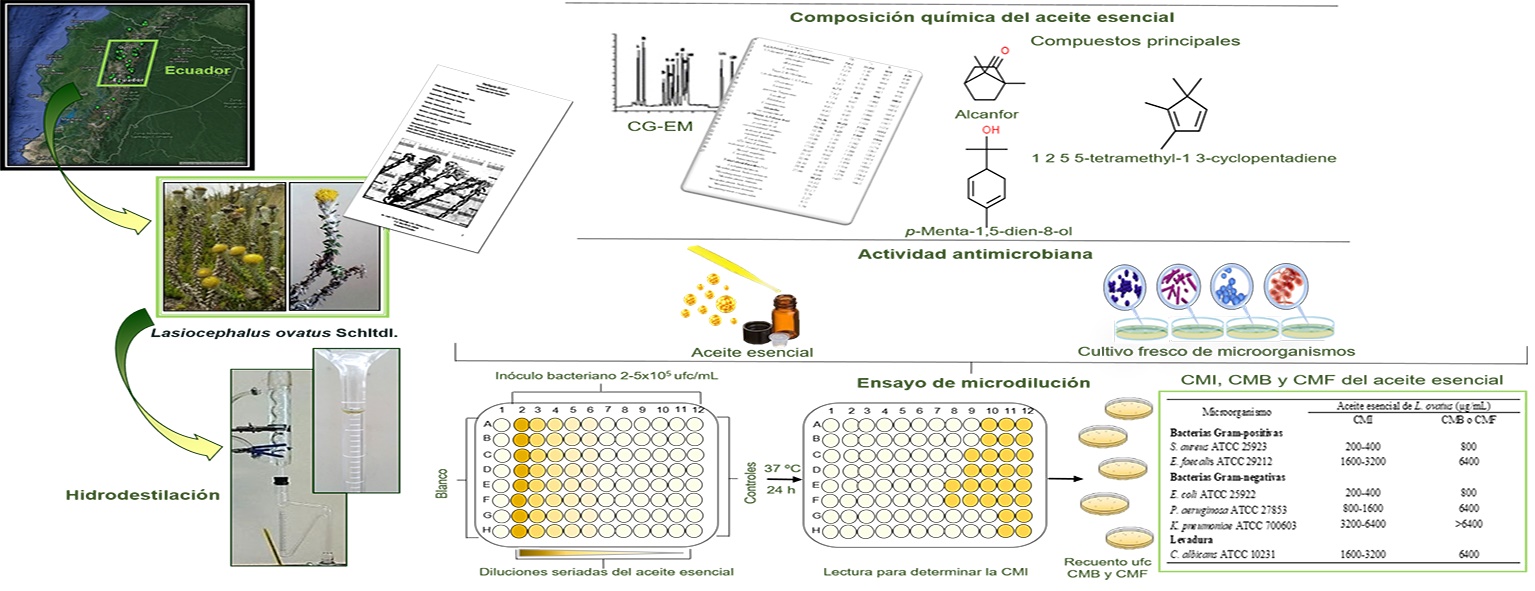
Ecuador es uno de los países más ricos en biodiversidad y endemismo del mundo, y cerca de 3200 especies de plantas tienen usos medicinales. El objetivo de esta investigación fue evaluar la composición química y el efecto antimicrobiano del aceite esencial de Lasiocephalus ovatus Schltdl. (Asteraceae) colectada en la provincia de Chimborazo, Ecuador. Las partes aéreas de L. ovatus fueron sometidas a hidrodestilación para obtener el aceite esencial, el cual fue analizado mediante cromatografía de gases acoplada a espectrometría de masas. La actividad fue evaluada frente a cinco bacterias y una levadura usando la técnica de microdilución en caldo en microplacas de 96 pozos. El rendimiento del aceite fue de 0,05 % y 27 compuestos fueron identificados, representando 95,45 % de la composición total con un elevado contenido de monoterpenos oxigenados (52,17 %). Los compuestos mayoritarios fueron alcanfor (40,48 %) y 1,2,5,5-tetrametil-1,3-ciclopentadieno (11,90 %), seguido por p-menta-1,5-dien-8-ol (5,23 %) y 1,6-dimetilhepta-1,3,5-trieno (4,69 %). Las bacterias más sensibles a la acción del aceite fueron Staphylococcus aureus ATCC 25923 y Escherichia coli ATCC 25922 con concentraciones mínimas inhibitorias de 200-400 μg/mL y bactericidas de 800 μg/mL. La inhibición antimicrobiana frente a las bacterias Enterococcus faecalis ATCC 29212, Pseudomonas aeruginosa ATCC 27853, Klebsiella pneumoniae ATCC 700603 y la levadura Candida albicans ATCC 10231 fue baja, con un rango de concentración mínima inhibitoria de 800 a 6400 μg/mL. Este reporte representa un primer análisis de la actividad antimicrobiana del aceite de L. ovatus, por lo tanto, una contribución importante al estudio del género Lasiocephalus.
Ecuador is one of the richest countries in biodiversity and endemism in the world, and nearly 3200 plant species have medicinal uses. The aim of this investigation was to evaluate the chemical composition and the antimicrobial effect of essential oil of Lasiocephalus ovatus Schltdl. (Asteraceae) collected at Chimborazo Province, Ecuador. The aerial parts of L. ovatus were subjected to hydrodistillation to obtain essential oil, which was analyzed by gas chromatography coupled to mass spectrometry. The activity was evaluated against five bacteria and one yeast using the broth microdilution technique in 96-well microplates. The oil yield was of 0.05 %, and 27 compounds were identified, representing 95.45 % of the total composition with a high content of oxygenated monoterpenes (52.17
%). The main compounds were camphor (40.48 %) and 1,2,5,5-tetramethyl-1,3-cyclopentadiene (11.90 %) followed by p-mentha- 1,5-dien-8-ol (5.23 %) and 1,6-dimethylhepta-1,3,5-triene (4.69 %). The antimicrobial effect of the essential oil was major against Staphylococcus aureus ATCC 25923 and Escherichia coli ATCC 25922 with minimum inhibitory concentrations of 200-400 μg/mL and bactericidal of 800 μg/mL. Antimicrobial inhibition against the bacteria Enterococcus faecalis ATCC 29212, Pseudomonas aeruginosa ATCC 27853, Klebsiella pneumoniae ATCC 700603 and the yeast Candida albicans ATCC 10231 was low, with minimum inhibitory concentration ranging from 800 to 6400 μg/mL. This report represents a first study of the chemical composition and antimicrobial activity of the oil of L. ovatus, therefore, an important contribution to the study of the genus Lasiocephalus.
Referencias
Adams RP. Identification of essential oil components by gas chromatography/mass spectrometry. 4.1 ed. Allured Publishing Corporation: Carol Stream, IL, USA, 2017. ISBN 978-0-932633-21-4.
Aquino R, Morelli S, Tomaino A, Pellegrino M, Saija A, Grumetto L, et al. Antioxidant and photoprotective activity of a crude extract of Culcitium reflexum H.B.K. leaves and their major flavonoids. J Ethnopharmacol. 2002;79(2):183-191. Doi: https://doi.org/10.1016/S0378-8741(01)00379-8.
Bassolé IH, Juliani HR. Essential oils in combination and their antimicrobial properties. Molecules. 2012;17(4):3989-4006. Doi: https://doi.org/10.3390/molecules17043989.
Calvo J, Freire E. A nomenclator of Senecio group Lasiocephalus (Compositae, Senecioneae): nomenclatural and taxonomic notes and new typifications. Phytotaxa. 2016;260(2):116–130. Doi: http://dx.doi.org/10.11646/phytotaxa.260.2.2
Cerón C. Plantas medicinales de los Andes ecuatorianos, In: M, Øllgaard B, Kvist L, Borchsenius F, Balslev H, editor(es). Botánica Económica de los Andes Centrales. La Paz: Universidad Mayor de San Andrés; 2006. p. 285-293.
Coté H, Boucher MA, Pichette A, Legault J. Anti-Inflammatory, antioxidant, antibiotic, and cytotoxic activities of Tanacetum vulgare L, essential oil and its constituents. Medicines (Basel). 2017;4(2):1-9. Doi: https://doi.org/10.3390/medicines4020034.
Cristani M, D'Arrigo M, Mandalari G, Castelli F, Sarpietro MG, Micieli D, et al. Interaction of four monoterpenes contained in essential oils with model membranes: Implications for their antibacterial activity. J Agric Food Chem. 2007;55(15):6300-6308. Doi; https://doi.org/10.1021/jf070094x.
Davies NW. Gas chromatographic retention indices of monoterpenes and sesquiterpenes on methyl silicone and Carbowax 20M phases. J Chromatogr A. 1990;503:1-24. Doi: https://doi.org/10.1016/S0021-9673(01)81487-4.
De Almeida RRP, Souto RNP, Silva MHL, Bastos CN, Da Silva MHL, Maia JGS. Chemical variation in Piper aduncum and biological properties of its dillapiole-rich essential oil. Chem Biodivers. 2009;6(9):1427-1434. Doi: https://doi.org/10.1002/cbdv.200800212
De Bernardi M, Vidari G, Vita P, Abdo S, Marinoni G, Mellerio G. Medicinal plant metabolites, III: GS-MS analysis of the essential oil of Lasiocephalus ovatus. Rev Latinoam Quim. 1990;21(3-4):97-98.
De Bernardi M, Vidari G, Vita P, Abdo S, Marinoni G, Mellerio G. Metabolites of medicinal plants, II, Furanoeremophilanes from Lasiocephalus ovatus. Gaz Chim It. 1988;118(8):565–568.
de la Torre L, Alarcón D, Kvist LP, Salazar J. Usos medicinales de las plantas. En: de la Torre L, Navarrete H, Muriel M, Macía MJ, Balslev H, editores. Enciclopedia de las plantas útiles del Ecuador. Quito y Aarhus: Herbario QCA de la Escuela de Ciencias Biológicas de la Pontífica Universidad Católica del Ecuador y Herbario AAU del Departamento de Ciencias Biológicas de la Universidad de Aarhus; 2008. p. 106-108. Disponible en: https://www.academia.edu/30089423/Enciclopedia_de_Plantas_U_tiles_del_Ecuador
Ghelichnia H. Essential oil composition of Thymus fedtschenkoi Ronniger at different growing altitudes in Mazandaran, Iran. Cercetări Agronomice în Moldova. 2018;51(2):75-83. Doi: https://doi.org/10.2478/cerce-2018-0018.
Gill AO, Holley RA. Disruption of Escherichia coli, Listeria monocytogenes and Lactobacillus sakei cellular membranes by plant oil aromatics. Int J Food Microbiol. 2006;108(1):1-9. Doi: https://doi.org/10.1016/j.ijfoodmicro.2005.10.009.
Gupta N, Saxena G. Antimicrobial activity of constituents identified in essential oils from Mentha and Cinnamomum through GC-MS. Int J Pharma Bio Sci. 2010;1(4):715–720.
Hamidpouri R, Hamidpour S, Hamidpour M, Shahlar M. Camphor (Cinnamomum camphora), a traditional remedy with the history of treating several diseases. Int J Case Rep Imag. 2013;4(2):86-89. Doi: https://doi.org/0.5348/ijcri-2013-02-267-RA-1.
Holetz FB, Pessini GL, Sanches NR, Cortes DAG, Nakamura CV, Philo BPD. Screening of some plants used in the Brazilian folk medicine for the treatment of infectious diseases. Mem Inst Oswaldo Cruz. 2002;97(7):1027-1031. Doi: http://dx.doi.org/10.1590/S0074-02762002000700017.
Hsouna AB, Halima NB, Abdelkafi S, Hamdi N. Essential oil from Artemisia phaeolepis: Chemical composition and antimicrobial activities. J Oleo Sci. 2013;62(12):973–980. Doi: https://doi.org/10.5650/jos.62.973.
Kotan R, Kordali S, Cakir A. Screening of antibacterial activities of twenty-one oxygenated monoterpenes. Z Naturforsch C. 2007;62(7-8):507-513. Doi: https://doi.org/10.1515/znc-2007-7-808.
Lis-Balchin ML. Aromatherapy Science: A Guide for Healthcare Professionals. Londres: Pharmaceutical press; 2006. P. 462.
Maffei M. Environmental factors affecting the oil composition of some Mentha species grown in north west Italy, Flavour Frag J. 1988;3(2):79-84. Doi: https://doi.org/10.1002/ffj.2730030206.
Magiatis P, Skaltsounis AL, Chinou I, Haroutounian SA. Chemical composition and in-vitro antimicrobial activity of the essential oils of three Greek Achillea species. Znaturforsch. 2002;57(3-4):287-290. Doi: https://doi.org/10.1515/znc-2002-3-415.
Moujir L, Seca A, Araujo L, Silva A, Barreto C. A new natural spiro heterocyclic compound and the cytotoxic activity of the secondary metabolites from Juniperus brevifolia leaves. Fitoterapia. 2011;82(2):225–229. Doi: https://doi.org/10.1016/j.fitote.2010.10.001.
Rios M, Koziol MJ, Borgtoft H, Granda G, editores. Plantas útiles del Ecuador: aplicaciones, retos y perspectivas/Useful plants of Ecuador: Applications, challenges, and perspectives. Quito: Corporación Sociedad para la Investigación y Monitoreo de la Biodiversidad Ecuatoriana (SIMBIOE); 2007. 662 p.
Rondón ME, Morales A, Buitrago D, Rojas J, Gualtieri M. Comparative study of the chemical composition of the essential oil of the Lasiocephalus longepenicillatus (Schultz-Bip, ex Sandw,) Cuatrec, (Senecio longepenicillatus) in two seasons of the year. Ciencia. 2005;13(4):440-442.
Ruales C, Guevara JE. La flora patrimonial de Quito descubierta por la expedición de Humboldt y Bonpland en el año 1802. Avances 2010;2(3):B54-B63. Doi: http://dx.doi.org/10.18272/aci.v2i3.45.
Sikkema J, De Bont JA, Poolman B. Interactions of cyclic hydrocarbons with biological membranes. J. Biol. Chem. 1994, 269(11):8022-8028.
Sikkema J, De Bont JA, Poolman B. Mechanisms of membrane toxicity of hydrocarbons. Microbiol Rev. 1995;59(2):201–222.
Silva-Moure K, Torrecilla P, Lapp M. Taxonomía de Lasiocephalus Willd. ex Schltdl. (Asteraceae) en Venezuela. Ernstia 2013; 23(2):91-116..
Soković M, Glamočlija J, Marin PD, Brkić D, van Griensven LJ. Antibacterial Effects of the Essential oils of commonly consumed medicinal herbs using an in vitro model. Molecules. 2010;15(11):7532-7546. Doi: https://doi.org/10.3390/molecules15117532.
Swamy MK, Akhtar MS, Sinniah UR. Antimicrobial properties of plant essential oils against human pathogens and their mode of action: An updated review. Evid Based Complement Alternat Med. 2016;2016(3012462):1-21. Doi: http://dx.doi.org/10.1155/2016/3012462.
Turina AV, Nolan MV, Zygadlo JA, Perillo MA. Natural terpenes: Self-assembly and membrane partitioning. Biophys Chem. 2006;122(2):101-113. Doi: https://doi.org/10.1016/j.bpc.2006.02.007.
White A, Hierbas del Ecuador: plantas medicinales. Quito: Editorial Ediciones Libri Mundi; 1985. 379 p.
Xu H, Blair NT, Clapham DE. Camphor activates and strongly desensitizes the transient receptor potential vanilloid subtype 1 channel in a vanilloid-independent mechanism. J Neurosci. 2005;25(39):8924–8937. Doi: https://doi.org/10.1523/JNEUROSCI.2574-05.2005.
Dimensions
PlumX
Visitas a la página del resumen del artículo
Descargas
Cómo citar
Licencia
Derechos de autor 2020 Acta Biológica Colombiana

Esta obra está bajo una licencia internacional Creative Commons Atribución-NoComercial-CompartirIgual 4.0.
1. La aceptación de manuscritos por parte de la revista implicará, además de su edición electrónica de acceso abierto bajo licencia Attribution-NonCommercial-ShareAlike 4.0 (CC BY NC SA), la inclusión y difusión del texto completo a través del repositorio institucional de la Universidad Nacional de Colombia y en todas aquellas bases de datos especializadas que el editor considere adecuadas para su indización con miras a incrementar la visibilidad de la revista.
2. Acta Biológica Colombiana permite a los autores archivar, descargar y compartir, la versión final publicada, así como las versiones pre-print y post-print incluyendo un encabezado con la referencia bibliográfica del articulo publicado.
3. Los autores/as podrán adoptar otros acuerdos de licencia no exclusiva de distribución de la versión de la obra publicada (p. ej.: depositarla en un archivo telemático institucional o publicarla en un volumen monográfico) siempre que se indique la publicación inicial en esta revista.
4. Se permite y recomienda a los autores/as difundir su obra a través de Internet (p. ej.: en archivos institucionales, en su página web o en redes sociales cientificas como Academia, Researchgate; Mendelay) lo cual puede producir intercambios interesantes y aumentar las citas de la obra publicada. (Véase El efecto del acceso abierto).




