Publicado
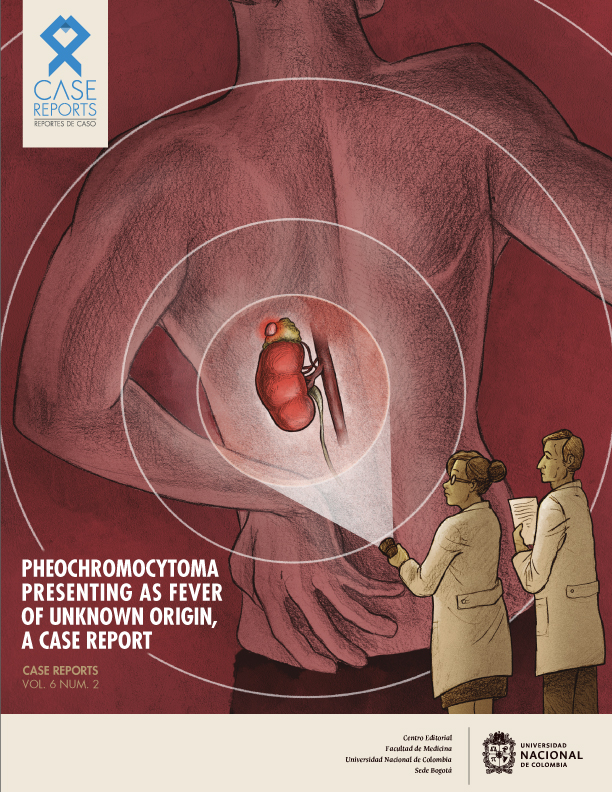
Pheochromocytoma presenting as fever of unknown origin, a case report
Fiebre de origen desconocido secundaria a un feocromocitoma. Reporte de caso
DOI:
https://doi.org/10.15446/cr.v6n2.84240Palabras clave:
Pheochromocytoma, Fever of Unknown Origin, Interleukin-6 (en)Feocromocitoma, Fiebre de origen desconocido, Interleucina-6 (es)
Descargas
Introduction: Pheochromocytoma is a generally benign neoplasm derived from chromaffin cells of the adrenal medulla. It is characterized by the production of large amounts of catecholamines and also by the capacity to secrete bioactive peptides such as cytokines, mainly interleukin-1 (IL-1), interleukin-6 (IL-6) and TNF alpha.
Case presentation: 24-year-old man, who consulted for fever, myalgia, and choluria. His laboratory tests were compatible with a systemic inflammatory response without infectious or autoimmune causes. However, a fluorodeoxyglucose positron emission tomography (FDGPET) revealed a left adrenal mass, without extra-adrenal lesions. On admission, increased levels of differentiated urine methanephrines, elevated baseline cortisol, non-suppressed adrenocorticotrophic hormone (ACTH), and positive low dose dexamethasone suppression test for cortisol were found. With suspicion of catecholamine and ACTH-producing pheochromocytoma, a tumor resection was performed, which conspicuously resolved all alterations of the inflammatory response. The histologic findings confirmed a pheochromocytoma, but the immunostaining for ACTH was negative. A literature review and the comparison of the findings with other reported cases allowed inferring that this was a case of interleukin-producing pheochromocytoma.
Conclusion: Pheochromocytoma may be a cause of febrile syndrome, with IL-6 being the main mediator, which explains the manifestationsof systemic inflammation and ACTH-mediated hypercortisolism.
Introducción. Un feocromocitoma es una neoplasia generalmente benigna de las células cromafines de la médula suprarrenal que se caracteriza por producir grandes cantidades de catecolaminas y que tiene la capacidad de secretar citoquinas como interleucina-1 (IL-1), interleucina-6 (IL-6) y factor de necrosis tumoral (TNF) alfa.
Presentación del caso. Paciente masculino de 24 años de edad, quien consultó por fiebre, mialgias y coluria. El sujeto presentó laboratorios compatibles con respuesta inflamatoria sistémica sin causa infecciosa o autoinmune y estudio de tomografía por emisión de positrones con fluorodesoxiglucosa que evidenció masa suprarrenal izquierda sin lesiones extra-adrenales. Al ingreso, los niveles de metanefrinas diferenciadas en orina y de cortisol basal se encontraban elevados; la hormona adrenocorticotropa (ACTH) no estaba suprimida, y el test de supresión de cortisol con dexametasona registró rango de hipercortisolismo. Se sospechó diagnóstico de feocromocitoma productor de catecolaminas y ACTH, por lo que se llevó a resección tumoral, con lo cual, llamativamente, se resolvieron todas las anomalías de respuesta inflamatoria. El reporte de patología confirmó un feocromocitoma, pero la inmunotinción para ACTH fue negativa. La revisión de la literatura y la comparación de los hallazgos con otros casos reportados permitieron inferir que se trató de un feocromocitoma productor de interleucinas.
Conclusión. El feocromocitoma puede ser una causa de síndrome febril, siendo la IL-6 el mediador principal que explicaría las manifestaciones de inflamación sistémica y el hipercortisolismo mediado por ACTH.
Referencias
Brown I, Finnigan NA. Fever of Unknown Origin (FUO). In: StatPearls. Treasure Island: StatPearls Publishing; 2019.
Kantorovich V, Pacak K. Pheochromocytoma and paraganglioma. Prog Brain Res. 2010;182:343-73. http://doi.org/cpwzpv.
Cunha BA, Lortholary O, Cunha CB. Fever of unknown origin: a clinical approach. Am. J. Med. 2015;128(10):1138.e1-1138.e15. http://doi.org/f3jbfm.
Zarkovic M, Ignjatovic S, Dajak M, Ciric J, Beleslin B, Savic S, et al. Cortisol response to ACTH stimulation correlates with blood interleukin-6 concentration in healthy humans. Eur J Endocrinol. 2008;159(5):649-52. http://doi.org/bvxpg4.
Navarra P, Tsagarakis S, Faria MS, Rees LH, Besser GM, Grossman AB. Interleukins-1 and-6 stimulate the release of corticotropin-releasing hormone-41 from rat hypothalamus in vitro via the eicosanoid cyclooxygenase pathway. Endocrinology. 1991;128(1):37-44. http://doi.org/dbd6cn.
Spinedi E, Hadid R, Daneva T, Gaillard RC. Cytokines stimulate the CRH but not the vasopressin neuronal system: evidence for a median eminence site of interleukin-6 action. Neuroendocrinology. 1992;56(1):46-53. http://doi.org/b4fshc.
Tsigos C, Papanicolaou DA, Defensor R, Mitsiadis CS, Kyrou I, Chrousos GP. Dose effects of recombinant human interleukin-6 on pituitary hormone secretion and energy expenditure. Neuroendocrinology. 1997;66(1):54-62. http://doi.org/c3b3fm.
Bethin KE, Vogt SK, Muglia LJ. Interleukin-6 is an essential, corticotropin-releasing hormone-independent stimulator of the adrenal axis during immune system activation. Proc Natl Acad Sci U SA. 2000;97(16):9317-22. http://doi.org/dw2hjf.
López-Calderón A, Calderón MD, Tresguerres JAF. Médula suprarrenal. In: Pombo M, Audí L, Bueno M, Calzada R, Cassorla F, Diéguez C, et al., editors. Tratado de endocrinología pediátrica. 4th ed. Barcelona: McGraw-Hill; 2019.
Filella X, Molina R, Ballesta AM. Estructura y función de las citocinas. Med Integr. 2003;39(2):63-71.
Blomqvist A, Engblom D. Neural Mechanisms of Inflammation-Induced Fever. Neuroscientist. 2018;24(4):381-99. http://doi.org/gc7bmr.
Saavedra-Ramírez PG, Vásquez-Duque GM, González-Naranjo LA. Interleucina-6: ¿amiga o enemiga? Bases para comprender su utilidad como objetivo terapéutico. Iatreia. 2011 [cited 2019 Oct 11];24(2):157-66. Available from: https://bit.ly/380MDZ2.
Venihaki M, Dikkes P, Carrigan A, Karalis KP. Corticotropin-releasing hormone regulates IL-6 expression during inflammation. J. Clin. Invest. 2001;108(8):1159-66. http://doi.org/dqn8s2.
Contreras MG, Bonilla-Lara D, Pérez-Guerreo EE, Ruiz-Padilla AJ. Saucedo-Ulloa M, Saldaña-Angiano JM, et al. Niveles altos de IL-6 asociados a efectos sistémicos y locales en la artritis reumatoide. El Residente. 2015;10(1):38-42.
Melmed S, Jameson JL. Hipófisis anterior: fisiología de las hormonas hipofisarias. In: Kasper D, Fauci A, Hauser S, Longo D, Jameson JL, Loscalzo J, editors. Harrison. Principios de Medicina Interna. 19th ed. New York: McGraw-Hill; 2019 [cited 2020 Jun 25]. Available from: https://bit.ly/3dDCAdr.
Sokabe A, Mizooka M, Sakemi R, Kobayashi T, Kishikawa N, Yokobayashi K. et al. Systemic Inflammatory Syndrome Associated with a Case of Jugular Paraganglioma. Intern Med. 2016;55(15):2105-8. http://doi.org/f8xxtc.
Willenberg HS, Päth G, Vögeli TA, Scherbaum WA, Bornstein SR. Role of interleukin-6 in stress response in normal and tumorous adrenal cells and during chronic inflammation. Ann N Y Acad Sci. 2002;966:304-14. http://doi.org/dnkcpf.
Toth B, Yokoyama Y, Schwacha MG, George RL, Rue LW, Bland KI, et al. Insights into the role of interleukin-6 in the induction of hepatic injury after trauma-hemorrhagic shock. J Appl Physiolo (1985). 2004;97(6):2184-2189. http://doi.org/b3fk6n.
Pérez-Guerra V, Ramírez-Cardona L, Yepes-Grajales OM, Vélez-Rivera JD, Marín-Zuluaga JI. Falla hepática aguda sobre crónica. Rev Col Gastroenterol. 2016 [cited 2019 Oct 11];31(3):262- 72. Available from: https://bit.ly/2VjbEtn.
Vilalta NP, de Puig AC. Gonadotropinas (LH y FSH) y corticotropina (ACTH). Endocrinol Nutr. 2007;54(2):109-17. http://doi.org/b3qfzg.
Tokuda H, Hosoi T, Hayasaka K, Okamura K, Yoshimi N, Kozawa O. Overexpression of protein kinase C-delta plays a crucial role in interleukin-6-producing pheochromocytoma presenting with acute inflammatory syndrome: a case report. Horm Metab Res. 2009;41(4):333-8. http://doi.org/bn7zs4.
Suzuki K, Miyashita A, Inoue Y, Iki S, Enomoto H, Takahashi Y, et al. Interleukin-6-Producing Pheochromocytoma. Acta Haematol. 1991;85(4):217-9. http://doi.org/dbtjch.
Shimizu C, Kubo M, Takano K, Takano A, Kijima H, Saji H, et al. Interleukin-6 (IL-6) producing pheochromocytoma: direct IL-6 suppression by non-steroidal anti-inflammatory drugs. Clin Endocrinol (Oxf). 2001;54(3):405-10. http://doi.org/bc4d7v.
Yarman S, Soyluk O, Altunoglu E, Tanakol R. Interleukin-6-producing pheochromocytoma presenting with fever of unknown origin. Clinics (Sao Paulo). 2011;66(10):1843-5. http://doi.org/dkps95.
Cheng X, Zhang M, Xiao Y, Li H, Zhang Y, Ji Z. Interleukin-6-producing pheochromocytoma as a new reason for fever of unknown origin: a retrospective study. Endocr Pract. 2018;24(6):507-511. http://doi.org/d2f6.
Siddiqui UM, Matta S, Wessolossky MA, Haas R. Fever of Unknown Origin: Could It Be a Pheochromocytoma? A Case Report and Review of the Literature. Case Rep Endocrinol. 2018;2018:3792691. http://doi.org/d2f8.
Minetto M, Dovio A, Ventura M, Cappia S, Daffar F, Terzolo M, et al. Interleukin-6 producing pheochromocytoma presenting with acute inflammatory syndrome. J Endocrinol Invest. 2003;26(5):453-7. http://doi.org/d2f9.
Carvalho-Cunha N, Gomes L, Saraiva J, Paiva I. Interleukin-6 Producing Pheochromocytoma: A Rare Cause of Systemic Inflammatory Response Syndrome. Case Rep Endocrinol. 2019;2019:7906272. http://doi.org/d2gb.
Dimensions
PlumX
Visitas a la página del resumen del artículo
Descargas
Cómo citar
Licencia
Derechos de autor 2020 Case Reports

Esta obra está bajo una licencia internacional Creative Commons Atribución 4.0.
Los autores al someter sus manuscritos conservarán sus derechos de autor. La revista tiene el derecho del uso, reproducción, transmisión, distribución y publicación en cualquier forma o medio.
El Formulario de Divulgación Uniforme para posibles Conflictos de Interés y los oficios de cesión de derechos y de responsabilidad deben ser entregados junto con el original.
Aquellos autores/as que tengan publicaciones con esta revista, aceptan los términos siguientes:
Los autores/as conservarán sus derechos de autor y garantizarán a la revista el derecho de primera publicación de su obra, el cual estará simultáneamente sujeto a la Licencia de reconocimiento de Creative Commons 4.0 que permite a terceros compartir la obra siempre que se indique su autor y su primera publicación en esta revista.
Los autores/as podrán adoptar otros acuerdos de licencia no exclusiva de distribución de la versión de la obra publicada (p. ej.: depositarla en un archivo telemático institucional o publicarla en un volumen monográfico) siempre que se indique la publicación inicial en esta revista.
Se permite y recomienda a los autores/as difundir su obra a través de Internet (p. ej.: en archivos telemáticos institucionales o en su página web) antes y durante el proceso de envío, lo cual puede producir intercambios interesantes y aumentar las citas de la obra publicada. (Véase El efecto del acceso abierto).