Publicado
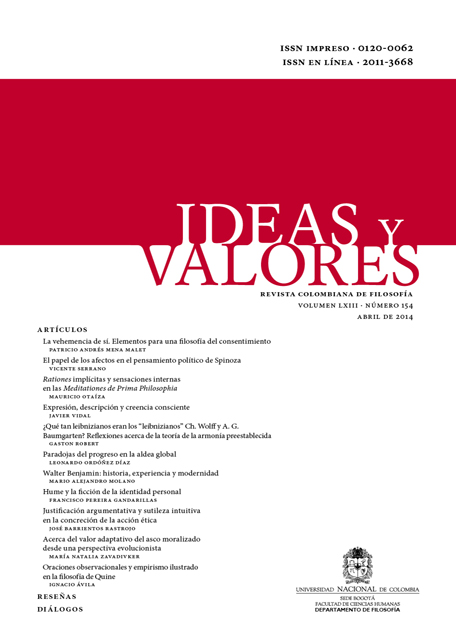
Acerca del valor adaptativo del asco moralizado desde una perspectiva evolucionista
DOI:
https://doi.org/10.15446/ideasyvalores.v63n154.32807Palabras clave:
A. Salles, asco moralizado, emociones, estrategias adaptativas, moral (es)Se aborda, desde una perspectiva evolucionista, el papel desempeñado por el "asco moralizado", entendido como repulsión emocional ante individuos y prácticas sociales que consideramos objeto de evaluación moral. Se parte de un análisis general de la emoción de asco y sus desencadenantes. A continuación, se abordan dos posiciones opuestas en relación con la confiabilidad y valor instrumental del asco para promover juicios morales "adecuados" e incitar a la acción moral. Se propone una reinterpretación del problema desde un enfoque evolucionista, procurando correlacionar los diversos juicios de valor que puede promover el asco moralizado, con diferentes estrategias adaptativas. Finalmente, se correlacionan tales estrategias con posiciones morales liberales y conservadoras.
Referencias
Bloom, P. Descartes' Baby: How the Science of Child Development Explain What Makes Us Human. New York: Basic Books, 2004.
Damasio, A. El error de Descartes [1994]. Barcelona: Crítica, 2008.
Darwin, C. The Expression of Emotions in Man and Animals [1872]. 3rd ed. New York: Oxford University Press, 1998.
Dawkins, R. El gen egoísta [1976]. Barcelona: Salvat, 2002.
De Waal, F. Primates y filósofos. La evolución de la moral del simio al hombre. Barcelona: Paidós, 2007.
Duffy, E. "Activation". Handbook of Psychophisiology [1972], Greenfield, N. S. & Sternach, R. A. (eds.). New York: Holt, Rinehart and Winston, 1993. 572-622.
García, V. & Sibils, R. "Las emociones: nuevas perspectivas desde el psicoanálisis y las neurociencias". Ponencia presentada en el 7° Congreso Virtual de Psiquiatría Interpsiquis, 2006.
Greenspan, P. Emotions and Reasons. London: Routledge, 1988.
James, W. "What Is an Emotion?", Mind 9/34 (1884): 188-205.
Kahan, D. "The Progressive Appropriation of Disgust". The Passions of Law, Bandes, S. (ed.). New York / London: New York University Press, 1999. 63-79.
McGinn, C. "Evolution, Animals and the Basis of Morality", Inquiry 22/1-4 (1979): 81-99.
Miller, G. The Mating Mind: How Sexual Choice Shaped the Evolution of Human Nature. London: Heineman, 2000.
Moore, M. (dir.). Bowling for Columbine. Dog Eat Dog Films / Alliance Atlantis Communications, 2002. Film.
Nussbaum, M. "Secret Sewers of Vice: Disgust, Bodies and the Law". The Passions of Law, Bandes, S. (ed.). New York / London: New York University Press, 1999. 19-62.
Nussbaum, M. Upheavals of Thought. Cambridge: Cambridge University Press, 2001.
Nussbaum, M. Hiding from Humanity. Princeton: Princeton University Press, 2004.
Panksepp, J. "Affective neuroscience: A conceptual framework for the neurobiological study of emotions", International Review of emotions research I (1991): 59-99.
Rosas, A. "La moral y sus sombras. La racionalidad instrumental y la evolución de las normas de equidad", Crítica. Revista Hispanoamericana de Filosofía 37/110 (2005): 79-104.
Rozin, P. "Moralization". Morality and Health, Brandt, A. & Rozin, P. (eds.). New York: Routledge, 1997. 379-401.
Rozin, P., Haidt, J. & McCauley, C. R. "Disgust". Handbook of Emotions, Lewis, M. & Haviland, J. (comps.). New York: Guilford, 1993. 575-594.
Rozin, P., Haidt, J. & McCauley, C. R. "Disgust: The Body and Soul Emotion". Handbook of Cognition and Emotion, Dalgleish, T & Power, M. (comps.). New York: Wiley, 1999. 429-445.
Rozin, P., Lowery, L., Imada, S. & Haidt, J. "The CAD Triad Hypothesis: A Mapping between Three Moral Emotions (Contempt, Anger, Disgust) and Three Moral Codes (Community, Autonomy, Divinity)", Journal of Personality and Social Psychology 76/ 4 (1999): 574-586.
Salles, A. L. F. "Sobre el asco en la moralidad", Diánoia LV/ 64 (2010): 27-45.
Shweder, R., Much, N., Mahapatra, M. & Park, L. "The 'Big Three' of Morality (Autonomy, Community and Divinity) and the 'Big Three' Explanations of Suffering". Morality and Health, Brandt, A. & Rozin, P. (eds.). New York: Routledge, 1997. 119-169.
Smith, A. A Theory of Moral Sentiments [1759]. New York: Modern Library, 1937.
Tomkins, S. S. Affect, Imagery, Consciousness. The Positive Affects. vol 1. New York: Springer, 1962.
Trivers, R. "The Evolution of Reciprocal Altruism", The Quarterly Review of Biology 46/1 (1971): 35-57.
Van den Berghe, P. L. The Ethnic Phenomenon. New York: Elsevier, 1981.
Williams, G. C. Adaptation and Natural Selection: A Critic of Some Current Evolutionary Thougth. Princeton: Princeton University Press, 1966.
Zahavi, A. The Handicap Principle: A Missing Piece of Darwin's Puzzle. Oxford: Oxford University Press, 1997.
Zavadivker, M. N. "¿Es la autoconciencia susceptible de justificación biológica?", Ludus Vitalis 16/30 (2008):75-99.
Dimensions
PlumX
Visitas a la página del resumen del artículo
Descargas
Cómo citar
Licencia
Derechos de autor 2016 Universidad Nacional de Colombia

Esta obra está bajo una licencia internacional Creative Commons Atribución 4.0.
De acuerdo con la Licencia Creative Commons Atribución-No Comercial-SinDerivar 4.0 Internacional. Se autoriza copiar, redistribuir el material en cualquier medio o formato, siempre y cuando se conceda el crédito a los autores de los textos y a Ideas y Valores como fuente de publicación original. No se permite el uso comercial de copia o distribución de contenidos, así como tampoco la adaptación, derivación o transformación alguna de estos sin la autorización previa de los autores y de la dirección de Ideas y Valores. Para mayor información sobre los términos de esta licencia puede consultar: http://creativecommons.org/licenses/by-nc-nd/4.0/legalcode.










.jpg)