Publicado
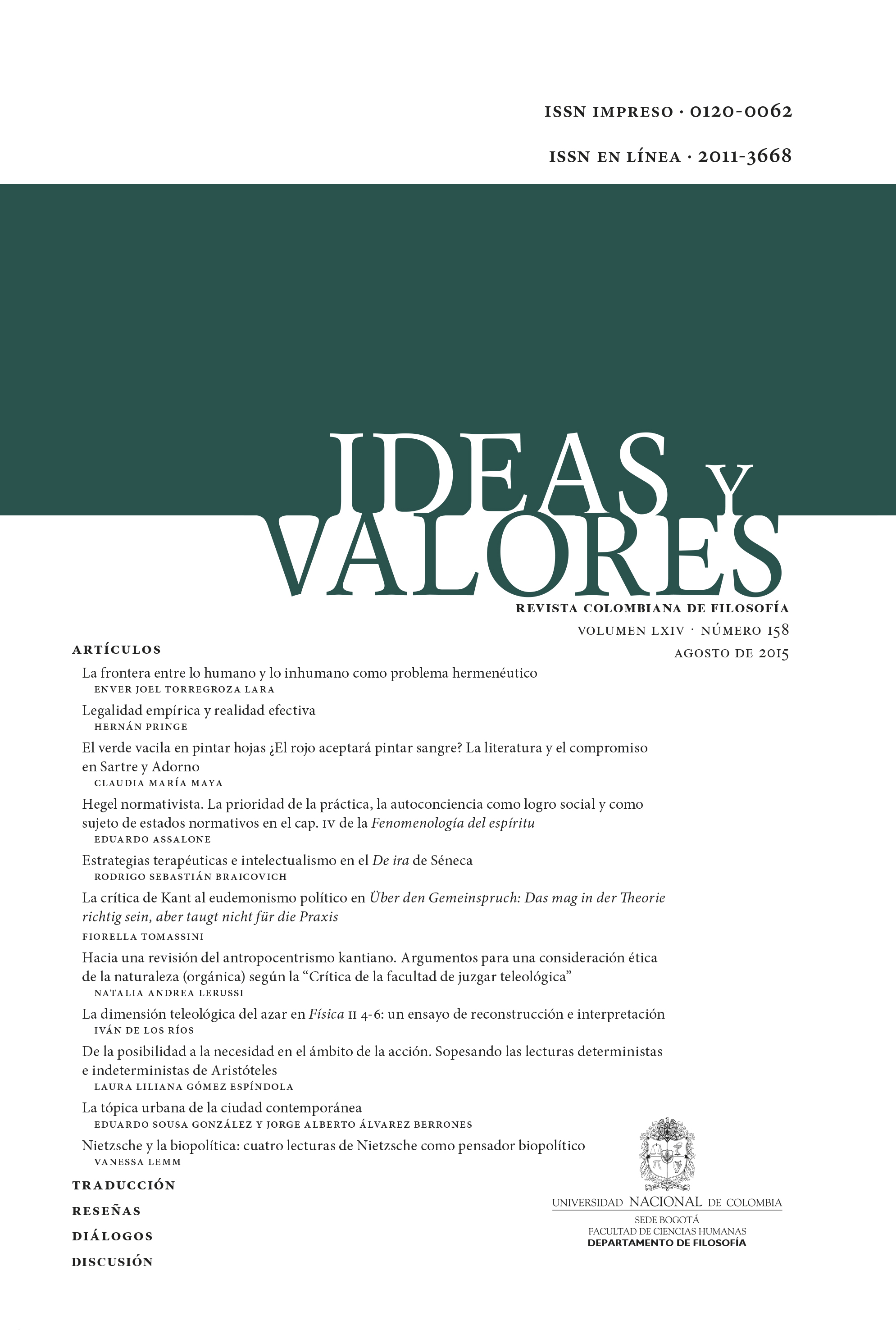
Hegel normativista La prioridad de la práctica, la autoconciencia como logro social y como sujeto de estados normativos, en el cap. IV de la Fenomenología del espíritu
DOI:
https://doi.org/10.15446/ideasyvalores.v64n158.40479Palabras clave:
G. W. F. Hegel, autoconciencia, filosofía analítica, neo-hegelianos de Pittsburgh. (es)Se desarrolla la concepción normativista de la autoconciencia hegeliana, de acuerdo con los aportes de los denominados “neohegelianos de Pittsburgh” (Robert Brandom, John McDowell), así como de otros autores anglosajones como Robert Pippin, Terry Pinkard y Paul Redding. Se presenta el recorrido de la autoconciencia en el capítulo IVde la Fenomenología del Espíritu, y se desarrollan algunos rasgos que pueden extraerse de dicha presentación, de acuerdo con la lectura normativista de los autores mencionados
Referencias
Armstrong Kelly, G. “Notes on Hegel’s ‘Lordship and Bondage’.” The Review of Metaphysics 19.4 (1966): 780-802.
Bavaresco, A. “Silogismo e Inferencialismo: Aproximações entre Hegel e Brandom.” VI Congresso Internacional da Sociedade Hegel Brasileira. 200 anos da Ciência da Lógica (1812). Sociedade Hegel Brasileira, Rio de Janeiro, octubre de 2011. Conferencia. http://www.hegelbrasil.org/gthegel/arquivos/agemirbavaresco.pdf.
Berto, F. “Hegel’s Dialectics as a Semantic Theory: An Analytic Reading.” European Journal of Philosophy 15.1 (2007): 19-30.
Beiser, F. C. German Idealism. The Struggle against Subjectivism, 1781-1801. Cambridge MA; London: Harvard University Press, 2008.
Beiser, F. C. Hegel. New York; London: Routledge, 2005.
Brandom, R. B. Making It Explicit. Reasoning, Representing, and Discursive Commitment. 1994. London; Cambridge, MA: Harvard University Press, 2001.
Brandom, R. B. Tales of the Mighty Dead. Historical Essays in the Metaphysics of Intentionality. London; Cambridge, MA: Harvard University Press, 2002.
Brandom, R. B. “The Structure of Desire and Recognition: Self-Consciousness and Self-Constitution.” Recognition and Social Ontology. Eds. Heikki Ikäheimo and Arto Laitinen. Leiden; Boston: Brill, 2011. 23-52. http://dx.doi.org/10.1163/ ej.9789004202900.i-398.13.
Flay, J. C. Hegel’s Quest for Certainty. Albany: State University of New York Press, 1984.
Gabriel, M. Transcendental Ontology. Essays in German Idealism. London; New York: Continuum, 2011.
Hegel, G. W. F. Phenomenology of Spirit. Trans. Arnold V. Miller. Oxford: Oxford University Press, 1977.
Hegel, G. W. F. “Phänomenologie des Geistes.” Werke. Band III. 1807. Frankfurt am Main: Suhrkamp Verlag, 1986.
Hegel, G. W. F. Fenomenología del Espíritu. Trad. Wenceslao Roces. Buenos Aires: Fondo de Cultura Económica, 2006.
Houlgate, S. “G.W.F. Hegel: The Phenomenology of Spirit.” The Blackwell Guide to Continental Philosophy. Eds. Robert Solomon and David Sherman. Oxford: Blackwell, 2003. 8-29. http://dx.doi.org/10.1002/9780470997093.ch2.
Knowles, D. Routledge Philosophy GuideBook to Hegel and the Philosophy of Right. London: Routledge, 2002.
McDowell, J. Having the World in View. Essays on Kant, Hegel and Sellars. Cambridge, MA: Harvard University Press, 2009.
Neuhouser, F. “Desire, Recognition, and the Relation between Bondsman and Lord.” The Blackwell Guide to Hegel’s Phenomenology of Spirit. Ed. Kenneth Westphal. Oxford: Blackwell, 2009. 37-54. http://dx.doi.org/10.1002/9781444306224.ch2.
O’Connor, B. “German Idealism and Normativity.” International Journal of Philosophical Studies 17.1 (2009): 3-7.
Ornelas Bernal, J. “¿Es relevante lo ‘dado’ para la justificación?” Contrastes. Revista Internacional de Filosofía 7 (2002): 115-133.
Pinkard, T. Hegel’s Phenomenology. The Sociality of Reason. Cambridge: Cambridge University Press, 1994.
Pippin, R. B. Hegel’s Idealism. The Satisfactions of Self-Consciousness. Cambridge: Cambridge University Press, 1989.
Pippin, R. B. “Brandom’s Hegel.” European Journal of Philosophy 13.3 (2005): 381-408. http://dx.doi.org/10.1111/j.1468-0378.2005.00235.x.
Pippin, R. B. Hegel on Self-Consciousness. Desire and Death in the Phenomenology of Spirit. Princeton; Oxford: Princeton University Press, 2011.
Redding, P. Analytic Philosophy and the Return of Hegelian Thought. Cambridge: Cambridge University Press, 2007. http://dx.doi.org/10.1017/CBO9780511487620.
Redding, P. “The Analytic Neo-Hegelianism of John McDowell & Robert Brandom.” The Blackwell Companion to Hegel. Eds. Stephen Houlgate and Michael Baur. Oxford: Blackwell, 2011. 576-593. http://dx.doi.org/10.1002/9781444397161.ch28.
Rockmore, T. Hegel, Idealism and Analytic Philosophy. New Haven; London: Yale University Press, 2005. http://dx.doi.org/10.12987/yale/9780300104509.001.0001.
Sellars, W. “Empiricism and the Philosophy of Mind.” Knowledge, Mind, and the Given. Reading Wilfrid Sellars’s “Empiricism and the Philosophy of Mind”. Eds. Willem DeVries and Timm Triplett. Indianapolis; Cambridge: Hackett Publishing Company, 2000. 205-276.
Dimensions
PlumX
Visitas a la página del resumen del artículo
Descargas
Cómo citar
Licencia
Derechos de autor 2015 Universidad Nacional de Colombia

Esta obra está bajo una licencia internacional Creative Commons Atribución-NoComercial-SinDerivadas 4.0.
De acuerdo con la Licencia Creative Commons Atribución-No Comercial-SinDerivar 4.0 Internacional. Se autoriza copiar, redistribuir el material en cualquier medio o formato, siempre y cuando se conceda el crédito a los autores de los textos y a Ideas y Valores como fuente de publicación original. No se permite el uso comercial de copia o distribución de contenidos, así como tampoco la adaptación, derivación o transformación alguna de estos sin la autorización previa de los autores y de la dirección de Ideas y Valores. Para mayor información sobre los términos de esta licencia puede consultar: http://creativecommons.org/licenses/by-nc-nd/4.0/legalcode.










.jpg)