Publicado
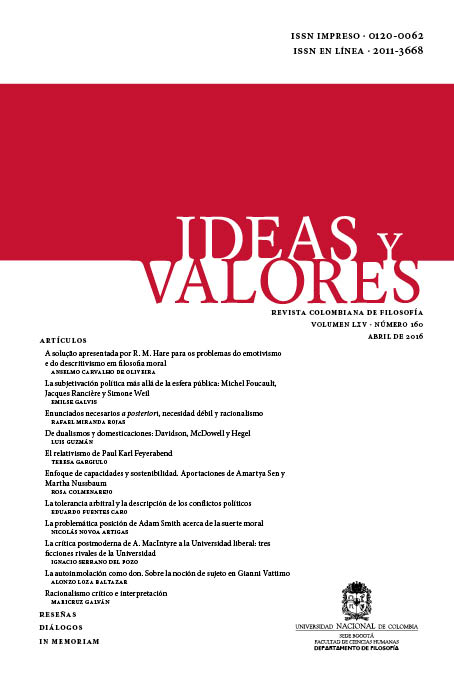
El relativismo de Paul Karl Feyerabend
DOI:
https://doi.org/10.15446/ideasyvalores.v65n160.42248Palabras clave:
P. K. Feyerabend, filosofía de la ciencia, relativismo, metafísica de la abundancia (es)Los críticos que han interpretado el pensamiento de Feyerabend como un relativismo radical no hacen justicia a su intencionalidad, y se muestran incapaces de comprender la unidad de su obra, en particular, su abandono posterior de los ideales relativis-tas. Se busca distinguir las diversas posiciones de Feyerabend frente al relativismo y exponer su reducción al absurdo de las nociones de la ciencia propias del positivis-mo lógico y del racionalismo crítico. Así mismo, se plantea cómo Feyerabend, ante la ausencia de un criterio para discernir la tarea científica, postula un relativismo, pero, al final de su vida, busca elaborar una metafísica de la abundancia que supere las coordenadas de aquel.
Referencias
Agassi, E. “Against Method: Outline of an Anarchistic Theory of Knowledge, by Paul K. Feyerabend, London: New Left Books 1975, 339 pp.”Philosophia 6.1 (1976): 165-177. http://dx.doi.org/10.1007/BF02383263.
Andersson, G. “Introducción: presupuestos, problemas, progreso.” Estructura y desarrollo de la ciencia. Eds. Gerard Radnitzky y Gunnar Andersson. Madrid: Alianza, 1984. 13-23.
Bhaskar, R.“Feyerabend and Bachelard: Two Philosophies of Science.” New Left Review 1.94 (1975): 31-55.
Broad, P. F. “Paul Feyerabend: Science and the Anarchist.” Science 206.4418 (1979): 534-537. http://dx.doi.org/10.1126/science.386510.
Bunge, M. Cápsulas. Barcelona: Gedisa, 2003.
Counihan, T. “Epistemology and Science – Feyerabend and Lecourt.” Economy and Society 5.1 (1976): 74-110. http://dx.doi.org/10.1080/03085147600000004.
Couvalis, G. “Recent Feyerabendiana.” Metascience 10.1 (2001): 39-49. http://dx.doi.org/10.1007/BF02915147.
Farrell, R. P. Feyerabend and Scientific Values: Tightrope-Walking Rationality. Dordrecht: Kluwer Academic Publishers, 2003.
Feyerabend, P. “Review of Foundations of Quantum Mechanics: A Study in Continuity and Symmetry. By A. Landé.” The British Journal for the Philosophy of Science 7.28 (1957): 354-357. http://dx.doi.org/10.1093/bjps/VII.28.354.
Feyerabend, P. “On the Quantum Theory of Measurement.”Realism, Rationalism and Scientific Method. Philosophical Papers. Volume 1. By Paul Karl Feyerabend. Cambridge: Cambridge University Press, 1957/1981. 207-218.
Feyerabend, P. “Complementarity.”Proceedings of the Aristotelian Society32. Suppl.(1958a): 75-104.
Feyerabend, P. “Review of Mathematical Foundations of Quantum Mechanics. By John von Neumann.” The British Journal for the Philosophy of Science 8.32 (1958b):343-347. http://dx.doi.org/10.1093/bjps/VIII.32.343.
Feyerabend, P. “Reichenbach’s Interpretation of Quantum Mechanics.” Realism, Rationalism and Scientific Method. Philosophical Papers. Volume 1. By Paul Karl Feyerabend. Cambridge: Cambridge University Press, 1958/1981. 236-246.
Feyerabend, P. “Review of The Direction of Time. By Hans Reichenbach.” The British Journal for the Philosophy of Science 9.36 (1959): 336-337. http://dx.doi.org/10.1093/bjps/IX.36.336.
Feyerabend, P. “Professor Bohm’s Philosophy of Nature. Review of Causality and Chance in Modern Physics. By David Bohm.” The British Journal for the Philosophy of Science 10.40 (1960): 321-338. http://dx.doi.org/10.1093/bjps/X.40.321.
Feyerabend, P. “Comments on Hill’s ‘Quantum Physics and Relativity Theory’.” Current Issues in the Philosophy of Science: Symposia of Scientists and Philosophers. Proceedings of Section L of the American Association for the Advancement of Science, 1959. Eds.Herbert Feigl and Grover Maxwell. New York: Holt, Rinehart and Winston, 1961.
-443.
Feyerabend, P. “Problems of Microphysics.” Frontiers of Science and Philosophy. Eds. Robert Garland Colodny and Carl Hempel. Pittsburgh: University of Pittsburgh Press, 1962. 189-283.
Feyerabend, P. “Explanation, Reduction and Empiricism.”Realism, Rationalism and Scientific Method. Philosophical Papers. Volume 1. By Paul Karl Feyerabend. Cambridge: Cambridge University Press, 1962/1981. 44-96.
Feyerabend, P. “Review of Erkenntnislehre. By Victor Kraft.” The British Journal for the Philosophy of Science 13.52 (1963): 319-323. http://dx.doi.org/10.1093/bjps/XIII.52.319.
Feyerabend, P. “Carta a Jack J. C. Smart.” Filosofía Natural. Por Paul Feyerabend. Eds. Helmut Heit y Eric Oberheim. Trad. Joaquín Chamorro Mielke. Buenos Aires: Debate, 1963/2013. 284-294.
Feyerabend, P. “Review of The Concept of the Positron: A Philosophical Analysis. By Norwood Russell Hanson.” The Philosophical Review73.2 (1964): 264-266. http://
dx.doi.org/10.2307/2183342.
Feyerabend, P. “Realism and Instrumentalism: Comments on the Logic of Factual Support.” Realism, Rationalism and Scientific Method. Philosophical Papers. Volume 1. By Paul Karl Feyerabend. Cambridge: Cambridge University Press, 1964/1981. 176-202.
Feyerabend, P. “Dialectical Materialism and the Quantum Theory.” Slavic Review25.3 (1966a): 414-417. http://dx.doi.org/10.2307/2492853.
Feyerabend, P. “On the possibility of a Perpetuum Mobile of the Second Kind.” Mind, Matter and Method: Essays in Philosophy and Science in Honor of Herbert Feigl. Eds. Paul Feyerabend and Grover Maxwell. Minneapolis: University of Minnesota Press, 1966b. 409-412.
Feyerabend, P. “Review of Philosophic Foundation of Quantum Mechanics. By Hans Reichenbach.” The British Journal for the Philosophy of Science17.4 (1967): 326-328. http://dx.doi.org/10.1093/bjps/17.4.326.
Feyerabend, P. “On a Recent Critique of Complementarity: Part i.”Philosophy of Science 35.5 (1968): 309-331. http://dx.doi.org/10.1086/288226.
Feyerabend, P. “Niels Bhor’s world view.” Realism, Rationalism and Scientific Method. Philosophical Papers. Volume 1. By Paul Karl Feyerabend. Cambridge: Cambridge University Press, 1968/1981. 247-297.
Feyerabend, P. “On a Recent Critique of Complementarity: Partii.” Philosophy of Science 36.1 (1969): 82-105. http://dx.doi.org/10.1086/288238.
Feyerabend, P. “Reply to Hellman’s Review.” Metaphilosophy10.2 (1970): 202-206. http://dx.doi.org/10.1111/j.1467-9973.1979.tb00077.x.
Feyerabend, P. “Two Models of Epistemic Change: Mill and Hegel.” Problems of Empiricism. Philosophical Papers. Volume 2. By Paul Karl Feyerabend. Cambridge: Cambridge University Press, 1970/1981a. 65-79.
Feyerabend, P. “Consolations for the Specialist.” Problems of Empiricism. Philosophical Papers. Volume 2.By Paul Karl Feyerabend. Cambridge: Cambridge University Press, 1970/1981b.131-167.
Feyerabend, P. Contra el método: esquema de una teoría anarquista del conocimiento. Trad. Francisco Hernán. Barcelona: Ariel, 1970/1989
Feyerabend, P. “Experts in a Free Society.” Knowledge, Science and Relativism. Philosophical Papers. Volume 3. By Paul Karl Feyerabend. Ed. John Preston. Cambridge: Cambridge University Press,1970/1999. 112-126.
Feyerabend, P. “On the Limited Validity of Methodological Rules.” Knowledge, Science and Relativism. Philosophical Papers. Volume 3. By Paul Karl Feyerabend. Ed.John Preston. Cambridge: Cambridge University Press, 1972/1999. 138-180.
Feyerabend, P. “Imre Lakatos.”The British Journal for the Philosophy of Science26.1 (1975): 1-18. http://dx.doi.org/10.1093/bjps/26.1.1.
Feyerabend, P. “Popper’s Objective Knowledge.” Problems of Empiricism. Philosophical Papers. Volume 2. By Paul Karl Feyerabend. Cambridge: Cambridge University Press, 1975/1981. 168-201.
Feyerabend, P. Tratado contra el método: esquema de una teoría anarquista del conoci-miento. Trad. Diego Ribes. Madrid: Tecnos, 1975/1992.
Feyerabend, P. “How to Defend Society Against Science.” Knowledge, Science and Relativism. Philosophical Papers. Volume 3. By Paul Karl Feyerabend. Ed. John Preston. Cambridge: Cambridge University Press, 1975/1999. 181-191.
Feyerabend, P. “Logic, Literacy and Professor Gellner.” The British Journal for the Philosophy of Science 27.4 (1976): 381-391. http://dx.doi.org/10.1093/bjps/27.4.381.
Feyerabend, P. “Rationalism, Relativism and Scientific Method.” Knowledge, Science and Relativism. Philosophical Papers. Volume 3. By Paul Karl Feyerabend. Ed.John Preston. Cambridge: Cambridge University Press, 1977/1999.200-211.
Feyerabend, P. La ciencia en una sociedad libre. Trad. Alberto Elena. Madrid: Siglo XXI, 1978/1982.
Feyerabend, P. “Democracy, Elitism and Scientific Method.” Knowledge, Science and Relativism. Philosophical Papers. Volume 3. By Paul Karl Feyerabend. Ed. John Preston. Cambridge: Cambridge University Press, 1980/1999. 212-226.
Feyerabend, P. “Introduction: Scientific Realism and Philosophical Realism.”Realism, Rationalism and Scientific Method. Philosophical Papers. Volume 1. By Paul Karl Feyerabend. Cambridge: Cambridge University Press, 1981a. 3-16.
Feyerabend, P. “Introduction: Proliferation and Realism as Methodological Principles.” Realism, Rationalism and Scientific Method. Philosophical Papers. Volume 1. By Paul Karl Feyerabend. Cambridge: Cambridge University Press, 1981b. 139-145.
Feyerabend, P. “Historical Background: Some Observations on the Decay of the Philosophy of Science.” Problems of Empiricism. Philosophical Papers. Volume 2.By Paul Karl Feyerabend. Cambridge: Cambridge University Press, 1981c. 1-33.
Feyerabend, P. “More Clothes from the Emperor’s Bargain basement: a Review of Laudan’s Progress and its Problems.” Problems of Empiricism. Philosophical Papers. Volume 2. By Paul Karl Feyerabend. Cambridge: Cambridge University Press, 1981d. 231-246.
Feyerabend, P. “Creativity: A Dangerous Myth.” Critical Inquiry 13.4 (1987a): 700-711. http://dx.doi.org/10.1086/448417.
Feyerabend, P. “Reason, Xenophanes and the Homeric Gods.” The Kenyon Review 9.4 (1987b): 12-22.
Feyerabend, P. Adiós a la razón. Trad. José R. de Rivera. Madrid: Técnos, 1987/2005.
Feyerabend, P. “Realism and the Historicity of Knowledge.” The Journal of Philosophy 86.8 (1989): 393-406. http://dx.doi.org/10.2307/2026649.
Feyerabend, P. Diálogo sobre el método. Trad. José Casas. Madrid: Cátedra, 1989/2000.
Feyerabend, P. Three Dialogues on Knowledge. Cambridge: Blackwell, 1991a.
Feyerabend, P. Diálogos sobre el conocimiento. Trad. Jeronima Garcia Bonafe. Madrid: Cátedra, 1991b.
Feyerabend, P. “Concluding Unphilosophical Conversation.” Beyond Reason: Essays on the Philosophy of Paul Feyerabend. Ed. Gonzalo Munévar. Dordrecht: Kluwer Academic Publishers, 1991c. 487-527.
Feyerabend, P. Provocaciones filosóficas. Trad. Ana P. Esteve Fernández. Madrid: Biblioteca Nueva, 1991/2003.
Feyerabend, P. “Reviewed Work: Science and Relativism: Some Key Controversies in the Philosophy of Science by Larry Laudan.” Isis83.2 (1992): 367-368. http://dx.doi.org/10.1086/356190.
Feyerabend, P. Against Method. London: Verso, 1993/2008a.
Feyerabend, P. “Postscript on Relativism.” Against Method. By: Paul Feyerabend. London: Verso, 1993/2008b. 268-272.
Feyerabend, P. Matando el tiempo: autobiografía. Trad. Fabián Chueca. Madrid: Debate, 1994/1995.
Feyerabend, P. La conquista de la abundancia: la abstracción frente a la riqueza del ser. Trads. Radamés Molina y César Mora. Barcelona: Paidós, 1994/2000.
Feyerabend, P. Ambigüedad y armonía. Trads. Antoni Beltrán y JoséRomo. Barcelona: Paidós, 1996/1999.
Finocchiaro, M. “Review of i. Lakatos and A. Musgrave. Criticism and the Growth of Knowledge.” Studies in History and Philosophy of Science3.4 (1973): 357-372. http://dx.doi.org/10.1016/0039-3681(73)90016-2.
Gellner, E. “Review of Beyond Truth and Falsehood.” The British Journal for the Philosophy of Science26.4 (1975): 331-342.http://dx.doi.org/10.1093/bjps/26.4.331.
Giedymin, J., “Consolations for the Irrationalist.” The British Journal for the Philosophy of Science22.1 (1971): 39-53. http://dx.doi.org/10.1093/bjps/22.1.39.
Grunfeld, J., “Feyerabend’s Irrational Science.” Logique et Analyse27 (1984): 221-232.
Harris, J. Against Relativism: A Philosophical Defense of Method. La Salle: Open Court, 1992.
Hattiangadi, J. “The Crisis in Methodology: Feyerabend.” Philosophy of the Social Sciences 7 (1977): 289-302. http://dx.doi.org/10.1177/004839317700700308.
Hattiangadi, J. “Two Concepts of Political Tolerance.” The Worst Enemy of Science? Essays in Memory of Paul Feyerabend. Eds. John Preston, Gonzalo Munévar and David Lamb. New York: Oxford University Press, 2000. 125-147.
Homero. La Ilíada. Trad. Luis Segaláy Estalella. Barcelona: Montaner y Simón Editores, 1908.
Hooker, C. “Between Formalism and Anarchism: A Reasonable Middle Way.” Beyond Reason: Essays on the Philosophy of Paul Feyerabend. Ed. Gonzalo Munévar. Dordrecht: Kluwer Academic Publishers, 1991. 41-107.
Horgan, J. “Paul Karl Feyerabend: el peor enemigo de la ciencia.” Investigacióny Ciencia 201(1993): 34-48.
Hoyningen-Huene, P. “Paul K. Feyerabend. An Obituary.” The Worst Enemy of Science? Essays in Memory of Paul Feyerabend. Eds. John Preston, Gonzalo Munévar and David Lamb. New York: Oxford University Press, 2000. 3-15.
Hoyningen-Huene, P. “More Letters by Paul Feyerabend to Thomas S. Kuhn on Proto-Structure.” Studies in History and Philosophy of Science 37.4 (2006): 610-632. http://dx.doi.org/10.1016/j.shpsa.2006.09.007.
Kadvany, J. “Reason in History: Paul Feyerabend’s Autobiography.” Inquiry39.1 (1996): 141-146. http://dx.doi.org/10.1080/00201749608602411.
Koertge, N. “Review of Paul Feyerabend, Science in a Free Society.” The British Journal for the Philosophy of Science 31.4 (1980): 385-390. http://dx.doi.org/10.1093/bjps/31.4.385.
Kulka, T. “How Far Does Anything Go? Comments on Feyerabend’s Epistemological Anarchism.” Philosophy of the Social Sciences 7.3 (1977): 277-287. http://dx.doi.org/10.1177/004839317700700307.
Laudan, L. Beyond Positivism and Relativism: Theory, Method and Evidence. Boulder: Westview Press, 1996.
Lakatos, I., and Feyerabend, P. For and Against Method. Including Lakatos’s Lectures on Scientific Method and Lakatos-Feyerabend Correspondence. Ed. Matteo Motterlini M. Chicago: University of Chicago Press, 1968-1974/1999.
Lloyd, E. “Feyerabend, Mill, and Pluralism.” The Worst Enemy of Science? Essays in Memory of Paul Feyerabend. Eds. John Preston, Gonzalo Munévar and David Lamb. New York: Oxford University Press, 2000. 115-124.
Mendoza, J. “Una licencia en la posmodernidad científica: notas sobre
Paul K. Feyerabend y dos figuras de la filosofía griega.” Philosophia73.1 (2013): 61-79.
Mill, J. S. Sobre la libertad. Trads. Pablo de Azcárate y Natalia Rodríguez Salmones. Madrid: Alianza, 1991.
Munévar, G. “Radical Fallibilism vs. Conceptual Analysis: The Significance of Feyerabend’s Philosophy of Science”. Metascience8.2 (1999): 216-226. http://dx.doi.org/10.1007/
BF02913264.
Munévar, G. “Preface.” The Worst Enemy of Science? Essays in Memory of Paul Feyerabend. Eds. John Preston, Gonzalo Munévar and David Lamb. New York: Oxford University Press, 2000. v-vi.
Munévar, G.Variaciones filosóficas sobre temas de Feyerabend. Ed. Germán Guerrero Pino. Cali: Programa Editorial Universidad del Valle, 2006.
Musgrave, A. “Evidential Support, Falsification, Heuristics, and Anarchism.” Progress and Rationality in Science. Eds. Gerard Radnitzky and Gunnar Andersson. Dordrecht: D. Reidel Pub. Co., 1978. 181-201.
Neto, J. “Feyerabend’s Skepticism.” Studies in History and Philosophy of Science22.4 (1991): 543-555. http://dx.doi.org/10.1016/0039-3681(91)90033-O.
Oberheim E. and Hoyningen-Huene P. “Radical Fallibilism vs. Conceptual Analysis: The Significance of Feyerabend’s Philosophy of Science.” Metascience 8.2 (1999): 226-233. http://dx.doi.org/10.1007/BF02913264.
Oberheim, E. “On the Historical Origins of the Contemporary Notion of Incommen-surability: Paul Feyerabend’s Assault on Conceptual Conservativism.” Studies in the History and Philosophy of Science36.2 (2005): 363-390. http://dx.doi.org/10.1016/j.shpsa.2005.04.003.
Oberheim, E. Feyerabend’s Philosophy. Berlin: Walter de Gruyter, 2006.
Popper, K. The Open Society and its Enemies. The High Tide of Prophecy: Hegel, Marx, and the Aftermath. [1945]. Vol. ii. Princeton: Princeton University Press, 1966.
Preston, J. Feyerabend: Philosophy, Science and Society. Oxford: Blackwell, 1997a.
Preston, J.“Feyerabend’s Retreat from Realism.” Philosophy of Science64.S1 (1997b): 421-431. http://dx.doi.org/10.1086/392619.
Preston, J.“Autor’s response.” Metascience 8.2 (1999):233-243.http://dx.doi.org/10.1007/BF02913265.
Preston, J. “Science as Supermarket: ‘Post-Modern’ Themes in Paul Feyerabend’s Later Philosophy of Science.” The Worst Enemy of Science? Essays in Memory of Paul Feyerabend. Eds. John Preston, Gonzalo Munévar and David Lamb. New York: Oxford University Press, 2000. 80-101.
Preston, J, Munévar G., and Lamb, D. (Eds.).The Worst Enemy of Science? Essays in mem-ory of Paul Feyerabend. New York: Oxford University Press, 2000.
Ribes, D. “Introducción: pluralismo teórico y límites de la ciencia.” Límites de la ciencia. Explicación, reducción y empirismo. Por Paul Karl Feyerabend. Trad. Ana Carmen Pérez Salvador y María del Mar Seguí. Barcelona: Paidós, 1989. 9-35.
Rossi, P. “Hermeticism, Rationality and the Scientific Revolution.” Reason, Experiment and Mysticism in the Scientific Revolution. Eds. Maria Luisa Righini Bonelli and William René Shea. London: Macmillan, 1975. 247-273.
Theocharis, T., and Psimopoulos, H. “Where Science Has Gone Wrong.” Nature329 (1987): 595-598.http://dx.doi.org/10.1038/329595a0.
Toledo Nickels, U.“La epistemología según Feyerabend.” Cinta de Moebio4 (1998): 123-129.
Tsou, J.“Reconsidering Feyerabend’s ‘Anarchism’.” Perspectives on Science11.2 (2003): 208-235. http://dx.doi.org/10.1162/106361403322495894.
Tula Molina, F. “Paul Feyerabend y el problema de las entidades teóricas.” Scientiae Studia 3.2 (2005): 257-275.
Watkins, J. “Feyerabend among Popperians 1948-1978.” The Worst Enemy of Science? Essays in Memory of Paul Feyerabend. Eds. John Preston, Gonzalo Munévar and David Lamb. New York: Oxford University Press, 2000. 47- 57.
Worrall, J. “Against Too Much Method.” Erkenntnis13 (1978): 279-295.
Dimensions
PlumX
Visitas a la página del resumen del artículo
Descargas
Cómo citar
Licencia
Derechos de autor 2016 Universidad Nacional de Colombia

Esta obra está bajo una licencia internacional Creative Commons Atribución-NoComercial-SinDerivadas 4.0.
De acuerdo con la Licencia Creative Commons Atribución-No Comercial-SinDerivar 4.0 Internacional. Se autoriza copiar, redistribuir el material en cualquier medio o formato, siempre y cuando se conceda el crédito a los autores de los textos y a Ideas y Valores como fuente de publicación original. No se permite el uso comercial de copia o distribución de contenidos, así como tampoco la adaptación, derivación o transformación alguna de estos sin la autorización previa de los autores y de la dirección de Ideas y Valores. Para mayor información sobre los términos de esta licencia puede consultar: http://creativecommons.org/licenses/by-nc-nd/4.0/legalcode.









.jpg)