Publicado
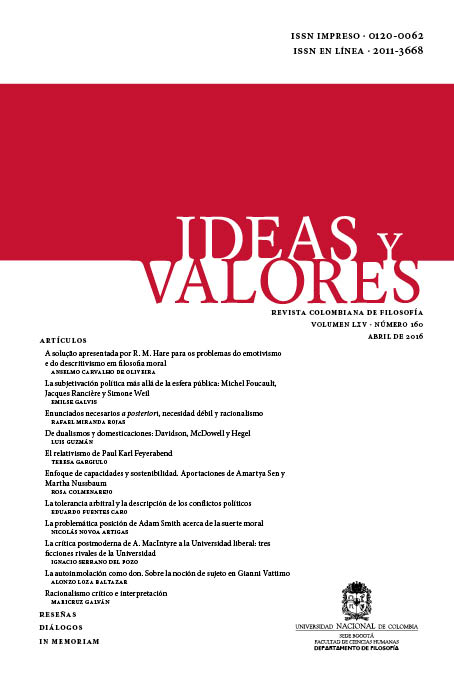
Enunciados necesarios a posteriori, necesidad débil y racionalismo
DOI:
https://doi.org/10.15446/ideasyvalores.v65n160.42641Palabras clave:
S. Kripke, lenguaje, necesidad, racionalismo (es)Se afirma que los enunciados necesarios a posteriori, propuestos por S. Kripke, exigen una comprensión débil de la necesidad; esto quiere decir: a) existencia contingen-te del designatum(no existencia en toda situación contrafáctica) y b) dependencia racionalista en principios lógicos a priori, particularmente los de diferencia y de identidad. La principal consecuencia es que los enunciados necesarios a posteriori corresponden a instancias de dichos principios lógicos. Contrario al racionalismo, esto no exige que dichos enunciados sean a priori, pues su justificación requiere in-formación empírica. Finalmente, se defiende que la distinción entre denotación y designación permite sostener que la necesidad débil se aplica a las instanciasde la clase, y no a esta, con lo que se evita el indeterminismo referencial.
Referencias
Boghossian, P. A., and Peacocke, C., eds. New Essays on the A Priori. Oxford: Clarendon Press, 2000.
Burge, T. “Frege on Apriority.” New Essays on the A Priori. Eds. Paul Artin Boghossian and Christopher Peacocke. Oxford: Clarendon Press, 2000. 11-42. http://dx.doi.org/10.1093/0199241279.003.0002.
Carnap, R. Meaning and Necessity: A Study in Semantics and Modal Logic. Chicago: University of Chicago Press, 1947.
Casullo, A. A priori Justification. Oxford: Oxford University Press, 2003.
Chalmers, D. “Two-Dimensional Semantics.” The Oxford Handbook of Philosophy of Language. Eds. Ernest LePore y Barry C. Smith. Oxford: Oxford University Press, 2006. 575-606.
http://dx.doi.org/10.1093/oxfordhb/9780199552238.003.0024.
Chang, H. Is Water h2o? Evidence, Realism and Pluralism. Dordrecht: Springer, 2012.
Eisenberg, D. S., and Kauzmann, W. The Structure and Properties of Water. Oxford: Oxford University Press, 2005.
Fine, K. “Essence and Modality.” Philosophical Perspectives 8: Logic and Language. Ed. James E. Tomberlin. Atascadero: Ridgeview Publ. Co., 1994. 1-16.
Greene , M . “‘Chocolate’ and Other Kind Terms: Implications for Semantic Externalism.” The Philosophical Quarterly61.243 (2011): 270-292. http://dx.doi.org/10.1111/j.1467-9213.2010.670.x.
Hale, B. “Modality.” A Companion to the Philosophy of Language. Eds. Bob Hale and Crispin Wright. Oxford: Blackwell, 1997. 487-514. http://dx.doi.org/10.1093/acprof:oso/9780199565818.001.0001.
Hendry, R. “Chemistry.” The Routledge Companion to Philosophy of Science. Eds. Stathis Psillos and Martin Curd. London: Routledge, 2008. 520-530. http://dx.doi.org/10.4324/9780203744857.ch55.
Kant, I. Critique of Pure Reason. Trans. Norman Kemp Smith. New York: St. Martin’s Press, 1965.
Kripke, S. “Identity and Necessity.” Identity and Individuation. Ed. Milton K. Munitz. New York: New York University Press, 1971. 135-164. http://dx.doi.org/10.1093/acprof:oso/9780199730155.003.0001.
Kripke, S. Naming and Necessity. Cambridge: Harvard University Press, 1980. http://dx.doi.org/10.1007/978-94-010-2557-7_9.
LaPorte, J. “Rigidity and Kind.” Philosophical Studies97.3 (2000): 293-316. http://dx.doi.org/10.1023/A:1018360026223.
LaPorte, J. Natural Kinds and Conceptual Change. Cambridge: Cambridge University Press, 2004.
Leibniz, G. W. New Essays on Human Understanding. Trans. Peter Remnant and Jonathan Bennett. New York: Cambridge University Press, 1981.
Loux, M. Metaphysics: A Contemporary Introduction. 3rd ed. New York: Routledge, 2006.
Markie, P. J. “Rationalism vs. Empiricism.” The Stanford Encyclopedia of Philosophy (Summer 2013 Edition). Ed. Edward E. Zalta. 2013. Web. <http://plato.stanford.edu/archives/sum2013/entries/rationalism-empiricism/>.
McLeod, S. “How to Reconcile Essence with Contingent Existence.” Ratio 21.3 (2008): 314-328. http://dx.doi.org/10.1111/j.1467-9329.2008.00404.x.
McLeod, S. “Rationalism and Modal Knowledge.” Crítica41.122 (2009): 29-42.
Miranda, R. “Rigidez de jurey de factoen los términos generales para clases naturales.” Areté24.1 (2012): 57-90.
Miranda, R. “Enunciados de identidad, invariabilidad proposicional y estipulación con-textual.” Discusiones Filosóficas14.23 (2013): 105-133.
Percival, P. “Theoretical Terms: Meaning and Reference.” A Companion to the Philosophy of Science. Ed. William Herbert Newton-Smith. Malden, Mass: Blackwell Publishing, 2001. 495-514.
Putnam, H. “Meaning and Reference.” The Journal of Philosophy70.19 (1973): 699-711. http://dx.doi.org/10.2307/2025079.
Putnam, H. “The Meaning of ‘Meaning’.” Minnesota Studies in the Philosophy of Science. Vol. 7, Language, Mind and Knowledge. Ed. Keith Gunderson. Minneapolis: University of Minnesota Press, 1975a. 215-271. http://dx.doi.org/10.1017/CBO9780511625251.014.
Putnam, H. Mind, Language and Reality: Philosophical Papers Vol. 2.Cambridge: Cambridge University Press, 1975b.
http://dx.doi.org/10.1017/CBO9780511625251.
Putnam, H. “Possibility and Necessity.” Realism and Reason: Philosophical Papers. Vol. 3. Ed. Hilary Putnam. Cambridge: Cambridge University Press, 1983. 46-68. http://dx.doi.org/10.1017/CBO9780511625275.005.
Salmon, N. Reference and Essence. Oxford: Blackwell, 1982.
Soames, S. Beyond Rigidity: The Unfinished Semantic Agenda of Naming and Necessity. New York: Oxford University Press, 2002.
Soames, S. “Knowledge of Manifest Natural Kinds.” Facta Philosophica6 (2004): 159-181.
Soames, S. Reference and Description: The Case against Two-Dimensionalism. Princeton: Princeton University Press, 2005.
Tahko, T. “On the Modal Content of A Posteriori Necessities.” Theoria75.4 (2009): 344–357. http://dx.doi.org/10.1111/j.1755-2567.2009.01048.x.
van Fraassen, B. The Scientific Image. Oxford: Clarendon Press, 1980.
Dimensions
PlumX
Visitas a la página del resumen del artículo
Descargas
Cómo citar
Licencia
Derechos de autor 2016 Universidad Nacional de Colombia

Esta obra está bajo una licencia internacional Creative Commons Atribución-NoComercial-SinDerivadas 4.0.
De acuerdo con la Licencia Creative Commons Atribución-No Comercial-SinDerivar 4.0 Internacional. Se autoriza copiar, redistribuir el material en cualquier medio o formato, siempre y cuando se conceda el crédito a los autores de los textos y a Ideas y Valores como fuente de publicación original. No se permite el uso comercial de copia o distribución de contenidos, así como tampoco la adaptación, derivación o transformación alguna de estos sin la autorización previa de los autores y de la dirección de Ideas y Valores. Para mayor información sobre los términos de esta licencia puede consultar: http://creativecommons.org/licenses/by-nc-nd/4.0/legalcode.










.jpg)