Publicado
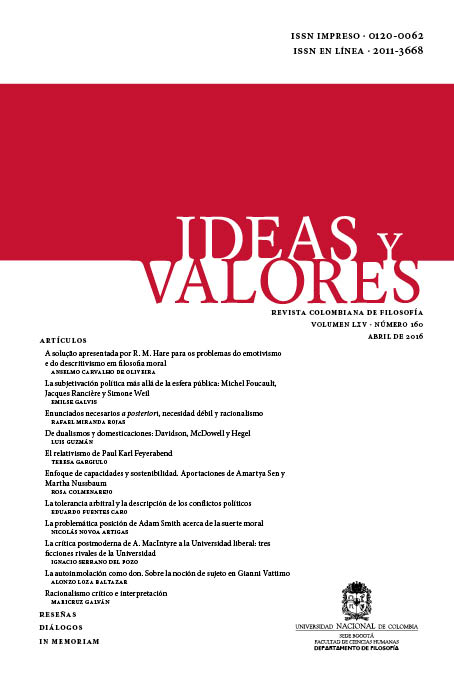
Enfoque de capacidades y sostenibilidad. Aportaciones de Amartya Sen y Martha Nussbaum
DOI:
https://doi.org/10.15446/ideasyvalores.v65n160.43084Palabras clave:
M. Nussbaum, A. Sen, enfoque de las capacidades, filosofía política, economía (es)La naturaleza interdisciplinar del “enfoque de las capacidades” (ca, por sus siglas en inglés) ha hecho que su estudio se encuentre diseminado en un amplio espectro de revistas. Así el case ha asentado en las áreas de la filosofía política o la economía del desarrollo, y ha ampliado su alcance al ser utilizado como marco teórico para la creación de indicadores sobre la privación, la calidad de vida o la salud, o bien para abordar las cuestiones de la educación superior o el impacto de la tecnología en la vida de las personas. Se ofrece una visión general sobre los principales conceptos empleados en ese enfoque, buscando distinguir las propuestas de A. Sen y M. Nussbaum, con el fin de analizar la idea de sostenibilidad y su incorporación en la agenda del enfoque.
Referencias
Aristóteles. Política. Intro., trad. y notas. Manuela García Valdés. Madrid: Editorial Gredos, 1999.
Aristóteles. Ética Nicomáquea. Ética Eudemia. Intro. Emilio Lledó Íñigo. Trad y notas. Julio Pallí Bonet. Madrid: Editorial Gredos, 2000.
Alkire, S. “Why the Capability Approach?” Journal of Human Development and Capabilities 6.1 (2005): 115–135. http://dx.doi.org/10.1080/146498805200034275.
Alkire, S. “Choosing Dimensions: The Capability Approach and Multidimensional Poverty.” Chronic Poverty Research Centre cprc Working Paper 88 (2007): 1-31. http://dx.doi.org/10.2139/ssrn.1646411.
Anand, S. and Sen, A. “Human Development and Economic Sustainability.” World Development28.12 (2000): 2029-2049. http://dx.doi.org/10.1016/S0305-750X(00)00071-1.
Bazin, D. Sauvegarder la nature. Une introduction au principe responsabilité de Hans Jonas.Paris: Ellipses, 2007.
Beckerman, W. and Pasek, J. Justice, Posterity and the Environment. Oxford: Oxford University Press, 2001.
Brudney, D. “Community and Completion.” Reclaiming the History of Ethics: Essays for John Rawls. Ed. Andrews Reath, Barbara Herman, and Christine M. Korsgaard. Cambridge: Cambridge University Press, 1997. 388-415.
Brugman, F. “Las convenciones de La unescoy su contribución al desarrollo sostenible.” Cultura y Desarrollo10 (2013): 4-6.
Crabtree, A. “Sustainable Development: Does the Capability Approach Have Anything to Offer? Outlining a Legitimate Freedom Approach.” Journal of Human Development and Capabilities14.1 (2013): 40–57. http://dx.doi.org/10.1080/19452829.2012.748721.
Crocker, D. A. “Functioning and Capability. The Foundations of Sen’s and Nussbaum’s Development Ethic.” Political Theory20.4 (1992): 584-612.
Drèze, J., and Sen, A. Hunger and Public Action.Oxford: Clarendon Press, 1989.
Drèze, J., and Sen, A. India: Economic Development and Social Opportunity. Oxford: Oxford University Press, 1995.
Drèze, J., and Sen, A. An Uncertain Glory. London: Allen Lane, 2013.
Fukuda-Parr, S. “The Human Development Paradigm: Operationalizing Sen’s Ideas on Capabilities.” Feminist Economics 9.2-3 (2003): 301–317. http://dx.doi.org/10.1080/1354570022000077980.
Goldsmith, E. and Allen, R. Blueprint for Survival. New Jersey: The New American Library, 1972.
Jonas, H. El Principio de Responsabilidad. Ensayo de una ética para la civilización tecno-lógica.Trad. Javier M. Fernández Retenaga.
Barcelona: Herder, 1995.
Klugman, J. Dir. El futuro sostenible que queremos. Informe Anual 2011/2012.New York: Programa de Naciones Unidas para el Desarrollo, 2011.
Kuklys, W. and Robeyns, I. “Sen´s Capability Approach to Welfare Economics.” Cambridge Working Papers in Economics 0415.Cambridge: Cambridge University Press, 2004. 1-41.
Lessmann, O. “Sustainability as a Challenge.” Sustainable Development: Capabilities, Needs and Well-Being. Eds. Félix Rauschmayer, Ines Omann and Johannes Frühmann. New York: Routledge, 2011. 33-59.
Meadows, D. H., Meadows, D. L., Randers, J.,y Behrens, W. Los límites del crecimiento:Informe al Club de Roma sobre el predicamento de la humanidad. Ciudad de México: Fondo de Cultura Económica, 1972.
Nussbaum, M. C. “ΨYXH in Heraclitus, i.” Phronesis17.1 (1972a): 1-16.
Nussbaum, M. C. “ΨYXH in Heraclitus, ii.” Phronesis 17.2 (1972b): 153-170.
Nussbaum, M. C. “The Text of Aristotle’s De Motu Animalium.” Harvard Studies in Classical Philology80 (1976): 119-159.
Nussbaum, M. C. “Saving Aristotle’s Appearances.” Language and Logos: Studies in Ancient Greek Philosophy.Eds. Malcolm Schofield and Martha Nussbaum. Cambridge, ma: Cambridge University Press, 1982. 267-293.
Nussbaum, M. C. and Hursthouse, R. “Plato on Commensurability and Desire.” Proceedings of the Aristotelian Society58 (1984): 55-96.
Nussbaum, M. C. The Fragility of Goodness: Luck and Ethics in Greek Tragedy and Philosophy. Cambridge, ma:Cambridge University Press, 1986a.
Nussbaum, M. C. “Therapeutic Arguments: Epicurus and Aristotle.” The Norms of Nature: Studies in Hellenistic Ethics. Eds. Malcolm Schofield and Gisela Striker. Cambridge, ma:Cambridge University Press, 1986b. 31-74.
Nussbaum, M. C. “Nature, Function, and Capability: Aristotle on Political Distribution.” Oxford Studies in Ancient Philosophysupplement (1988): 145-184.
Nussbaum, M. C. “Aristotelian Social Democracy.” Liberalism and the Good.Eds. R. Bruce Douglas, Gerald R. Mara and Henry S. Richardson. New York: Routledge, 1990. 203-252.
Nussbaum, M. C. “Human Functioning and Social Justice: In Defense of Aristotelian Essentialism.” Political Theory20 (1992): 202-247.
Nussbaum, M.C. and Sen, A. Eds. The Quality of Life: Papers Presented at a Conference Sponsored by the World Institute for Development Economics Research. Oxford: United Nations University, 1993.
Nussbaum, M. C. “Aristotle on Human Nature and the Foundations of Ethics.” World, Mind, and Ethics: Essays on the Philosophy of Bernard Williams. Eds. James Edward John Altham and Ross Harrison. Cambridge: Cambridge University Press, 1995. 86-131.
Nussbaum, M. C. “Capabilities and Human Rights.” Fordham Law Review 66.2 (1997): 273-300.
Nussbaum, M. C. “Public Philosophy and International Feminism.” Ethics108.4 (1998): 762-796.
Nussbaum, M.C. “Capacidades humanas y justicia social. En defensa del esencialismo aristotélico.” Necesitar, desear, vivir. Sobre desarrollo humano, crecimiento económico y sustentabilidad. Coord. Jorge Riechmann. Madrid: Los Libros de la Catarata, 1999a. 43-104.
Nussbaum, M. C. “The Feminist Critique of Liberalism.” Sex and Social Justice. New York: Oxford University Press, 1999b. 5-80.
Nussbaum, M. C. Women and Human Development: The Capabilities Approach. Cambridge: Cambridge University Press, 2000. http://dx.doi.org/10.1017/CBO9780511841286.
Nussbaum, M. C. “El futuro del liberalismo feminista.” Areté 13.1 (2001): 59-101.
Nussbaum, M. C. Las mujeres y el desarrollo humano.Trad. Roberto Bernet. Barcelona: Herder, 2002.
Nussbaum, M. C. “Capabilities as Fundamental Entitlements: Sen and Social Justice.” Feminist Economics9.2-3 (2003a): 33–59. http://dx.doi.org/10.1080/1354570022000077926.
Nussbaum, M. C. Interview. Ethique économique/Ethics and Economics1 (2003b): 1-5.
Nussbaum, M. C. Upheavals of Thought: The Intelligence of Emotions.New York: Cambridge University Press, 2003c. http://dx.doi.org/10.1017/CBO9780511840715.
Nussbaum, M. C. The Frontiers of Justice.Cambridge,ma: The Belknap Press of Harvard University Press, 2006.
Nussbaum, M. C. Las fronteras de la justicia.Trad. Ramón Vilá Vernis y Albino Santos Mosquera. Barcelona: Paidós, 2007.
Nussbaum, M. C. Creating Capabilities. The Human Development Approach.Cambridge, ma:Harvard University Press, 2011. http://dx.doi.org/10.4159/harvard.9780674061200.
Nussbaum, M. C. Crear capacidades, propuesta para el desarrollo humano. Trad. Albino Santos Mosquera.Barcelona: Paidós, 2012.
Nussbaum, M. C. Political Emotions. Why Love Matters for Justice. Cambridge, ma: The Belknap Press of Harvard University Press, 2013.
Marx, K. Obra selecta. Antología de textos de economía y de filosofía. Manuscritos de París. Manifiesto del Partido Comunista. Crítica del programa de Gotha. Ed. Jacobo Muñoz. Madrid: Editorial Gredos, 2012.
O’Connell, M. H. Compassion: Loving Our Neighbor in an Age of Globalization. New York: Orbis Books, 2009.
Ostrom, E. Governing the Commons: The Evolution of Institutions for Collective Action.Cambridge: Cambridge University Press, 1990.
Pelenc, J., Lompo, M.K., Ballet, J. and Dubois, J.L. “Sustainable Human Development and the Capability Approach: Integrating Environment, Responsability and Collective Agency.” Journal of Human Development and Capabilities14.1 (2013): 77–94. http://
dx.doi.org/10.1080/19452829.2012.747491.
Rauschmayer, F., and Lessmann, O. “The Capability Approach and Sustainability.” Journal of Human Development and Capabilities14.1 (2013): 1–5. http://dx.doi.org/10.1080/19452829.2012.751744.
Rawls, J. A Theory of Justice.Cambridge, ma: Harvard University Press, 1971.
Rawls, J. “Kantian Constructivism in Moral Theory.” Journal of Philosophy77 (1980): 515-571.
Rawls, J. Justicia como equidad.Trad. Miguel Ángel Rodilla. Madrid: Tecnos, 2002.
Rawls, J. El liberalismo político.[1993]. Trad. Antoni Domènech. Barcelona: Crítica, 2004.
Ricoeur, P. Le Temps de la Responsabilité de Fréderic Lenoir. Paris: Fayard, 1991.
Ricoeur, P. Le Juste.Paris: Esprit, 1995.
Robeyns, I. “Sen’s Capability Approach and Gender Inequality: Selecting Relevant Capabilities.” Feminist Economics9.2-3 (2003): 61-92.
Robeyns, I. “The Capability Approach: A Theoretical Survey.” Journal of Human Development and Capabilities6.1 (2005a): 93-117. http://dx.doi.org/10.1080/146498805200034266.
Robeyns, I. “Selecting Capabilities for Quality of Life Measurement.” Social Indicators Research 74.1 (2005b): 191–215. http://dx.doi.org/10.1007/s11205-005-6524-1.
Robeyns, I. “How Useful Is Sen’s Capability Approach for Feminist Economics?” Nouvelles Questions Feministes 26.2 (2007): 45.
Rockström, J., et al. “Planetary Boundaries: Exploring the Safe Operating Space for Humanity.” Ecology and Society14.2 (2009): 32.
Scanlon, T.M. What We Owe Each Other. Cambridge, ma: Harvard University Press, 1998.
Sen, A. “Rational Fools: A Critique of the Behavioral Foundations of Economy Theory.” Philosophy and Public Affairs6.4 (1977): 317-344.
Sen, A. “Equality of What?” The Tanner Lectures on Human Values. Ed. Sterling MacMurrin. Salt Lake City: University of Utah Press, 1980. 195-220.
Sen, A. Choice, Welfare, and Measurement. Oxford: Cambridge, ma: Harvard University Press, 1982.
Sen, A. “Rights and Capabilities.” Resources, Values and Development. Cambridge, ma: Harvard University Press, 1984. 307-325.
Sen, A. “Well-Being, Agency and Freedom: The Dewey Lectures 1984.” The Journal of Philosophy82.4 (1985a): 169–221.
Sen, A. Commodities and Capabilities. Amsterdam: North Holland, 1985b.
Sen, A. The Standard of Living. Cambridge University: Cambridge University Press, 1987.
Sen, A. “The Concept of Development.” Handbook of Development Economics.Eds. Hollis Chenery and T. N. Srinivasam. Vol. 1. Amsterdam: Elsevier Science Publishers, 1988. 10–26.
Sen, A. “Justice: Means versus Freedoms.” Philosophy and Public Affairs19.2 (1990): 111–121.
Sen, A. Inequality Re-Examined. Oxford: Clarendon Press, 1992a.
Sen, A. “Missing Women.” The British Medical Journal304.6827 (1992b): 587–588.
Sen, A. “Capability and Well-Being.” The Quality of Life. Oxford: Clarendon Press, 1993a. 30–53.
Sen, A. “Positional Objectivity.” Philosophy and Public Affairs22.2 (1993b): 126–145.
Sen, A. “Freedoms and Needs.” New Republic(1994): 31–38.
Sen, A. “Gender Inequality and Theories of Justice.” Women, Culture and Development: A Study of Human Capabilities.Eds. Martha Nussbaum and Jonathan Glover. Oxford: Clarendon Press, 1995. 153–198.
Sen, A. “On the Status of Equality.” Political Theory24.3 (1996a): 394–400.
Sen, A. “On the Foundations of Welfare Economics: Utility, Capacity and Practical Reason.” Ethics, Rationality and Economic Behaviour.Eds. Francesco Farina, Frank Hahn, and Stefano Vanucci. Oxford: Clarendon Press, 1996b. 50–65.
Sen, A. Reason before Identity. Oxford: Oxford University Press, 1999a.
Sen, A. Development as Freedom. Oxford: Oxford University Press, 1999b.
Sen, A. “Consequential Evaluation and Practical Reason.” Journal of Philosophy97.9 (2000): 477–502. http://dx.doi.org/10.2307/2678488.
Sen, A. “Missing Women Revisited.” The British Medical Journal327.7427 (2003): 1297–1298. http://dx.doi.org/10.1136/bmj.327.7427.1297.
Sen, A. “Capabilities, Lists, and Public Reason: Continuing the Conversation.” Feminist Economics10.3 (2004): 77–80. http://dx.doi.org/10.1080/1354570042000315163.
Sen, A. “Why Exactly Is Commitment Important for Rationality?” Economics and Philosophy 21.1 (2005): 5-14. http://dx.doi.org/10.1017/S0266267104000355.
Sen, A. “El desarrollo como libertad.” Gaceta Ecología55 (2009): 14-20.
Sen, A. La idea de la justicia.Trad. Hernando Valencia Villa. Madrid: Taurus, 2010.
Sen, A. “The Ends and Means of Sustainability.” Journal of Human Development and Capabilities14.1 (2013): 6–20. http://dx.doi.org/10.1080/19452829.2012.747492.
Sowle Cahill, L. Global Justice, Christology, and Christian Ethics. New York: Cambridge University Press, 2013.
Steward, F. “Women and Human Development: The Capabilities Approach by Martha Nussbaum.” Journal of International Development 13.8 (2001): 1189–1202.
Steward, F. and Deneulin, S. “Amartya’s Sen Contribution to Development Thinking.” Studies in Comparative International Development 37 (2002): 61–70.
UN’S WECED. Our Common Future. Dir. Grö Brundtland. Madrid: Alianza, 1987.
Watene, K. “Nussbaum’s Capability Approach and Future Generations.” Journal of Human Development and Capabilities14.1 (2013): 21-39.
Wolff, J. and De-Shalit, A. Disadvantage. New York: Oxford University Press, 2007.
Wollstonecraft, M. A. Vindication of the Rights of Men, in a Letter to the Right Honourable Edmund Burke; Occasioned by his Reflections on the Revolution in France.[1790]. Oxford; Melbourne: Oxford University Press, 1994a.
Wollstonecraft, M. Vindicación de los derechos de la mujer. Ed. Isabel Burdiel. Madrid: Cátedra, 1994b.
Dimensions
PlumX
Visitas a la página del resumen del artículo
Descargas
Cómo citar
Licencia
Derechos de autor 2016 Universidad Nacional de Colombia

Esta obra está bajo una licencia internacional Creative Commons Atribución-NoComercial-SinDerivadas 4.0.
De acuerdo con la Licencia Creative Commons Atribución-No Comercial-SinDerivar 4.0 Internacional. Se autoriza copiar, redistribuir el material en cualquier medio o formato, siempre y cuando se conceda el crédito a los autores de los textos y a Ideas y Valores como fuente de publicación original. No se permite el uso comercial de copia o distribución de contenidos, así como tampoco la adaptación, derivación o transformación alguna de estos sin la autorización previa de los autores y de la dirección de Ideas y Valores. Para mayor información sobre los términos de esta licencia puede consultar: http://creativecommons.org/licenses/by-nc-nd/4.0/legalcode.








.jpg)