Publicado
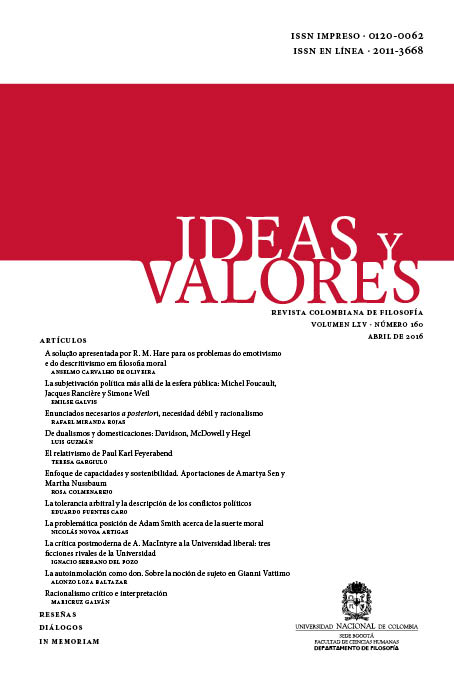
La tolerancia arbitral y la descripción de los conflictos políticos
DOI:
https://doi.org/10.15446/ideasyvalores.v65n160.43606Palabras clave:
política, tolerancia, Estado (es)Se defiende la posibilidad de que el Estado sea tolerante cuando actúa como árbitro en los conflictos de tolerancia. Se consideran dos objeciones que dependen de cómo describimos los conflictos políticos y, en particular, los de tolerancia. Se presenta una teoría de descripciones políticas y cómo con ella podemos responder, de una ma-nera políticamente satisfactoria, a las dos objeciones que se plantean en el artículo. Con ello, se discute la relación entre la justificación de las acciones políticas en un contexto normativo ideal y su justificación en los contextos más locales y no ideales donde ocurre la acción política.
Referencias
Abrams, K. “Forbearant and Engaged Toleration: A Comment on David Heyd.” Toleration and Its Limits. Eds. Melissa Williams and Jeremy Waldron. New York: New York University Press, 2008. 195-219.
Annis, D. “A Contextualist Theory of Epistemic Justification.” American Philosophical Quarterly 15.3 (1978): 213-219.
Anscombe, G. E. M. Intención. Barcelona: Paidós, 1991.
Balint, P. “Not Yet Making Sense of Political Toleration.” Res Publica 18.3 (2012): 259-264. http://dx.doi.org/10.1007/s11158-012-9177-3.
Cohen, A. J. “What Toleration Is.” Ethics115.1 (2004): 68-95. http://dx.doi.org/10.1086/421982.
Creppell, I. “Toleration, Politics and the Role of Mutuality.” Toleration and Its Limits. Eds. Melissa Williams and Jeremy Waldron. New York: New York University Press, 2008. 315-359.
de Matos, F. “Group Knowledge Implies Belief.” ivColoquio Internacional de la Sociedad Chilena de Filosofía Analítica, Santiago de Chile. 25 de Marzo 2014. Ponencia.
Ferretti, M. P. and Lægaard, S. “A Multirelational Account of Toleration.” Journal of Applied Philosophy 30.3 (2013): 224-238. http://dx.doi.org/10.1111/japp.12018.
Forst, R. The Right to Justification: Elements of a Constructivist Theory of Justice. Trans. Jeffrey Flynn. New York: Columbia University Press, 2012.
Forst, R. Toleration in Conflict: Past and Present. Trans. Ciaran Cronin.Cambridge: Cambridge University Press, 2013.
Fuentes, E. “The Basic Concept of Toleration.” 2012. ts.
Galeotti, A. E. Toleration as Recognition. Cambridge: Cambridge University Press, 2002.
Heyd, D. “Is Toleration a Political Virtue?” Toleration and Its Limits. Eds. Melissa Williams and Jeremy Waldron. New York: New York University Press, 2008. 171-194.
Horton, J. “Toleration as a Virtue”. Toleration: An Elusive Virtue. Ed. David Heyd. Princeton: Princeton University Press, 1996. 28-43.
Jones, P. “Making Sense of Political Toleration.” British Journal of Political Science 37.3 (2007): 383-402.http://dx.doi.org/10.1017/S000712340700021X.
Kvanvig, J. “Norms of Assertion”. Assertion: New Philosophical Essays. Eds. Jessica Brown and Herman Cappelen. Oxford: Oxford University Press, 2011. 233-250.
McKinnon, C. Toleration: A Critical Introduction. New York: Routledge, 2006.
Nagel, T. “Moral Conflict and Political Legitimacy.” Philosophy and Public Affairs 16.3 (1987): 215-240.
Newey, G. Virtue, Reason and Toleration. Edinburgh: Edinburgh University Press, 1999.
Newey, G. “Is Democratic Toleration a Rubber Duck?” Res Publica7.3 (2001): 315-336.http://dx.doi.org/10.1023/A:1012221130057.
Newey, G. “Toleration, Politics and the Role of Murality.” Toleration and Its Limits. Eds. Melissa Williams and Jeremy Waldron. New York: New York University Press, 2008. 360-391.
Newey, G. Toleration in Political Conflict. Cambridge: Cambridge University Press, 2013.
Nussbaum, M. The New Religious Intolerance: Overcoming the Politics of Fear in an Anxious Age. Cambridge: The Belknap Press of Harvard University Press, 2012.
Rawls, J. Political Liberalism. New York: Columbia University Press, 1993.
Rossi, E., and Sleat, M. “Realism in Normative Political Theory.” Philosophy Compass 9.10(2014): 689-701. http://dx.doi.org/10.1111/phc3.12148.
Sabl. A. “‘Virtuous to Himself ’: Pluralistic Democracy and the Toleration of Tolerations.” Toleration and Its Limits. Eds. Melissa Williams and Jeremy Waldron. New York: New York University Press, 2008. 220-240.
Waldron, J. “Toleration: Is There a Paradox?” New York University Public Law and Legal Theory Working Papers. NELLCO, February 2 2013. Web.
Williamson, T. “Knowledge, Context, and the Agent’s Point of View.” Contextualism in Philosophy: Knowledge, Meaning, and Truth. Eds. Gerhard Preyer and Georg Peter. Oxford: Clarendon Press, 2005. 91-114.
Dimensions
PlumX
Visitas a la página del resumen del artículo
Descargas
Cómo citar
Licencia
Derechos de autor 2016 Universidad Nacional de Colombia

Esta obra está bajo una licencia internacional Creative Commons Atribución-NoComercial-SinDerivadas 4.0.
De acuerdo con la Licencia Creative Commons Atribución-No Comercial-SinDerivar 4.0 Internacional. Se autoriza copiar, redistribuir el material en cualquier medio o formato, siempre y cuando se conceda el crédito a los autores de los textos y a Ideas y Valores como fuente de publicación original. No se permite el uso comercial de copia o distribución de contenidos, así como tampoco la adaptación, derivación o transformación alguna de estos sin la autorización previa de los autores y de la dirección de Ideas y Valores. Para mayor información sobre los términos de esta licencia puede consultar: http://creativecommons.org/licenses/by-nc-nd/4.0/legalcode.








.jpg)