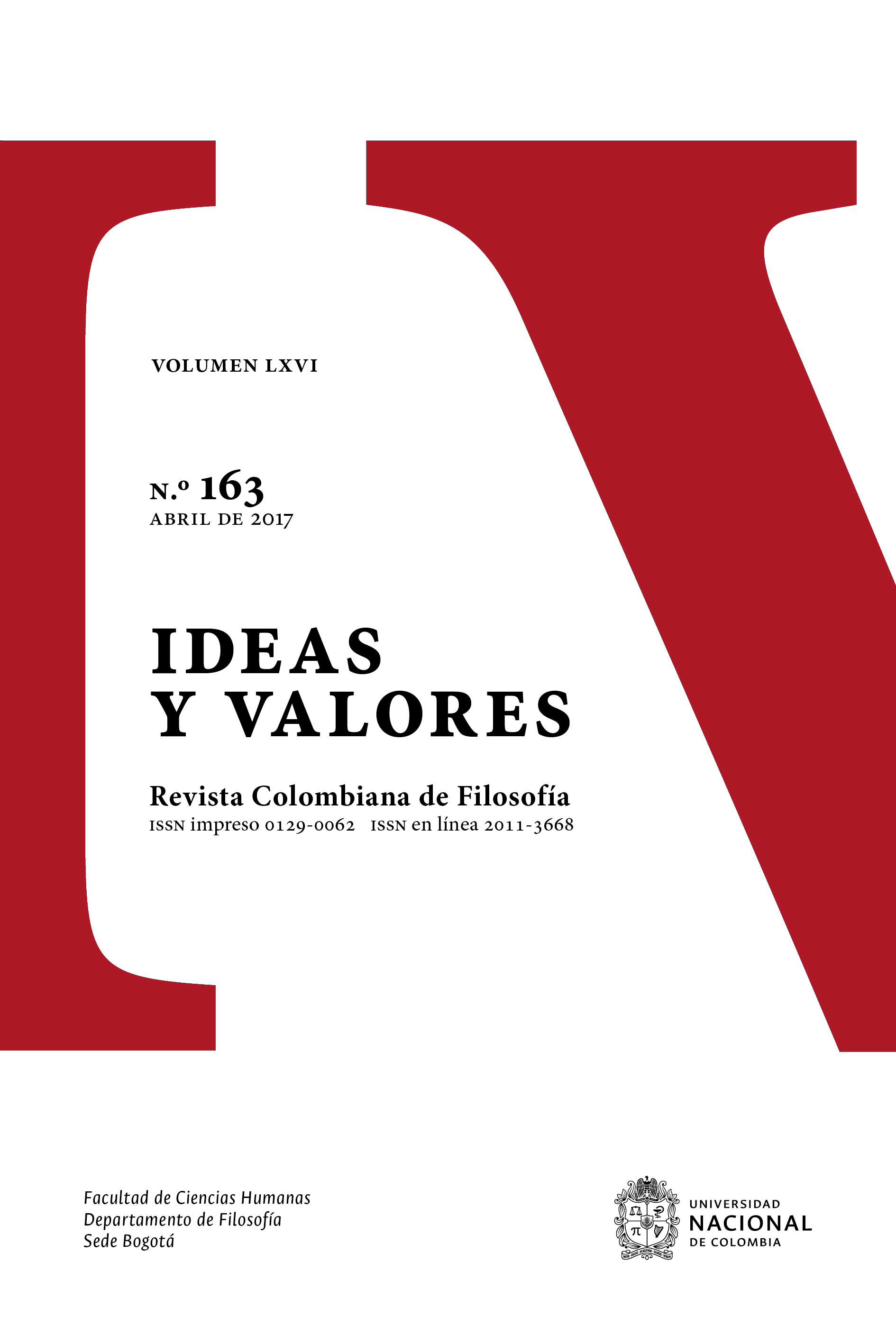
Publicado
¿Es la vida familiar relevante para la justicia social?
Is Family Life Relevant to Social Justice?
DOI:
https://doi.org/10.15446/ideasyvalores.v66n163.49543Palabras clave:
A Honneth J, Rawls, familia, feminismo, justicia, liberalismo. (es)A Honneth J, Rawls, family, feminism, justice, liberalism (en)
Referencias
Anderson, J. y Honneth, A. “Autonomy, Vulnerability, Recognition and Justice.” Autonomy and the Challenges to Liberalism. Eds. Joel Anderson and John Christman. Cambridge: Cambridge University Press, 2005. 127-149.
Beck-Gernsheim, E. Reinventing the Family: in Search of new Lifestyles. Cambridge: Polity Press, 2002.
Becker, G. A Treatise on the Family. Cambridge, ma.: Harvard University Press, 1981.
Benhabib, S. El Ser y el Otro en la ética contemporánea. Feminismo, comunitarismo y posmodernismo. Trad. Gabriel Zadunaisky. Barcelona: Gedisa, 2006.
Honneth, A. “Integridad y desprecio. Motivos básicos de una concepción de la moral desde la teoría del reconocimiento.” Isegoría 5 (1992): 78-93. https://doi.org/10.3989/isegoria.1992.i5.339.
Honneth, A. La lucha por el reconocimiento. Trad. Manuel Ballestero. Barcelona: Crítica, 1997.
Honneth A. Desintegració: Fragments per a un diagnostic sociologic de l´epoca. Valencia: Tandem, 1999.
Honneth, A. “Grounding Recognition: a Rejoinder to Critical Questions.” Inquiry 45.2 (2002): 499-520. https://doi.org/10.1080/002017402320947577.
Honneth, A. “Between Justice and Affection: the Family as a Field of Moral Disputes.” Disrespect. The Normative Foundations of Critical Theory. Cambridge: Polity Press, 2007a. 144-162.
Honneth, A. “Love and Morality.” Disrespect. The Normative Foundations of Critical Theory. Cambridge: Polity Press, 2007b. 163-180.
Honneth, A. “A textura da justiça. Sobre os limites do procedimentalismo contemporâneo.” Civitas 9.3 (2009): 345-368.
Honneth, A. Freedom´s Right. The Social Foundations of Democratic Life. New York: Columbia University Press, 2014.
Hume, D. Enquiry Concerning the Principles of Moral. Oxford: Oxford University Press, 1975.
Lasch, Ch. Haven in a Heartless World: The Family Besieged. New York: Norton and Company, 1977.
Mill, J.S. The Subjection of Women. Aukland: The Floating Press, 2009.
Nussbaum, M. “The Feminist Critique to Liberalism.” Sex and Social Justice. Oxford: Oxford University Press, 1999. 55-80.
Nussbaum M. “Love, Care, and Dignity.” Women and Human Development. New York: Cambridge University Press, 2000. 241-297.
Okin, S. M. Justice, Gender and the Family. New York: Basic Books, 1989.
Rawls, J. Teoría de la justicia. Trad. María Dolores González. Ciudad de México: Fondo de Cultura Económica, 2000.
Rawls, J. “Una revisión de la idea de razón pública.” El derecho de gentes. Trad. Hernando Valencia. Barcelona: Paidós, 2001. 155-205.
Rawls, J. La justicia como equidad. Una reformulación. Trad. Andrés de Francisco. Buenos Aires: Paidós, 2004.
Rousseau, J. J. Discourse on Political Economy. Paris: Pléiade, 1969.
Sandel, M. El liberalismo y los límites de la justicia. Trad. María Luz Melon. Barcelona: Gedisa, 2000.
Satz, D. “Feminist Perspectives on Reproduction and the Family.” The Stanford Encyclopedia of Philosophy. Web. 6 Nov. 2004. http://plato.stanford.edu/entries/feminism-family/
Sen, A. “Gender and Cooperative Conflicts.” Persistent Inequalities. Women and World Development. Ed. Irene Tinker. Oxford: Oxford University Press, 1990. 123-149.
Waldron, J. “When Justice Replaces Affection.” Liberal Rights: Collected Papers 1981-1991. Cambridge: Cambridge University Press, 1993. 370-391.
Dimensions
PlumX
Visitas a la página del resumen del artículo
Descargas
Cómo citar
Licencia
Derechos de autor 2017 Ideas y Valores

Esta obra está bajo una licencia internacional Creative Commons Atribución-NoComercial-SinDerivadas 4.0.
De acuerdo con la Licencia Creative Commons Atribución-No Comercial-SinDerivar 4.0 Internacional. Se autoriza copiar, redistribuir el material en cualquier medio o formato, siempre y cuando se conceda el crédito a los autores de los textos y a Ideas y Valores como fuente de publicación original. No se permite el uso comercial de copia o distribución de contenidos, así como tampoco la adaptación, derivación o transformación alguna de estos sin la autorización previa de los autores y de la dirección de Ideas y Valores. Para mayor información sobre los términos de esta licencia puede consultar: http://creativecommons.org/licenses/by-nc-nd/4.0/legalcode.









.jpg)