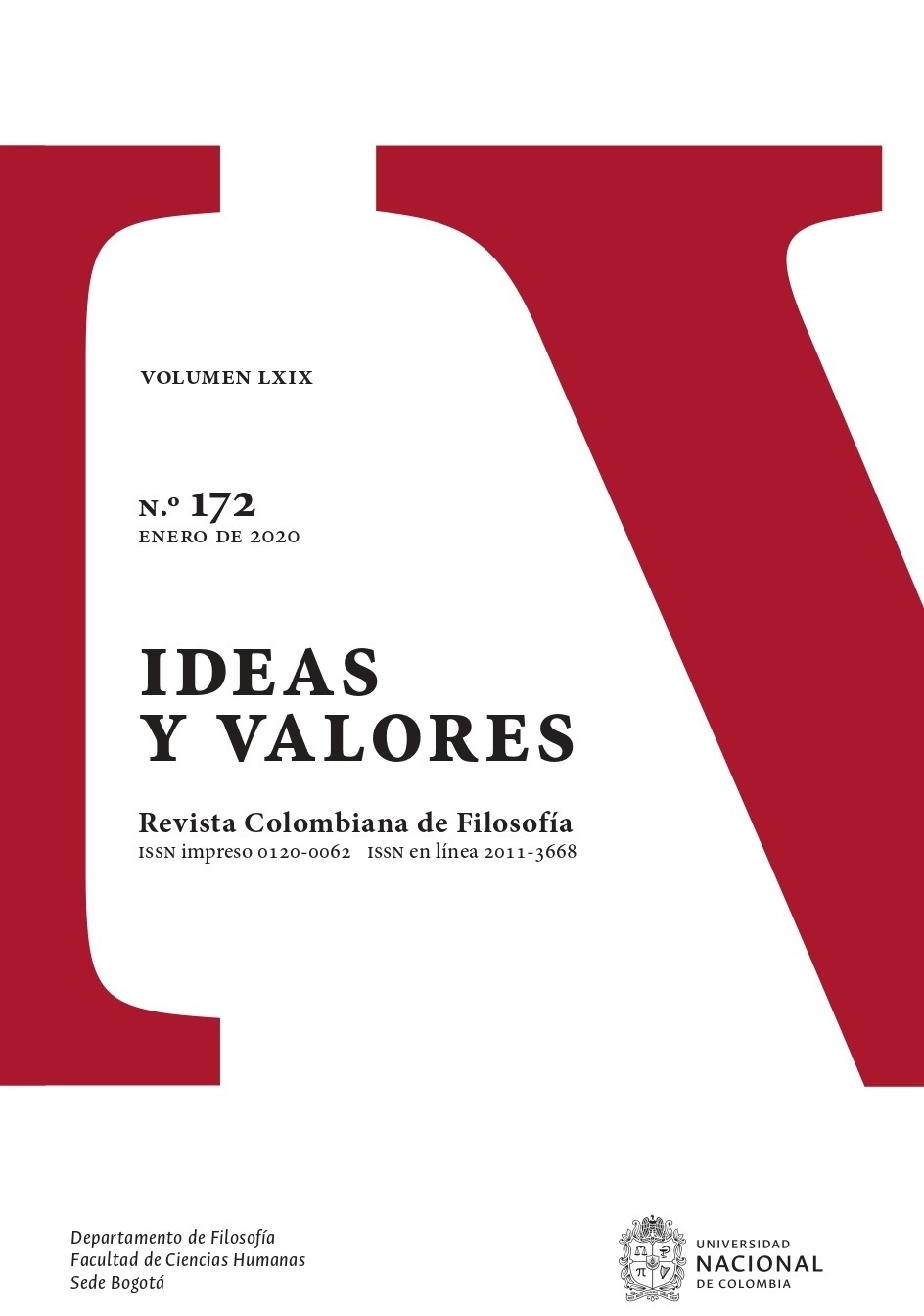
Publicado
El problema de la no identidad. Cuatro soluciones posibles
The Non-identity Problem. Four Possible Solutions
DOI:
https://doi.org/10.15446/ideasyvalores.v69n172.64869Palabras clave:
D. Parfit, M. Meyer, daño, identidad. (es)D. Parfit, M. Meyer, harm, identity. (en)
El artículo defiende una solución al problema de la no identidad, que surge porque la existencia de muchas personas futuras es contingente en relación con nuestras de- cisiones. Esto hace que, aunque tengan una calidad de vida muy baja, tal situación no sea peor para ellas. Se defiende una solución basada en una noción de umbral de daño: tal noción ayuda a explicar la incorrección que existe en los casos atravesados por el problema de la no identidad. Finalmente, se analizan otras tres soluciones. Sin embargo, se afirma que no son completamente satisfactorias sin un desarrollo ulterior.
The article defends a solution to non-identity problem, which arises because the exist- ence of many future persons is contingent with respect to our decisions. Consequently, despite their possible low quality of life, that situation is not worse for them. The article argues for a solution based on the threshold notion of harm, which helps in explaining the wrongness involved in those cases crossed by the non-identity prob- lem. Finally, it analyzes three other solutions. However, it is argued that they are not entirely satisfactory without further developments.
Referencias
Adams, R. M. “Existence, Self Interest, and the Problem of Evil.” Noûs 3.1 (1979): 53-65.
Barry, B. “Circumstances of Justice and Future Generations.” Obligations to Future Generations. Eds. Richard Sikora and Brian Barry. Philadelphia: Temple University Press, 1978. 204-248.
Boonin, D. “How to Solve the Non-Identity Problem.” Public Affairs Quarterly 22.2 (2008): 127-157.
Feinberg, J. Harm to Others: The Moral Limits of Criminal Law. Vol i. Oxford: Oxford University Press, 1984.
Gascón Abellán, M., y De Lora, P. Bioética: Principios, Desafíos, Debates. Madrid: Alianza, 2008.
Griffin, J. Well-Being: its Meaning, Measurement and Moral Impact. New York: Oxford Clarendon Press, 1986.
Hare, R. M. Essays on Bioethics. Oxford: Oxford University Press, 1993.
Heyd, D. “Parfit on the Non-Identity Problem, Again.” Law Ethics Hum. Right. 8.1 (2014): 1-20.
Kavka, G. “The Paradox of Future Individuals.” Philosophy & Public Affairs 11.2 (1982): 93-112.
Mckay, T., and Nelson, M. “Propositional Attitude Reports.” The Stanford Encyclopaedia of Philosophy (Spring 2014 Edition). Ed. Edward N. Zalta, 2014. https://plato.stan-ford.edu/archives/spr2014/entries/prop-attitude-reports/
Meyer, L. “Past and Future: The Case for a Threshold Notion of Harm.” Rights, Culture, and the Law: Themes from the Legal and Political Philosophy of Joseph Raz. Eds. Lukas Meyer, Stanly Paulson and Thomas Pogge. Oxford: Oxford University Press, 2003. 143-159.
Meyer, L. “Intergenerational Justice.” The Stanford Encyclopaedia of Philosophy (Fall 2015 Edition). Ed. Edward N. Zalta, 2015. 1-101.
Meyer L., and Roser, D. “Enough for the Future.” Intergenerational Justice. Eds. Axel Gosseries and Lukas Meyer. Oxford: Oxford University Press, 2009. 219-248.
Parfit, D. “On Doing the Best for Our Children.” Ethics and Population. Ed. Bayles, M. Cambridge: Shenkman, 1976. 100-115.
Parfit, D. “Further Generations: Further Problems.” Philosophy and Public Affairs 11.2 (1982): 113-172.
Parfit, D. “Energy Policy and the Further Future: The Identity Problem.” Energy and the Future. Eds. Douglas MacLean and Peter Brown. Totowa: Rowman and Allanheld, 1983. 166-179.
Parfit, D. “Comments.” Ethics 96.4 (1986): 832-872.
Parfit, D. Reasons and Persons. Oxford: Clarendon Press, 1987.
Parfit, D. On What Matters. Vol. ii. Oxford: Oxford University Press, 2011.
Pettit, P. On the People’s Terms: A Republican Theory and Model of Democracy. Cambridge: Cambridge University Press, 2012.
Scanlon, T. M. What We Owe to Each Other. Cambridge, ma: Harvard University Press, 1988.
Schwartz, T. “Obligations to Posterity.” Obligations to Future Generations. Eds. Richard Sikora and Brain Barry. Philadelphia: Temple University Press, 1978. 3-13.
Seleme H. “Deben los Filósofos Morales Aprender de los Juristas?” doxa, Cuadernos de Filosofía del Derecho 37 (2014): 263-280.
Shiffrin, S. V. “Wrongful Life, Procreative Responsibility and the Significance of Harm.” Legal Theory 5 (1999): 117-148.
Shiffrin, S. V. “Harm and Its Moral Significance.” Legal Theory 18 (2012): 357-398.
Singer, P. Practical Ethics: Second Edition. Cambridge: Cambridge University Press, 1999.
Truccone-Borgogno, S. “Entre la utilidad y el daño: el problema de la no identidad.” Τέλος, Revista Iberoamericana de Estudios Utilitaristas XXI/2 (2017): 67-84.
Truccone-Borgogno, S. “Consideraciones sobre la fuerza de las razones en contra de dañar.” Crítica: Revista Hispanoamericana de Filosofía 50.149 (2018): 31-57.
Dimensions
PlumX
Visitas a la página del resumen del artículo
Descargas
Cómo citar
Licencia
Derechos de autor 2020 Los derechos son del autor(es), quien(es) puede re-publicar en parte o en su totalidad el documento ya publicado en la revista siempre y cuando se dé el debido reconocimiento a Ideas y Valores

Esta obra está bajo una licencia internacional Creative Commons Atribución-NoComercial-SinDerivadas 4.0.
De acuerdo con la Licencia Creative Commons Atribución-No Comercial-SinDerivar 4.0 Internacional. Se autoriza copiar, redistribuir el material en cualquier medio o formato, siempre y cuando se conceda el crédito a los autores de los textos y a Ideas y Valores como fuente de publicación original. No se permite el uso comercial de copia o distribución de contenidos, así como tampoco la adaptación, derivación o transformación alguna de estos sin la autorización previa de los autores y de la dirección de Ideas y Valores. Para mayor información sobre los términos de esta licencia puede consultar: http://creativecommons.org/licenses/by-nc-nd/4.0/legalcode.







.jpg)