Publicado
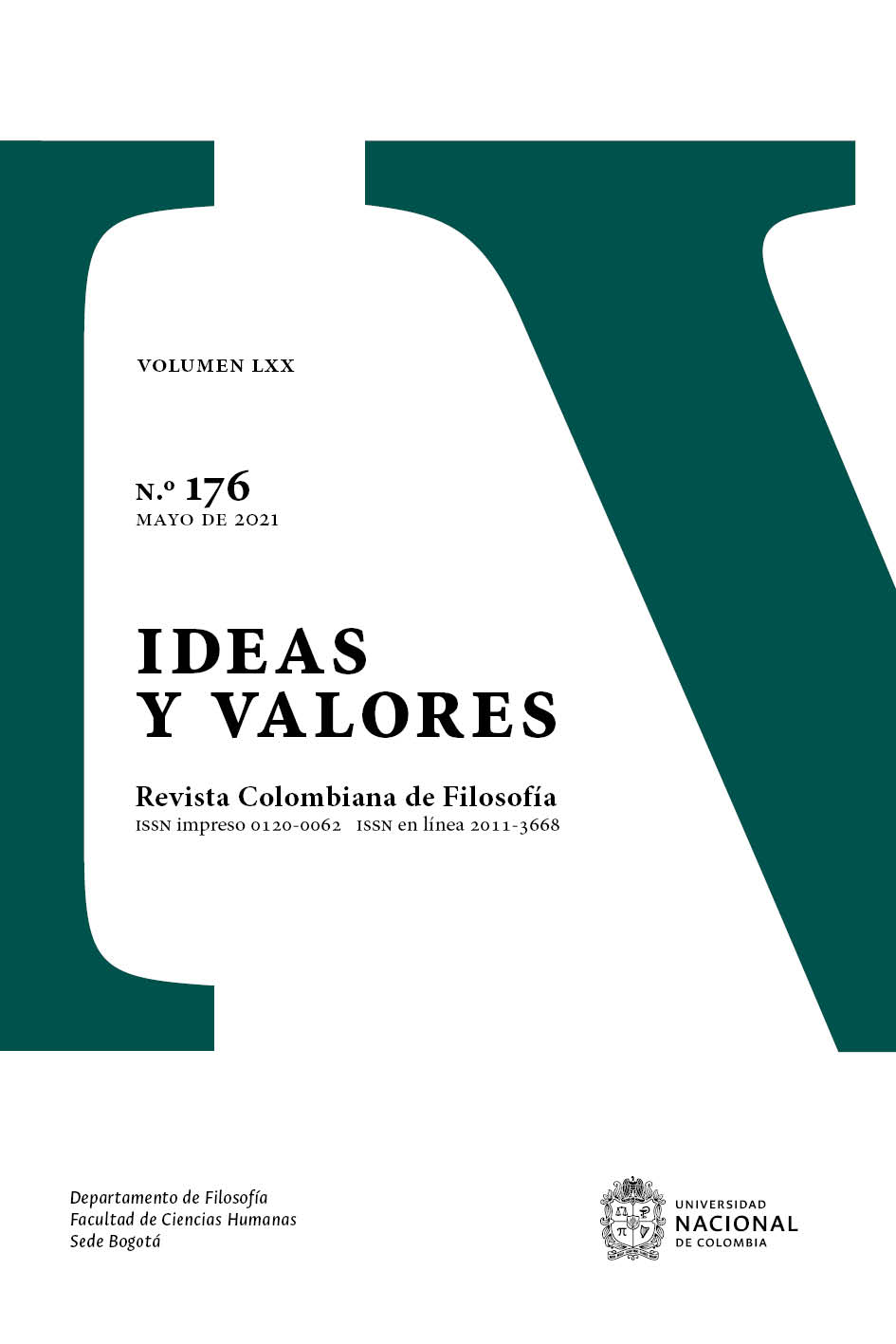
La libertad moral en Thomas Reid. La cuestión del método
Moral Freedom in Thomas Reid. The Question of Method
DOI:
https://doi.org/10.15446/ideasyvalores.v70n176.70962Palabras clave:
T. Reid, D. Hume, Voluntad, Libertad, Método (es)T. Reid, D. Hume, Will, Freedom, Method (en)
Precisamente en momentos en que el determinismo humeano de la voluntad estaba comenzando a tener fuerza de tradición, surge Thomas Reid con una filosofía de la voluntad libre que tiene los rasgos principales de la tradición clásica anterior a Hume, medieval y tempranamente moderna. Su método inductivo, sin embargo, está tomado de Newton y del sentido común. Desde esta metodología ilustrada, Reid afirma que la voluntad es una facultad metafísica. Ha tenido influencia en la agent-cause theory, que se ha opuesto a la event-cause theory en la teoría de la acción contemporánea, de allí su alto interés histórico.
Precisely, by the time in which humean’s will determinism was beginning to have strength of tradition, Thomas Reid arises with a philosophy of free will that had the main features of the pre-Hume classic tradition, medieval and early modern. His inductive method, however, is taken from Newton and from common sense. Since this illustrated methodology, Reid states that will is a metaphysical faculty. It has had influence in agent-cause theory, which has opposed to event-cause theory in contemporary action theory, thence its high historical interest.
Referencias
Duggan, T. “Active Power and the Liberty of Moral Agents.” Thomas Reid. Critical Interpretation. Eds. Stephen Barker and Tom Beauchamp. Filadelfia: Philosophical Monographs, 1976. 103-110.
Ellos, W. J. Thomas Reid’s Newtonian Realism. Washington D.C.: University Press of America, 1981.
Haldane, J. “Thomas Reid and the History of Ideas.” American Catholic Philosophical Quarterly 74.3 (2000): 447-469.
Hume, D. A Treatise of Human Nature. Oxford: The Clarendon Press, 1960.
Hume, D. Enquiries Concerning the Human Understanding and Concerning the Principles of Morals. Oxford: The Clarendon Press, 1902.
Kenny, A. Will, Freedom and Power. Oxford: Blackwell, 1975.
Kenny, A. The Metaphysics of Mind. Oxford: Oxford University Press, 1992.
Laudan, L. “Thomas Reid and The Newtonian Turn of British Methodological Thought.” The Methological Heritage of Newton. Eds. Robert Butts and John Davis. Toronto: University of Toronto Press, 1970. 103-131.
Newton, I. “Mathematical Principles of Natural Philosophy. Optics.” Great Books of the Western World. Vol. 32. Eds. Jerome Mortimer Adler et al. Chicago: Encyclopaedia Britannica, 1990.
O’Connor, T. “Thomas Reid on Free Agency.” Journal of the History of Philosophy 32.4 (1994): 605-622.
Pink, T. Self-Determination: The Ethics of Action. Oxford: Oxford University Press, 2017.
Reid, T. An Inquiry into the Human Mind. On the Principles of Common Sense. Pensilvania: The Pennsylvania State University Press, 1997.
Reid, T. Essays on the Intellectual Powers of Man. Pensilvania : Pennsylvania State University Press, 2002a.
Reid, T. The Correspondence of Thomas Reid. Pensilvania : Pennsylvania State University Press, 2002b.
Reid, T. Essays on the Active Powers of Man. Edimburgo: Edinburgh University Press, 2010.
Stalley, R. F. Causality and Agency in the Philosophy of Thomas Reid. Eds. Melvin Dalgarno and Eric Matthews. Dordrecht, Boston: Kluwer, 1989, 275-283.
Stewart, D. “Account of the Life and Writings of Thomas Reid.” The Works of Thomas Reid. Vol. I. Ed. William Hamilton. Londres: Thoemmes Press, 1994.
Taylor, R. Action and Purpose. Nueva Jersey: Englewood Cliffs, 1966.
Turnbull, G. The Principles of Moral and Christian Philosophy. Philosophical works and Correspondence of George Turnbull. Indianapolis: Liberty Fund, 2005.
Van Cleve, J. Problems from Reid. Nueva York: Oxford University Press, 2015.
Wood, P. Thomas Reid on Animal Creation. Paper Relating to the Life of Sciences. Edimburgo: Edinburgh University Press, 1995.
Dimensions
PlumX
Visitas a la página del resumen del artículo
Descargas
Cómo citar
Licencia
Derechos de autor 2021 Los derechos son del autor(es), quien(es) puede re-publicar en parte o en su totalidad el documento ya publicado en la revista siempre y cuando se dé el debido reconocimiento a Ideas y Valores

Esta obra está bajo una licencia internacional Creative Commons Atribución-NoComercial-SinDerivadas 4.0.
De acuerdo con la Licencia Creative Commons Atribución-No Comercial-SinDerivar 4.0 Internacional. Se autoriza copiar, redistribuir el material en cualquier medio o formato, siempre y cuando se conceda el crédito a los autores de los textos y a Ideas y Valores como fuente de publicación original. No se permite el uso comercial de copia o distribución de contenidos, así como tampoco la adaptación, derivación o transformación alguna de estos sin la autorización previa de los autores y de la dirección de Ideas y Valores. Para mayor información sobre los términos de esta licencia puede consultar: http://creativecommons.org/licenses/by-nc-nd/4.0/legalcode.







.jpg)