Publicado
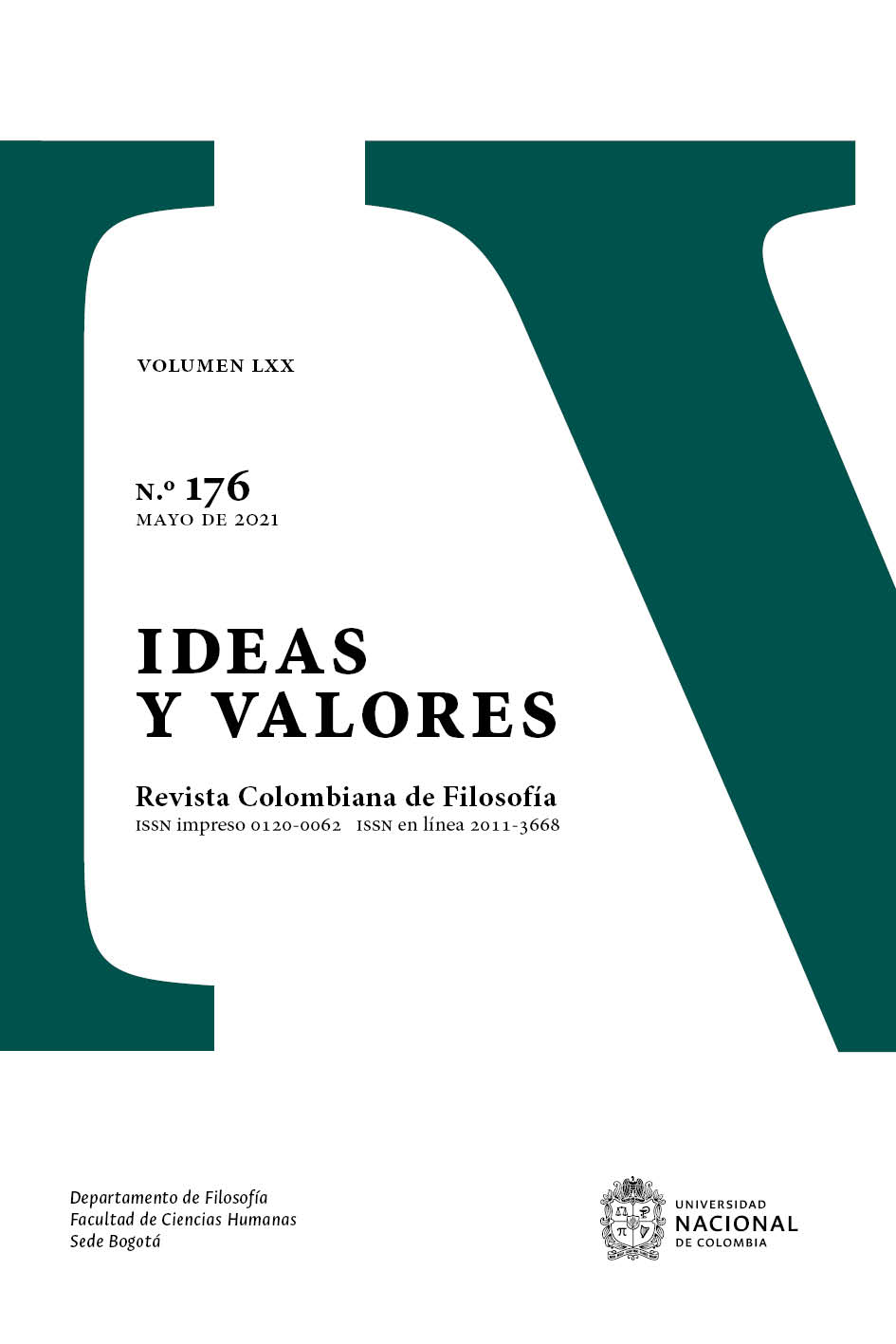
La cuestión del animal en el concepto de lo político de Carl Schmitt Entre teología política y zoología política
The Question of the Animal in Schmitt's Concept of the Political: Between Political Theology and Political Zoology
¿Es el animal un tema de interés para Carl Schmitt? El sentido común académico presupone que la cuestión del animal es ajena tanto a los intereses intelectuales de Schmitt como a su concepción de lo político, de lo teológico y de la relación que ambos mantienen entre sí. En este trabajo sugerimos que esta impresión debe ser revisada a la luz de evidencia textual que revela el interés de Schmitt por la cuestión del animal y de intérpretes de su obra que, aunque de manera tangencial, discuten dicha cuestión.
Referencias
Agamben, G. Estado de Excepción. Homo Sacer ii, 1. Valencia: Pre-textos, 2004.
Agamben, G. Homo Sacer. El poder soberano y la nuda vida. Valencia: Pre-textos, 2010.
Ashcraft, R. “Hobbes’s Natural Man. A Study in Ideology Formation.” The Journal of Politics 33.4 (1971): 1076-1117.
Ashcraft, R. “Leviathan Triumphant. Thomas Hobbes and the Politics of Wild Men.” The Wild Man Within. An Image in Western Thought from the Renaissance to Romanticism. Eds. Edward Dudley and Maximilian Novak. Pittsburgh: University of Pittsburgh Press, 1972. 141-82.
Balibar, É. “El Hobbes de Schmitt, el Schmitt de Hobbes.” Las Torres de Luca. International Journal of Political Philosophy 5.9 (2016): 201-259.
Churchill, W. “A Disarmament Fable.” Winston Churchil.org. Web. 06 Aug. 2018. [https://winstonchurchill.org/resources/speeches/1915-1929-nadir-and-recovery/a-disarmament-fable/]
Darat, N. “Hobbes as a Sociobiologist. Rethinking the State of (Human) Nature.” Kriterion. Revista de Filosofía 58.136 (2017): 163-183.
Derrida, J. Seminario La bestia y el soberano. (2001-2002). 1 vols. Buenos Aires: Ediciones Manantial, 2010.
Donaldson, S., and Will, K. Zoopolis. A Political Theory of Animal Rights. Oxford: Oxford University Press, 2011.
Dotti, J. “El Hobbes de Schmitt.” Cuadernos de Filosofía 10.32 (1989): 57-68.
Dotti, J. “¿Quién mató al Leviatán? Schmitt intérprete de Hobbes en el contexto del nacionalsocialismo.”Deus Mortalis 1 (2002): 93-190.
Hobbes, T. El Leviatán o la materia, forma y poder de una república eclesiástica y civil. México: FCE, 1992.
Jacobson, N. “The Strange Case of the Hobbesian Man.” Representations 63 (1998): 1-12.
Lemm, V. Nietzsche’s Animal Philosophy Culture, Politics, and the Animality of the Human Being. New York: Fordham University Press, 2009.
Maschke, G. “Zum ‘Leviathan’ von Carl Schmitt.” Der Leviathan in der Staatslehre des Thomas Hobbes. Sinn und Fehlschlag eines politischen Symbol. Köln: Hohenheim Verlag (1982): 179-244.
Massumi, B. What Can Animals Teach Us About Politics? Durham: Duke University Press, 2014.
Meier, H. Carl Schmitt, Leo Strauss y el concepto de lo político. Un diálogo entre ausentes. Buenos Aires; Madrid: Katz Editores, 2008.
Dimensions
PlumX
Visitas a la página del resumen del artículo
Descargas
Cómo citar
Licencia
Derechos de autor 2020 Los derechos son del autor(es), quien(es) puede re-publicar en parte o en su totalidad el documento ya publicado en la revista siempre y cuando se dé el debido reconocimiento a Ideas y Valores

Esta obra está bajo una licencia internacional Creative Commons Atribución-NoComercial-SinDerivadas 4.0.
De acuerdo con la Licencia Creative Commons Atribución-No Comercial-SinDerivar 4.0 Internacional. Se autoriza copiar, redistribuir el material en cualquier medio o formato, siempre y cuando se conceda el crédito a los autores de los textos y a Ideas y Valores como fuente de publicación original. No se permite el uso comercial de copia o distribución de contenidos, así como tampoco la adaptación, derivación o transformación alguna de estos sin la autorización previa de los autores y de la dirección de Ideas y Valores. Para mayor información sobre los términos de esta licencia puede consultar: http://creativecommons.org/licenses/by-nc-nd/4.0/legalcode.









.jpg)