Publicado
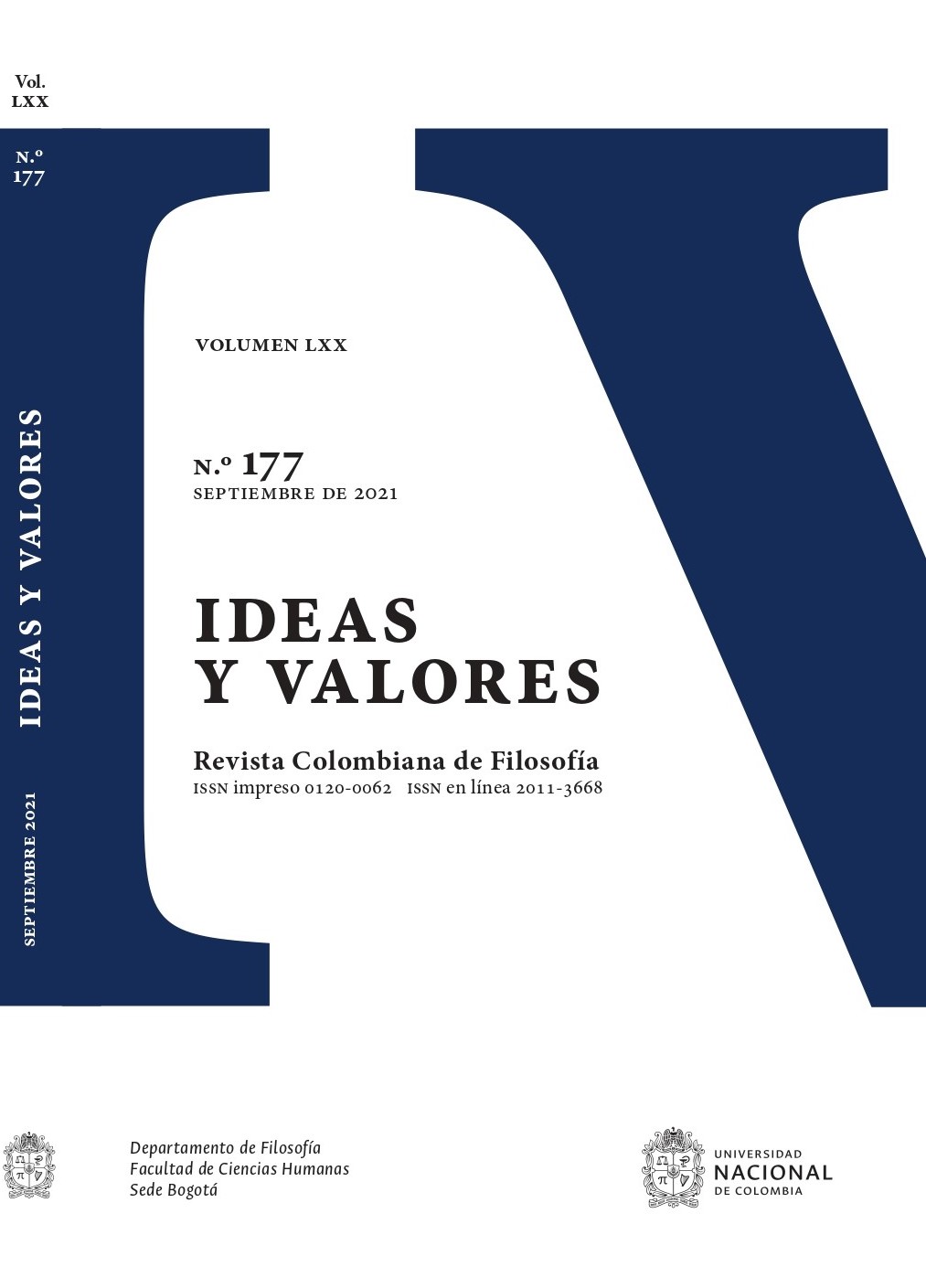
¿Se atrapa antes a un mentiroso que a un cojo? Mentira, engaño, sinceridad y verdad en Los ensayos de Michel de Montaigne
Can You Catch a Liar before a Cripple? Lie, Deception, Sincerity and Truth in Michel de Montaigne's Essays
DOI:
https://doi.org/10.15446/ideasyvalores.v70n177.94580Palabras clave:
Engaño, Mentira, Rumor, Sinceridad, Verdad (es)Deceit, Lie, Rumor, Sincerity, Truth (en)
Los estudios actuales sobre la mentira priman su lado epistémico y desatienden los aspectos morales. Tal distinción es clara en los intentos de diferenciar la mentira de la intención de engañar, y tienen como contrapartida una concepción de la verdad realista. Por ello, las interpretaciones que cuestionan o minimizan la existencia de la Verdad tienden a ser rechazadas, y parece que tampoco podrían abordar satisfactoriamente la mentira. En este artículo cuestionaremos dicha asunción, mostrando cómo un autor del Renacimiento, Michel de Montaigne, sostiene una perspectiva “negadora” de la verdad y critica la mentira, precisamente destacando su dimensión moral.
Current studies on lying emphasize its epistemic side and neglect the moral aspects. Such a distinction is clear in the attempts to distinguish lying from the intention to deceive and has as a counterpart a realistic conception of truth. Therefore, interpretations that question the existence of truth, or that minimize it, tend to be rejected, and it seems that they could not satisfactorily address the lie either. In this article we will question this assumption, showing how a Renaissance author, Michel de Montaigne, maintains a “denying” perspective of truth while criticizing the lie, precisely by highlighting its moral dimension.
Referencias
Agustín de Hipona. Obras de San Agustín, Tratados morales. t. XII. Trads. Félix García, Lope Cilleruelo y Ramiro Flórez. Madrid: BAC, 1954.
Aristóteles. Poética. Trad. Valentín García. Madrid: Gredos, 1974.
Basset, B. “Erreur/vérité, mensonge/sincérité, d’Érasme à Montaigne.” Bulletin de la Société internationale des amis de Montaigne 63.1 (2016): 73-91.
Blackburn, S. La verdad: guía de perplejos. Trad. Antonio Prometeo. Barcelona: Crítica, 2006.
Böll, H. El honor perdido de Katharina Blum. Trad. Helene Katendhal. Barcelona: Círculo de Lectores, 2001.
Carson, T. L. “The Definition of Lying.” Nous 40.2 (2006): 284-306.
Carson, T. L. Lying and Deception. Theory and Practice. Oxford: Oxford University Press, 2010.
Chisholm, R. M. y Feehan, T. D. “The Intent to Deceive.” Journal of Philosophy 74.3(1977): 143 159.
Davidson, D. “Deception and Division.” The Multiple Self. Ed. Jon Elster. Cambridge: Cambridge University Press, 1987. 79-92.
Delègue, Y. Montaigne et la mauvaise foi. L´écriture de la vérité. Paris: Champion, 2000.
Dummett, M. La verdad y otros enigmas. Trad. Alfredo Herrera. México: FCE, 1990.
Fallis, D. “What is Lying?” Journal of Philosophy 106.1 (2009): 29-56
Frankfurt, H. Sobre la charlatanería y sobre la verdad. Trads. Carme Castells y Miguel Candel. Barcelona: Paidós, 2013.
Frege, G. “Thoughts.” Logical Investigations. Trads. P. T. Geach y R. H. Stoothoff. Oxford: Blackwell, 1977. 1-30.
García-Carpintero, M. “¿Qué es la verdad?” Revista de libros 133 (2008): 1-6.
García Jurado, F. “‘Mentir’ y ‘Decir mentira’. Una differentia entre la miscelanea de Aulo Gelio y el ensayo de Montaigne.” Atene e Roma 6.1-2 (2012): 1-20.
Guerrier, O. “La vérité n’est jamais matière d’erreur.” Bulletin de la Société internationale des amis de Montaigne 63.1 (2016): 93-102.
Hartle, A. “Montaigne and Skepticism.” The Cambridge Companion to Montaigne. Ed. Ullrich Langer. Cambridge: Cambridge University Press, 2005. 183-206.
Lackey, J. “Lies and Deception: An Unhappy Divorce.” Analysis 73.2 (2013): 236-248.
Lynch, M. P. La importancia de la verdad para una cultura pública decente. Trad. Pablo Hermida. Barcelona: Paidós, 2005.
Mahon, J. E. “The Definition of Lying and Deception.” Standford Encyclopedia, 2008. Web. 23 march de 2020 [http://plato.stanford.edu/archives/win2016/entries/lying-definition/]
Mathieu-Castellani, G. Montaigne ou la vérité du mensonge. Paris: Droz, 2000.
Meillassoux, Q. After Finitude: An Essay on the Necessity of Contingency. Londres: Continuum, 2009.
Menager, D. “Parole et mensonge dans le livre I des Essais.” Cahiers Textuel 12 (1993): 145- 154.
Miernowski, J. “Montaigne on Truth and Skepticism.” The Oxford Handbook of Montaigne. Ed. Philippe Desan. Oxford: Oxford University Press, 2016. 544-561.
Montaigne, M. de. Les Essais. Paris: PUF, 2004.
Montaigne, M. de. Los ensayos. Trad. Jordi Bayod. Barcelona: Acantilado, 2007.
Olfert, C. M. M. “Skeptical Investigation and its Perks: Diog. Laert. 9.69-70 and 79- 89.” Pyrrhonian Skepticism in Diogenes Laertius. Ed. Katja M. Vogt. Tübingen: Mohr Siebeck, 2015. 147-170.
Pascal, B. Conversación con el Sr. de Saci. Trad. Alicia Villar. Salamanca: Sígueme, 2006.
Popkin, R. H. The History of Scepticism. From Savonarola to Bayle. New York: Oxford University Press, 2003.
Putnam, H. El pragmatismo. Un debate abierto. Trad. Roberto Rosaspini. Barcelona: Gedisa, 1999.
Raga Rosaleny, V. “¿Montaigne escéptico? La influencia de Pascal en nuestra comprensión de Los ensayos.” Ideas y Valores 68.171 (2019): 59-80.
Raga Rosaleny, V. “Los ensayos de Michel de Montaigne y el escepticismo.” Guía Comares de Montaigne. Ed. Joan Lluís Llinàs. Granada: Comares, 2020. 91-114.
Reguig, D. “Le mensonge de Montaigne: la référence aux Essais dans la Logique de Port-Royal. ” Dix-septième siècle 219.4 (2010): 711-727.
Rorty, R. “Is Truth a Goal of Inquiry? Donald Davidson versus Crispin Wright.” Truth and Progress. Philosophical Papers. 3 vols. Ed. Richard Rorty. Cambridge: Cambridge University Press, 2010. 19-42.
Rousseau, J.-J. Œuvres complètes. t. I. Paris: Gallimard, 1959.
Saul, J. M. Lying, Misleading, and What is Said. An Exploration in Philosophy of Language and in Ethics. Oxford: Oxford University Press, 2012.
Sexto Empírico. Esbozos pirrónicos. Trads. Antonio Gallego y Teresa Muñoz. Madrid: Gredos, 1993.
Shiffrin, S. V. Speech Matters. On Lying, Morality and the Law. Princeton: Princeton University Press, 2014.
Skalko, J. Why is it Intrinsically Evil to Violate the Purpose of a Power or Use Assertions Unnaturally? Doctoral Dissertation, 2018.
Sorensen, R. “Bald-Faced Lies! Lying Without the Intent to Deceive.” Pacific Philosophical Quarterly 88.2 (2007): 251-264.
Sorensen, R. “Knowledge-lies.” Analysis 70.4 (2010): 608-615.
Starobinski, J. “Montaigne et la dénonciation du mensonge.” Dialectica 22.2 (1968): 120-131.
Starobinski, J. Montaigne en mouvement. Paris: Gallimard, 1982.
Tarski, A. “The Semantic Conception of Truth.” Philosophy and Phenomenological Research 4.3 (1944): 341-376.
Tomasini-Bassols, A. “Mentira, engaño y desorientación.” Praxis Filosófica 50 (2020): 207-226.
Williams, B. Verdad y veracidad. Trads. Alberto Enrique Álvarez y Rocío Orsi. Barcelona: Tusquets, 2006.
Dimensions
PlumX
Visitas a la página del resumen del artículo
Descargas
Cómo citar
Licencia
Derechos de autor 2021 Los derechos son del autor(es), quien(es) puede re-publicar en parte o en su totalidad el documento ya publicado en la revista siempre y cuando se dé el debido reconocimiento a Ideas y Valores

Esta obra está bajo una licencia internacional Creative Commons Atribución-NoComercial-SinDerivadas 4.0.
De acuerdo con la Licencia Creative Commons Atribución-No Comercial-SinDerivar 4.0 Internacional. Se autoriza copiar, redistribuir el material en cualquier medio o formato, siempre y cuando se conceda el crédito a los autores de los textos y a Ideas y Valores como fuente de publicación original. No se permite el uso comercial de copia o distribución de contenidos, así como tampoco la adaptación, derivación o transformación alguna de estos sin la autorización previa de los autores y de la dirección de Ideas y Valores. Para mayor información sobre los términos de esta licencia puede consultar: http://creativecommons.org/licenses/by-nc-nd/4.0/legalcode.






.jpg)