Published
Design of Comminution Plants in the Ceramic Industry Using a Simulation-based Optimization Approach
Diseño de una planta de molienda para la industria de cerámica mediante un enfoque de optimización basado en simulaciones
DOI:
https://doi.org/10.15446/ing.investig.v41n3.87761Keywords:
Comminution, equipment selection, genetic algorithm, simulation (en)molienda, selección de equipos, algoritmo genético, simulación (es)
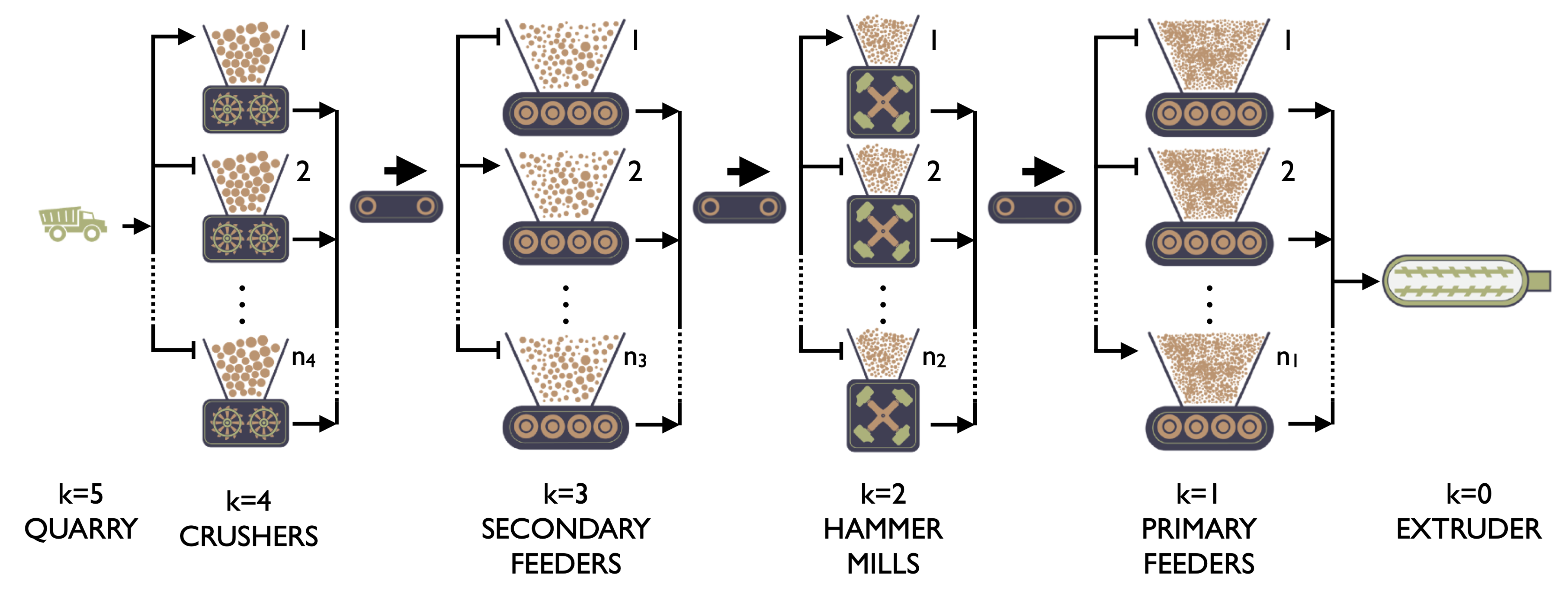
In many cases, the design process of a structural ceramic comminution plant typically consists of an ‘expert designer’ who makes decisions using intuitive criteria to select commercial equipment. This paper proposes a simulationbased optimization approach to help decisionmaking. The complexity of the problem lies in selecting the model and amount of equipment for each stage at the lowest cost while simultaneously satisfying a previously fixed production and granulometry. The proposed approach is based on a genetic algorithm to generate solutions and facilitate the optimization process, together with discrete simulation to evaluate the performance of the comminution process according to its service level. To evaluate the algorithm, different problems, whose parameters are based on the requirements of the ceramic industry, are solved and analyzed.
En muchos casos, el proceso de diseño de una planta estructural de molienda para la industria de la cerámica consiste en un “diseñador experto” que utiliza criterios intuitivos para seleccionar equipos comerciales. Este artículo propone un enfoque de optimización basado en simulación para ayudar en la toma de decisiones. La complejidad del problema radica en seleccionar el modelo y número de equipos en cada etapa por el costo más bajo y, simultáneamente, satisfacer producción y granulometría fijadas previamente. El enfoque propuesto se basa en un algoritmo genético para generar soluciones y facilitar el proceso de optimización, junto con un modelo de simulación para evaluar el rendimiento del proceso de molienda de acuerdo con su nivel de servicio. Para evaluar el algoritmo, se resuelve y analizan diferentes problemas cuyos parámetros se basan en los requerimientos de la industria cerámica.
References
Asbjörnsson, G., Hulthén, E., and Evertsson M. (2013). Modelling and simulation of dynamic crushing plant behavior with MATLAB/Simulink. Minerals Engineering, 43-44, 112-120. https://doi.org/10.1016/j.mineng.2012.09.006
Barberá-Martinez, L., Viveros-Gunckel, P., González-Prida-Díaz, V., and Mena, R. (2014). Influence of the input load on the reliability of the grinding line. A case study. Revista DYNA, 89(5), 560-568. https://doi.org/10.6036/7013
Burt, C. N. and Caccetta, L. (2018). Literature review. In Burt, C. N. and Caccetta, L. (Eds.) Equipment Selection for Mining: with Case Studies (pp. 25-51). New York, NY: Springer. https://doi.org/10.1007/978-3-319-76255-5_3
Cely-Illera, L. (2016). Raw materials for the ceramics industry from norte de santander. I. Mineralogical, chemical and physical characterization. Revista Facultad de Ingeniería - Universidad de Antioquia, 80(2016), 31-37. https://doi.org/10.17533/udea.redin.n80a04
Derpich, I., Munoz, N., and Espinoza, A.(2019). Improving the productivity of the copper mining process in the Chilean copper industry. Croatian Operational Research Review, 10(2), 227-240. https://doi.org/10.17535/crorr.2019.0020
Farzanegan, A. and Mirzaei, Z. S. (2015). Scenario-Based Multi-Objective Genetic Algorithm Optimization of Closed Ball-Milling Circuit of Esfordi Phosphate Plant. Mineral and Extractive Metallurgy Review, 36(2), 71-82. https://doi.org/10.1080/08827508.2013.868348
Guerrero, W. J., Sotelo-Cortés, L. A., and Romero-Mota E. (2018). Simulation-optimization techniques for closed-loop supply chain design with multiple objectives. Revista DYNA, 35(206), 202-210. https://doi.org/10.15446/dyna.v85n206.70596
Holland, J. (1975). Adaptation in Natural and Artificial Systems. Ann arbour, MI: The University of Michigan Press.
Kruszelnicka, W. (2020). New model for ecological assessment of comminution process in energy biomass processing chain. E3S Web of Conferences, 154, 1-21. https://doi.org/10.1051/e3sconf/202015401001
Légaré, B., Bouchard, J., and Poulin. (2016). A Modular Dynamic Simulation Model for Comminution Circuits. IFAC-PapersOnLine, 49(20), 19-24. https://doi.org/10.1016/j.ifacol.2016.10.090
Li, H., Evertsson, M., Lindqvist, M., Hulthén, E., and Asbjornsson, G. (2018). Dynamic modeling and simulation of a SAG millpebble crusher circuit by controlling crusher operational parameters. Minerals Engineering, 127, 98-104. https://doi.org/10.1016/j.mineng.2018.07.010
Lin, J. T. and Chen, C.-M. (2015). Simulation optimization approach for hybrid flow shop scheduling problem in semiconductor back-end manufacturing. Simulation Modelling Practice and Theory, 51, 100-114. https://doi.org/10.1016/j.simpat.2014.10.008
Martins, S. (2016). Size-energy relationship in comminution, incorporating scaling laws and heat. International Journal of Mineral Procesing, 153, 29-43. https://doi.org/10.1016/j.minpro.2016.05.020
Musingwini, C. (2016). Mine Planning and Equipment Selection (MPES 2015). Journal of the Southern African Institute of Mining and Metallurgy, 116(9), 809-820. http://www.scielo.org.za/scielo.php?script=sci_arttext&pid=S2225-62532016000300001
Negahban, A. and Smith, J. S. (2014). Simulation for manufacturing system design and operation: Literature review and analysis. Journal of Manufacturing Systems, 33(2), 241-261. https://doi.org/10.1016/j.jmsy.2013.12.007
Pradenas-Rojas, L. and Passicot-Guzmán, P. (2017). Optimizing the use of cranes and trucks in forestry operations. Revista DYNA, 84(201), 172-179. https://doi.org/10.15446/dyna.v84n201.52739
Regional Activity Centre for Cleaner Production (RAC/CP). (2006). Phases in the manufacture of ceramic products. In RAC/CP (Eds.) Pollution Prevention in the Structural Ceramics Sector, (pp. 45-52). http://www.cprac.org/docs/ceramicaestr_ang.pdf
Seebacher, G., Winkler, H., and Oberegge, r B. (2015). In-plant logistics efficiency valuation using discrete event simulation. International Journal of Simulation Modelling, 14(2015), 60-70. https://doi.org/10.2507/IJSIMM14(1)6.289
Wang, G., Yan, Y., Zhang, X., Shangguan, J., and Xiao, Y. (2008). A simulation optimization approach for facility layout problem. In IEEE (Eds.) 2008 IEEE International Conference on Industrial Engineering and Engineering Management, IEEM 2008. https://doi.org/10.1109/IEEM.2008.4737966
Dimensions
PlumX
Article abstract page views
Downloads
How to Cite




License
Copyright (c) 2021 Ignacio Ortiz de Landazuri Suárez, María José Oliveros Colay

This work is licensed under a Creative Commons Attribution 4.0 International License.
The authors or holders of the copyright for each article hereby confer exclusive, limited and free authorization on the Universidad Nacional de Colombia's journal Ingeniería e Investigación concerning the aforementioned article which, once it has been evaluated and approved, will be submitted for publication, in line with the following items:
1. The version which has been corrected according to the evaluators' suggestions will be remitted and it will be made clear whether the aforementioned article is an unedited document regarding which the rights to be authorized are held and total responsibility will be assumed by the authors for the content of the work being submitted to Ingeniería e Investigación, the Universidad Nacional de Colombia and third-parties;
2. The authorization conferred on the journal will come into force from the date on which it is included in the respective volume and issue of Ingeniería e Investigación in the Open Journal Systems and on the journal's main page (https://revistas.unal.edu.co/index.php/ingeinv), as well as in different databases and indices in which the publication is indexed;
3. The authors authorize the Universidad Nacional de Colombia's journal Ingeniería e Investigación to publish the document in whatever required format (printed, digital, electronic or whatsoever known or yet to be discovered form) and authorize Ingeniería e Investigación to include the work in any indices and/or search engines deemed necessary for promoting its diffusion;
4. The authors accept that such authorization is given free of charge and they, therefore, waive any right to receive remuneration from the publication, distribution, public communication and any use whatsoever referred to in the terms of this authorization.