Published
Verification of a Fabless Device Model Using TCAD Tools: from Bipolar Transistor Formation to I-V Characteristics Extraction
Verificación de un modelo de dispositivo sin defectos utilizando herramientas TCAD: desde la formación de transistores bipolares hasta la extracción de características I-V
DOI:
https://doi.org/10.15446/ing.investig.v41n3.88685Keywords:
Electronics engineering education, laboratory learning environment, learning technology, TCAD tools (en)educación en ingeniería electrónica, entorno de aprendizaje de laboratorio, tecnología de aprendizaje, herramientas TCAD (es)
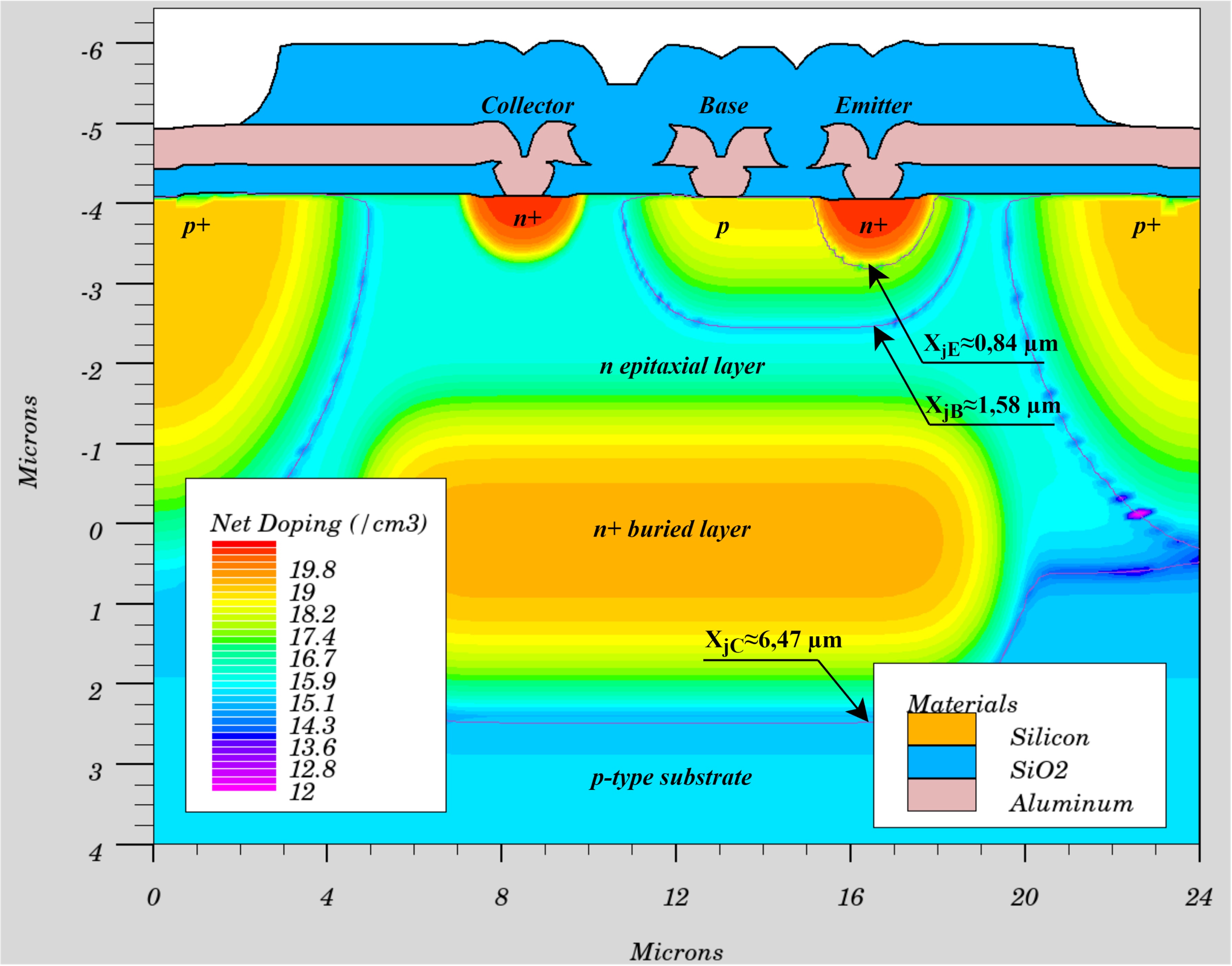
This paper describes the analysis of processes used in microand nanoelectronic device manufacturing. It also presents an exemplary and novel laboratory exercise in which an epitaxial planar n + pn bipolar transistor with junction isolation is illustrated and analyzed stepbystep. Only seven photolithography steps are used to obtain this bipolar transistor structure: for buried layer formation, for junction transistor isolation and collectors regions formation, for base region formation, for emitter and collector n+ region formation, for contact windows, for first aluminum metallization, and, finally, for passivation. Silvaco TCAD software tools are used to implement all of these manufacturing processes and to simulate the resulting IV characteristics of all presented semiconductor structures. This type of laboratory work provides students with basic knowledge and a consistent understanding of bipolar transistor manufacturing, as well as facilitating theoretical understanding, analysis, and simulation of various semiconductor manufacturing processes without the need for costly and lengthy technological manufacturing experiments. This article also presents the conclusions and other benefits of such laboratory work, as well as possible recommendations for further improvement or expansion.
Este artículo describe el análisis de los procesos utilizados en la fabricación de dispositivos de micro y nanoelectrónica. También presenta un ejercicio de laboratorio ejemplar y novedoso en el que se ilustra y analiza paso a paso un transistor bipolar plano n + pn epitaxial con aislamiento de unión. Solo se utilizan siete pasos de fotolitografía para obtener esta estructura de transistor bipolar: para la formación de capas enterradas, para el aislamiento del transistor de unión y la formación de regiones colectoras, para la formación de regiones base, para la formación de regiones emisoras y colectoras n+, para ventanas de contacto, para la primera metalización de aluminio, y finalmente para pasivación. Las herramientas de software Silvaco TCAD se utilizan para implementar todos estos procesos de fabricación y para simular las características IV resultantes de todas las estructuras de semiconductores presentadas. Este tipo de trabajo de laboratorio proporciona a los estudiantes conocimientos básicos y una comprensión constante de la fabricación de transistores bipolares. Asimismo, este estudio facilita la comprensión teórica, el análisis y la simulación de varios procesos de fabricación de semiconductores sin la necesidad de experimentos de fabricación tecnológicos costosos y largos. Este artículo también presenta las conclusiones y otros beneficios de dicho trabajo de laboratorio, así como posibles recomendaciones para una su mejora o expansión.
References
Annegarn, M., Baldi, L., Hartman, R., Lehner, N., Matheron, G., and Van Roosmalen, F. (2012, November). Innovation for the future of Europe: Nanoelectronics beyond 2020. Paris: Aeneas and Catrene. https://ec.europa.eu/digital-single-market/en/news/innovation-future-europe-nanoelectronics-beyond-2020
Armstrong, G. A. and Maiti, C. K. (2007). Technology computer aided design for Si, SiGe and GaAs integrated circuits (Vol. 21). London: IET.
Barzdenas, V., Grazulevicius, G., and Vasjanov, A. (2020). TCAD tools in undergraduate studies: A laboratory work for learning deep submicron CMOS processes. The International Journal of Electrical Engineering and Education, 57(2), 133-163. https://doi.org/10.1177/0020720919846811
Barzdenas, V. and Navickas, R. (2012). Microtechnologies: A Laboratory Manual. Vilnius: Technika.
European Commission (2012). Key Enabling Technologies. A bridge to growth and jobs. Press release. https://ec.europa.eu/commission/presscorner/detail/en/MEMO_12_484
European Commission (2013). Status Implementation Report –Second High-Level Expert Group on Key Enabling Technologies (KETs). https://ec.europa.eu/growth/content/status-implementation-report----second-high-level-expert-group-key-enabling-technologies-kets_en
European Commission (2015). High-Level Expert Group on Key Enabling Technologies. Final Report KETs: Time to Act. https://ec.europa.eu/growth/content/high-level-expert-group-kets-publishes-final-recommendations_en
European Commission (2018). What are KETs and why are they important? Internal Market, Industry, Entrepreneurship and SMEs. https://ec.europa.eu/growth/industry/policy/keyenablingtechnologies/description_en
Eurostat (2018). ICT specialists in employment – Statistics Explained. https://ec.europa.eu/eurostat/statistics-explained/index.php?title=ICT_specialists_in_employment
Maiti, C. K. and Maiti, A. (2013). Teaching technology computer aided design (TCAD) online. In Information Resources Management Association (Eds.) Industrial Engineering: Concepts, Methodologies, Tools, and Applications (pp. 1043-1063). Hershey, PA: IGI Global.
Maiti, C. K. (2017). Introducing Technology Computer-Aided Design (TCAD): Fundamentals, Simulations, and Applications. Boca Raton, FL: CRC Press.
Marcus, R. B. and Sheng, T. T. (1982). The oxidation of shaped silicon surfaces. Journal of the Electrochemical Society, 129(6), 1278. https://doi.org/10.1149/1.2124118
Plummer, J. D., Deal, M., and Griffin, B. P. (2000). Silicon VLSI Technology: Fundamentals, Practice, and Modeling. Upper Saddle River, NJ: Prentice Hall.
Sarkar, C. K. (Ed.) (2013). Technology computer aided design: simulation for VLSI MOSFET. Boca Raton, FL: CRC Press.
United States Department of Labor (2019). Computer and information technology occupations: Occupational Outlook Handbook. https://www.bls.gov/ooh/computer-and-information-technology/home.htm
Dimensions
PlumX
Article abstract page views
Downloads
How to Cite




License
Copyright (c) 2021 Vaidotas Barzdenas, Gediminas Grazulevicius, John Liobe, Aleksandr Vasjanov, Leonid Kladovscikov

This work is licensed under a Creative Commons Attribution 4.0 International License.
The authors or holders of the copyright for each article hereby confer exclusive, limited and free authorization on the Universidad Nacional de Colombia's journal Ingeniería e Investigación concerning the aforementioned article which, once it has been evaluated and approved, will be submitted for publication, in line with the following items:
1. The version which has been corrected according to the evaluators' suggestions will be remitted and it will be made clear whether the aforementioned article is an unedited document regarding which the rights to be authorized are held and total responsibility will be assumed by the authors for the content of the work being submitted to Ingeniería e Investigación, the Universidad Nacional de Colombia and third-parties;
2. The authorization conferred on the journal will come into force from the date on which it is included in the respective volume and issue of Ingeniería e Investigación in the Open Journal Systems and on the journal's main page (https://revistas.unal.edu.co/index.php/ingeinv), as well as in different databases and indices in which the publication is indexed;
3. The authors authorize the Universidad Nacional de Colombia's journal Ingeniería e Investigación to publish the document in whatever required format (printed, digital, electronic or whatsoever known or yet to be discovered form) and authorize Ingeniería e Investigación to include the work in any indices and/or search engines deemed necessary for promoting its diffusion;
4. The authors accept that such authorization is given free of charge and they, therefore, waive any right to receive remuneration from the publication, distribution, public communication and any use whatsoever referred to in the terms of this authorization.