Published
Modeling and Control of Small-Scale Underground Mine Ventilation Networks
Modelado y control de redes de ventilación de minas subterráneas de pequeña escala
DOI:
https://doi.org/10.15446/ing.investig.90968Keywords:
Ventilation, modeling, control systems, mines (en)Vebtilación, Modelado, sistemas de control, minas (es)
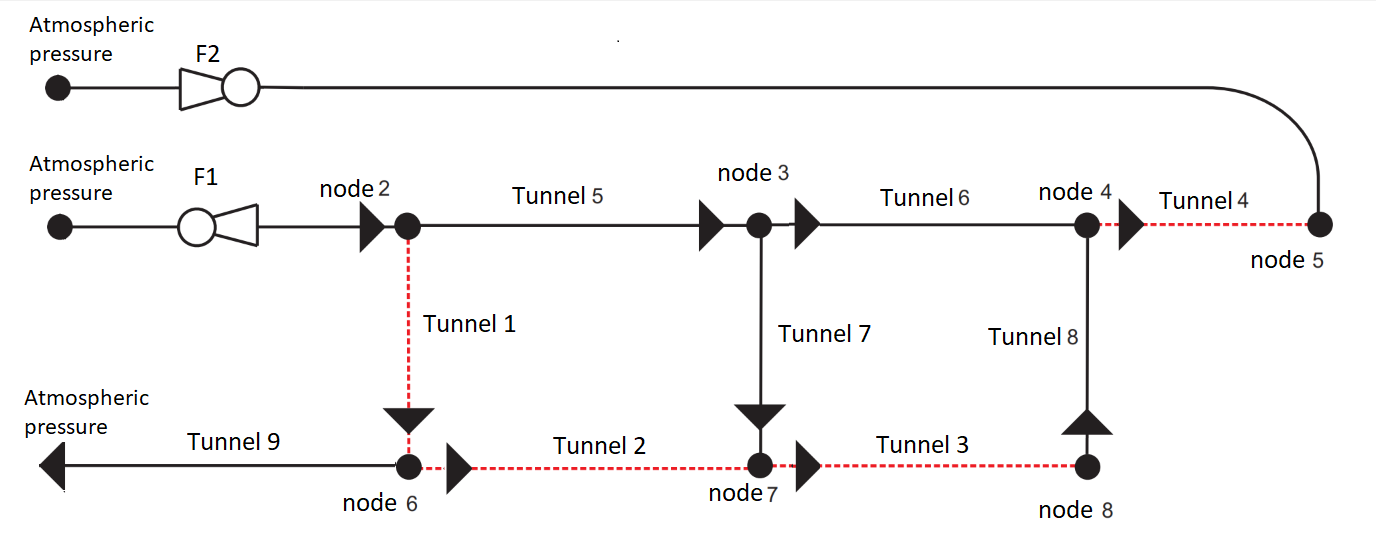
This paper presents a nonlinear model and a control strategy to regulate airflow in small-scale underground mine ventilation networks. In underground ventilation control systems, a sensor and an actuator for each branch are usually considered. However, in small-scale underground mines, it is too expensive to have automatic doors for controlling the air flow in each tunnel, as well as to install flow and gas sensors in each branch. In order to regulate airflow in small-scale underground ventilation networks, the number of sensors and actuators is regarded as a limitation for practical installation. This work presents an alternative modeling of the network, with direct control of the airflow in each tunnel, by varying the speed of the fans available on the external surface of the mine. A state space model is presented, and a linear quadratic controller with integral action and a state estimator is designed. To validate the model and the controller, a network ventilation system for a small-scale mine with nine branches (tunnels) and two actuators (fans) is presented.
Este artículo presenta un modelado no lineal y una estrategia para el control del flujo de aire en redes de ventilación de minas subterráneas de pequeña escala. Para los sistemas de control de ventilación subterránea usualmente se consideran un sensor y un actuador en cada rama. Sin embargo, en las minas subterráneas de pequeña escala, es muy costoso colocar puertas automáticas para controlar el flujo de aire en cada túnel, as ́ı como instalar sensores de flujo y gas en cada rama. Con el fin de regular el flujo de aire en redes de ventilación subterránea de pequeña escala, se considera el número de sensores y actuadores como una limitante para la instalación práctica. Este trabajo presenta una alternativa para el modelado de la red, con control directo del flujo de aire en cada túnel, a través de la variación de velocidad de los ventiladores disponibles en la superficie externa de la mina. Se presenta un modelo de espacio de estado y se diseña un controlador cuadrático lineal con acción integral y un estimador de estado. Para
validar el modelo y el controlador, se presenta un sistema de red de ventilación para una mina de pequeña escala con nueve ramas (túneles) y dos actuadores (ventiladores).
References
Danko, G. L. (2017). Model Elements and Network Solutions of Heat, Mass, and Momentum Transport Processes. Springer International Publishing. https://doi.org/10.1007/978-3-662-52931-7
de Villiers, D. J., Mathews, M. J., Maré, P., Kleingeld, M., and Arndt, D. (2019). Evaluating the impact of auxiliary fan practices on localized subsurface ventilation. International Journal of Mining Science and Technology, 29(6):933–941. http://dx.doi.org/10.1016/j.ijmst.2019.02.008
Egeland, O. and Gravdahl, J. T. (2002). Modeling and Simulation for Automatic Control.
Gugat, M. and Ulbrich, S. (2017). The isothermal Euler equations for ideal gas with source term: Product solutions, flow reversal and no blow up. Journal of Mathematical Analysis and Applications, 454(1):439–452. http://dx.doi.org/10.1016/j.jmaa.2017.04.064
Hartman, H., Mutmansky, J., Ramani, R., and Wang, Y. (1997). Mine Ventilation and Air Conditioning. John Wiley Sons, NC., (3rd) edition.
Hu, Y., Koroleva, O. I., and Krstić, M. (2003). Nonlinear control of mine ventilation networks. Systems Control Letters, 49(4):239–254, http://dx.doi.org/10.1016/S0167-6911(02)00336-5
Jing, G., Cai, W., Zhang, X., Cui, C., Liu, H., and Wang, C. (2020). An energy-saving control strategy for multi-zone demand-controlled ventilation system with data-driven model and air balancing control. Energy, 199:117328. http://dx.doi.org/10.1016/j.energy.2020.117328
Kirk, D. E. (1998). Optimal control theory an introduction. Dover publications, Mineola, New York.
Knights, P. and Scanlan, B. (2019). A study of mining fatalities and coal price variation. International Journal of Mining Science and Technology, 29(4):599–602. http://dx.doi.org/10.1016/j.ijmst.2019.06.016
Kozielski, M., Sikora, M., and Wróbel, Ł. (2021). Data on methane concentration collected by underground coal mine sensors. Data in Brief, 39. http://dx.doi.org/10.1016/j.dib.2021.107457
McPherson, M. J. (1993). Subsurface Ventilation and Environmental Engineering. Springer Netherlands, Dordrecht, http://dx.doi.org/10.1007/978-94-011-1550-6
Nardo, M. and Yu, H. (2021). Intelligent Ventilation Systems in Mining Engineering: Is ZigBee WSN Technology the Best Choice? Applied System Innovation, 4(3):42. http://dx.doi.org/10.3390/asi4030042
Pałaka, D., Paczesny, B., Gurdziel, M., and Wieloch, W. (2020). Industry 4.0 in development of new technologies for underground mining. E3S Web of Conferences, 174: 2–7. http://dx.doi.org/10.1051/e3sconf/202017401002
Petrov, N. N., Shishkin, M., Dmitriev, V. M., and Shadrin, V. F. (1992). Modeling mine aerology problems. Journal of Mining Science, 28(2):185–191. https://doi.org/10.1007/BF00710740
Raji, B., Tenpierik, M. J., Bokel, R., and van den Dobbelsteen, A. (2020). Natural summer ventilation strategies for energy saving in high-rise buildings: a case study in the Netherlands. International Journal of Ventilation, 19(1):25–48. http://dx.doi.org/10.1080/14733315.2018.1524210
Rasool, H., Rasool, A., Ikram, A. A., Rasool, U., Jamil, M., and Rasool, H. (2020). Compatibility of objective functions with simplex algorithm for controller tuning of HVDC system. Ingeniería e Investigación, 39(3):34–43. http://dx.doi.org/10.15446/ing.investig.v39n3.70221
Ren, C. and Cao, S.-J. (2020). Implementation and visualization of artificial intelligent ventilation control system using fast prediction models and limited monitoring data. Sustainable Cities and Society, 52, 101860. http://dx.doi.org/10.1016/j.scs.2019.101860
Rodríguez-Diaz, O., Novella-Rodríguez, D. F., Witrant, E., and Franco-Mejía, E. (2021). Control strategies for ventilation networks in small-scale mines using an experimental benchmark. Asian Journal of Control, 23(1): 72–81. http://dx.doi.org/10.1002/asjc.2394
Sui, J., Yang, L., and Hu, Y. (2016). Complex fluid network optimization and control integrative design based on nonlinear dynamic model. Chaos, Solitons and Fractals, 89: 20–26. http://dx.doi.org/10.1016/j.chaos.2015.09.009
Summers, T. H. and Lygeros, J. (2014). Optimal Sensor and Actuator Placement in Complex Dynamical Networks, volume 47. IFAC, http://dx.doi.org/10.3182/20140824-6-ZA-1003.00226
Tolmachev, S. T. (1966). Determining the air-flow directions in a ventilation network. Soviet Mining Science, 2:598–603. https://doi.org/10.1007/BF02506231
Wang, K. and Du, F. (2020). Coal-gas compound dynamic disasters in China: A review. Process Safety and Environmental Protection, 133:1–17. http://dx.doi.org/10.1016/j.psep.2019.10.006
Zhu, S., Jiang, Z., Zhou, K., Peng, G., and Yang, C. (2014). The characteristics of deformation and failure of coal seam floor due to mining in Xinmi coal field in China. Bulletin of engineering geology and the environment, 73(4):1151–1163. http://dx.doi.org/10.1007/s10064-014-0612-x
Dimensions
PlumX
Article abstract page views
Downloads
How to Cite




License
Copyright (c) 2022 Oscar Oswaldo Rodriguez Diaz, Edinson Franco-Mejía, Esteban Rosero

This work is licensed under a Creative Commons Attribution 4.0 International License.
The authors or holders of the copyright for each article hereby confer exclusive, limited and free authorization on the Universidad Nacional de Colombia's journal Ingeniería e Investigación concerning the aforementioned article which, once it has been evaluated and approved, will be submitted for publication, in line with the following items:
1. The version which has been corrected according to the evaluators' suggestions will be remitted and it will be made clear whether the aforementioned article is an unedited document regarding which the rights to be authorized are held and total responsibility will be assumed by the authors for the content of the work being submitted to Ingeniería e Investigación, the Universidad Nacional de Colombia and third-parties;
2. The authorization conferred on the journal will come into force from the date on which it is included in the respective volume and issue of Ingeniería e Investigación in the Open Journal Systems and on the journal's main page (https://revistas.unal.edu.co/index.php/ingeinv), as well as in different databases and indices in which the publication is indexed;
3. The authors authorize the Universidad Nacional de Colombia's journal Ingeniería e Investigación to publish the document in whatever required format (printed, digital, electronic or whatsoever known or yet to be discovered form) and authorize Ingeniería e Investigación to include the work in any indices and/or search engines deemed necessary for promoting its diffusion;
4. The authors accept that such authorization is given free of charge and they, therefore, waive any right to receive remuneration from the publication, distribution, public communication and any use whatsoever referred to in the terms of this authorization.