Correo Electrónico
 DNINFOA - SIA
 Bibliotecas
 Convocatorias
 Identidad U.N.


Published
PROPIEDADES FÍSICAS DE PARTÍCULAS DE InN OBTENIDAS POR PULVERIZACIÓN CATÓDICA RF ASISTIDA POR CAMPO MAGNÉTICO
PHYSICAL PROPERTIES OF InN PARTICLES OBTAINED BY RF MAGNETRON SPUTTERING
Keywords:
Nitruro de Indio, Magnetrón sputtering, Espectroscopía Raman (es)Indium Nitride, Magnetron sputtering, Raman Spectroscopy (en)
Downloads
Capas de InN fueron preparadas por pulverización catódica asistida por campo magnético, en una atmosfera mixta de argón y nitrógeno sobre substratos de Si(100), Si(111) y vidrio. La temperatura del substrato Ts se varió (300-500 oC) con el fin de correlacionarla con las propiedades ópticas, estructurales y morfológicas de las capas. Los resultados rayos-X permitieron revelar la presencia de InN hexagonal tipo wurtzita en cada una de las capas, además de óxidos de indio (InxOy) atribuidos a diferentes factores. Se evidenció una dependencia en la calidad cristalina de cada una de las capas en función de Ts. El coeficiente de absorción óptica y el ancho de banda fueron determinados a partir de los espectros de absorbancia y transmitancia obtenidos por UV/Vis. Modos vibraciones asociados al semiconductor InN y InxOy fueron identificados por microscopia Raman. La morfología de las capas y el tamaño de grano fue analizado a partir de micrografías SEM donde se logró determinar la formación de macropartículas ~ 0.5 mm y nanopartículas ~ 50 nm de diferentes geometrías.
PROPIEDADES FÍSICAS DE PARTÍCULAS DE InN OBTENIDAS POR PULVERIZACIÓN CATÓDICA RF ASISTIDA POR CAMPO MAGNÉTICO
PHYSICAL PROPERTIES OF InN PARTICLES OBTAINED BY RF MAGNETRON SPUTTERING
Roberto Bernal-Correa1,2, Carlos M. Velasquez1, Máximo López-López3, Álvaro Pulzara-Mora1
1Laboratorio de Nanoestructuras Semiconductoras, Universidad Nacional de Colombia, sede Manizales. A.A. 127, Colombia.
2Escuela de Materiales, Universidad Nacional de Colombia, sede Medellín, Colombia.
3Grupo de Estado Sólido, Departamento de Física, Centro de Investigación y de Estudios Avanzados del I.P.N. Av. Instituto Politécnico Nacional No. 2508, A.P. 14-740, 07000, México D.F, México.
(Recibido: Abril/2014. Aceptado: Junio/2014)
Contacto: Álvaro Pulzara-Mora: aopulzaram@unal.edu.co
Bernal–Correa, R., Velasquez, C., López–López, M. & Pulzara–Mora, A., Momento. 48, 34 (2014)
Resumen
Capas de InN fueron preparadas por pulverización catódica asistida por campo magnético, en una atmosfera mixta de argón y nitrógeno sobre substratos de Si(100), Si(111) y vidrio. La temperatura del substrato Ts se varió (300-500 °C) con el fin de correlacionarla con las propiedades ópticas, estructurales y morfológicas de las capas. Los resultados rayos-X permitieron revelar la presencia de InN hexagonal tipo wurtzita en cada una de las capas, además de óxidos de indio (InxOy) atribuidos a diferentes factores. Se evidenció una dependencia en la calidad cristalina de cada una de las capas en función de Ts. El coeficiente de absorción óptica y el ancho de banda fueron determinados a partir de los espectros de absorbancia y transmitancia obtenidos por UV/Vis. Modos vibraciones asociados al semiconductor InN y InxOy fueron identificados por microscopia Raman. La morfología de las capas y el tamaño de grano fue analizado a partir de micrografías SEM donde se logró determinar la formación de macropartículas ~ 0.5 µm y nanopartículas ~ 50 nm de diferentes geometrías.
Palabras clave: Nitruro de Indio, Magnetrón sputtering, Espectroscopía Raman
Abstract
InN layers were prepared by magnetron sputtering, in a mixed atmosphere of argon and nitrogen on Si substrates (100), Si (111), and glass. The substrate temperature Ts was varied (300-500 °C) in order to correlate it with the optical, structural, and morphological properties of the layers. X-ray results have revealed a presence of hexagonal InN type wurtzite in each of the layers in addition to oxides of indium (InxOy) attributed to different factors. Dependence was evident on the crystalline quality of each layer according to Ts. The optical absorption coeffcient and the band gap were determined from the absorbance and transmittance spectra obtained by UV/Vis. Vibration modes associated with the semiconductor InN and InxOy were identified by Raman microscopy. The morphology of the layers and the grain size was analyzed from SEM micrographs where it was determined the formation of particulates ~ 0.5 µm and ~ 50 nm of different geometries.
Keywords: Indium Nitride, Magnetron sputtering, Raman Spectroscopy
Introducción
En los últimos años los semiconductores III-N han tomado gran interés debido a sus múltiples aplicaciones. En particular, el nitruro de indio (InN) ha tomado mucha relevancia por sus aplicaciones en dispositivos optoelectrónicos de alta velocidad y celdas solares de alta eficiencia.[1, 2] El crecimiento de estos cristales semiconductores se ha realizado por técnicas epitaxiales como Epitaxia de Haces Moleculares (MBE) [3, 4], deposición por láser pulsado asistido por plasma,[5] y en algunos casos y con menor frecuencia por magnetrón sputtering r.f.[6, 7] El InN es un semiconductor cuyo ancho de banda directo (0.6 eV hasta 2.1 eV a 300 K), es aun controversial, ya que depende de la condiciones y el método de preparación. El InN existe en las fases wurtzita (wz) y zinc-blenda, pero es más común la fase wurtzita, ya que la zinc-blenda requiere condiciones especiales de preparación y la utilización de un substrato que tenga la misma estructura cristalina.
Recientes reportes de InN obtenido por magnetrón sputtering, se han enfocado principalmente en presentar resultados de propiedades ópticas y estructurales bajo diferentes flujos de gas.[8] Sin embargo, hay pocos trabajos en donde se realice un estudio comparativo entre los diferentes tipos de substratos utilizados para la deposición y las temperaturas de depósito, que den cuenta de los posibles factores que influyen en la formación de InN de buena calidad estructural utilizando magnetrón sputtering r.f.[6]
En este trabajo reportamos la obtención de InN tipo wz (h-InN) sobre diferentes substratos por medio de magnetrón sputtering reactivo variando la temperatura del substrato (300-500 °C). Se determinó la influencia de la temperatura en las propiedades ópticas, estructurales y morfológicas de las muestras. También se discute el ancho de banda prohibido (Eg) del material, y la posible formación de In2O3.
Experimental
Las capas de InN fueron depositadas por medio de la técnica pulverización catódica asistida por campo magnético r.f, sobre substratos de vidrio comercial, Si(111) sometido a un tratamiento químico (superficie rugosa) y Si(100) convencional, en una atmosfera mixta Ar/N2 = 95/5. El blanco de In tiene una pulgada de diámetro con una pureza de 99.999 % Los substratos fueron sometidos a un baño térmico en acetona por 15 minutos en una cubeta de ultrasonido. Posteriormente fueron secados utilizando gas nitrógeno. Previo al depósito se realizó vacío hasta alcanzar 2 X 10 -6 Torr. Luego, se fijó la temperatura hasta el valor deseado (Ts = 300 °C, 400 °C y 500 °C), manteniendo una presión constante de 5 X 10 -3 Torr. Finalmente, se depositaron las muestras durante una hora en una atmosfera mixta de Ar+N.
La estructura cristalina de las películas se determinó por medio de difracción de rayos-X en una geometría Bragg-Brentano, en un equipo RIGAKU, MINIFLEX II, Operando a temperatura ambiente, equipado con una fuente de radiación de Cu Kα (λ= 1.540562 Å), operando a 30 kV y 15 mA, en un rango de 20 ≤ 2θ ≤ 60. El estudio óptico se realizó utilizando un equipo PERKINELMER LAMBDA UV/Vis en los modos transmitancia y absorbancia en un rango de 300 – 1000 nm. Los modos vibracionales característicos del semiconductor InN se identificaron por medio de espectroscopia Raman utilizando una línea laser de 532 nm, en configuración de backscattering. La difusividad térmica de las capas se determinó por fotoacústica en configuración de celda cerrada implementado en el laboratorio en un rango de 100 – 1000 Hz. La morfología de las capas fue analizada por medio de microscopia electrónica de barrido en un equipo FEI–PHILIPS modelo XL30TMP en modo de electrones secundarios con aumentos de X10000 y X80000.
Resultados
Las diferentes técnicas de caracterización empleadas permitieron corroborar la formación de partículas de nitrúro de indio hexagonal (h–InN) y la dependencia estructural, óptica y morfológica en función de la temperatura de depósito.
Rayos X
Las muestras fueron caracterizadas por difracción de rayos-X. La Figura 1a. muestra los difractogramas del grupo de muestras V1-V3 (sustrato vidrio) 300°C hasta 500°C respectivamente, donde se puede observar de manera clara una fuerte dependencia de la estructura en función de la temperatura, aumentando las intensidades relativas del pico asociado al plano cristalográfico (100) del h-InN en la posición 2θ = 29.8. También se aprecian planos asociados direcciones cristalográficas (002), (101), (102) y (110) no muy definidos en las posiciones 2θ ≈ 31.4, 32.5, 43.6, y 52.0 respectivamente. La presencia de planos cristalográficos de In2O3 se debe a la contaminación superficial posterior a la preparación debido al contacto con el ambiente. Un comportamiento muy similar se evidencio en las capas de h-InN sobre sustratos de Si (100) muestras P1) - P3), como se muestra en la en la Figura 1b. Las capas depositadas sobre substratos de Si (111) etiquetadas como R1) - R3) mostraron un comportamiento diferente, el cual creemos que se debe la morfología rugosa propia del substrato como a su dirección cristalográfica, tema que sería discutido más adelante de acuerdo a resultados obtenidos por microscopia electrónica de barrido.
Espectroscopia Ráman
Las diferentes capas se analizaron por microscopia Ráman, utilizando un laser de Ar (línea de excitación de 532 nm) como fuente de excitación. La Figura 1d. muestra los espectros Raman para las capas depositadas sobre un substrato de vidrio, tomando como referencia el espectro del substrato. Aunque en las diferentes muestras se observan los mismos modos vibracionales, existe una clara dependencia en función de la temperatura del substrato al momento del depósito de las capas, aumentando la intensidad de los picos asociados a los modos vibracionales del h{InN en función de la temperatura.
Resultados similares han sido reportados por otros autores,[9] donde muestran modos vibracionales asociados a In2O3 con fase cubica en la posición 135 cm-1 y modos vibracionales característicos de h-InN E2 (alto) en 490 cm-1 y A1(LO) en 573 cm-1. Este comportamiento está de acuerdo con los resultados observados en rayos-x donde se indicó una combinación de fases en las diferentes capas. Una deconvolución en Gaussianas del espectro V3) Raman (no mostrada en el trabajo) permitió determinar con mayor exactitud las posiciones y posibles contribuciones en el espectro Raman (la Tabla 1. Indica los modos presentes en la aleación y sus respectivas posiciones).

Figura 1. a) y b) Difractogramas de capas de h-InN sobre substratos de vidrio y Si (100) respectivamente, c) Difractograma en escala logarítmica de h-InN sobre substrato de Si(111) y d) espectros Raman de capas de h{InN sobre substratos de vidrio.

Tabla 1. Modos vibracionales identificados en los espectros Raman de las capas depositados sobre substratos de vidrio.
En las capas depositadas sobre los demás substratos no se determinaron modos vibracionales asociados a la capa, debido a que estos fueron opacados por la alta intensidad de los modos vibracionales de los substratos de Silicio.
Microscopí electrónica de barrido

Figura 2. a(-c) Micrografías SEM de capas V1)-V3) a X10000 donde se observa cambio en la distribución de grano.
Las imágenes SEM tomadas sobre la superficie de las muestras, evidencian la formación de micro y nanoparticulas en las diferentes capas obtenidas sobre substratos de vidrio y silicio, la Figura 2 muestra las imágenes a X10000 aumentos de las capas sobre substratos de vidrio a: a) 300 °C Tg, b) 400 °C Tg y c) 500°°C Tg, donde una clara dependencia en la morfología de las muestras en función de la temperatura del substrato es evidente, en la cual se observa una disminución en el tamaño de partícula y un cambio en su geometría. A 300 °C se observan granos (cristales) hexagonales no muy definidos, mientras que para temperaturas superiores existe una deformación y cambio en el tama∇o de partícula obteniendo nanoparticulas de geometría no muy definida. Dicho comportamiento puede atribuirse a la mayor movilidad de iones al momento de depósito a mayores temperaturas.
Un comportamiento similar es observado en las muestras P1)- P3) (no mostradas en este trabajo. En las capas R1)-R3) (Figura 3( se observa un comportamiento un poco diferente ya que no se aprecia un cambio drástico en la morfología de las muestras, aunque si en la distribución de estas, disminuyendo la densidad

Figura 3. a)-c) Micrografías SEM de capas R1)-R3) a X20000 respectivamente.d)-f) micrografías SEM de capas R1)-R3) a X45000 respectivamente. g)-i) micrografías SEM de capas R3) a diferentes aumentos mostrando la formación de nanopartículas.
para mayores temperaturas. Este fenómeno puede explicarse debido a la influencia del substrato de tipo rugoso y a la dirección cristalográfica (111) de este tipo de substrato. Lo que ocasionó cambios en el crecimiento preferencial del material tal como lo muestran los resultados de rayos-X.
Espectroscopia UV-VIS
Los espectros de transmisión fueron tomados en el rango de 300 hasta 1100 nm (Figura 4a). A partir de estos espectros se determinó el ancho de banda del material asociado a la transición electrónica interbanda entre la banda de valencia y la banda de
conducción, extrapolando la curva (αhv)2 vs hv cuando (αhv)2 → 0, obteniendo un valor de 2.25 eV. Anchos de banda directos entre 1.8 y 2.21 eV se han reportado en muestras policristalinas y en nanocristales hexagonales de InN.[12, 14] La dependencia lineal del espectro de absorción cerca del borde de absorción y el orden de magnitud de (αhv)2 indica que el InN es un semiconductor de ancho de banda directo. La dependencia del ancho de banda de InN como función de la temperatura se muestra en el inset de la Figura 4, donde se observa que hay un corrimiento del ancho de banda (Eg) hacia altas energías con el aumento de temperatura del substrato. Este comportamiento se debe probablemente al llenado de estados arriba del ancho de banda del semiconductor (corrimiento Moss - Burstein) que corre el ancho de banda debido a altas concentraciones de dopaje, aunque no se puede descartar otros efectos asociados a impurezas. El desplazamiento (ΔEMB = CN 2⁄3) del ancho de banda por efecto Moss-Burstein es proporcional a N 2/3, donde N es la concentración de portadores libres, y C es una constante que depende de las características del material.
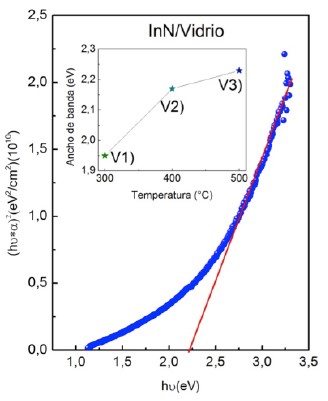
Figura 4. a) (αhv)2 en función de la energía (hv). En el inset se muestra la variación del ancho de banda como función de la temperatura del substrato.
Fotoacustica
La difusividad térmica de las capas se determinó a partir de resultados de amplitud fotoacústica, utilizando un láser de estado sólido de longitud de onda 630 nm y un obturador mecánico (chopper) que permite modular la señal en un rango de 100-1000 Hz, con un paso de 10 Hz. Para determinar el difusividad térmica de las muestras se realizó un ajuste considerando el modelo de muestras térmicamente gruesas y ópticamente opacas donde la longitud de difusión de las ondas térmicas generadas en las capas es menor que el espesor de la muestra (Ecuación 1).

donde A es la amplitud de la señal fotoacustica (SFA), fc es la frecuencia de corte, ƒ la frecuencia de modulación y C una constante. A partir del valor obtenido de ƒc se determinó la difusividad térmica (α)utilizando la relación (2), donde l es el espesor de la muestra

Un típico resultado de SFA es mostrado en la Figura 5 para las muestras V1)-V3). El valor de difusividad térmica para las muestras fue de 0,31-0,17 cm2/seg tal como se indica en la figura, lo que está en buen acuerdo con la literatura donde se reportan valores de difusividad térmica del orden de 0,2 cm2/seg.[15] Para la muestra V1) se obtuvo un valor mayor de difusividad térmica comparado con V2) y V3). Esta diferencia se puede explicar cómo la dependencia con la temperatura Ts al momento de preparar las muestras, lo que ocasiona cambios en la estructura del material (relajación estructural) y su morfología, propiedades que están relacionadas con los resultados de SFA ya que pueden aparecer efectos combinados de recombinación radiativa superficial y en bulto, debidos a defectos en la red e impurezas, otra posible explicación, son los efectos en la interface substrato-capa, ya que la SFA se puede ver alterada debido a defectos en interfaces y distribución de grano en semiconductores, tema que ha sido de investigado por algunos autores en materiales como Si e InSb.[16-18]
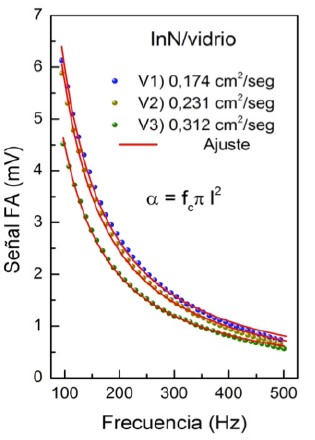
Figura 5. Amplitud de la señal fotoacústica en función de la frecuencia de modulación para las muestras V1)-V3).
Conclusiones
Se lograron determinar condiciones para la formación de microparticulas y nanopárticulas en muestras de InN preparadas por medio de magnetrón sputtering reactivo r.f. utilizando una relación de gases Ar/N baja. Además se encontró una dependencia del ancho de banda del material con la temperatura de depósito. Los valores de ancho de banda obtenidos, están de acuerdo con otros trabajos donde reportan la obtención de h–InN por magnetrón sputtering R.F.
Agradecimientos
A la dirección de Investigaciones de la Universidad Nacional de Colombia sede Manizales DIMA por el financiación del proyecto titulado “Estudio de propiedades físicas de InN”, código 17075 en la convocatoria semilleros de investigación 2013. Roberto Bernal Correa, agradece a COLCIENCIAS por la beca otorgada en el marco del programa “Francisco José de Caldas Convocatoria 528”. Al Dr. Oscar Giraldo del Laboratorio de Materiales Nanoestructurados y Funcionales por facilitar las medidas de rayos-X. A Alejandra Sotelo Departamento de Física CINVESTAV-IPN México, D.F por su soporte técnico.
Referencias
[1] T. Veal, C. McConville, and W. Schaff, Indium Nitride and Related Alloys (CRC Press, 2011).
[2] K. Scott, A. Butcher, M. Wintrebert-Fouquet, P. P.-T. Chen, K. E. Prince, H. Timmers, S. K. Shrestha, T. V. Shubina, S. V. Ivanov, R. Wuhrer, M. R. Phillips, and B. Monemar, Phys. Status Solidi C 2, 2263 (2005).
[3] A. Ajagunna, A. Adikimenakis, E. Iliopoulos, K. Tsagaraki, M. Androulidaki, and A. Georgakilas, J. Cryst. Growth 311, 2058 (2009).
[4] Y.-H. Wang, W.-L. Chen, and M.-F. Chen, Physica E 41, 1746 (2009).
[5] F. Stokker-Cheregi, A. Nedelcea, M. Filipescu, A. Moldovan, D. Colceag, V. Ion, R. Bîrjega, and M. Dinescu, Appl. Surf. Sci. 257, 5312 (2011).
[6] C. Cao, H. Chan, and C. Choy, Thin Solid Films 441, 287 (2003).
[7] S. Valdueza-Felip, J. Ibá∇ez, E. Monroy, M. González-Herráez, L. Artús, and F. Naranjo, Thin Solid Films 520, 2805 (2012).
[8] H. Shinoda and N. Mutsukura, Thin Solid Films 503, 8 (2006).
[9] X.-M. Cai, F. Ye, Y.-Q. Hao, D.-P. Zhang, Z.-H. Zhang, and P. Fan, J. Alloy. Compd. 484, 677 (2009).
[10] J. Chen, W. Shen, J. Wang, H. Ogawa, and Q. Guo, J. Cryst. Growth 262, 435 (2004).
[11] L. Chuah, Z. Hassan, S. Ng, and H. A. Hassan, J. Alloy. Compd. 479, L54 (2009).
[12] K. L. Westra, R. P. W. Lawson, and M. J. Brett, J. Vac. Sci. Technol. A 6, 1730 (1988).
[13] C. M. Ghimbeu, J. Schoonman, and M. Lumbreras, Ceram.Int. 34, 95 (2008).
[14] K. Ikuta, Y. Inoue, and O. Takai, Thin Solid Films 334, 49 (1998).
[15] M. Levinshtein, S. Rumyantsev, and M. Shur, Properties of Advanced Semiconductor Materials: GaN, AIN, InN, BN, SiC, SiGe, A Wiley-Interscience publication (Wiley, 2001).
[16] A. Vasilév, V. Sablikov, and V. Sandomirskii, Sov. Phys. J. 30, 544 (1987).
[17] K. Ersching, C. Campos, J. de Lima, T. Grandi, S. Souza, and P. Pizani, Mater. Chem. Phys. 122, 528 (2010).
[18] Z. El-Qahtani, A. Badawi, K. Easawi, N. Al-Hosiny, and S. Abdallah, Mat. Sci. Semicon. Proc. 20, 68 (2014).
How to Cite
APA
ACM
ACS
ABNT
Chicago
Harvard
IEEE
MLA
Turabian
Vancouver
Download Citation
Article abstract page views
Downloads
License
Those authors who have publications with this journal, accept the following terms:
a. The authors will retain their copyright and will guarantee the publication of the first publication of their work, which will be subject to the Attribution-SinDerivar 4.0 International Creative Commons Attribution License that permits redistribution, commercial or non-commercial, As long as the Work circulates intact and unchanged, where it indicates its author and its first publication in this magazine.
b. Authors are encouraged to disseminate their work through the Internet (eg in institutional telematic files or on their website) before and during the sending process, which can produce interesting exchanges and increase appointments of the published work.