Published
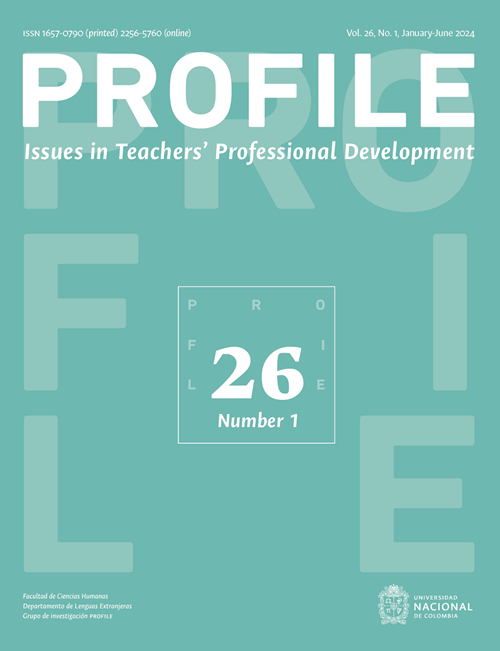
(De)Motivating Factors Among TESOL Professionals Writing in English for Publication From South America
Factores (des)motivantes entre profesionales en la enseñanza del inglés como lengua extranjera que escriben en inglés para publicación desde Sudamérica
DOI:
https://doi.org/10.15446/profile.v26n1.108198Keywords:
demotivation, experiences, motivation, South America, writing for publication (en)desmotivación, escritura para publicación, experiencias, motivación, Sudamérica (es)
While the literature has examined the experiences and attitudes of TESOL (Teaching English to Speakers of Other Languages) professionals toward writing in English for publication in terms of material, environmental, and political conditions as well as (non)discursive challenges, little is known about the (de)motivating factors underpinning their drive to publish in English, particularly in South America. This study explores the (de)motivation of 522 TESOL professionals in South America to write for publication in English. The study adopted a sequential mixed-methods design that consisted of an online survey followed by 20 individual interviews with purposefully sampled participants. Findings show that, despite personal and social-contextual challenges, the participants were driven by altruism, impact, and self-efficacy.
La literatura ha examinado las experiencias y actitudes de los profesionales en la enseñanza del inglés como lengua extranjera en relación con condiciones materiales, contextuales y políticas, así como en relación con dificultades (no)discursivas. Sin embargo, poco se conoce sobre los factores (des)motivantes que subyacen para publicar en inglés en Sudamérica. Por tanto, este estudio exploró la (des)motivación alrededor de la escritura en inglés para publicación entre 522 profesionales de inglés como lengua extranjera en Sudamérica. Se adoptó un diseño de método secuencial mixto que consistió en una encuesta en línea seguida por veinte entrevistas individuales con participantes escogidos selectivamente. Los resultados sugieren que, a pesar de los desafíos personales y sociocontextuales, los participantes dieron prioridad al altruismo, el impacto, y la autoeficacia.
References
Arnoux, E. (2016). Minorización lingüística y diversidad: en torno al español y al portugués como lenguas científicas. In M. V. Carvalho Garcia, G. Ribeiro Pereira, F. Berto, & S. Schernikau Soares Akasha (Eds.), Anais do seminário ibero-americano de diversidade linguística (pp. 290–306). Iphan.
Banegas, D. L., Loutayf, S., Company, S., Alemán, M., & Roberts, G. (2020). Learning to write book reviews for publication: A collaborative action research study on student-teachers’ perceptions, motivation, and self-efficacy. System, 95, 102371. https://doi.org/10.1016/j.system.2020.102371
Braun, V., & Clarke, V. (2021). Thematic analysis. In E. Lyons & A. Coyle (Eds.), Analysing qualitative data in psychology (3rd ed., pp. 128–147). Sage.
Brown, J. D. (1988). Understanding research in second language learning: A teacher’s guide to statistics and research design. Cambridge University Press.
Cárdenas, M. L., & Rainey, I. (2018). Publishing from the ELT periphery: The Profile journal experience in Colombia. In M. J. Curry & T. Lillis (Eds.), Global academic publishing: Policies, perspectives, and pedagogies (pp. 151–165). Multilingual Matters. https://doi.org/10.21832/9781783099245-016
Carlino, P., & Cordero Carpio, G. (2023). Enseñar con escritura y enseñar a escribir: enfoque entrelazado mediante colaboración interdisciplinar. Lengua y Sociedad, 22(2), 35–64. https://doi.org/10.15381/lengsoc.v22i2.24685
Colombo, L., & Rodas, E. L. (2021). Interdisciplinarity as an opportunity in Argentinian and Ecuadorian writing groups. Higher Education Research & Development, 40(2), 207–219. https://doi.org/10.1080/07294360.2020.1756750
Corcoran, J. (2019). Addressing the “bias gap”: A research-driven argument for critical support of plurilingual scientists’ research writing. Written Communication, 36(4), 538–577. https://doi.org/10.1177/0741088319861648
Creswell, J., & Plano Clark, V. L. (2018). Designing and conducting mixed methods research (3rd ed.). Sage.
Curry, M. J., & Lillis, T. (Eds.). (2018). Global academic publishing: Policies, perspectives and pedagogies. Multilingual Matters. https://doi.org/10.21832/9781783099245
Darvin, R., & Norton, B. (2021). Investment and motivation in language learning: What’s the difference? Language Teaching, 56(1), 29–40. https://doi.org/10.1017/S0261444821000057
De Sousa Santos, B., & Meneses, P. (Eds.). (2014). Epistemologías del sur (Perspectivas). Akal.
Dörnyei, Z., & Ushioda, E. (2021). Teaching and researching motivation (3rd ed.). Routledge. https://doi.org/10.4324/9781351006743-2
Englander, K., & Corcoran, J. (2019). English for research publication purposes: Critical plurilingual pedagogies. Routledge. https://doi.org/10.4324/9780429053184
Flowerdew, J. (2019). The linguistic disadvantage of scholars who write in English as an additional language: Myth or reality. Language Teaching, 52(2), 249–260. https://doi.org/10.1017/S0261444819000041
Flowerdew, J., & Habibie, P. (2022). Introducing English for research publication purposes. Routledge. https://doi.org/10.4324/9780429317798
Habibie, P., & Starfield, S. (2020). Journal of English for Research Publication Purposes: Visions and directions. Journal of English for Research Publication Purposes, 1(1), 1–3. https://doi.org/10.1075/jerpp.00001.edi
Hanauer, D. I., & Englander, K. (2011). Quantifying the burden of writing research articles in a second language: Data from Mexican scientists. Written Communication, 28(4), 403–416. https://doi.org/10.1177/0741088311420056
Innocentini, V. A., & Navarro, F. D. (2022). Negotiating across languages: Metadiscourse in English and Spanish abstracts in soil science. Literatura y Lingüística, (46), 113–152.
Janssen, G., & Restrepo, S. (2019). A utilization-focused program evaluation of an ERPP tutoring service at one Colombian university. In J. Corcoran, K. Englander, & L.-M. Muresan (Eds.), Pedagogies and policies for publishing research in English: Local initiatives supporting international scholars (pp. 19–35). Routledge. https://doi.org/10.4324/9781315151229-2
Janssen, G., & Ruecker, T. (2022). Apoyo and English for research publication purposes at a Latin American university. TESOL Quarterly, 56(2), 750–762. https://doi.org/10.1002/tesq.3097
Kuteeva, M., & Mauranen, A. (2014). Writing for publication in multilingual contexts: An introduction to the special issue. Journal of English for Academic Purposes, 13, 1–4. https://doi.org/10.1016/j.jeap.2013.11.002
Langum, V., & Sullivan, K. P. H. (2020). Academic writing, scholarly identity, voice and the benefits and challenges of multilingualism: Reflections from Norwegian doctoral researchers in teacher education. Linguistics and Education, 60, 100883. https://doi.org/10.1016/j.linged.2020.100883
Lee, I. (2014). Publish or perish: The myth and reality of academic publishing. Language Teaching, 47(2), 205–261. https://doi.org/10.1017/S0261444811000504
Li, Y., & Flowerdew, J. (2020). Teaching English for research publication purposes (ERPP): A review of language teachers’ pedagogical initiatives. English for Specific Purposes, 59, 29–41. https://doi.org/10.1016/j.esp.2020.03.002
Lillis, T., & Curry, M. J. (2016). Academic writing for publication in a multilingual world. In R. M. Manchón & P. K. Matsuda (Eds.), Handbook of second and foreign language writing (pp. 201–222). De Gruyter Mouton. https://doi.org/10.1515/9781614511335-012
Lillis, T., & Curry, M. J. (2022). The dynamics of academic knowledge making in a multilingual world: Chronotypes of production. Journal of English for Research Publication Purposes, 3(1), 109–142. https://doi.org/10.1075/jerpp.22002.lil
Lincoln, Y. S., & Guba, E. G. (1985). Naturalistic inquiry. Sage.
López-Navarro, I., Moreno, A. I., Quintanilla, M. Á., & Rey-Rocha, J. (2015). Why do I publish research articles in English instead of my own language? Differences in Spanish researchers’ motivations across scientific domains. Scientometrics, 103, 939–976. https://doi.org/10.1007/s11192-015-1570-1
Mendoza, A., Oropeza, V., Rodríguez, D., Sobrevilla, Z., & Martínez, J. (2021). Challenges, feelings, and attitudes towards writing in ERPP in semi-periphery countries: The case of Mexican graduate students. Journal of English for Research Publication Purposes, 2(2), 129–159. https://doi.org/10.1075/jerpp.21008.men
Mur-Dueñas, P. (2019). The experience of a NNES outer circle novice scholar in scholarly publication. In P. Habibie & K. Hyland (Eds.), Novice writers and scholarly publication: Authors, mentors, gatekeepers (pp. 97–116). Palgrave Macmillan. https://doi.org/10.1007/978-3-319-95333-5_6
Navarro, F., Lillis, T., Donahue, T., Curry, M. J., Ávila Reyes, N., Gustafsson, M., Zavala, V., Lauría, D., Lukin, A., McKinney, C., Feng, H., & Motta-Roth, D. (2022). Rethinking English as a lingua franca in scientific-academic contexts: A position statement. Journal of English for Research Publication Purposes, 3(1), 143–153. https://doi.org/10.1075/jerpp.21012.nav
Paltridge, B. (2019). Reviewers’ feedback on second-language writers’ submissions to academic journals. In K. Hyland & F. Hyland (Eds.), Feedback in second language writing: Contexts and issues (2nd ed., pp. 226–244). Cambridge University Press. https://doi.org/10.1017/9781108635547.014
Paltridge, B. (2020). Writing for academic journals in the digital era. RELC Journal, 51(1), 147–157. https://doi.org/10.1177/0033688219890359
Ramírez-Castañeda, V. (2020). Disadvantages in preparing and publishing scientific papers caused by the dominance of the English language in science: The case of Colombian researchers in biological sciences. PLoS ONE, 15(9), e0238372. https://doi.org/10.1371/journal.pone.0238372
Rathert, S., & Okan, Z. (2010). Writing for publication as a tool in teacher development. ELT Journal, 69(4), 363–372. https://doi.org/10.1093/elt/ccv029
Rodas, E. L., Colombo, L., Calle, M. D., & Cordero, G. (2021). Looking at faculty writing groups from within: Some insights for their sustainability and future implementations. International Journal for Academic Development, 28(2), 205–216. https://doi.org/10.1080/1360144X.2021.1976189
Rounsaville, A. R., & Zemliansky, P. (2020). Sociomaterial paradoxes in global academic publishing: Academic literacies at the intersection of practice and policy. College English, 82(6), 612–636. https://doi.org/10.58680/ce202030806
Salager-Meyer, F. (2014). Writing and publishing in peripheral scholarly journals: How to enhance the global influence of multilingual scholars? Journal of English for Academic Purposes, 13, 78–82. https://doi.org/10.1016/j.jeap.2013.11.003
Sheldon, E. (2020). “We cannot abandon the two worlds, we have to be in both”: Chilean scholars’ views on publishing in English and Spanish. Journal of English for Research Publication Purposes, 1(2), 120–142. https://doi.org/10.1075/jerpp.19016.she
Ushioda, E. (Ed.). (2013). International perspectives on motivation: Language learning and professional challenges. Palgrave.
Waigandt, D., Noceti, S., & Lothringer, R. (2019). Writing for publication in English: Institutional initiatives at the Universidad Nacional de Entre Ríos. In J. N. Corcoran, K. Englander, & L.-M. Muresan (Eds.), Pedagogies and policies for publishing research in English: Local initiatives supporting international scholars (pp. 56–73). Routledge. https://doi.org/10.4324/9781315151229-4
Xu, X. (2020a). China “goes out” in a centre–periphery world: Incentivizing international publications in the humanities and social sciences. Higher Education, 80, 157–172. https://doi.org/10.1007/s10734-019-00470-9
Xu, X. (2020b). Performing under “the baton of administrative power”? Chinese academics’ responses to incentives for international publications. Research Evaluation, 29(1), 87–99. https://doi.org/10.1093/reseval/rvz028
Zavala, V. (2019). Justicia sociolingüística para los tiempos de hoy. Íkala, Revista de Lenguaje y Cultura, 24(2), 343–359. https://doi.org/10.17533/udea.ikala.v24n02a09
Dimensions
PlumX
Article abstract page views
Downloads
How to Cite
License
Copyright (c) 2024 Darío Luis Banegas, María Elisa Romano

This work is licensed under a Creative Commons Attribution-NonCommercial-NoDerivatives 4.0 International License.
You are authorized to copy and redistribute the material in any medium or format as long as you give appropriate credit to the authors of the articles and to Profile: Issues in Teachers' Professional Development as original source of publication. The use of the material for commercial purposes is not allowed. If you remix, transform, or build upon the material, you may not distribute the modified material.
Authors retain the intellectual property of their manuscripts with the following restriction: first publication is granted to Profile: Issues in Teachers' Professional Development.