Published
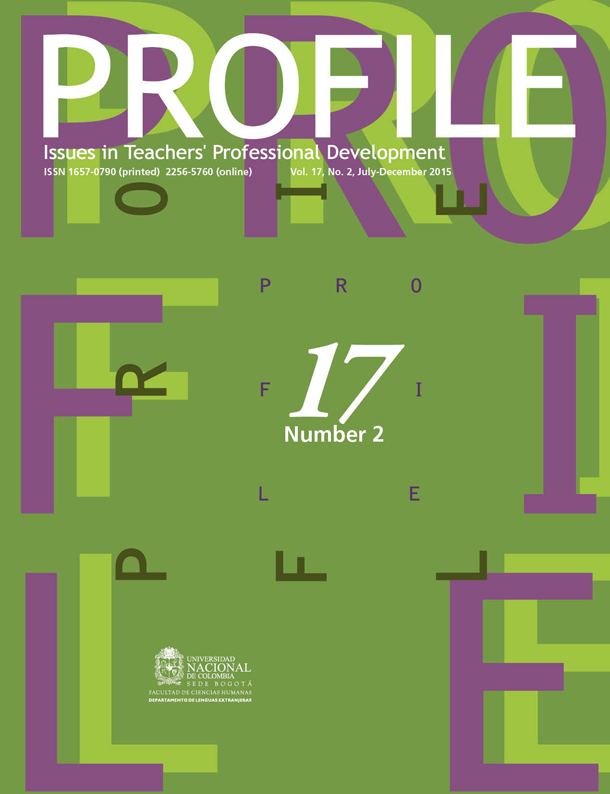
When Students Say Far Too Much: Examining Gushing in the ELT Classroom
Cuando los alumnos dicen demasiado: análisis del uso excesivo de palabras en clases de inglés como lengua extranjera
DOI:
https://doi.org/10.15446/profile.v17n2.44375Keywords:
Insincerity, gushing, lack of knowledge, language insecurity, unnecessary reinforcement (en)Falta de conocimiento, inseguridad del lenguaje, insinceridad, refuerzo innecesario, uso excesivo de palabras (es)
English foreign-language users often overuse words when faced with difficult situations. Called gushing, such excessive use of words is often legitimately employed by native speakers to express, for instance, gratitude and apologies when a simple thank you or sorry does not sufficiently convey an interlocutor’s feelings. This paper examines the appropriateness and effectiveness of gushing when employed by advanced students facing difficult situations. Answering discourse completion tasks, students from a private university in Guadalajara, Mexico were asked to employ acquiescing, persisting, and aggressing strategies to resolve two particular situations. The results indicate that gushing was widely used, but in communicatively ineffective ways, reflecting an area where teachers can help develop students’ communicative competencies.
Los hablantes del inglés como lengua extranjera frecuentemente usan palabras en exceso cuando enfrentan situaciones difíciles. Hablantes nativos utilizan un excesivo número de palabras para expresar, por ejemplo, gratitud y disculpas cuando un simple gracias o lo siento no transmite completamente los sentimientos del interlocutor. Este artículo examina el uso excesivo de palabras por alumnos con un nivel avanzado de inglés al enfrentarse a situaciones difíciles. Al responder un cuestionario, alumnos universitarios en Guadalajara, México, usaron estrategias conciliadoras, interrogativas y argumentativas para resolver dos situaciones específicas. Los resultados indican que un uso excesivo de palabras fue utilizado pero en formas comunicativamente ineficaces y reflejan un área donde los profesores pueden ayudar a los alumnos a desarrollar competencias comunicativas.
References
Aijmer, K. (1996). Conversational routines in English: Convention and creativity. London, UK: Longman.
Austin, J. L. (1962). How to do things with words. Oxford, UK: Oxford University Press.
Beebe, L. M., & Waring, H. Z. (2005). Pragmatic development in responding to rudeness. In J. Frodesen & C. Holten (Eds.), The power of context in language teaching and learning (pp. 67-79). Boston, MA: Heinle.
Bergman, M. L., & Kasper, G. (1993). Perception and performance in native and nonnative apology. In G. Kasper & S. Blum-Kulka (Eds.), Interlanguage pragmatics (pp. 82-107). Oxford, UK: Oxford University Press.
Edmondson, W., & House, J. (1981). Let’s talk and talk about it: A pedagogic interactional grammar of English. Munich, DE: Urban & Schwarzenberg.
Goffman, E. (1967). Interaction ritual: Essays on face to face behaviour. New York, NY: Anchor Books.
Gower, R., Phillips, D., & Walters, S. (1995). Teaching practice handbook. Oxford, UK: Macmillan Heinemann.
Grice, H. P. (1975). Logic in conversation. In P. Cole & J. Morgan (Eds.), Syntax and Semantics, Volume 3: Speech Acts (pp. 1-58). New York, NY: Academic Press.
Harmer, J. (2007). The practice of English language teaching. Harlow, UK: Pearson Longman.
Jautz, S. (2008). Gratitude in British and New Zealand radio programmes: Nothing but gushing? In K. P. Schneider & A. Barron (Eds.), Variational pragmatics: A focus on regional varieties in pluricentric languages (pp. 141-178). Amsterdam, NL: John Benjamins. https://doi.org/10.1075/pbns.178.07jau
Jautz, S. (2013). Thanking formulae in English: Explorations across varieties and genres. Amsterdam, NL: John Benjamins. https://doi.org/10.1075/pbns.230
Dimensions
PlumX
Article abstract page views
Downloads
How to Cite
License

This work is licensed under a Creative Commons Attribution-NonCommercial-NoDerivatives 4.0 International License.
You are authorized to copy and redistribute the material in any medium or format as long as you give appropriate credit to the authors of the articles and to Profile: Issues in Teachers' Professional Development as original source of publication. The use of the material for commercial purposes is not allowed. If you remix, transform, or build upon the material, you may not distribute the modified material.
Authors retain the intellectual property of their manuscripts with the following restriction: first publication is granted to Profile: Issues in Teachers' Professional Development.