Published
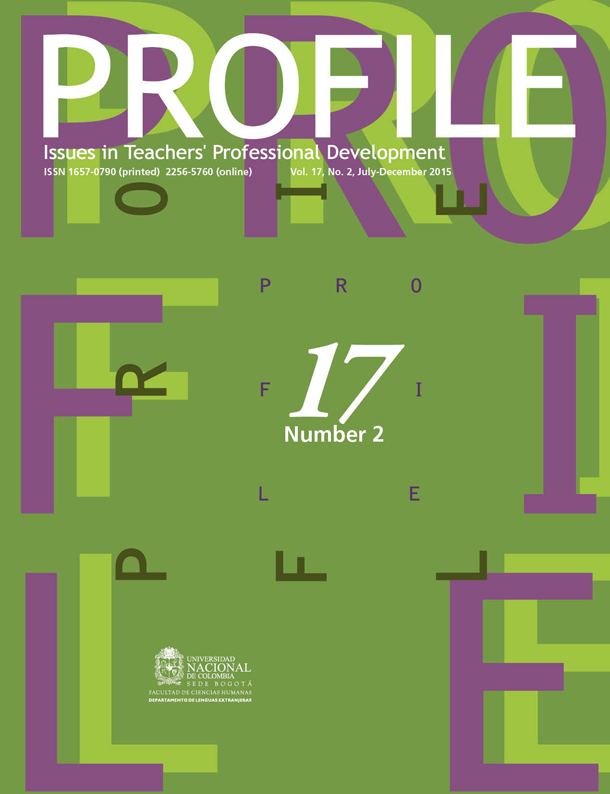
Teacher Activities and Adolescent Students’ Participation in a Colombian EFL Classroom
Actividades de enseñanza y participación de estudiantes adolescentes en una clase de enseñanza de inglés como lengua extranjera en Colombia
DOI:
https://doi.org/10.15446/profile.v17n2.48091Keywords:
Class activities, foreign language, mother tongue, student participation (en)Actividades de clase, lengua extranjera, lengua materna, participación estudiantil (es)
The present study concerns the activities teachers develop and ninth-graders’ participation in responses to those activities. The objectives of this study were to identify and describe the types of teaching activities developed and how students respond to them and to show how the target language is used in the classroom. The data collection was conducted through daily field notes and a diary. The findings show that in the classroom, the teacher develops twelve types of activities, and the percentage of use of the target language is low.
El presente estudio da cuenta del tipo de actividades desarrolladas por una maestra y la respuesta/participación de los estudiantes del grado noveno en esas actividades. Los objetivos de esta investigación fueron identificar y describir el tipo de actividades desarrolladas, la forma como los estudiantes responden a éstas y mostrar el uso de la lengua extranjera en el salón de clase. Para recolectar los datos se usó registro diario de y un diario de campo. Los resultados muestran que en el salón de clases la docente desarrolla doce tipos de actividades y que el porcentaje de uso de lengua extranjera es bajo.
References
Akram, A., & Malik, A. (2010). Integration of language learning skills in second language acquisition. International Journal of Arts and Sciences, 3(14), 231-240.
Allegra, M. C., & Rodríguez, M. M. (2010). Actividades controladas para el aprendizaje significativo de la destreza de producción oral en inglés como LE [Controlled activities to develop meaningful oral English skills]. Revista ciencias de la educación, 20(35), 133-152.
Allwright, D., & Bailey, K. M. (1991). Focus on the language classroom: An introduction to classroom research for language teachers. Cambridge, UK: Cambridge University Press.
Almarza Sánchez, M. Á. (2000). An approach to the integration of skills in English teaching. Didáctica (Lengua y Literatura), 12, 21-41. Retrieved from http://revistas.ucm.es/index.php/DIDA/article/view/DIDA0000110021A/19603
Alvarado Rico, L. J. (2013). Identifying factors causing difficulties to productive skills among foreign languages learners. Opening Writing Doors Journal, 10(2), 54-76.
Bilingüismo aún no dice “yes” en Cali. (2010, August 22). El País de Cali. Retrieved from www.mineducacion.gov.co/observatorio/1722/article-244053.html
Brown, H. D. (2007). Teaching by principles: An interactive approach to language pedagogy (3rd ed.). New York, NY: Pearson Education.
Clutterbuck, P. (1999). Lessons on the spot. Retrieved from http://www.blake.com.au/v/vspfiles/downloadables/l25_30min_english.pdf
Davies, M. J. (2011). Increasing students’ L2 usage: An analysis of teacher talk time and student talk time. Birmingham, UK: University of Birmingham. Retrieved from http://www.birmingham.ac.uk/documents/college-artslaw/cels/essays/languageteaching/daviesessay1tttessaybank.pdf
Fernández Loya, C. (2002). Observación y auto-observación de clases [Observation and self-observation in class]. Cervantes, 2, 119-128. Retrieved from http://didacticaelesalvador2009.wikispaces.com/file/history/Observaci%C3%B3n+y+auto-observaci%C3%B3n+de+clases,+Carmelo+Fern%C3%A1ndez.pdf
Gairns, R., & Redman, S. (1986). Working with words: A guide to teaching and learning vocabulary. Cambridge, UK: Cambridge University Press.
Geertz, C. (1973). La interpretación de las culturas [Cultures interpretation]. Barcelona, ES: Gedisa.
Gocer, A. (2010). A qualitative research on the teaching strategies and class applications of the high school teachers who teach English in Turkey as a foreign language. Education, 131(1), 196-219.
Granger, C. (1998). Play games with English 1: Teacher’s resource book. Oxford, UK: Macmillan Heinemann.
Gunduz, M. (2004). Communicative orientation in the language class and the effect of activity types on interaction (Doctoral dissertation). University of Leicester, United Kingdom.
Gutiérrez Quintana, E. (2007). Técnicas e instrumentos de observación de clases y su aplicación en el desarrollo de proyectos de investigación reflexiva en el aula y de autoevaluación del proceso docente [Techniques and instruments for classroom observation and their application in the design of reflective research projects and in self-evaluation of pedagogical processes]. In S. Pastor Cesteros & S. Roca Marín (Eds.), La evaluación en el aprendizaje y la enseñanza del español como LE/L2 (pp. 336-342). Alicante, ES: Servicio de Publicaciones de la Universidad de Alicante. Retrieved from http://cvc.cervantes.es/ensenanza/biblioteca_ele/asele/pdf/18/18_0336.pdf
Harmer, J. (2007a). How to teach English (2nd ed.). London, UK: Pearson Education.
Harmer, J. (2007b). The practice of English language teaching (4th ed.). Edinburgh, UK: Pearson Education.
Hernández Gaviria, F., & Faustino, C. C. (2006). Un estudio sobre la enseñanza de lenguas extranjeras en colegios públicos de Cali [A study about foreign language teaching in public schools in Cali]. Lenguaje, 34, 217-250.
Hernández Sampieri, R., Fernández Collado, C., & Baptista Lucio, P. (1991). Metodología de la investigación [Research methodology]. México, MX: McGrawHill.
Hinkel, E. (2006). Current perspectives on teaching the four skills. TESOL Quarterly, 40(1), 109-131. https://doi.org/10.2307/40264513
Hinojosa Cordero, M. F., & Quinatoa Mullo, S. A. (2012). Aplicación de técnicas para desarrollar las destrezas de listening and speaking de los estudiantes de quinto, sexto y séptimo [Application of techniques for developing listening and speaking English skills in fifth, sixth, and seventh graders] (Unpublished undergraduate monograph). Universidad Estatal de Bolívar, Ecuador.
Hitotuzi, N. (2006). The learner’s mother tongue in the L2 learning-teaching symbiosis. PROFILE Issues in Teachers’ Professional Development, 7(1), 161-171.
Howard-Williams, D., & Herd, C. (1989). Word games with English plus. Oxford, UK: Heinemann.
Johnson, K. E. (1995). Understanding communication in second language classrooms. New York, NY: Cambridge University Press.
Klippel, F. (1984). Keep talking: Communicative fluency activities for language teaching. Cambridge, UK: Cambridge University Press.
Lasagabaster, D. (2013). The use of the L1 in CLIL classes: The teachers’ perspectives. Latin American Journal of Content and Language Integrated Learning (LACLIL), 6(2), 1-21. https://doi.org/10.5294/laclil.2013.6.2.1
Majid, S., Yeow, C. W., Ying, A., & Shyong, L. R. (2010). Enriching learning experience through class participation: A students’ perspective. Cooperation and Collaboration in Teaching and Research: Trends in Library Information Studies Education. Retrieved from http://conf.euclid-lis.eu/index.php/IFLA2010/IFLA2010/paper/view/10/10
Muñoz Hernández, C. A. (2005). Usos de lengua materna (L1) y lengua meta (L2) en un contexto de inmersión real [Mother (L1) and target (L2) language use in an immersion context] (Unpublished master’s thesis). University of Indiana, United States.
Nielsen Nino, J. B. (2010). Actividades didácticas de motivación en el aula para la enseñanza del inglés como lengua extranjera de los estudiantes de grado undécimo del Colegio Champagnat de Bogotá [Classroom motivational activities for teaching EFL to eleventh graders at Colegio Champagnat in Bogotá] (Unpublished undergraduate monograph). Universidad de La Salle, Colombia.
Nunan, D. (1992). Research methods in language learning. New York, NY: Cambridge University Press.
Peace Corps. (1989). TEFL/TESL: Teaching English as a foreign or second language. Washington DC: Center for Applied Linguistics.
Prieto Castillo, C. Y. (2007). Improving eleventh graders’ oral production in English class through cooperative learning strategies. PROFILE Issues in Teachers’ Professional Development, 8, 75-90.
Richards, J. C. (2006). Communicative language teaching today. Cambridge, UK: Cambridge University Press.
Richards, J. C., & Schmidt, R. (2010). Longman dictionary of language teaching and applied linguistics (4th ed.). London, UK: Routledge.
Riddell, D. (2003). Teaching English as a foreign/second language. London, UK: Bookpoint.
Sánchez, L., Pernía, J., Rivas, J., & Villalobos, J. (2012). Uso de la lengua materna en una clase de inglés como lengua extranjera: un estudio de casos [The use of the first language in an English-as-a-foreign-language class: A case study]. Educación, Lenugaje y Sociedad, 9(9), 67-95.
Sandin, M. P. (2003). Investigación cualitativa en educación [Qualitative research in education]. Madrid, ES: McGraw-Hill.
Seymour, D., & Popova, M. (2003). 700 classroom activities. Oxford, UK: Macmillan.
Solihah, I., & Yusuf, F. N. (n.d.). Classroom participation: A case of a junior high school students in EFL context. Retrieved from http://file.upi.edu/Direktori/FPBS/JUR._PEND._BAHASA_INGGRIS/197308162003121-FAZRI_NUR_YUSUF/Kumpulan_artikel--ppt/Paper_CONAPLIN_Participation_Fazri%26Intan.pdf
Urrutia León, W., & Vega Cely, E. (2010). Encouraging teenagers to improve speaking skills through games in a Colombian public school. PROFILE Issues in Teachers’ Professional Development, 12(1), 11-31.
Dimensions
PlumX
Article abstract page views
Downloads
How to Cite
License

This work is licensed under a Creative Commons Attribution-NonCommercial-NoDerivatives 4.0 International License.
You are authorized to copy and redistribute the material in any medium or format as long as you give appropriate credit to the authors of the articles and to Profile: Issues in Teachers' Professional Development as original source of publication. The use of the material for commercial purposes is not allowed. If you remix, transform, or build upon the material, you may not distribute the modified material.
Authors retain the intellectual property of their manuscripts with the following restriction: first publication is granted to Profile: Issues in Teachers' Professional Development.